Barcelona Gothic Quarter: Street Photography in the Old City
There is a particular quality to light in the Barcelona Gothic Quarter that no other part of the city quite replicates. It arrives sideways, filtered through the narrow gap between two medieval facades, cutting a pale diagonal across the stone pavement before vanishing into shadow. We were there for Barcelona Gothic Quarter street photography on a winter morning — cameras in hand, streets still belonging almost entirely to residents — a cyclist threading through an arched passage, a woman walking away from us into the light at the far end of the lane. We were not there to document a postcard. We were there to watch what the light does to people, and what people do to the light.
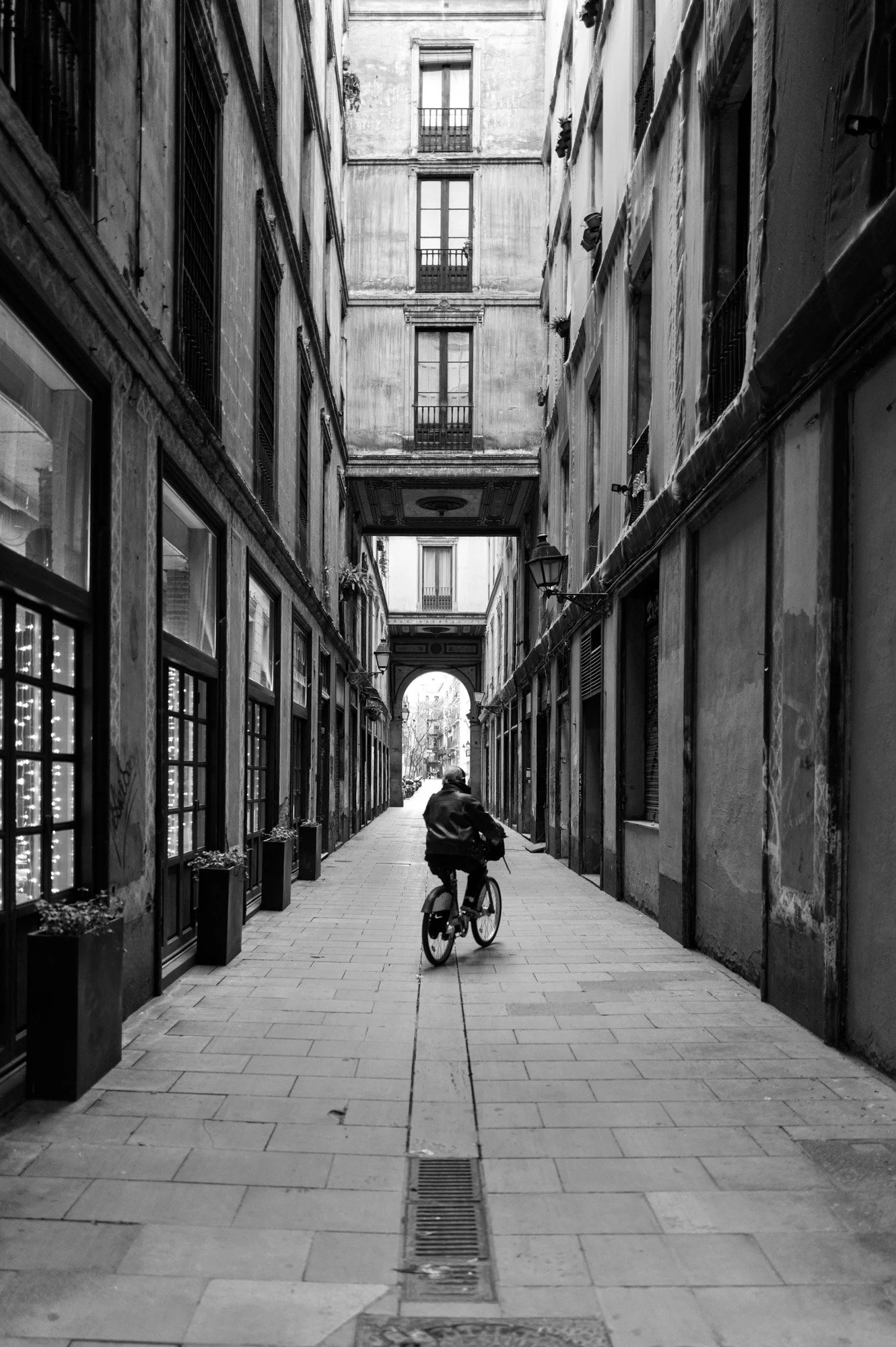
Light at the end of the alley — Leica Q3
A City Built for Black and White
The Gothic Quarter is one of the oldest continuously inhabited urban districts in Europe. Its streets follow the original grid of the Roman city of Barcino, overlaid with two thousand years of construction, demolition, renovation, and neglect. What remains is a dense, layered neighbourhood where first-century ruins coexist with medieval churches, nineteenth-century market halls, and the occasional shopfront selling irreverent souvenirs. In black and white, these contradictions dissolve. The eye goes straight to geometry, to shadow, to the human figure inside the frame.
Shooting here in monochrome is not a purely aesthetic choice — it is a logical one. Colour introduces too much visual noise: the orange plastic barriers, the competing signage in a dozen languages, the tourist luggage in primary colours. Without colour, the Gothic Quarter reveals its bones. The arc of a passage. The perspective of a lane running ruler-straight for two hundred metres before bending out of sight. The single figure who gives the entire composition its scale. Working with the Leica Q3's 28mm lens — almost uncomfortably wide in tight spaces — forces a physical proximity that longer focal lengths would deny.
This post is the second stop in our Barcelona black and white project, following the wider introduction in Barcelona Street Photography in Black and White. The series continues from here into Barcelona Modern Architecture, where the same eye for geometry turns toward concrete and glass.
Street Photography in the Gothic Quarter: The Figure and the Frame
Street photography in the Gothic Quarter is largely a practice of patience and peripheral vision. You do not photograph people here so much as you photograph the space they move through — and then, if you are attentive and the light cooperates, a figure enters the frame and the image becomes something else entirely.
The most direct expression of this is the photograph that opens this post: a cyclist disappearing down a long carreró towards an archway at the far end, stone walls pressing in from both sides, a drainage line running straight down the centre of the pavement like a compositional guide. The figure is small, almost incidental. The architecture carries the structure of the image. But without that cyclist, the image is an empty corridor. With them, it is a passage being lived through.
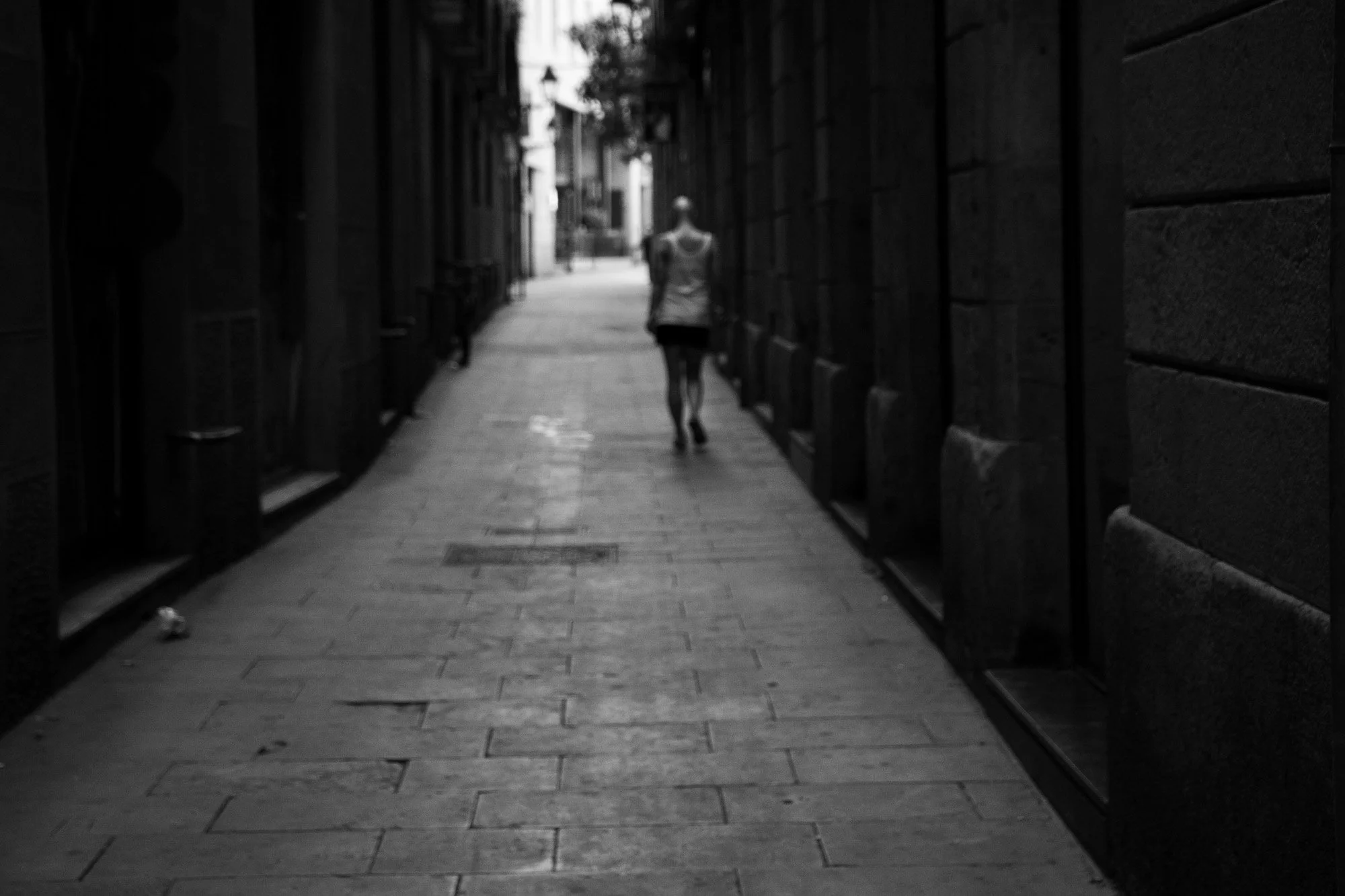
Somewhere in the Gothic — Leica Q3
The same logic applies to a second frame: a silhouette, back to the camera, standing in the threshold of a Gothic arch while the interior courtyard opens out behind them in layers of light and vegetation. The figure does not know they are being photographed. They are simply pausing, caught between two spaces. We pressed the shutter because the light made it necessary.
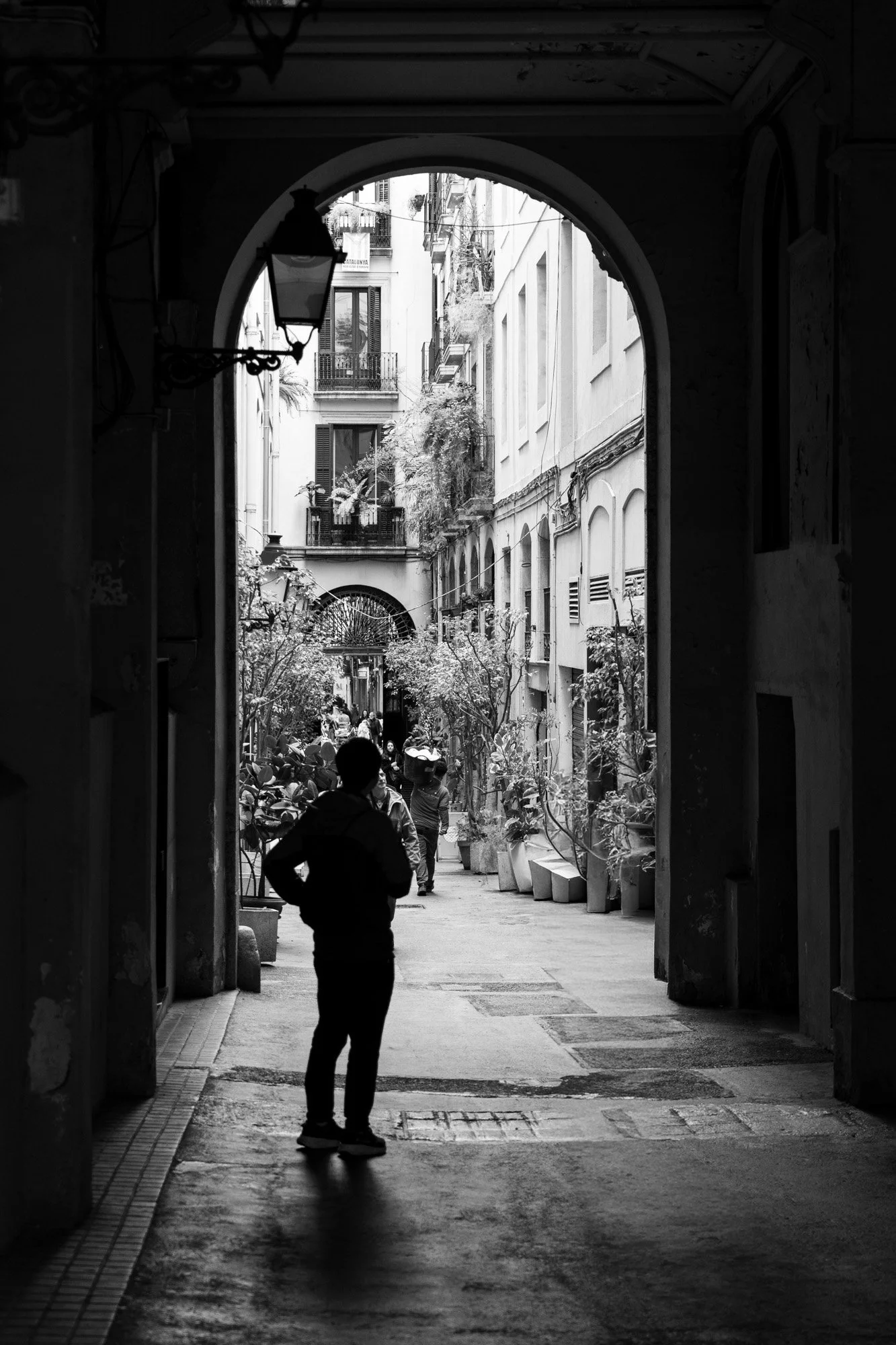
Through the arch — Leica Q3
The Other Barcelona: Residents, Musicians and the Unexpected
The Gothic Quarter is not a preserved ruin. It is a functioning, densely inhabited neighbourhood, and daily life asserts itself at every turn. On the morning of this shoot, two musicians rounded a corner near Plaça de Sant Felip Neri, one of them pulling an enormous double bass on a trolley — unhurried, at ease with the weight of the instrument, clearly making this journey regularly. A few streets further on, a young woman was crouched on the pavement outside a bar, filling a notebook page, entirely unbothered by the city moving around her. These are not spectacular moments. They are simply the neighbourhood being itself.
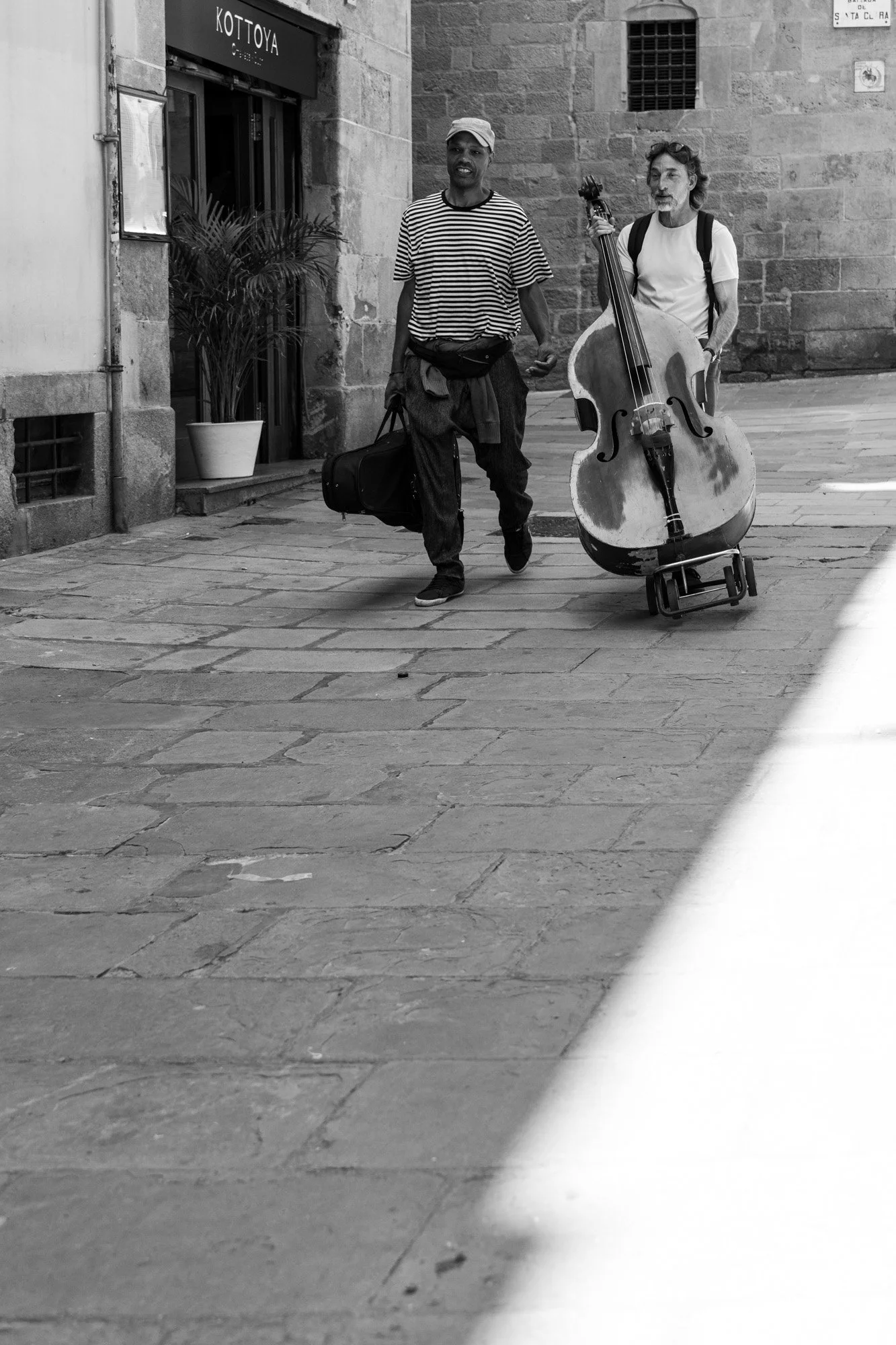
On their way — Leica Q3
This is what the Gothic Quarter offers the patient photographer more freely than almost anywhere else in Barcelona: a constant, low-key theatre of ordinary life inside extraordinary architecture. The deliveryman waiting outside a shuttered herbolari. The couple arguing quietly in the shadow of a medieval wall. And then the shopfront that stops you mid-stride: two headless mannequins in a medieval stone doorway, dressed in a combination of Catholic imagery and novelty boxer shorts, displayed with full commercial seriousness.
The neighbourhood holds its absurdities alongside its history without apparent discomfort. Similar rhythms of everyday life inside remarkable urban spaces appear in our walk through Brooklyn's streets — a reminder that street photography rarely requires a famous subject.
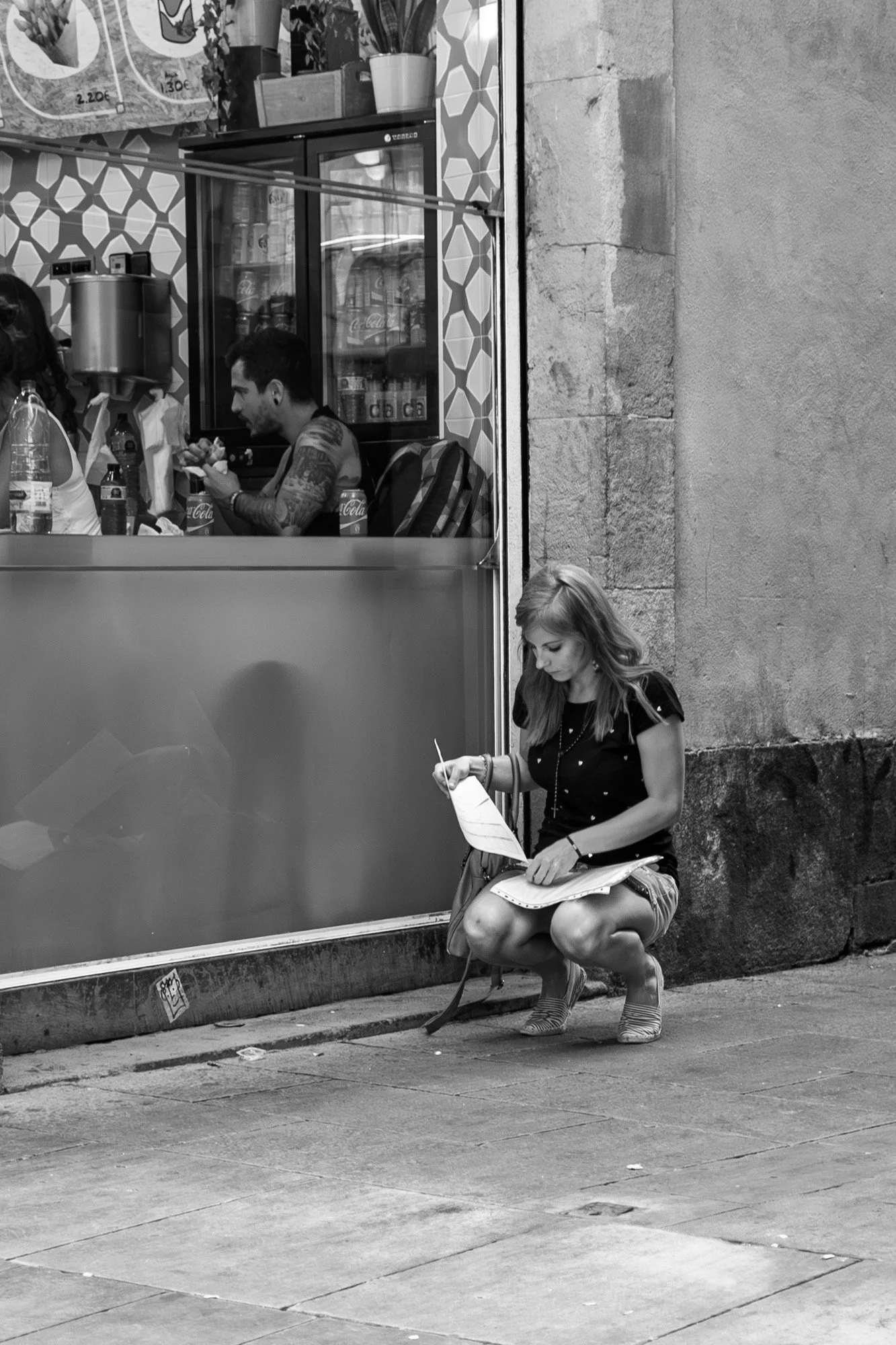
A moment between the city — Leica Q3
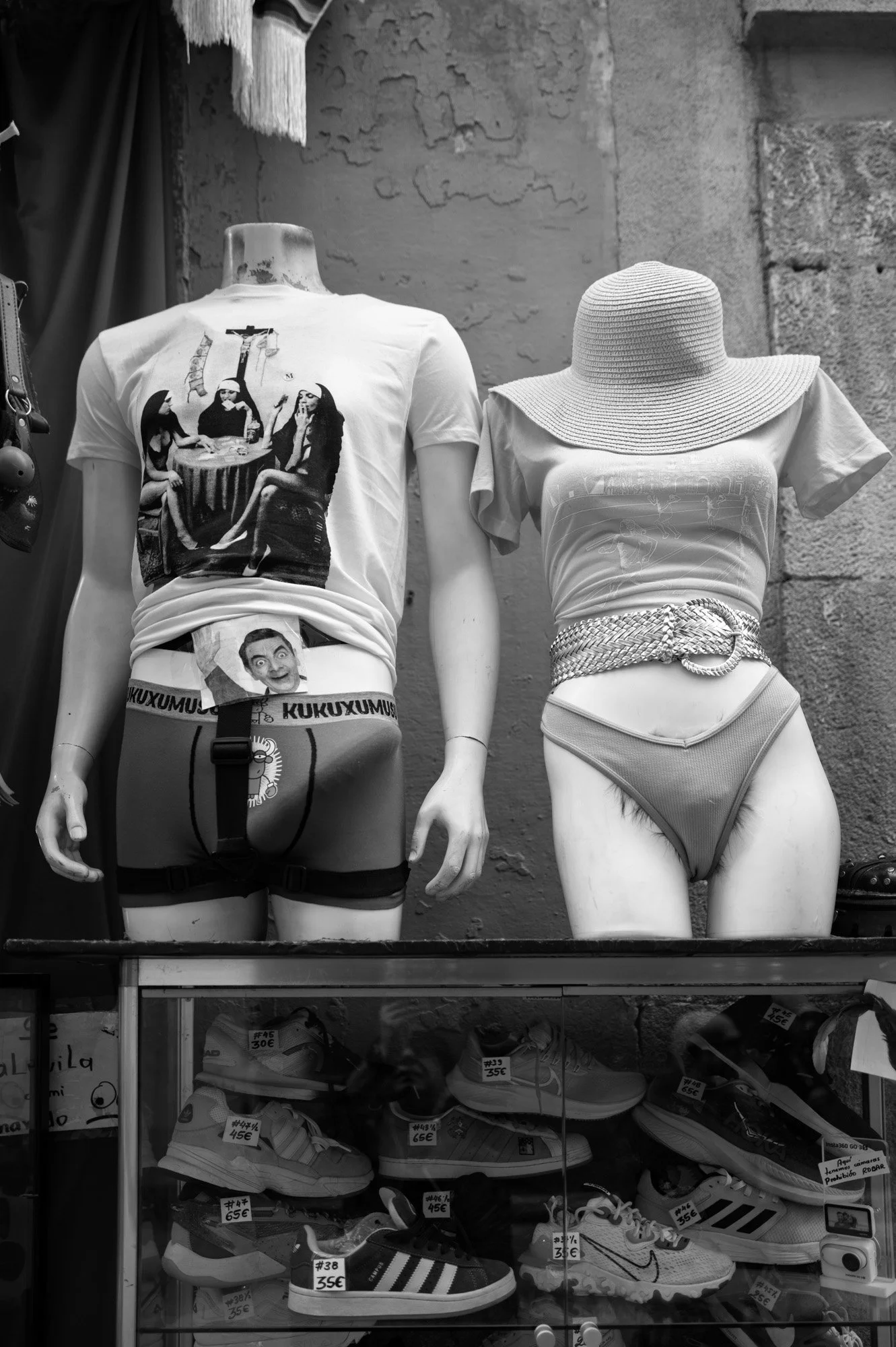
The Gothic Quarter, unfiltered — Leica Q3
After Dark — The Gothic Quarter at Night
We returned in the evening, when the tour groups had dispersed and the neighbourhood's working residents — bar staff, delivery riders, musicians finishing a last set — began to claim the streets again. The light changes completely after dark. The strong lateral shadows of midday dissolve into pools of warm artificial light, reflections in glass, the ghostly quality of a face seen through a shop window.
The light does something else at night in the Gothic Quarter: it makes the mundane cinematic. The narrow streets, lit only from shopfronts and the occasional streetlamp, create a natural chiaroscuro that would take considerable effort to reproduce in a studio. We found ourselves returning to the same corners multiple times, waiting for the right figure to pass through the right pool of light. Street photography at night asks for a different pace — slower, more deliberate, more willing to wait.
The final image in this series is the hardest to explain in purely technical terms. Through a glass pane, a figure in black formal wear — bowler hat, bow tie, waistcoat — looks outward with an expression that sits somewhere between melancholy and mild amusement. The bokeh of street lights clusters behind him like a loose constellation. It takes a moment to understand what you are seeing: a mannequin dressed as Charlie Chaplin, transformed by the glass, the reflection, and the night into something nearly human. The Gothic Quarter does this regularly. It blurs the boundary between performance and ordinary life, between genuine history and its commercial reproduction, between what is real and what is simply a very convincing replica.
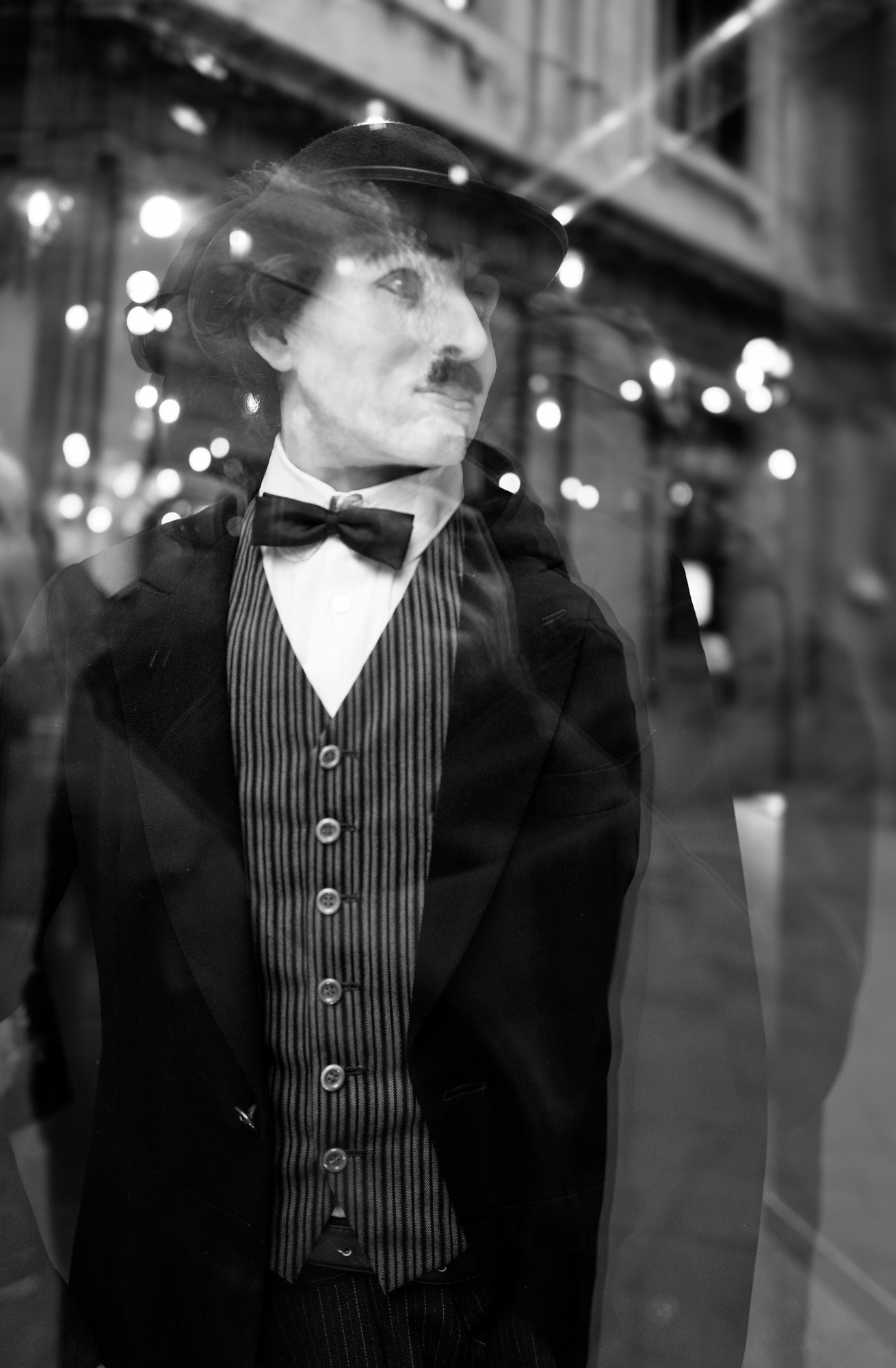
After dark — Leica Q3
Walk the Gothic Quarter on a weekday morning or late on a winter evening. Take your widest lens, slow down, and let the light do most of the work.
Photos: Leica Q3 · 28mm · f/2.8–8 · ISO 250–1600
Want one of these on your wall?
Every photo on this site can be printed — archival paper, signed and numbered. Browse prints →
See more street photography from Barcelona in the portfolio.
Cosme Lapena is a Barcelona-based street and urban photographer and founder of bCLPhoto. Browse the portfolio or read more on the blog.