Barcelona Modern Architecture: A Street Photography Series
Barcelona Modern Architecture Photography — Where Concrete Meets the Everyday
Barcelona modern architecture photography rarely happens where you expect it. We spent a week chasing the city's contemporary skyline — the twisting tower on Montjuïc, the raw concrete of MACBA, the geometric mural on a hidden terrace — and found that the best frames appeared not when the buildings stood empty, but when someone walked through them. A child on a balance bike. A man checking his phone. A woman glancing at her screen against a wall of grey and white stripes. Modern Barcelona is loud in its forms and quiet in its people, and that contrast became the spine of this series.
This is the third chapter in our Barcelona black and white project, following our walk through the Gothic Quarter and the wider hub post on Barcelona street photography. Where those posts lived in narrow medieval lanes, this one moves into concrete, glass, and steel — the Barcelona built after 1992, when the city rebuilt itself for the world and never really stopped.
Icons Against a Flat Sky
The Torre de Comunicacions de Montjuïc, Santiago Calatrava's telecommunications tower from the '92 Olympics, opens the series. Photographed from below with a single figure passing between the granite columns of the Anella Olímpica, it reads less like a building and more like a gesture — a javelin thrower frozen mid-throw. Every time we return to this square, the light changes the tower's mood entirely; in flat overcast conditions it turns almost sculptural, all curve and no shadow.
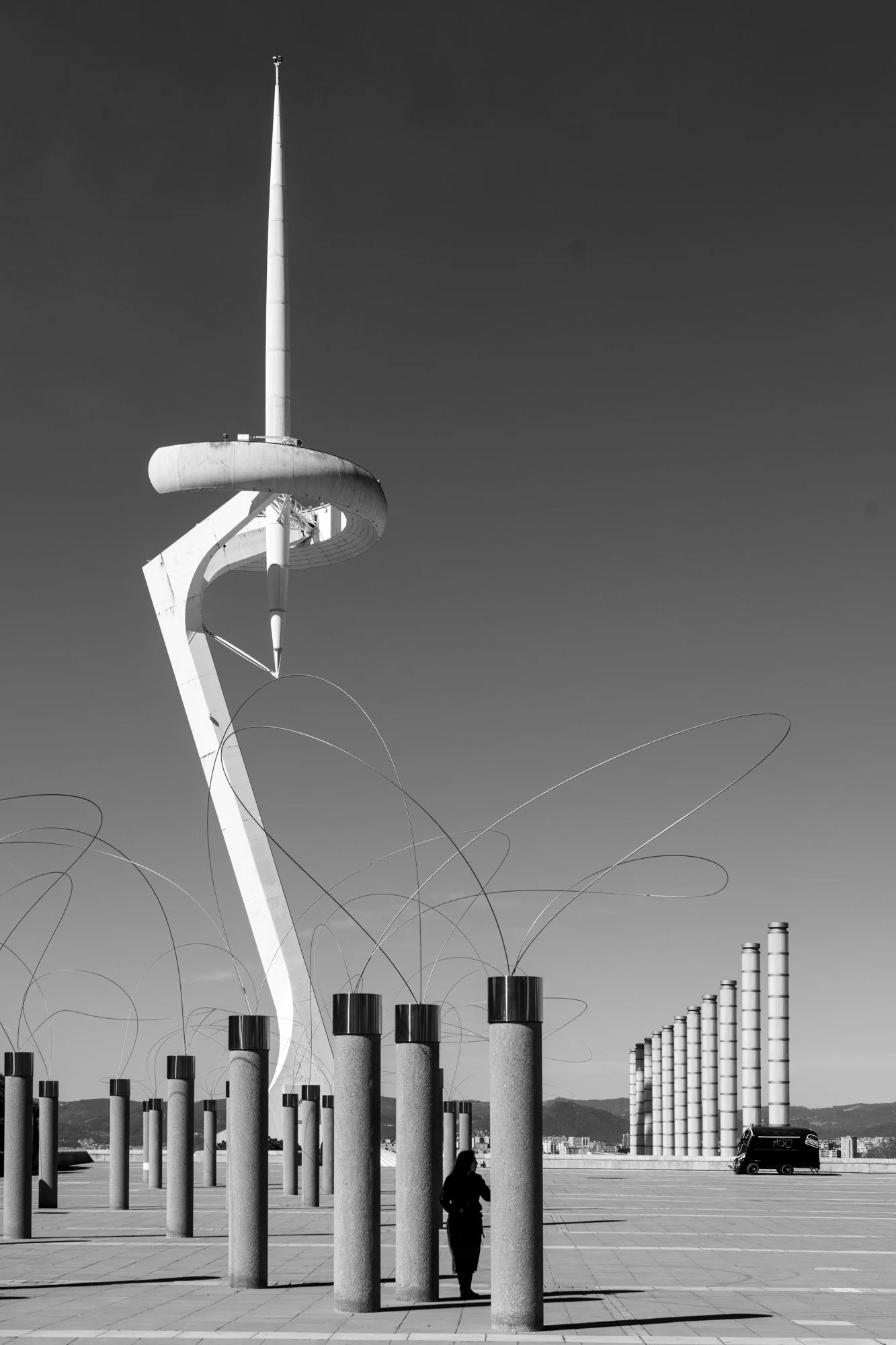
Torre de Comunicacions de Montjuïc — Sony A7R IV
A short walk away, the geometric mural on a residential terrace gave us one of the stranger frames in the set: a woman scrolling her phone, framed by alternating grey panels and a half-circle that could be a rising moon or a closing eye. It's not a landmark. Nobody photographs it on purpose. But it's exactly the kind of found geometry that makes Barcelona modern architecture photography different from photographing famous facades — half the city's best modern lines belong to buildings nobody named.
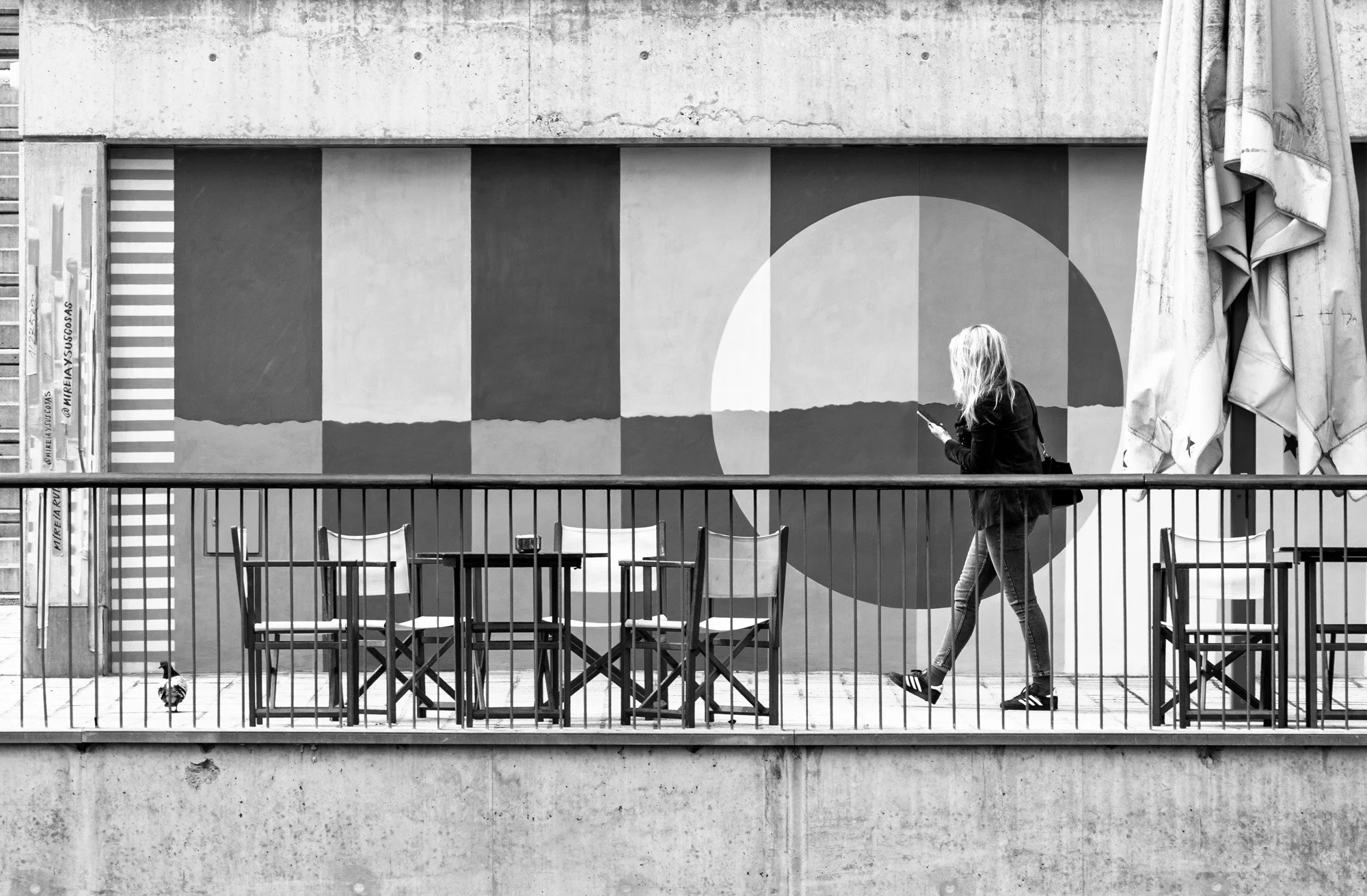
Found geometry, Eixample terrace — Sony A7R IV
Life at Street Level
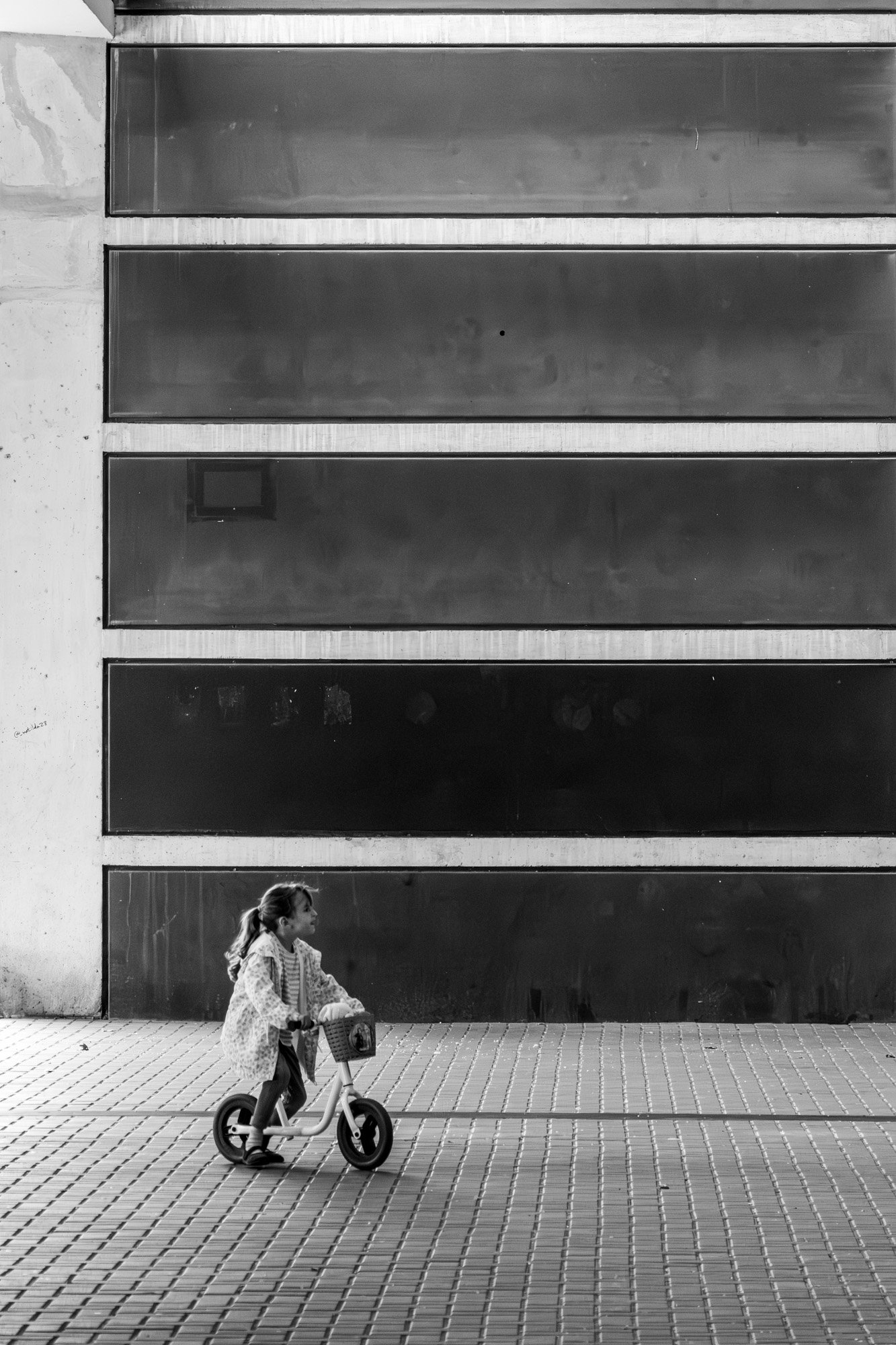
The human element does most of the work in this post. A girl rides her balance bike past a dark, mirrored garage door, her pale raincoat the only warm tone against a wall of cold reflections — a composition built entirely on scale, the building enormous and indifferent, the child moving through it without a second thought. Nearby, at MACBA, a man walks past the museum's curved white extension with a plastic bag in hand, the old brick church visible just behind the concrete curve. That single frame is the clearest statement of what modern Barcelona actually looks like: contemporary architecture and pre-industrial stone existing on the same street, ignoring each other.
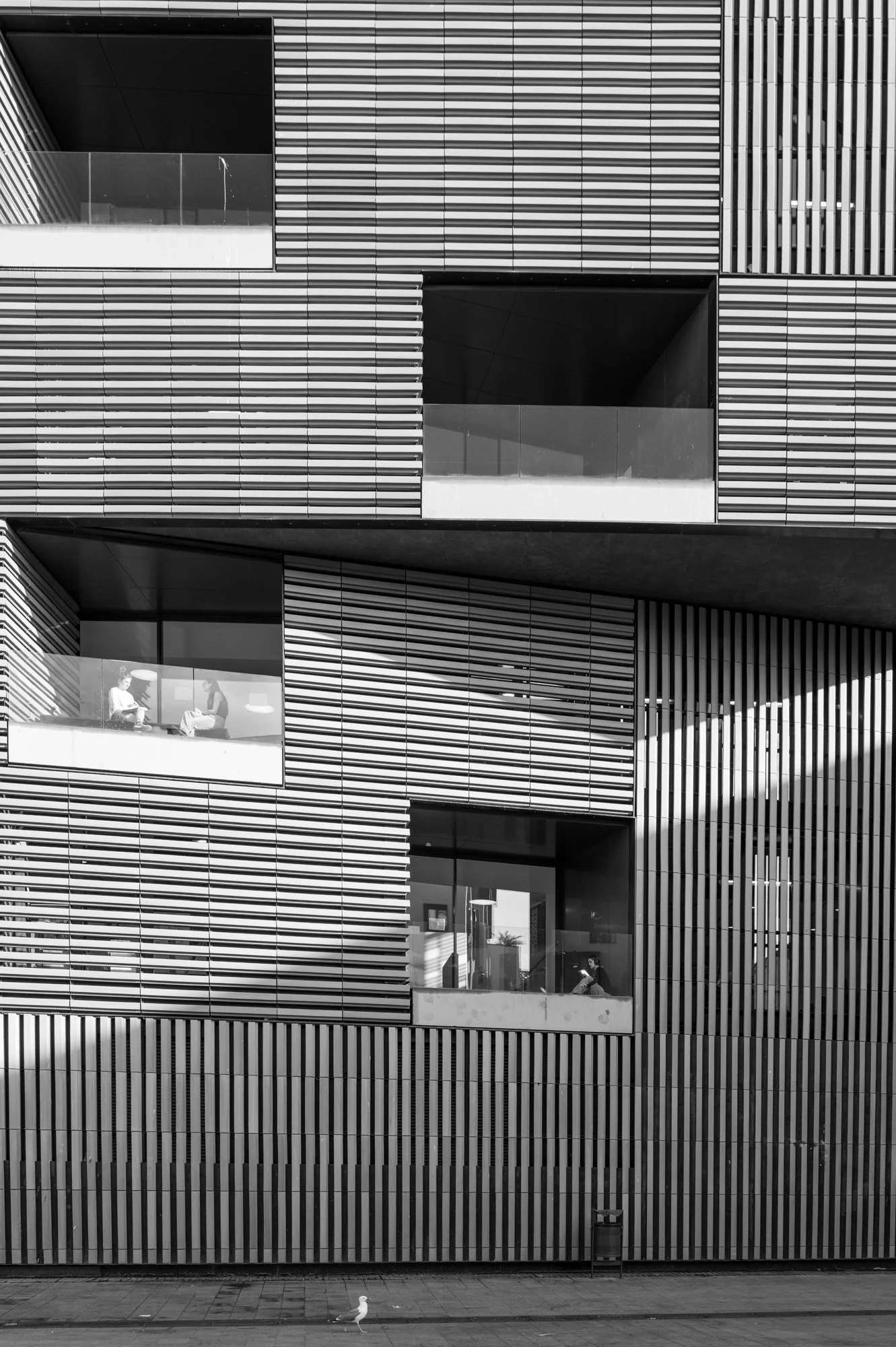
Rhythm and reflection — Leica Q3
Scale and indifference — Sony A7R IV
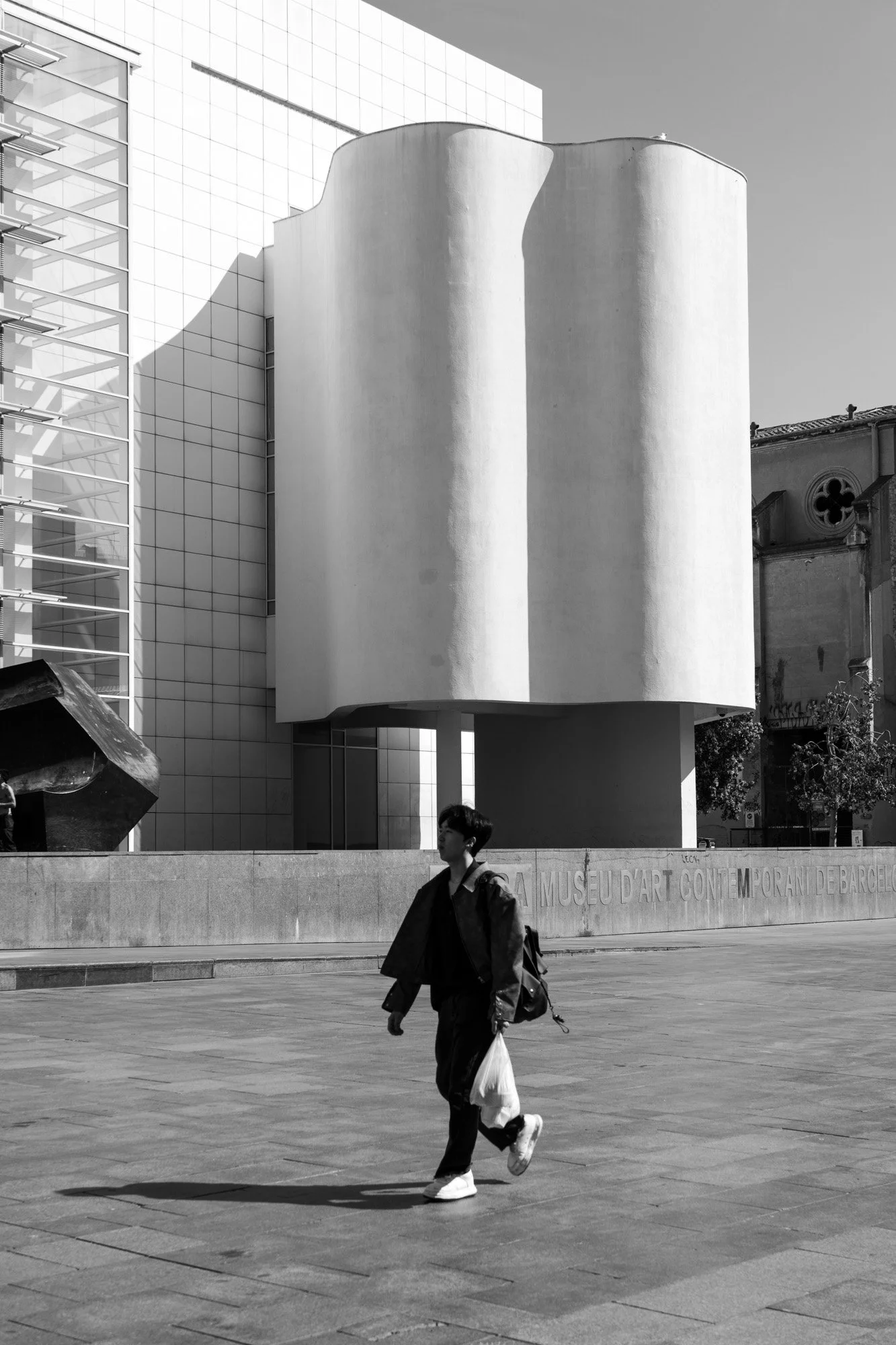
Old and new, ignoring each other — Sony A7R IV
Further into El Raval, a tall white building rises over graffiti-covered walls, its clean rows of windows undermined by tags reading "El Raval against sixteen," a man checking his phone at the base of it all. We chose this frame specifically because it resists the postcard version of modern Barcelona — no polished plaza, no tourist angle, just the tension between institutional cleanliness and a neighbourhood that writes on its own walls.
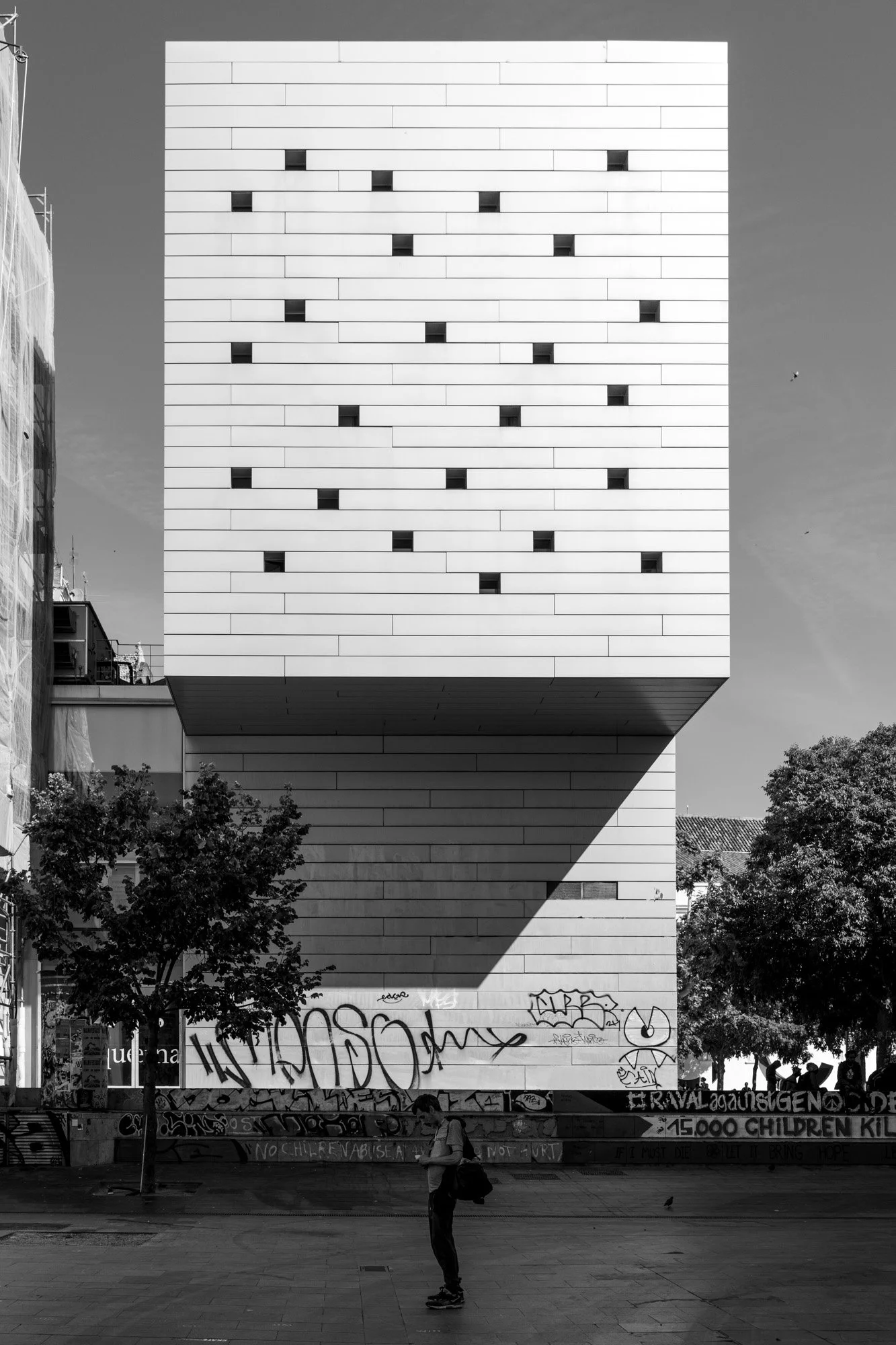
Institutional clean, neighbourhood loud — Sony A7R IV
Closing the Series on La Pedrera
We end where Gaudí's influence quietly bleeds into the modern city: a shadow line cutting diagonally across a plaza, a single seated figure barely visible in the distance, and finally La Pedrera itself, its wave-like stone facade framed by parked bicycles. It's a soft close for a series built on hard geometry — a reminder that Barcelona's modern identity was never separate from its older one, just an extension of the same restlessness.
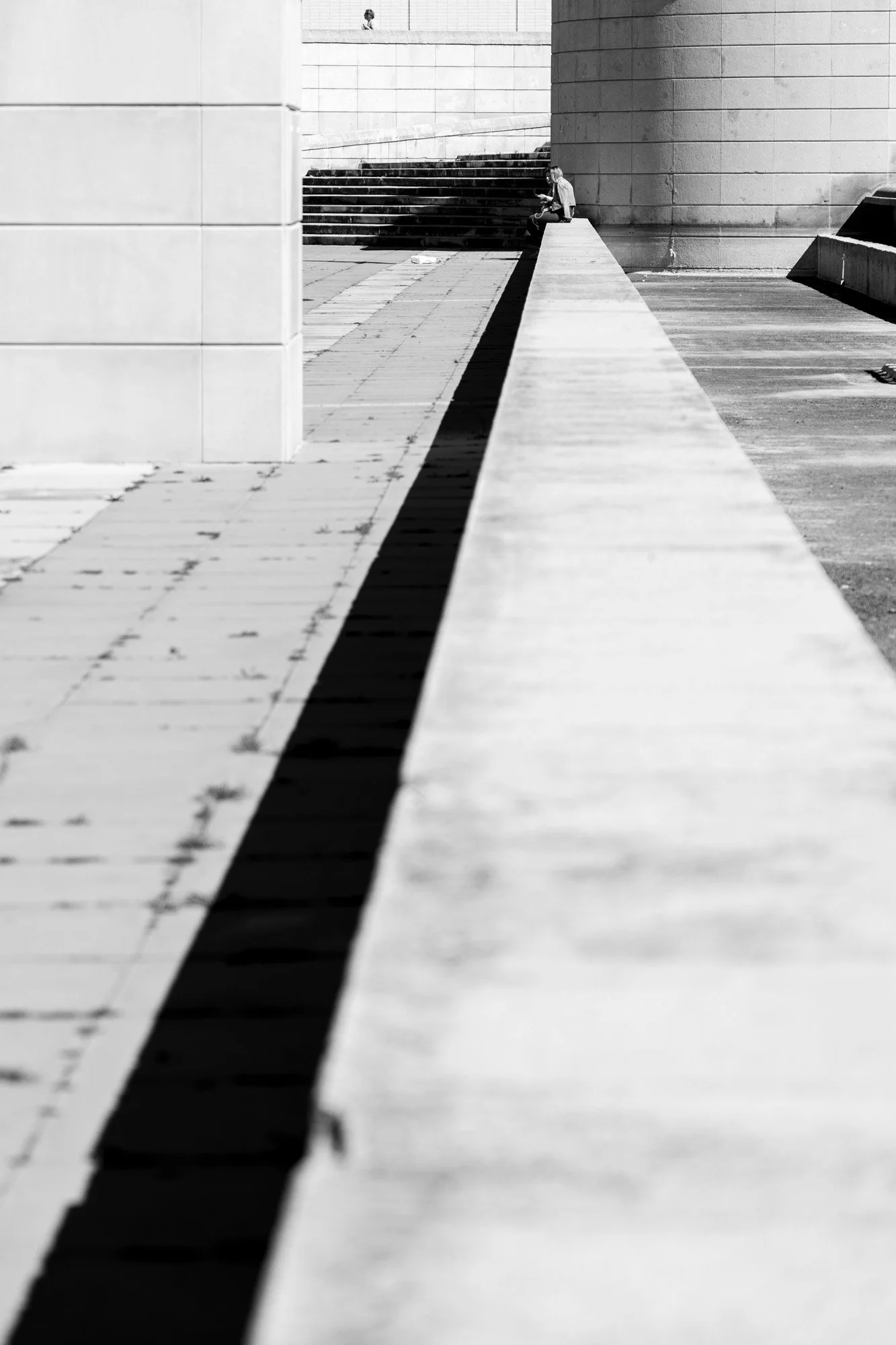
A soft close for hard geometry — Sony A7R IV
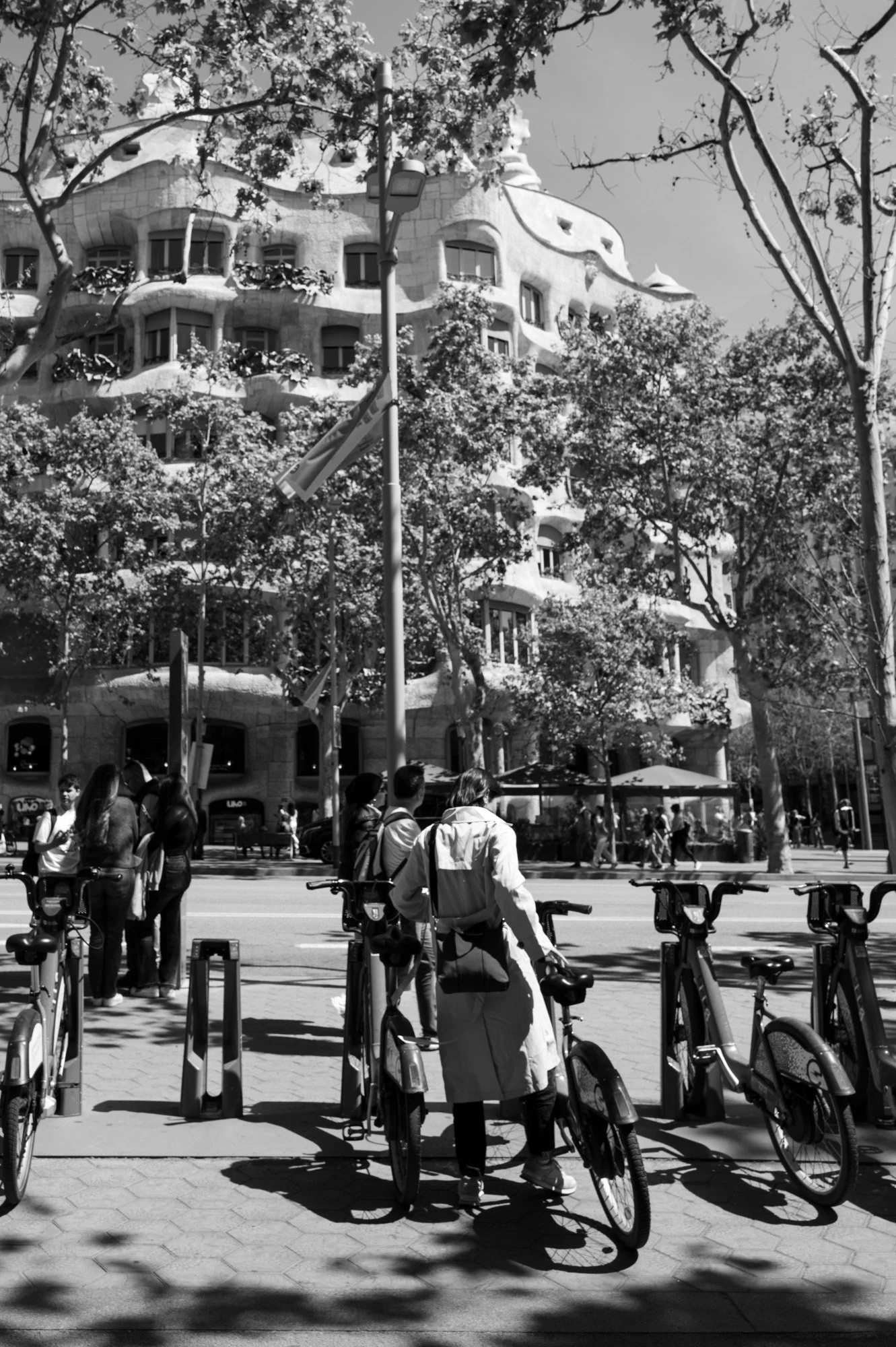
La Pedrera, restlessness continued — Leica Q3
Shooting this series meant covering more ground than the previous two posts combined — Montjuïc, Raval, Eixample, Diagonal — carrying the Leica Q3 and Sony A7R IV through midday light that flattens most cities but somehow suits Barcelona's concrete. The camera's rangefinder framing forced us to commit to compositions before the moment resolved, which is exactly the discipline this kind of architecture demands: decide on the geometry first, then wait for a person to complete it.
If Barcelona's medieval lanes drew you into the first two posts of this series, we hope its concrete towers and quiet courtyards convince you the modern city deserves just as much attention.
For a different register entirely — the same city in the heat of summer and in colour — visit Barcelona Street Photography: Glimpses of a City in Full Summer.
Photos: Sony A7R IV ISO 100-200 · 24-40mm f/2.8–11 · 1/250s
Leica Q3 · ISO 250 · 28mm · f/2.8–8 · 1/250s
This series was featured on 35mmc — read "Two Cameras, One City" for the other half of the story: how the Leica Q3 and the Sony a7R IV split the work between the Gothic Quarter and the glass-and-steel city.
See more urban architecture photography from Barcelona in the portfolio.
Every photo on this site can be printed — archival paper, signed and numbered. Browse prints →
Cosme Lapena is a Barcelona-based street and urban photographer and founder of bCLPhoto. Browse the portfolio or read more on the blog.