The City of Arts and Sciences, Valencia
ORIGINALLY PUBLISHED SEP 2018 — UPDATED MAY 2026

The City of Arts and Sciences. In this photo we can see L’Hemisfèric on right and the Palau de les Arts Reina Sofía on the left. ISO 100, 24mm, f/4, 0.5 sec
Originally published in 2018. Updated and revised in 2026.
The City of Arts and Sciences
Originally published in 2018. Updated and revised in 2026.
We had spent the afternoon at the Albufera Natural Park, and by the time we reached the City of Arts and Sciences the light was already fading. I had seen photos of the complex before, but nothing quite prepares you for the first time you stand in front of it. The scale is one thing. The reflections are another. Within minutes, tripods were out and nobody was saying much — which is usually a good sign.
That night shoot went on for hours.
About the Complex
The City of Arts and Sciences — Ciutat de les Arts i les Ciències in Valencian — sits on the former riverbed of the Turia. After a catastrophic flood in 1957, the river was diverted south of the city, and the dry channel was gradually transformed into a long public park. The architectural complex came later, designed mainly by Santiago Calatrava, with Félix Candela contributing to L'Oceanogràfic.
Construction started in 1996. L'Hemisfèric opened in 1998, followed by the Science Museum and L'Umbracle in 2000, L'Oceanogràfic in 2003, the Palau de les Arts Reina Sofía in 2005, and finally L'Àgora in 2009. It took over a decade to complete — and it shows. Each building feels considered, not rushed.
What makes it work visually is the relationship between the structures and the water. Calatrava's forms — the eye of L'Hemisfèric, the whale-rib silhouette of the Science Museum — are dramatic on their own. Reflected on a still pool at dusk, they become something else entirely.
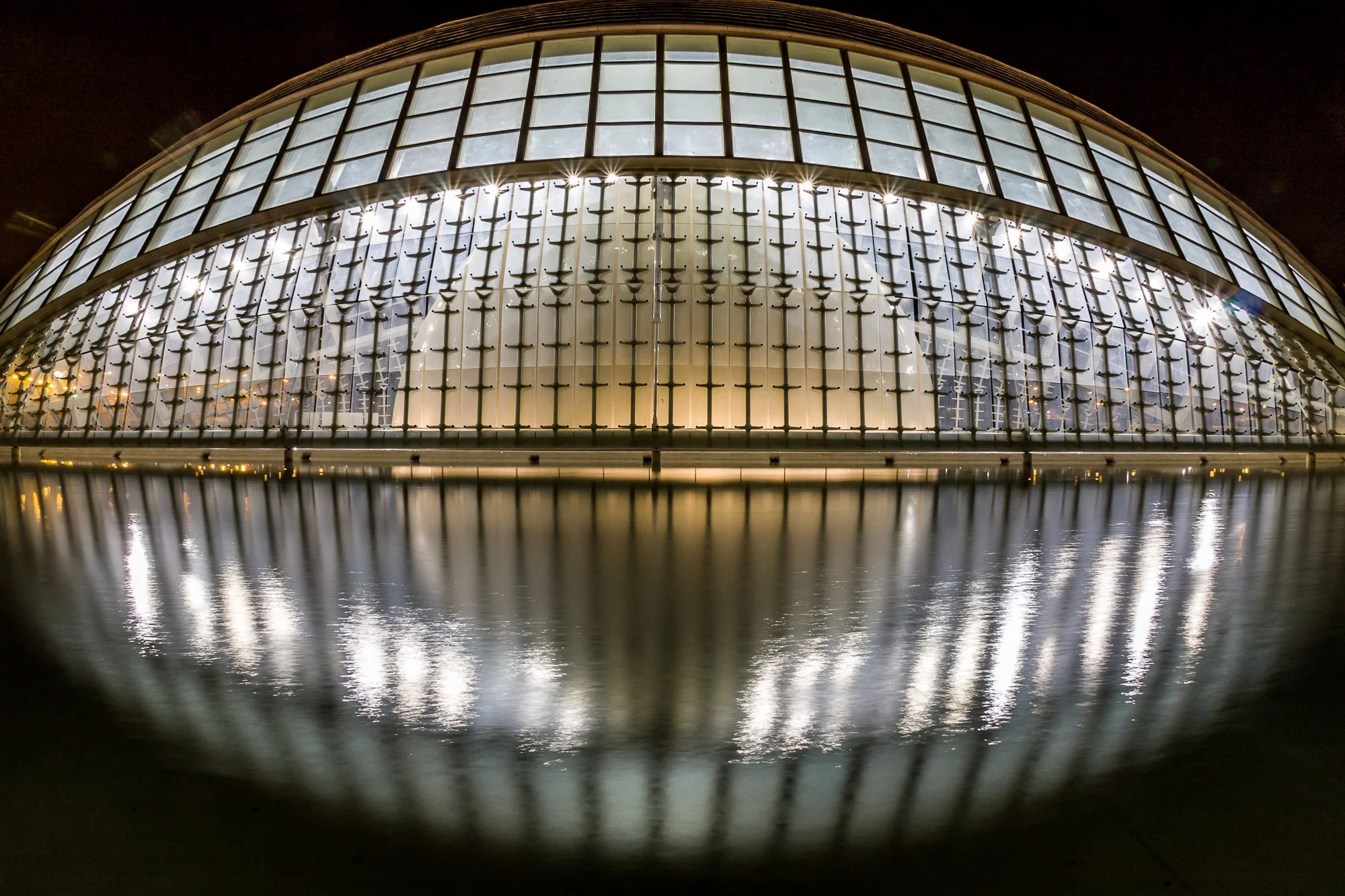
The City of Arts and Sciences. L’Hemisfèric. ISO 100, 18mm, f/3.5, 0.4 sec.
Photographic appeal
For photographers, the appeal is immediate and obvious. Curved lines, strong symmetry, and those pools — it all adds up to a location that almost composes itself. But that's also the challenge: because it's so visually generous, it's easy to come away with competent shots that look like everyone else's. The difference tends to come from time of day, patience, and being willing to move around rather than plant the tripod and stay there.

Palau de les Arts Reina Sofía ISO 100, 24mm, f:10, 4 sec.
A photographer’s personal moment
The first time I photographed the complex, I arrived just before blue hour. The air was still, and the water in front of L'Hemisfèric was perfectly calm. As the lights came on, the building's eyelid shape reflected cleanly on the surface, forming a complete oval — an eye looking back at me. I adjusted the tripod, tried a few angles, and felt that rare thing: the scene doing most of the work. Every frame looked intentional. It felt almost too easy.
It's that kind of place. You can spend hours here exploring small shifts in perspective — two steps left, crouch down, move closer to the water — and each change opens up a different image. Even after several visits, it still surprises me.
I've visited the complex more than once, at different times of day and in different seasons. Each time it's offered something new — a different quality of light, a reflection I hadn't noticed before, a composition that only works from one specific angle. If you're planning a visit, my honest advice is this: don't rush it. Give yourself at least two sessions — one at sunrise, one at blue hour. Bring your tripod. And leave room for the unexpected.
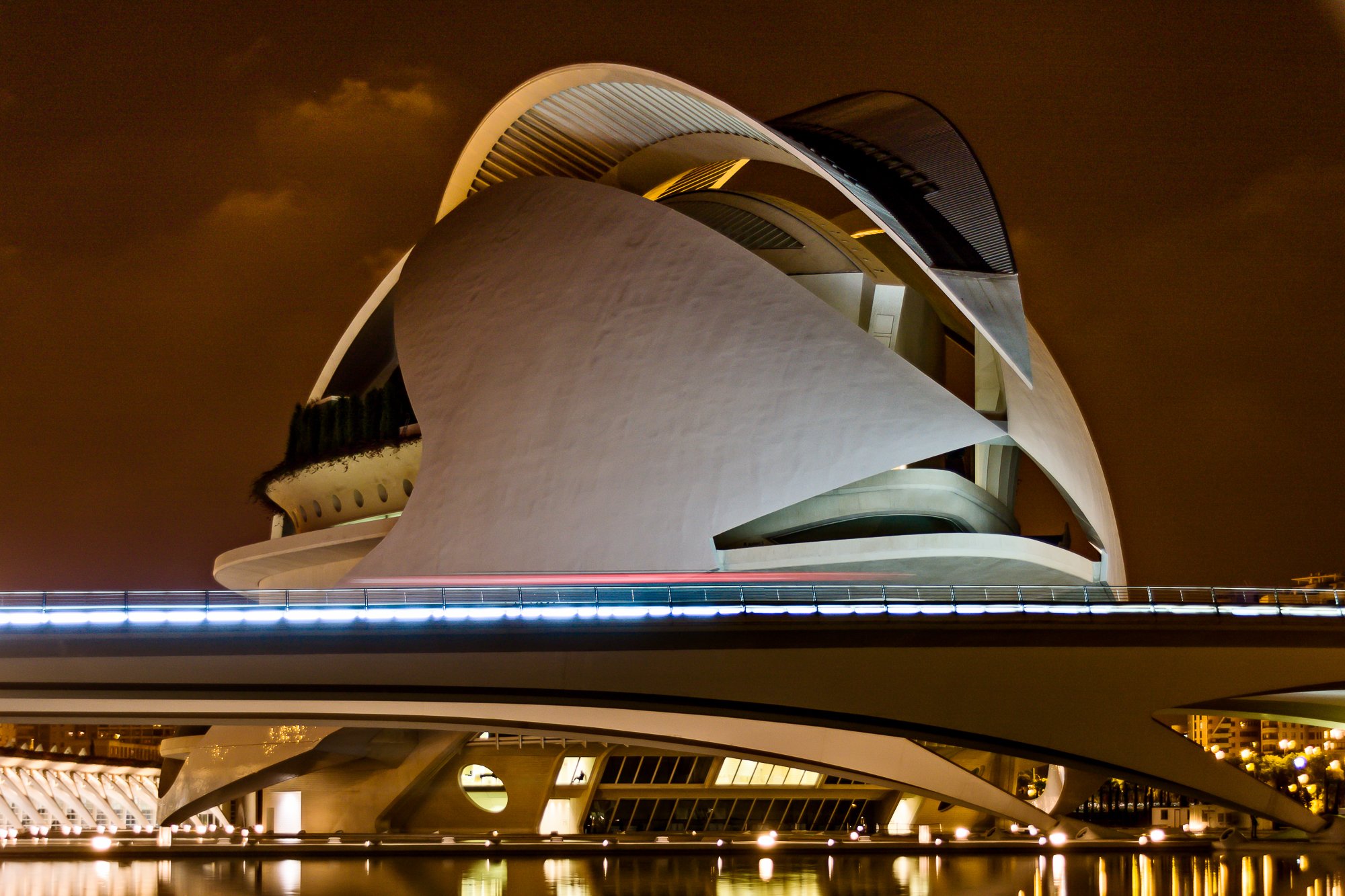
The City of Arts and Sciences. In this photo we can see L’Hemisfèric and the Palau de les Arts Reina Sofía on behind, in front its reflection on artificial lake. ISO 100, 42mm, f/4.5, 1 sec
If You Go
The City of Arts and Sciences deserves more than a quick visit. Arrive at sunrise for still water and empty paths, or at blue hour when the lights come on and the white concrete gives way to something closer to a film set. A tripod is non-negotiable at either end of the day. Walk the entire complex before you start shooting — each building is its own location, and the relationships between them only become clear once you've seen the whole thing.
And if you can, come back a second time. The light changes everything here.

The City of Arts and Sciences. L’Hemisfèric. ISO 100, 28mm, f/4, 3.2 sec.
Valencia has more than one face — the City of Arts and Sciences is the modernist one. For the natural counterpart, see The Albufera, a freshwater lagoon just south of the city where the light is completely different. For more landmark architecture photography, Battersea Power Station in London makes for a compelling comparison.
See more urban architecture photography in the portfolio.
Want one of these on your wall?
Every photo on this site can be printed — archival paper, signed and numbered. Browse prints →
Cosme Lapena is a Barcelona-based street and urban photographer and founder of bCLPhoto.
Exhibited at espai [b] since 2010 · Published in The Eye of Photography and 35mmc. Browse the portfolio or read more on the blog.