Street Colors — Urban Photography in Madrid
ORIGINALLY PUBLISHED SEP 2023 — UPDATED MAY 2026
Street Colors — On Graffiti, Madrid, and Why I Always Stop to Look
I have a weakness for graffiti. Not the tags — the rushed signatures sprayed at eye level on shutters and letterboxes, the territorial marks that say I was here without saying anything else. Those I walk past. But when someone has taken a wall and turned it into something that makes you stop mid-stride, change direction, pull out your camera — that's a different thing entirely. That's what I'm after.
Madrid understands this better than most cities. The neighbourhood of Embajadores, in the Lavapiés area of the city centre, has been a canvas for serious street art for years. Walking through it feels less like a neighbourhood and more like an open-air gallery where the works change with the seasons and nobody charges admission.

Colourful street art mural in Calle Embajadores, Madrid, urban photography – bCLPhoto
The Festival
I first came across this particular stretch during a street art festival in 2015 — a curated event that brought together artists from across Europe to work on the walls of Calle Embajadores and the surrounding streets. The scale of some of the pieces was breathtaking. Full building facades, four or five storeys high, painted with the kind of detail and ambition you'd expect on a museum canvas. The work wasn't decorative. It engaged — with politics, with identity, with the texture of the neighbourhood itself.
The corner of Calle de Embajadores and Travesía de Cabestreros is one of the most iconic spots in this open-air gallery. It currently features a piece by Okuda — Óscar San Miguel Erice, a Fine Arts graduate from the Complutense University of Madrid who has been painting walls across the world since the early 2000s. His work is immediately recognisable: geometric multicoloured patterns layered over figurative forms, a visual language that sits somewhere between sacred iconography and pop art. Seeing it at full building scale, on a street corner in Lavapiés, is something else entirely.
What I find compelling about the best street art is precisely what makes it different from gallery work: its relationship with context. These pieces don't exist in a neutral white space. They exist on a specific wall, in a specific street, in a specific city. The peeling plaster underneath, the drainpipe cutting through the composition, the shopfront at the base — all of it becomes part of the image. You can't separate the art from its location.

Street art festival photography in Embajadores street, Madrid, 2015 – bCLPhoto
Photographing Colour in the Street
Colour this saturated presents its own photographic challenges. Shooting in bright midday sun — which Madrid delivers reliably — means harsh shadows and blown-out highlights that fight against the subtleties of the painted surface. I prefer overcast light for murals, or the low-angle sun of early morning and late afternoon, when the light rakes across the wall and brings out the texture of the brushwork.
I was shooting with a wide-angle lens for most of this session, keeping close to the walls to capture scale and detail simultaneously. The temptation with large murals is always to step back and get the whole thing in — but often the most interesting frames are the details: a face close up, the point where two colours meet, the way the paint has cracked and faded in one corner while the rest remains vivid.
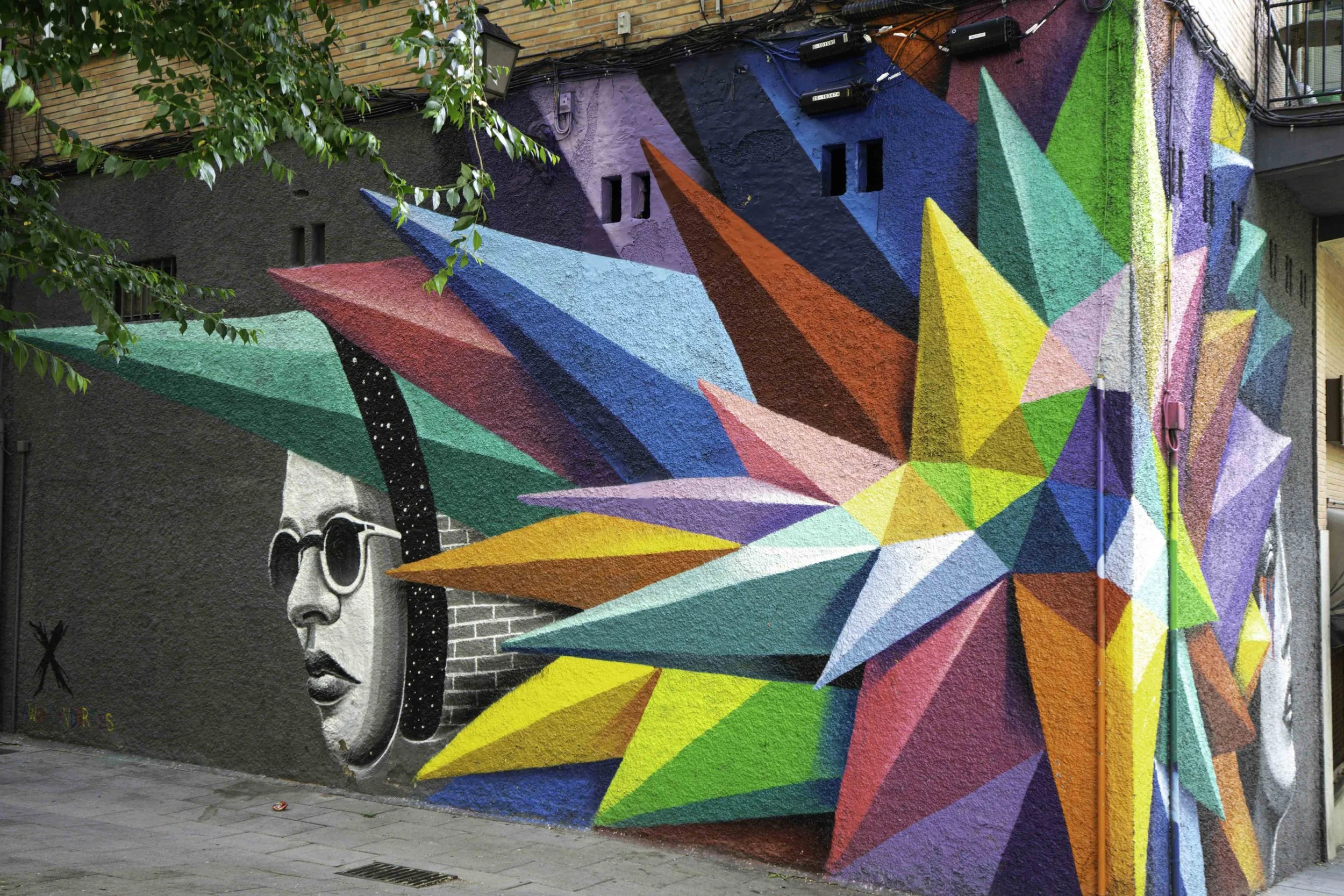
Colourful street art mural in Madrid, urban photography – bCLPhoto
Why It Matters
Street art is ephemeral. The mural you photograph today may be whitewashed next year, painted over by another artist, or simply worn away by weather and time. That impermanence is part of its character — and it's part of what makes photographing it feel urgent in a way that photographing a painting in a museum does not. You're capturing something that exists in a specific moment, in a specific place, subject to forces that no curator can control.
That's the thing about graffiti, when it's done well. It doesn't ask permission. It doesn't wait for the right moment. It just appears — on a wall in Madrid, or London, or Istanbul — and it asks you to look.
I always do.
Madrid's street art sits alongside other urban photography on the blog — see Street Art in Antwerp: The Murals of Larsen Bervoets for another encounter with large-scale murals, or Barcelona Street Photography for colour and life closer to home.
See more street photography in the portfolio.
Cosme Lapena is a Barcelona-based street and urban photographer and founder of bCLPhoto.
Exhibited at espai [b] since 2010 · Published in The Eye of Photography and 35mmc. Browse the portfolio or read more on the blog.