ORIGINALLY PUBLISHED 2019 — REWRITTEN NOVEMBER 2026
Jaume Plensa's Soul of the Ebro is a giant made of letters, and in August 2008 it was the reason I kept going back to one corner of Expo Zaragoza. I spent two days at the Expo with my wife and our younger daughter, then fifteen. Zaragoza had built the international exhibition on a bend of the river Ebro around a single theme, water and sustainable development. I saw the sculpture first in the afternoon, and that night I went back to it with the camera.
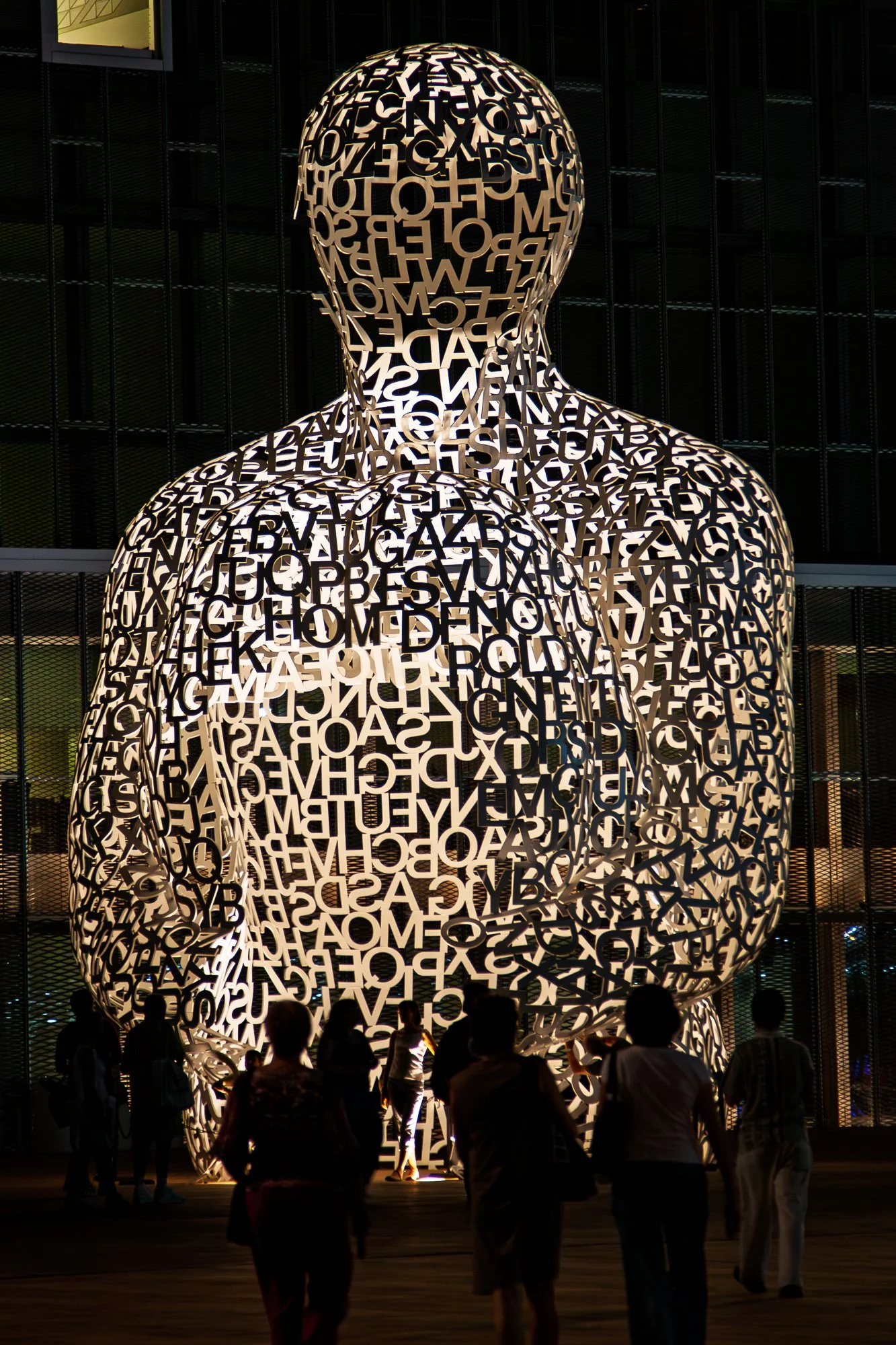
Walking towards the light — Canon EOS 40D
Seen from across the square after dark, it stopped looking like steel. It glowed from the inside, the letters dark against their own light, and the people walking towards it turned into black shapes at its feet. One person in a white top stood inside it, right at the base, and only then did the scale make sense.
Jaume Plensa's Soul of the Ebro, by Day and by Night
The Alma del Ebro stands in front of the Palacio de Congresos. It was made for the Expo and it has stayed. It is a seated figure about twelve metres tall and seven and a half wide, built from letters of stainless steel lacquered white and welded together. It is hollow, so you can walk inside it (Zaragoza Turismo). Plensa described it as a seated human being looking inward. Look for words in it and you will find almost none, only the alphabet used as building material.
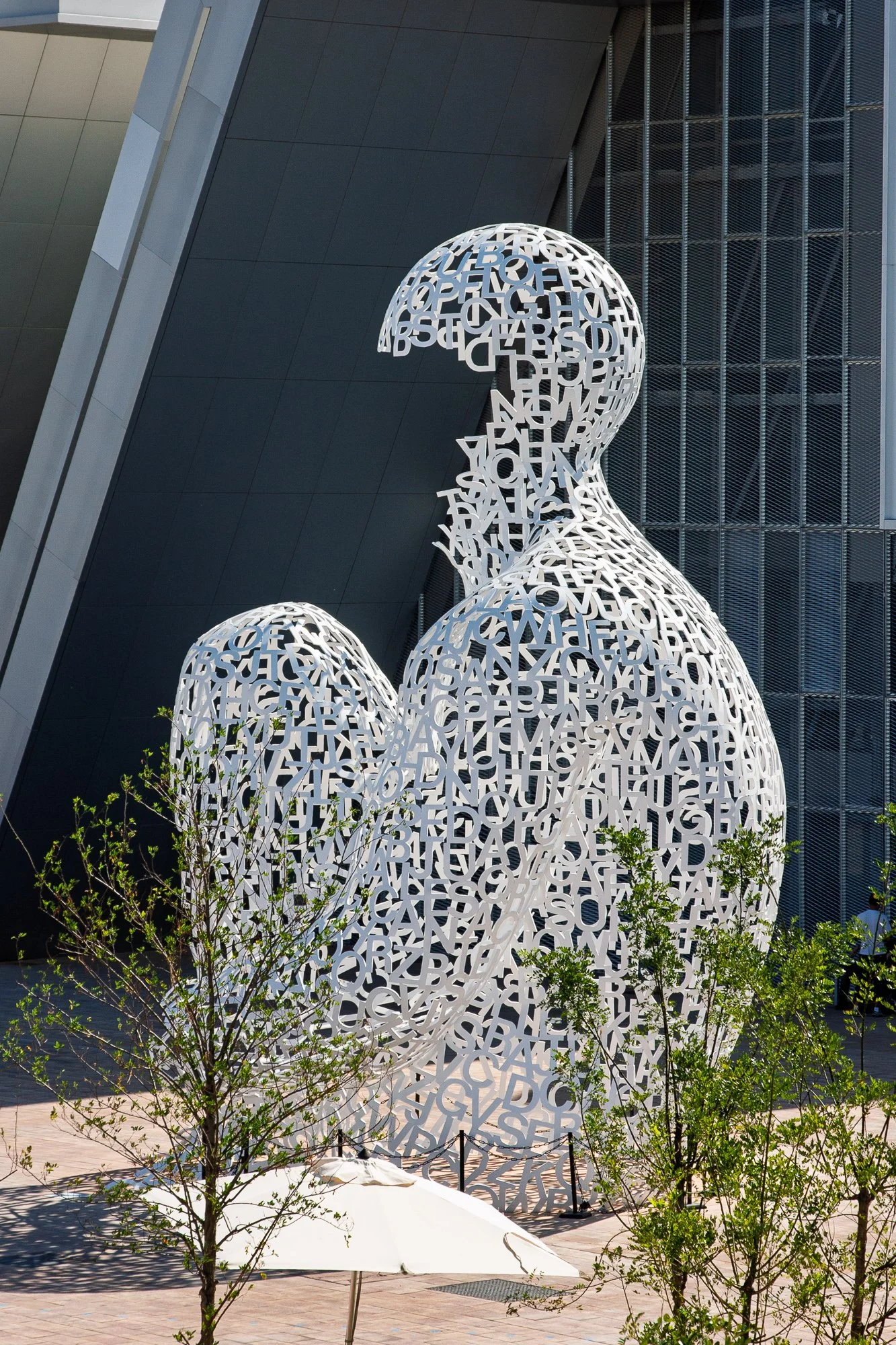
Chalk white in the afternoon — Canon EOS 40D
In the afternoon it is a different object. Against the dark, slanted façade of the congress centre the steel is chalk white, and the sun pushes the shadows of the letters through the figure and onto the paving. From the side you see the posture: the head bowed, the body folded over itself. The trees planted for the Expo were still small, and a closed white parasol from a nearby terrace cut into the bottom of the frame.
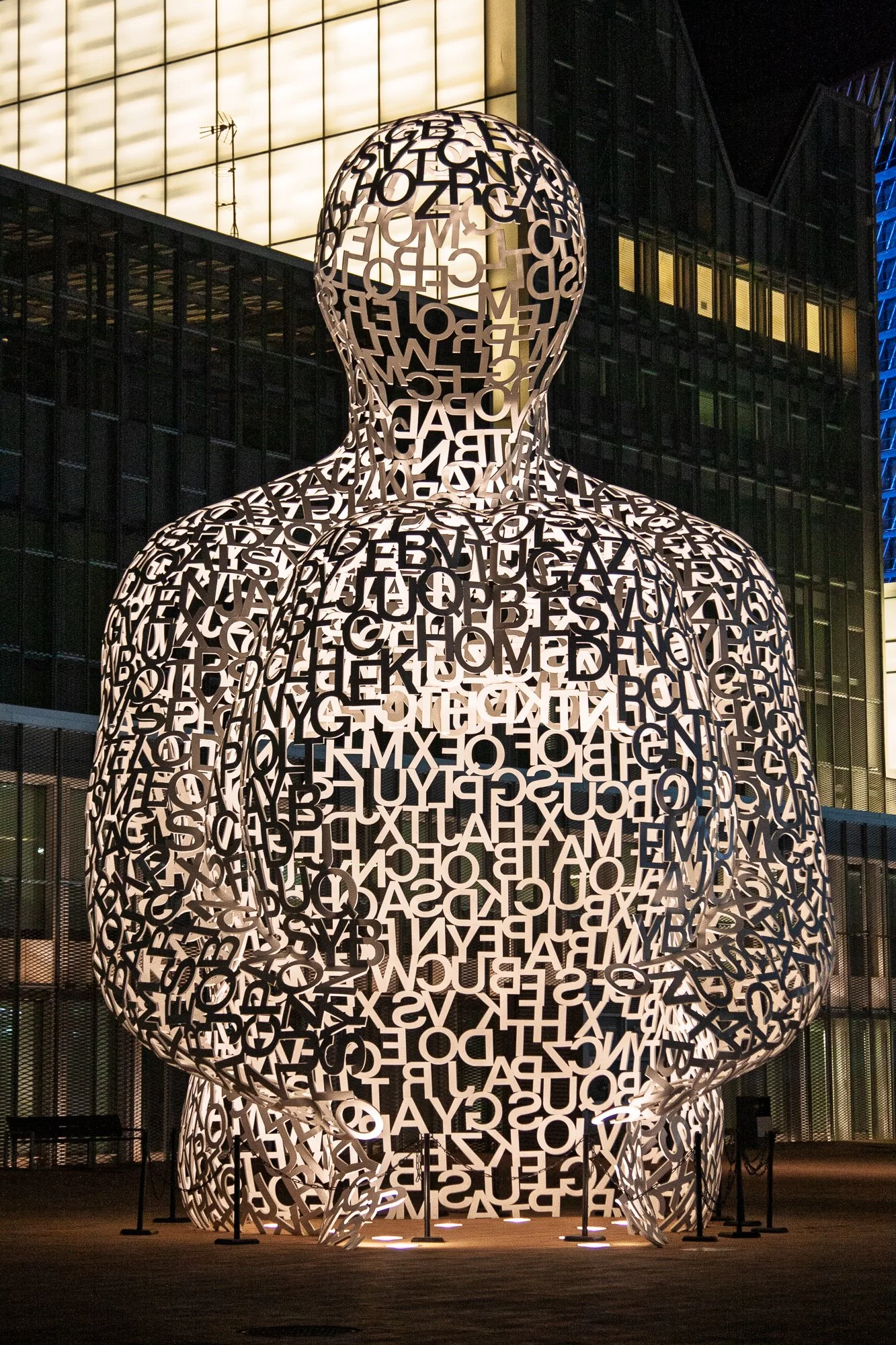
A lamp left on — Canon EOS 40D
At night the lights set in the ground take over. They sit inside the base and throw their light upwards, so the letters on the near side go dark and the ones behind them glow, and the whole figure seems lit from within. In this frame there is nobody around it. There is only a ring of posts and chains, the lit windows of the building behind, and the sculpture shining like a lamp someone had left on.
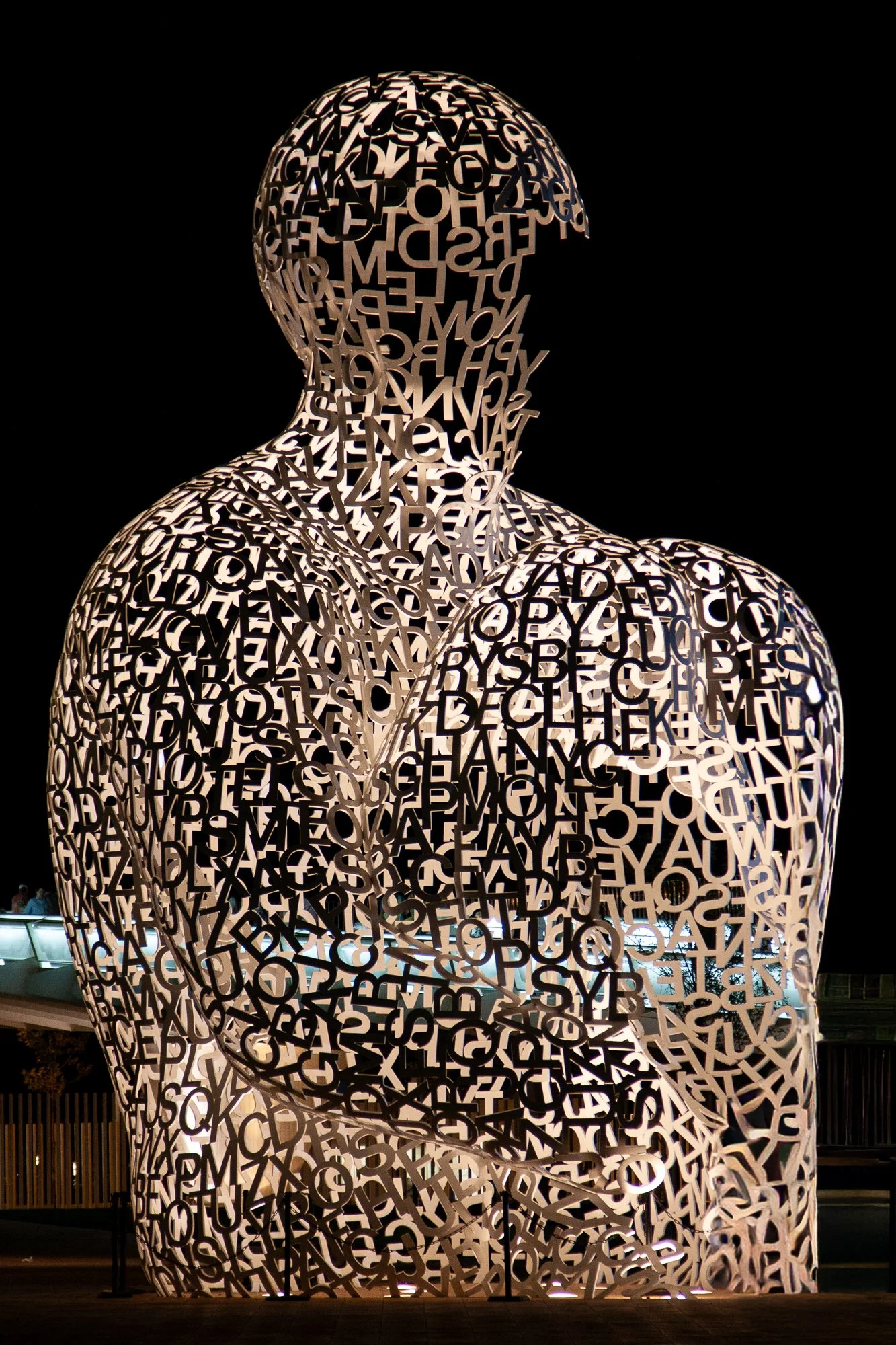
Looking inward — Canon EOS 40D
From behind and to one side, against the black sky, it becomes a single shape: the shoulders, the bowed head, the curve of the back. A strip of blue light from a walkway shows through the letters in the lower half, the only colour in the frame. I shot all of these handheld, at 0.6 to 0.8 of a second and ISO 400 to 800. At those speeds a steady hand matters more than the lens.

Type, not texture — Canon EOS 40D
Closer in, the letters stop being a texture and become type again. An M, an O, a Z and an R are each cut from steel and welded to their neighbours at odd angles, with the light coming through the gaps. Half the head falls into darkness, and the face it does not have is made of empty space. We went inside it too, the three of us, but I have no photograph from in there. From inside, it is a place rather than a picture.
The Water Tower and Expo Zaragoza at Night
The Expo grounds were laid out on a meander of the Ebro, and at night the buildings did what the sculpture did: they lit themselves. The tallest was the Torre del Agua, the 76-metre Water Tower by Enrique de Teresa, lit blue from top to bottom (Expo 2008).
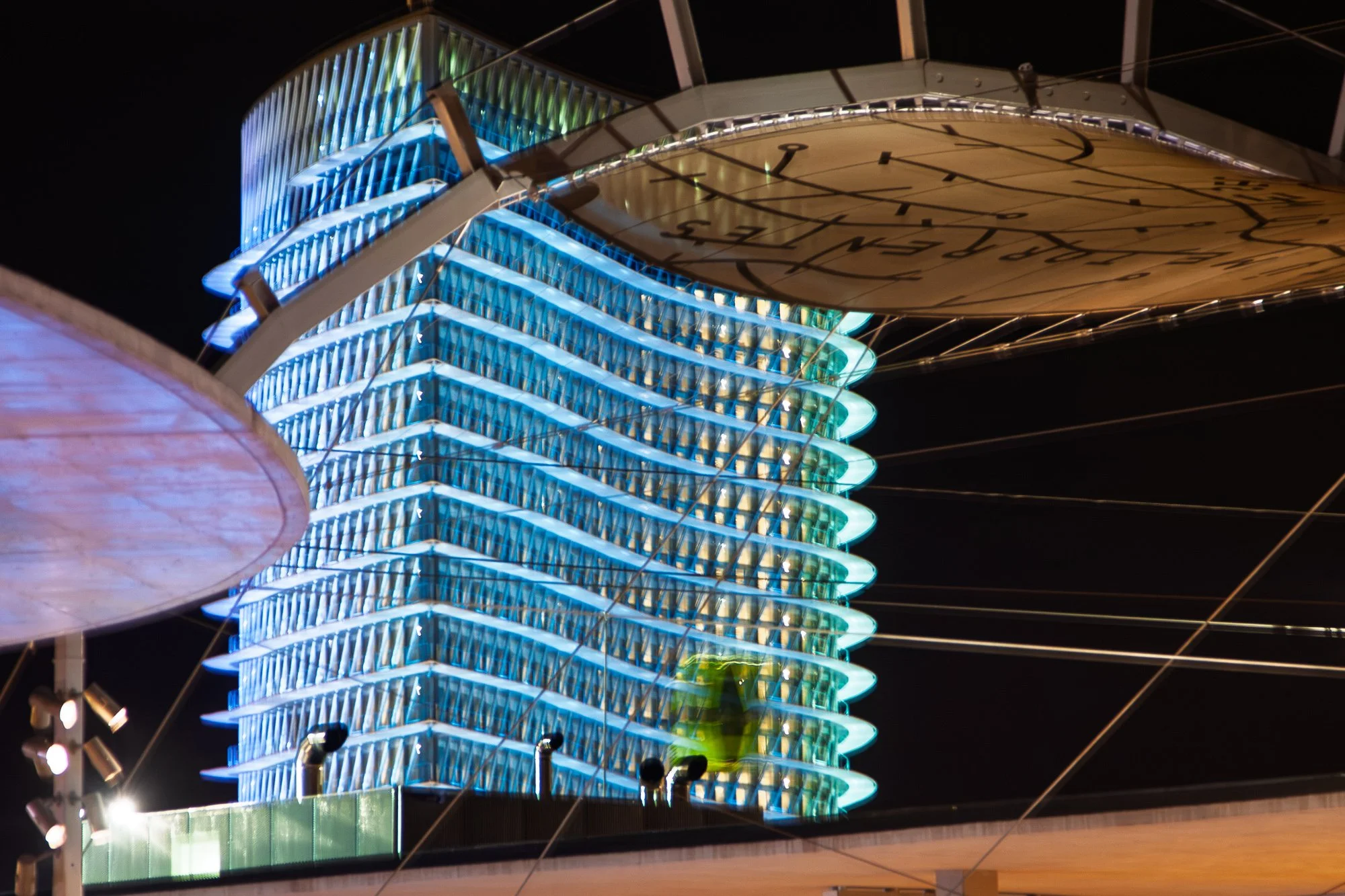
Under the canopy — Canon EOS 40D
I found it first behind one of the big oval canopies hung on cables over the walkways. The canopy had lettering painted on its underside, and floodlights blazed on a pole to the left. The tower's glass and blue fins filled the space between the canopy and the roof below. With the words overhead, the frame became one more game of letters.
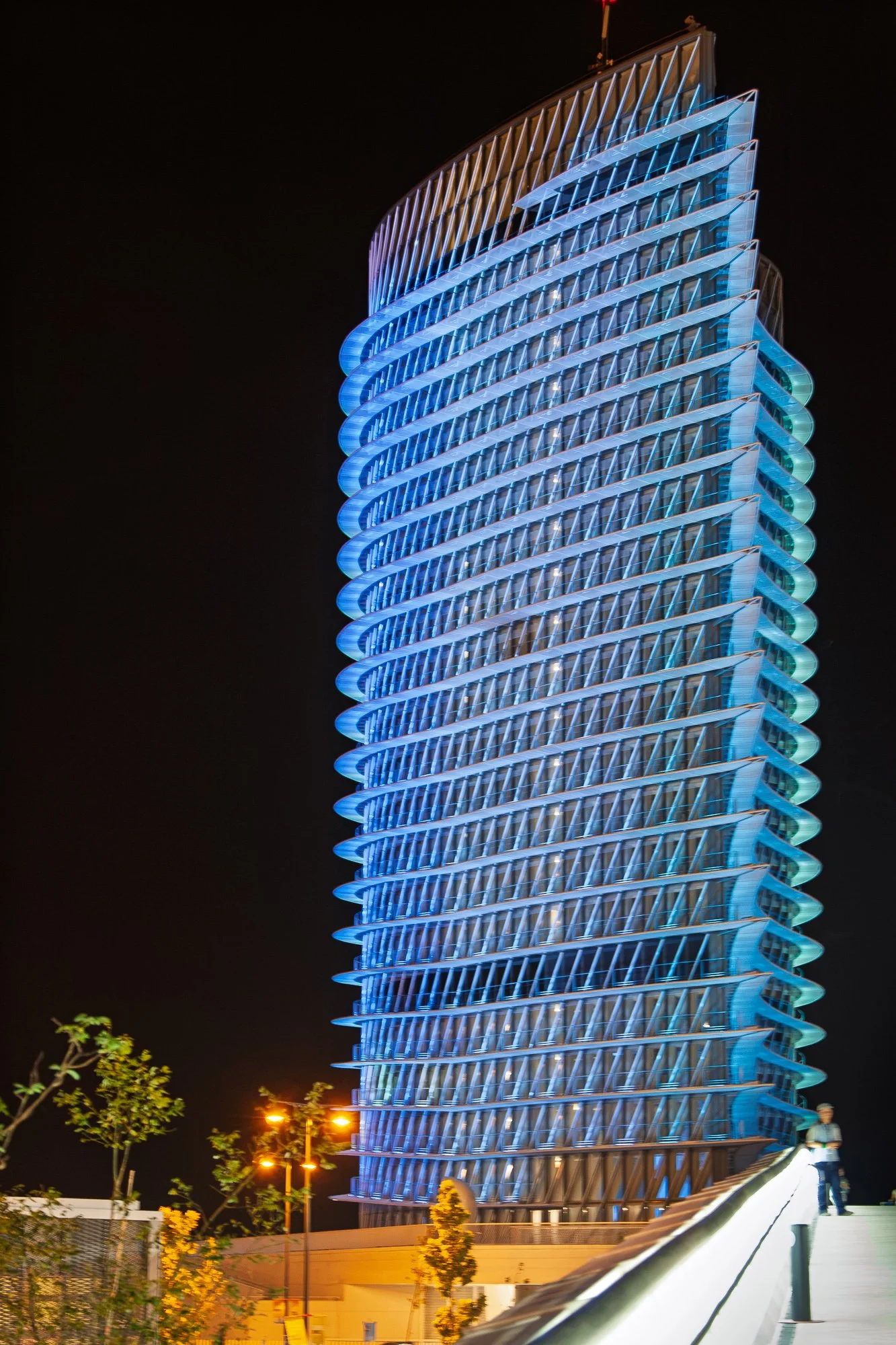
76 metres of blue — Canon EOS 40D
Seen whole, the tower is a stack of curved blue fins, one on every floor, and each of them bends like a small wave. A man stood on the white ramp on the right, and the street lamps on the left burned orange against all that blue. Without him, the tower would have no scale.
The Awakening of the Serpent: Letters in the Parade
The next day belonged to the parade. Every day a procession called The Awakening of the Serpent, created by Cirque du Soleil, wound through the grounds. Crowds lined the route and leaned over the railings of the walkways above. I photographed far more of it than I will ever show here. These are the three frames that belong next to Plensa.
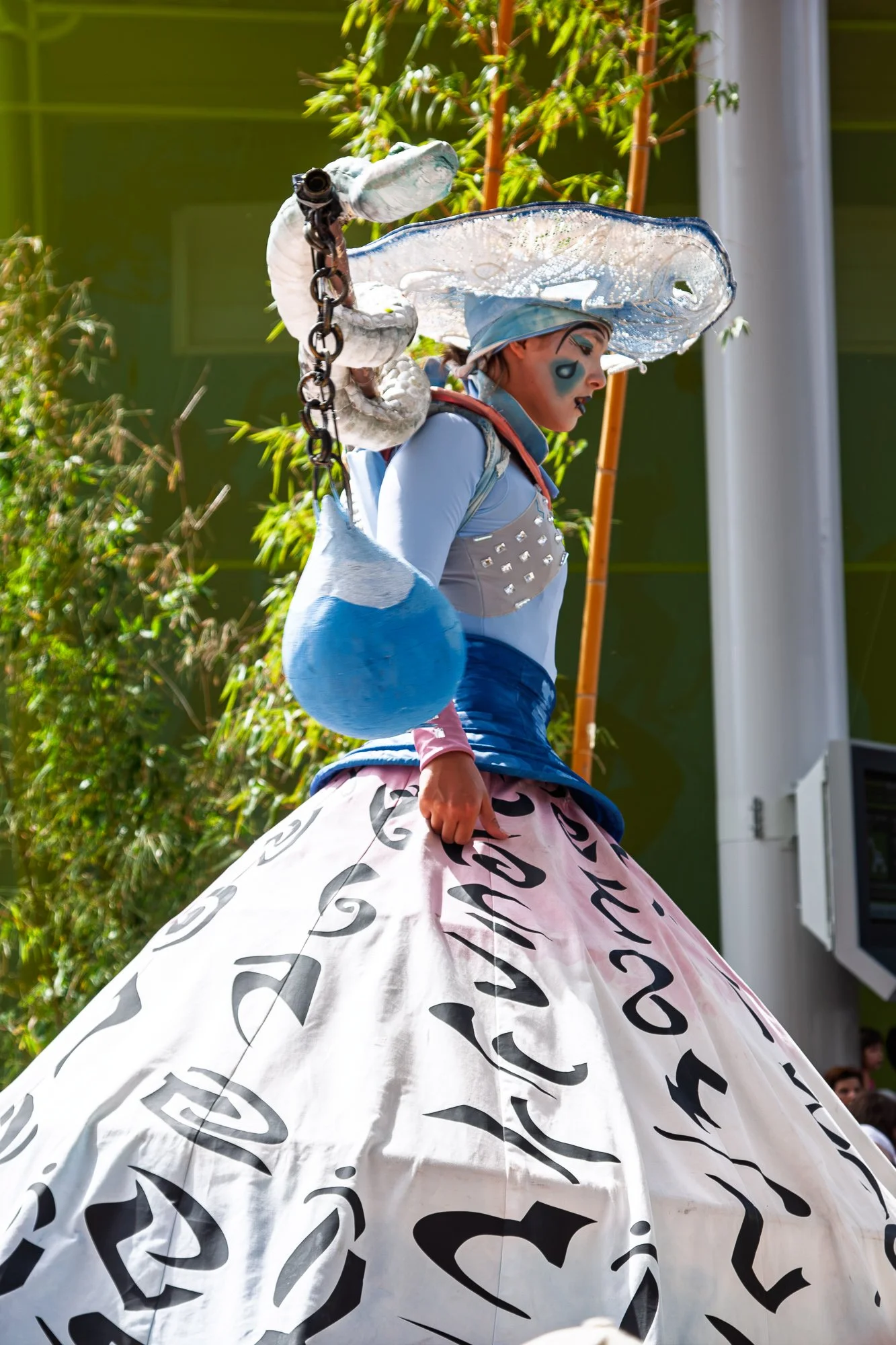
The serpent and the script — Canon EOS 40D
This performer is the reason I chose them. She wore a wide hat of blue lace and a serpent coiled across her shoulders, with blue water drops hanging from it on chains. Her huge white bell of a skirt was painted with black marks that look like a script nobody can read. That was letters again, or at least the idea of them, a day after the giant made of the alphabet.
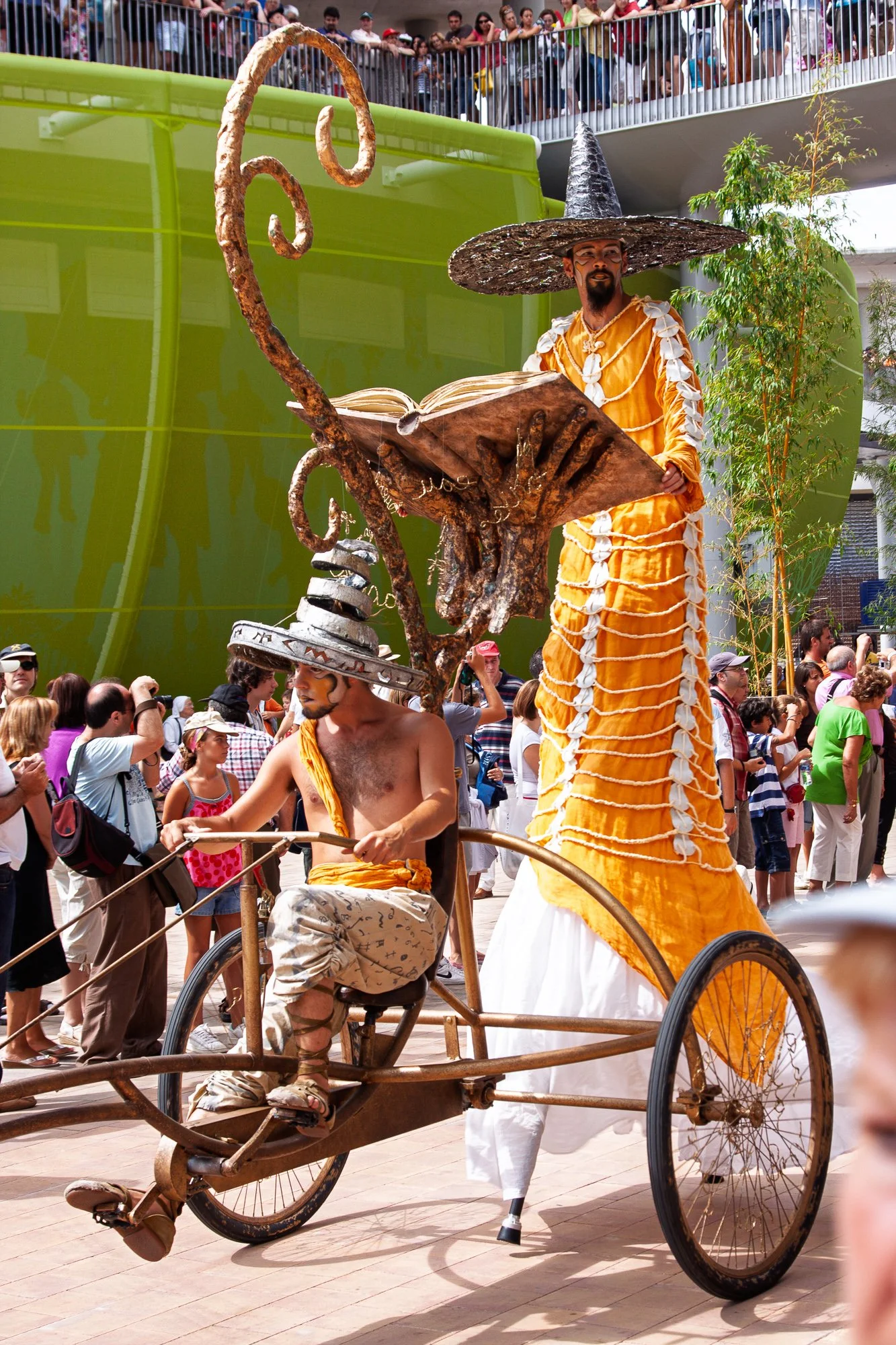
The reader — Canon EOS 40D
Further along the route came a figure on stilts in a long orange robe ringed with rope, a wide dark hat on his head. He was reading from an open book held up by a sculpted tree. A bare-chested young man in a spiral hat, his face painted in gold and brown, rode the old tricycle that carried the whole thing forward. Even in a parade, someone had brought a book.
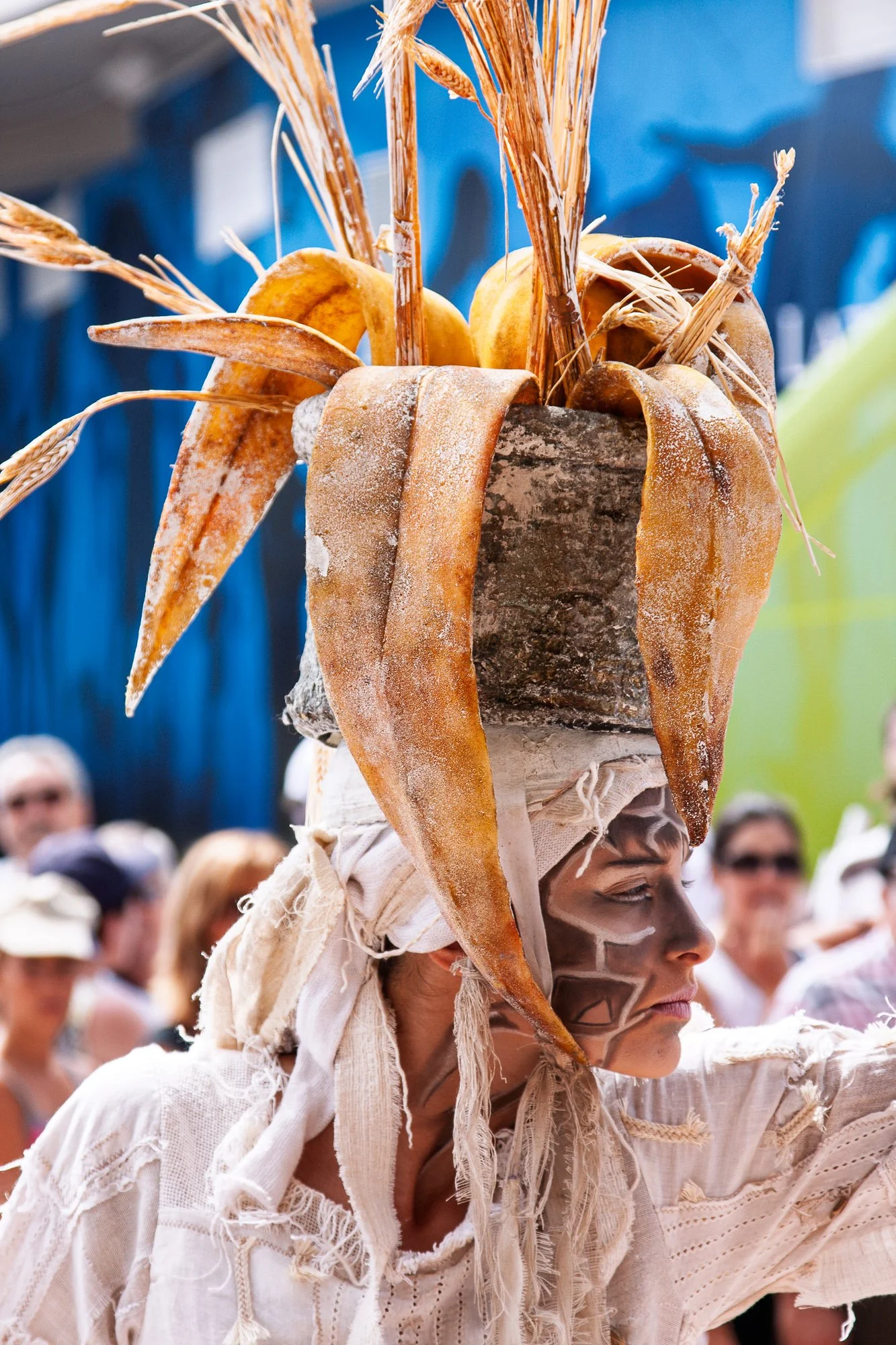
Waiting for water — Canon EOS 40D
Not every character was loud. A woman in ragged cream linen carried a stone pot on her head, sprouting stalks of wheat and long curling shapes like baked crusts. Her face was painted brown with white lines, like dry earth cracking. In a parade about water, she looked like the land waiting for it.
The Bridge Pavilion and the Ebro at Dusk
The Expo's other great building crossed the river itself. Zaha Hadid's Bridge Pavilion is 270 metres long, a covered bridge and exhibition hall in one. During the Expo it was one of the main entrances and housed the exhibition Water, a unique resource (Zaragoza Turismo).
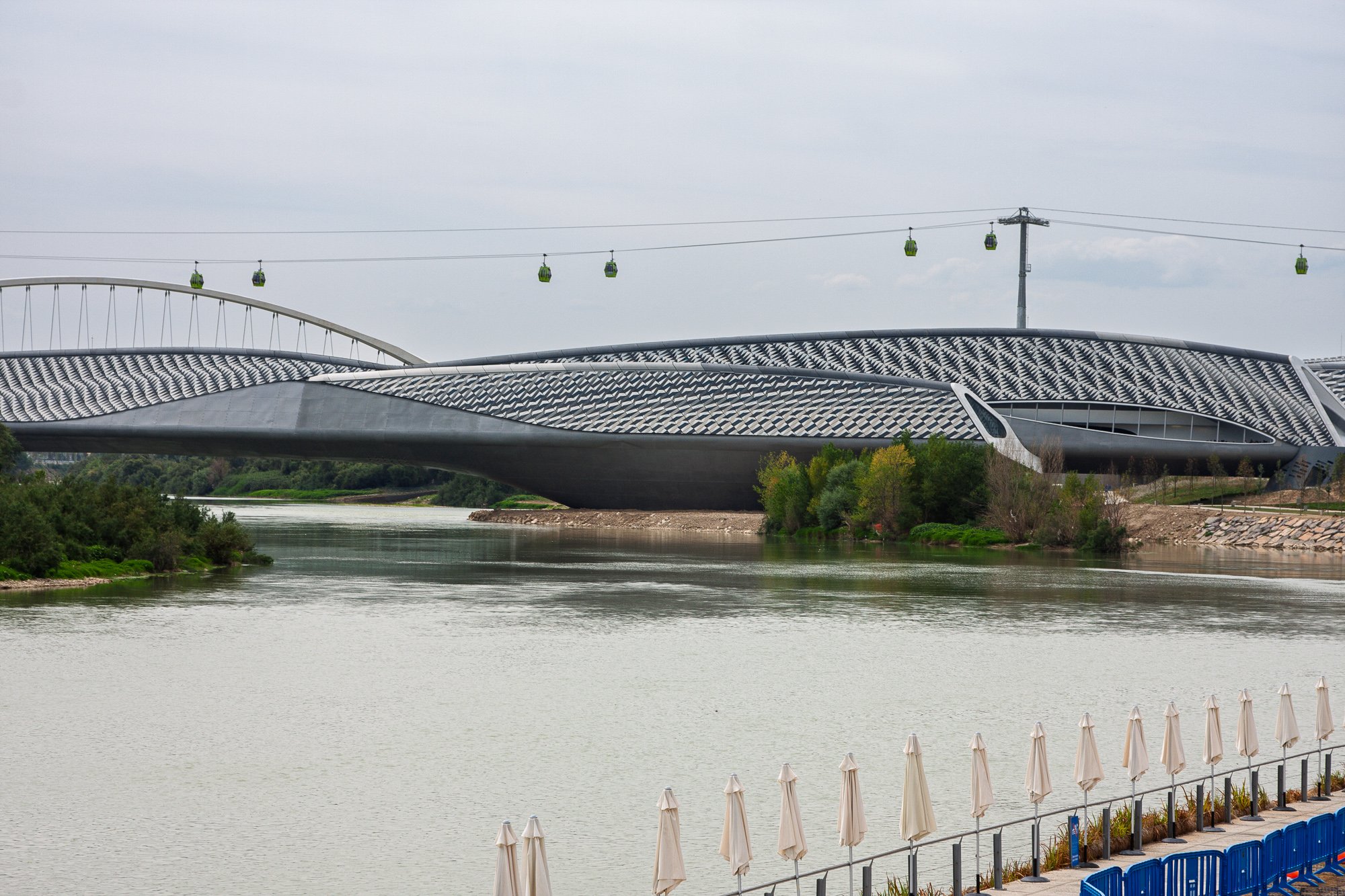
Scales on the river — Canon EOS 40D
By day, under a flat grey sky, its skin of grey and white diamond tiles looked like the scales of an animal lying across the Ebro. The green cable cars of the Expo slid over it on their wire, and on the near bank a row of closed white parasols waited for the evening.
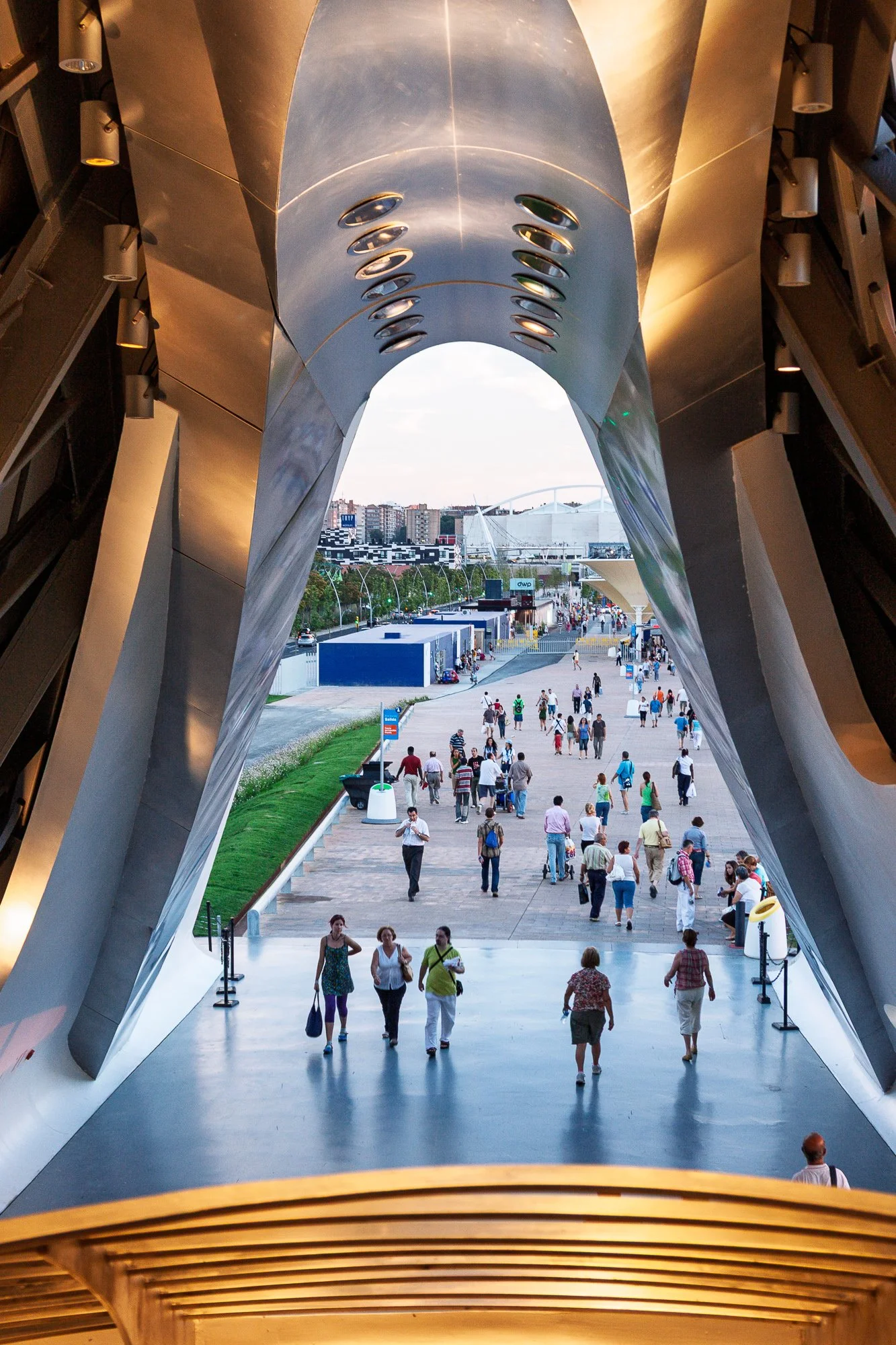
The way in — Canon EOS 40D
Inside, the structure is a tunnel of steel, and at its end a pointed opening frames the Expo like a gateway. In the evening light I watched people come in off the long avenue, with the city's apartment blocks and a white arch in the distance. Their reflections stretched across the polished floor. It is the only frame from the trip where the architecture and the crowd carry equal weight.
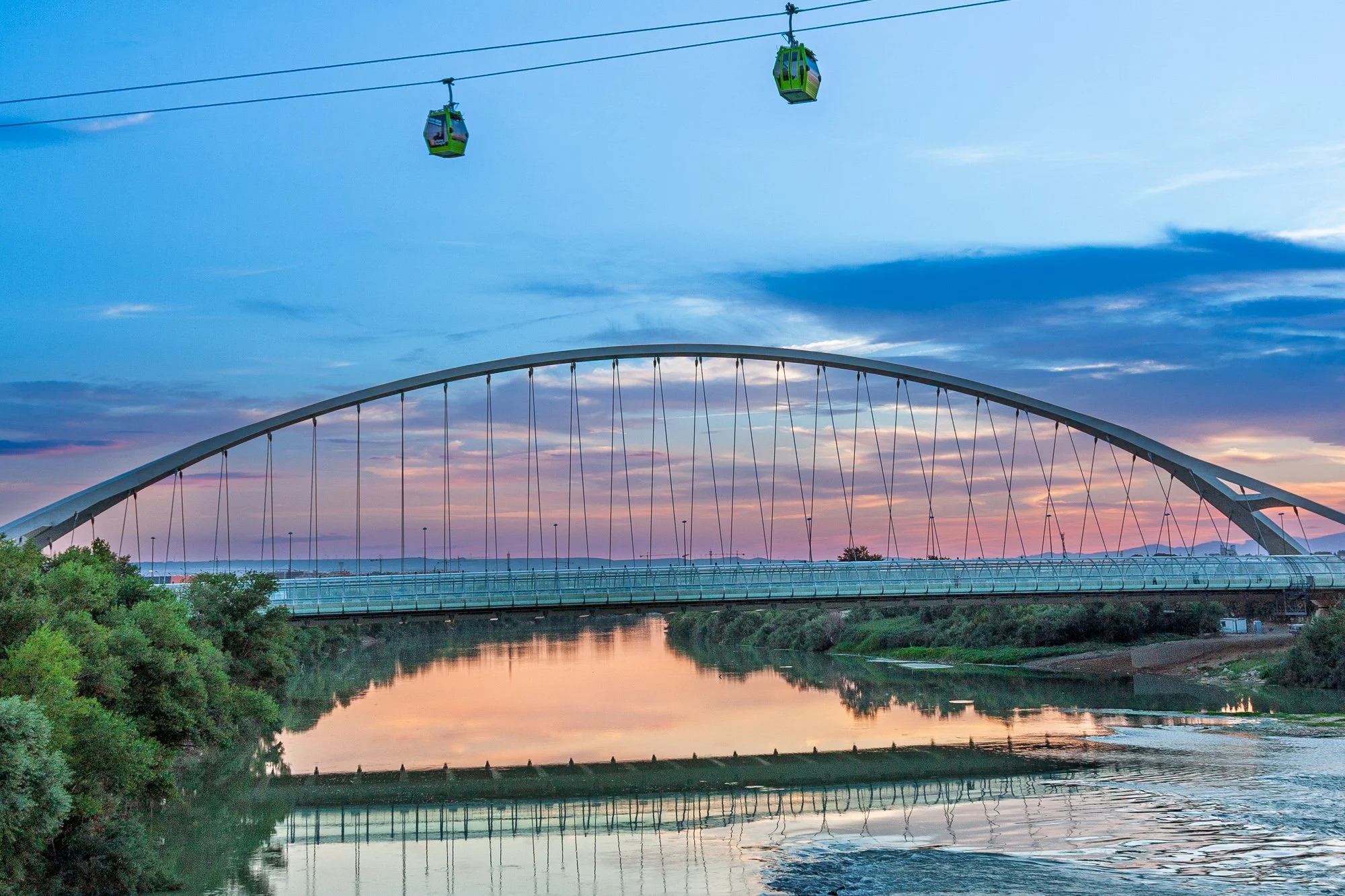
The last light on the Ebro — Canon EOS 40D
The last frame I kept from Zaragoza is the simplest. The sky had turned pink and blue, the arch and its glass walkway lay mirrored in the still water, and two of the green cable cars hung above it all. It is the Expo's theme with nobody having to explain it: a river, a bridge, and a little light left at the end of the day.
For another sculpture that makes you stop, see the Museum of Forbidden Art in Barcelona. And from the same year and the same Canon EOS 40D, there is an afternoon on the Albufera with forty other photographers.
If you go to Zaragoza, see the Soul of the Ebro twice: once in daylight, and once after dark.
Subscribe to the newsletter for new stories from the street, along with a free street photography guide.
Photos: Canon EOS 40D · Canon 24-105mm f/4L · night frames handheld at 0.6–0.8s, ISO 400–800 · Zaragoza, August 2008
See more urban architecture in the portfolio.
Every photograph in this post is also available as a fine art print.
Cosme Lapena is a Barcelona-based street and urban photographer and founder of bCLPhoto.
Exhibited at espai [b] since 2010 and PH21 Gallery · Published in The Eye of Photography and 35mmc.