Murano Glassmakers, Part I: The Craft in Black and White
ORIGINALLY PUBLISHED MAR 2019 — UPDATED MAY 2026

Murano glassmaker in the workshop, Venice – bCLPhoto
MURANO 1 — The Glassmakers of Murano
There are experiences that stay with you not because they were comfortable, but because they demanded something of you. Murano was one of those.
The island sits just a short vaporetto ride from Venice, and everyone tells you to go. What they don't always tell you is what it actually feels like to step inside one of the old furnace workshops — the fornaci — where the glass has been blown by hand for centuries. I had my camera with me, as always. What I hadn't fully anticipated was how much the light — or the near-absence of it — would define every frame I took.
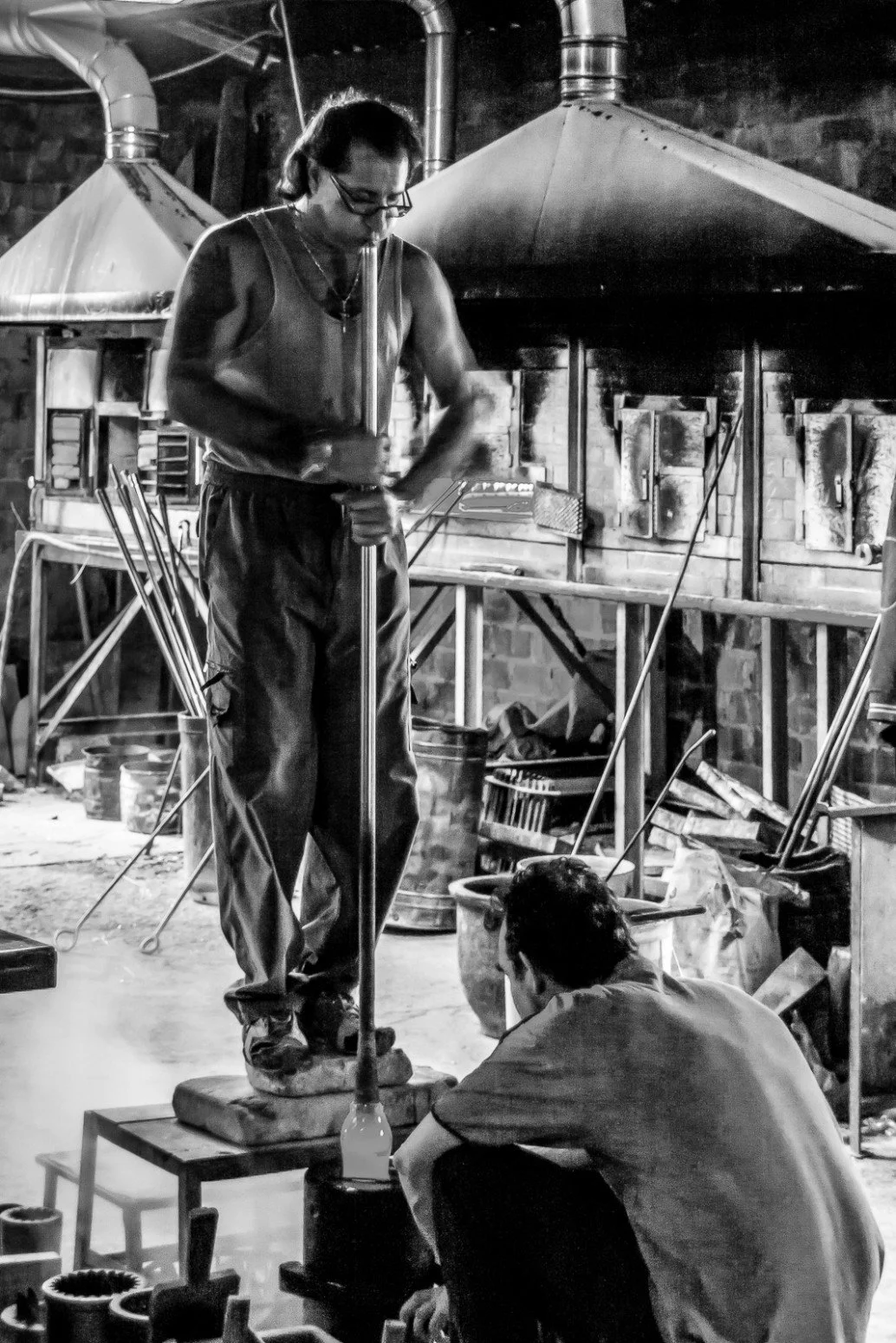
Glassmaker in action, Murano island, Venice – bCLPhoto
Inside the Furnace
The workshop was dim. Not the gentle dimness of a museum or a church, but the deep, almost suffocating darkness of an industrial space where the only sources of light are the furnaces themselves and the incandescent glow of molten glass pulled from them. Your eyes adjust, slowly. And then you start to see.
The maestros moved with a calm precision that made the whole thing look effortless — which, of course, it is anything but. A gather of molten glass at the end of a blowpipe glows orange and white, somewhere between lava and light. They'd pull it from the furnace, rotate it continuously to keep the shape, and then bring it to their lips and blow — a long, steady breath that expanded the molten mass into something fragile and luminous.
I was shooting with available light only. No flash — it would have been both intrusive and useless in a space that large. Wide open aperture, ISO pushed as high as I dared. Even then, the exposures were on the edge. The glow of the molten glass became my main light source, and I leaned into it: positioning myself so that the bright core of the gather illuminated the maestro's hands and face, letting everything else fall into shadow. Some of the frames are dark. I kept them that way. The darkness is part of the truth of the place.

Murano glassmaker putting the glass in the incandescent oven – bCLPhoto
A Craft With Deep Roots
Murano's glassmaking tradition dates back to 1291, when the Venetian Republic ordered all glassmakers to relocate their furnaces to the island — officially to reduce the fire risk to Venice's wooden buildings, but also, many historians believe, to keep the secrets of the craft contained. For centuries, Murano glassmakers were among the most closely guarded artisans in Europe. They were forbidden to leave the Republic on pain of death. In exchange, they were granted privileges rarely afforded to craftsmen: the right to wear swords, immunity from prosecution, and permission for their daughters to marry Venetian nobles.
The tradition survived wars, plagues, and the slow decline of the Venetian Republic. It survives today, in workshops like the one I visited, where the techniques have changed little in seven hundred years.
Continued in Part 2 →
This is the first of two posts from Murano. Continue with Murano Glassmakers, Part II: The Colors of Molten Glass for more images from the glass workshops. For more European travel photography, see Paris Photography or Hamburg: A City Built on Bridges.
Browse the full travel photography portfolio at bCLPhoto.
Cosme Lapena is a Barcelona-based street and urban photographer and founder of bCLPhoto.
Exhibited at espai [b] since 2010 · Published in The Eye of Photography and 35mmc. Browse the portfolio or read more on the blog.