ORIGINALLY PUBLISHED 2023 — REWRITTEN OCTOBER 2026
My best afternoon of Albufera photography was not planned by me at all. In May 2008 I drove down to Valencia with my wife and our daughter, then about fourteen, for a national meet-up of the Canonistas: an online community of Canon users from all over Spain, with a strong group in Catalonia that went out shooting together most weekends. There were some forty of us, of every age, and on the second day the programme was simple. Paella in El Palmar, an hour's rest, a boat out onto the lagoon, and then the sunset.

The last boat in — Canon EOS 40D
That is where the day ended, with a boatman standing at the stern in his hat, his passengers sitting in a row in front of him, and the sun laying a path across the water right behind his shoulders. But the afternoon began a few hours earlier, on a quay full of photographers.
El Palmar After Lunch
El Palmar is the fishermen's village in the middle of the Albufera, about ten kilometres south of Valencia. Fishermen settled on what was then an island in the thirteenth century, and their guild still decides who may fish the lagoon and where. Today it is also where Valencia comes to eat rice, and the long lunch is part of the visit.
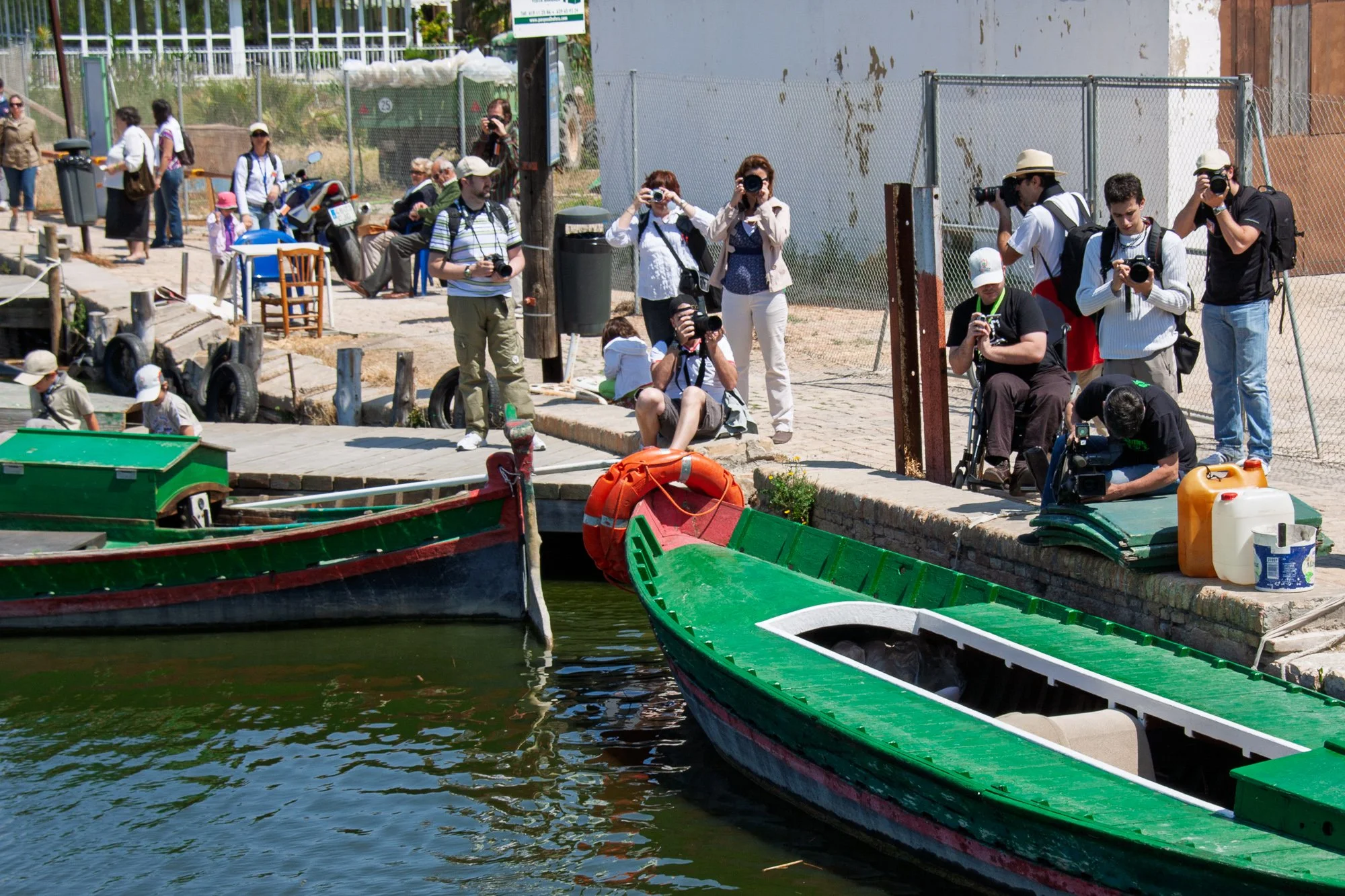
Forty photographers, one quay — Canon EOS 40D
After the paella, the quay filled up with cameras. Forty people with forty Canons is a strange sight for a fishing village, and the moored boats got more attention that afternoon than they had probably had all year. We were all photographing the same things, and half the fun was seeing afterwards how differently each of us had seen them.
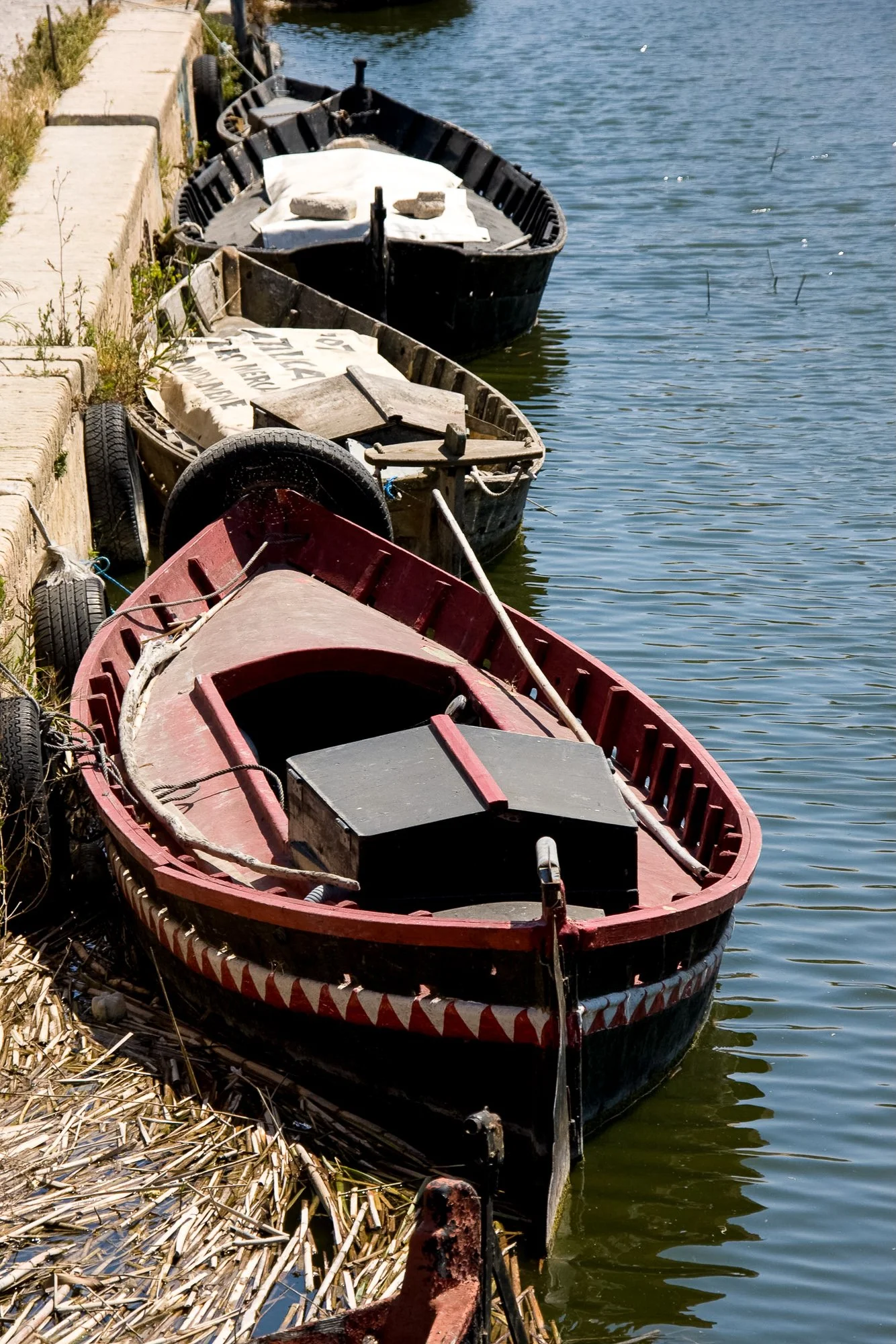
Tyres for fenders — Canon EOS 40D
The boats along the canal were the first thing I photographed. The nearest was painted red and black, with a band of red and white zigzags running along the hull, a pole lying across the deck and a wooden box in the middle. Old car tyres hung over the side as fenders, and behind it two more boats, one black and one bleached grey, waited nose to tail against the stone edge, with a layer of cut reed floating on the water around them.
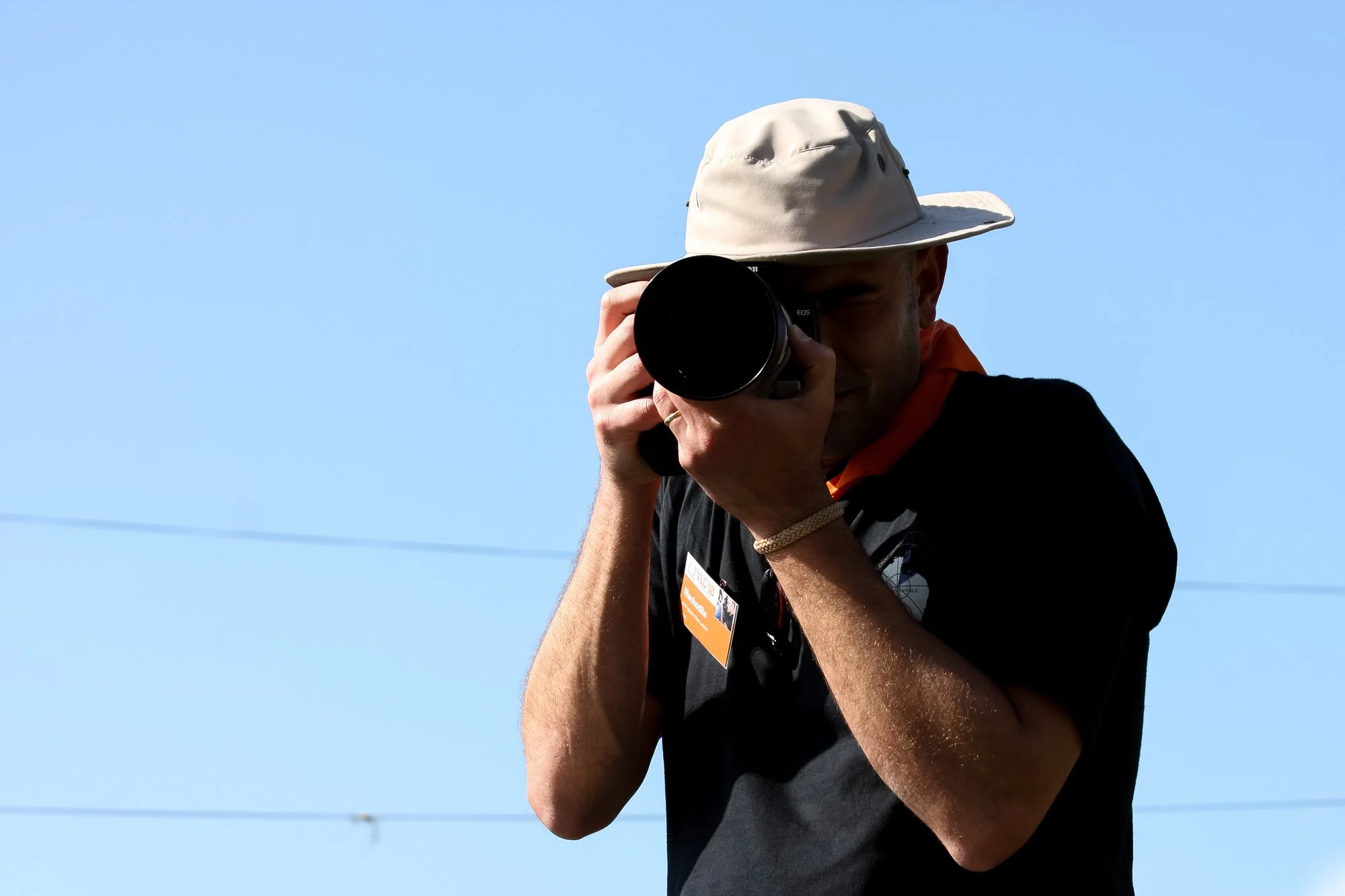
VLC'08 — Canon EOS 40D
The photographers themselves were just as photogenic. This one wore a wide cream hat, an orange neckerchief and a badge clipped to his T-shirt with the meet-up's name on it, VLC'08. Turning the camera on the group became a small game of its own that weekend: everyone was photographing everyone, and it is in those frames, more than in the landscapes, that the meet-up comes back to me.
Out on the Lagoon by Boat
The whole group went out on the lagoon in two boats. The Albufera is large and very shallow, and the traditional boats are still pushed along with a long pole, the perxa, the way they have been for centuries (Albufera Natural Park). From the water the landscape flattens into three bands: sky, reeds and water, with the city on the horizon.
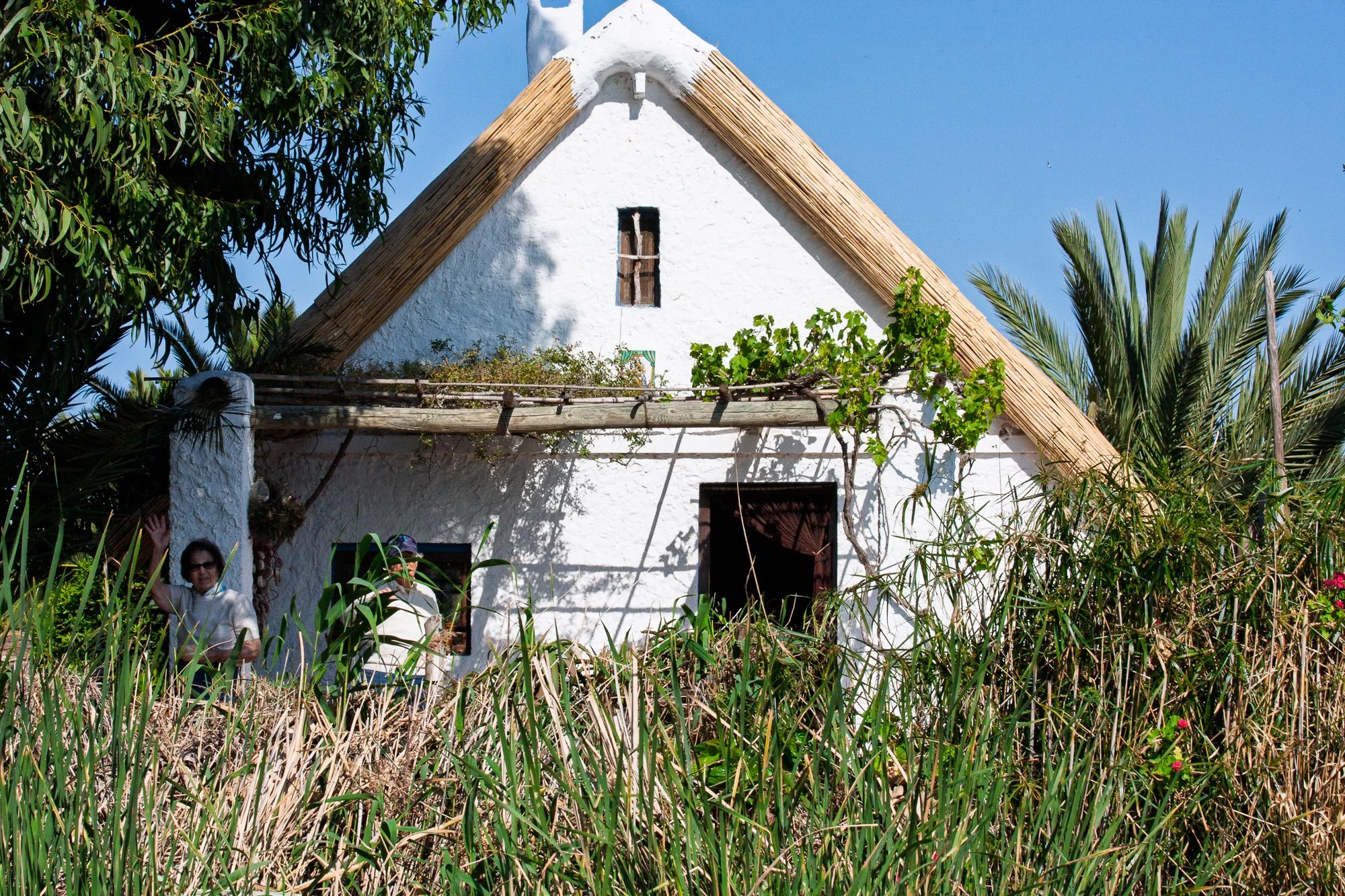
Hello from the shore — Canon EOS 40D
Along the banks we passed the barraques, the whitewashed houses of the lagoon with their steep thatched roofs. This one had a vine trained over a wooden pergola, a palm on one side and a eucalyptus on the other. As our boat went by, a woman in sunglasses raised her hand and waved from behind the tall grass, and the man next to her looked up from what he was doing. I had about two seconds to take it.
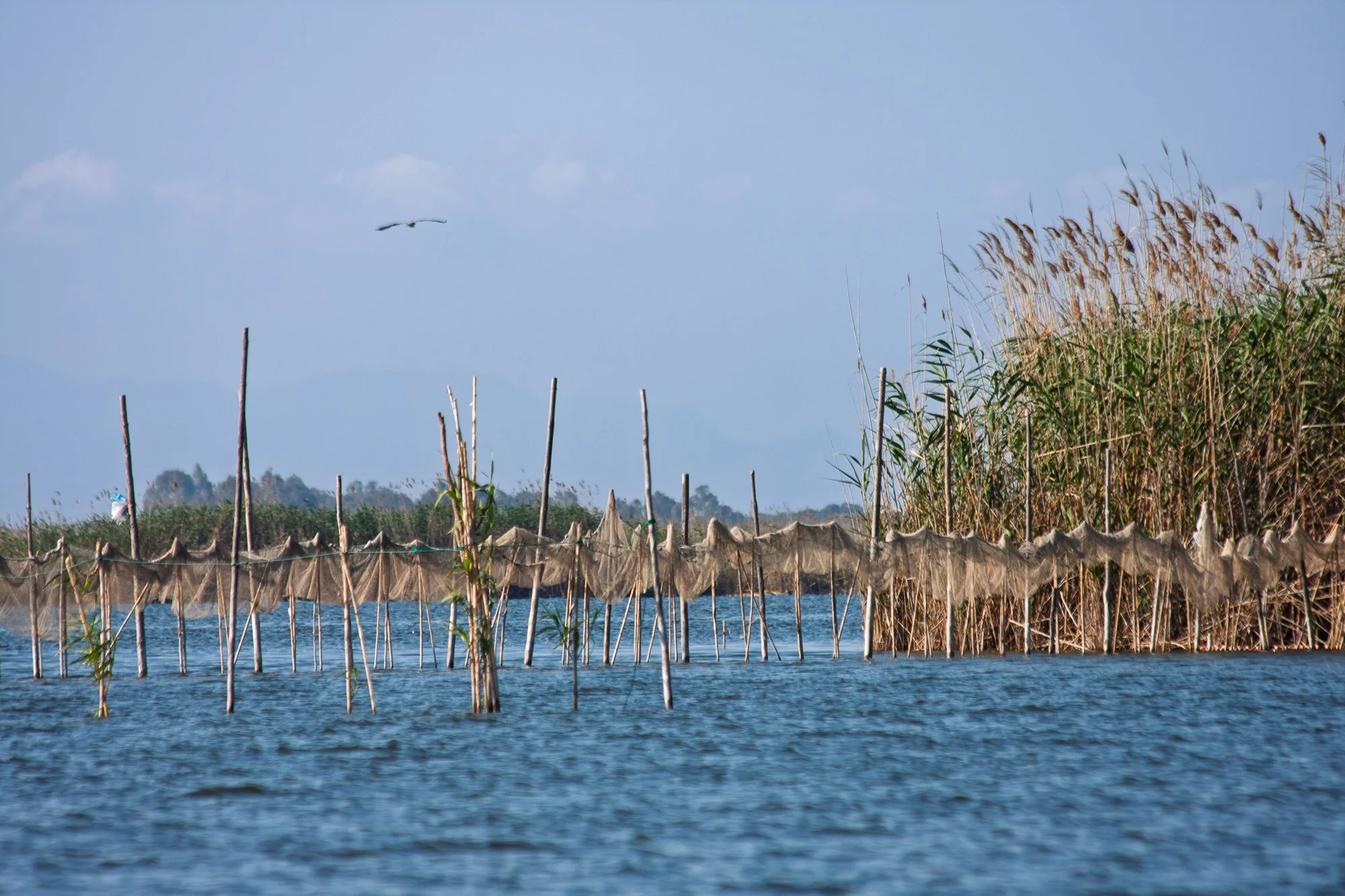
Nets and a heron — Canon EOS 40D
Further out, the lagoon is still a working place. Long lines of nets hang between wooden poles driven into the water, and they lead to the reed beds where the fish gather. The fishing spots, the redolins, are still drawn by lot among the fishermen of El Palmar, a tradition that goes back to the Middle Ages (Mètode). While I framed the nets, a heron crossed the sky above them, small enough that you only notice it the second time you look.
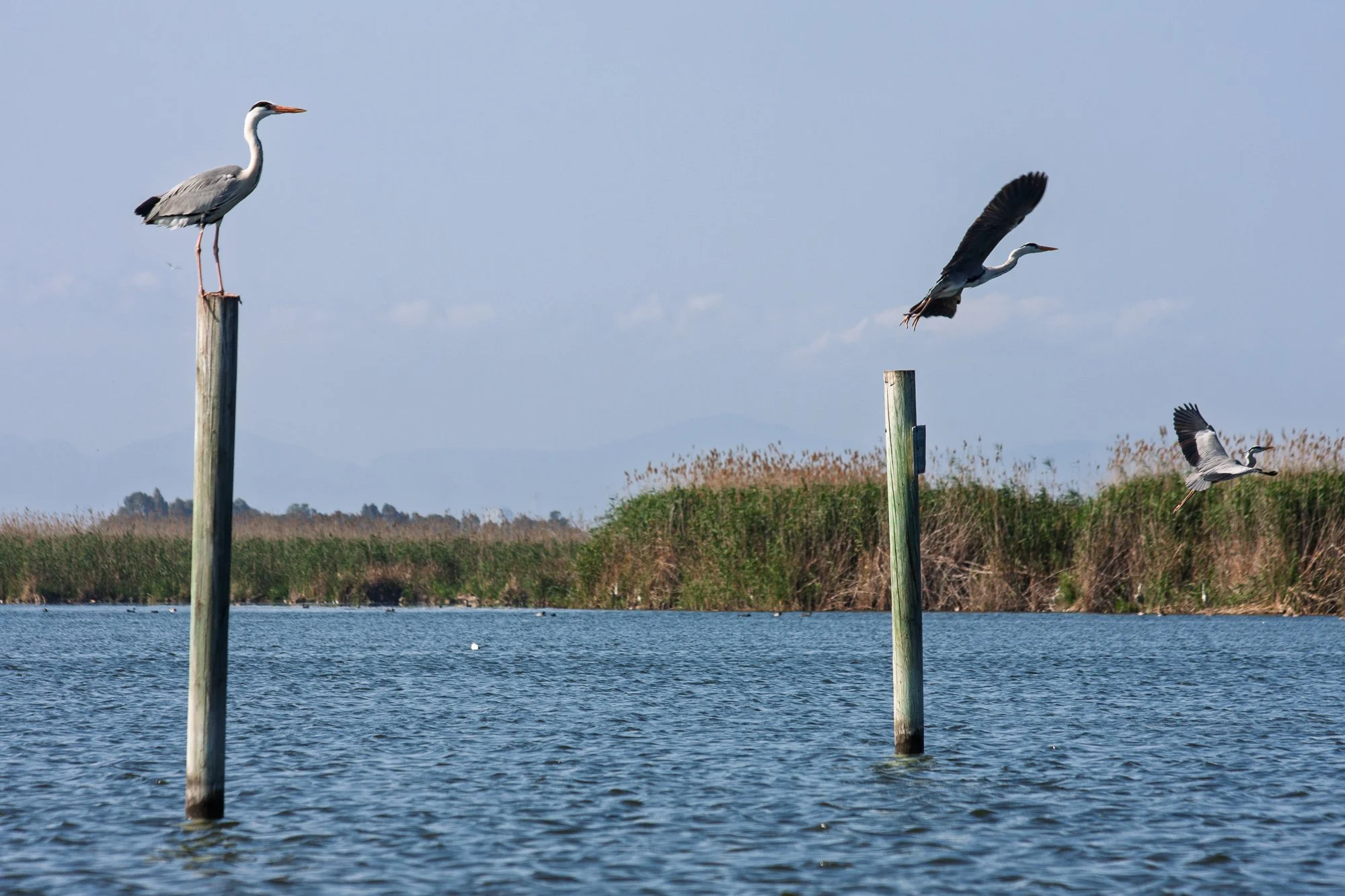
One stays, two go — Canon EOS 40D
The herons were everywhere. Two wooden posts stood in the open water, and as the boat came closer one heron stayed put on the left while the other launched itself from the right-hand post and a third flew off low over the reeds. It is the only frame from the boat that I would call lucky. From a moving boat, with the shutter at 1/100s, most of my heron pictures that afternoon were a grey smudge and a lot of reeds.
Back on the Jetty
Our boat came back first, and from the jetty I got to photograph the second one coming in. The light had started to drop and turn, and everything on the water was now backlit.
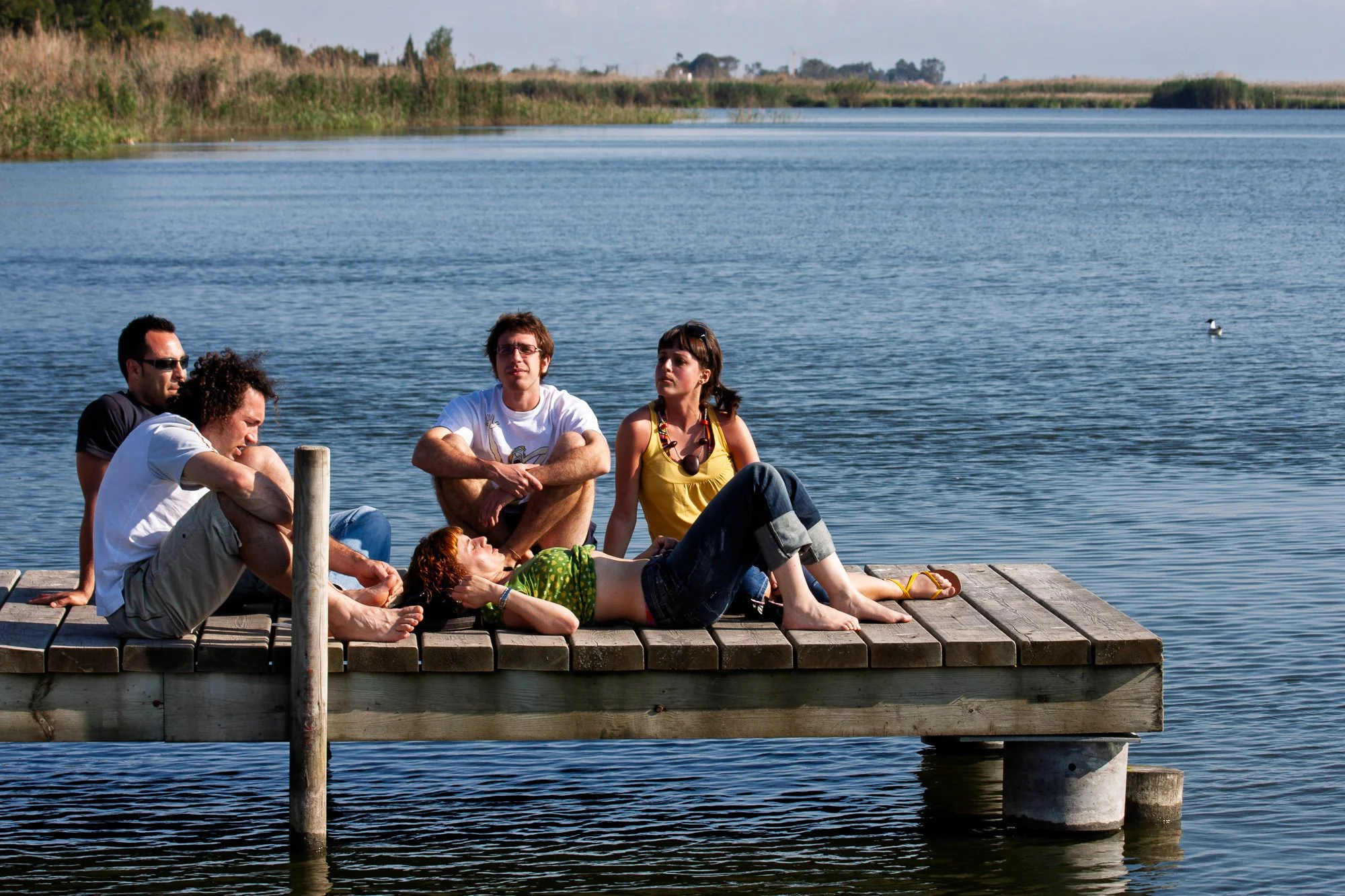
Waiting for nothing in particular — Canon EOS 40D
On a small wooden platform nearby, five young people had settled in for the evening: barefoot, sunglasses pushed up, one of them lying back with her head in a friend's lap. Nobody was taking pictures or going anywhere. A gull floated on the water behind them. In a day organised entirely around photographing, they were the only people who had simply come to sit by the water.
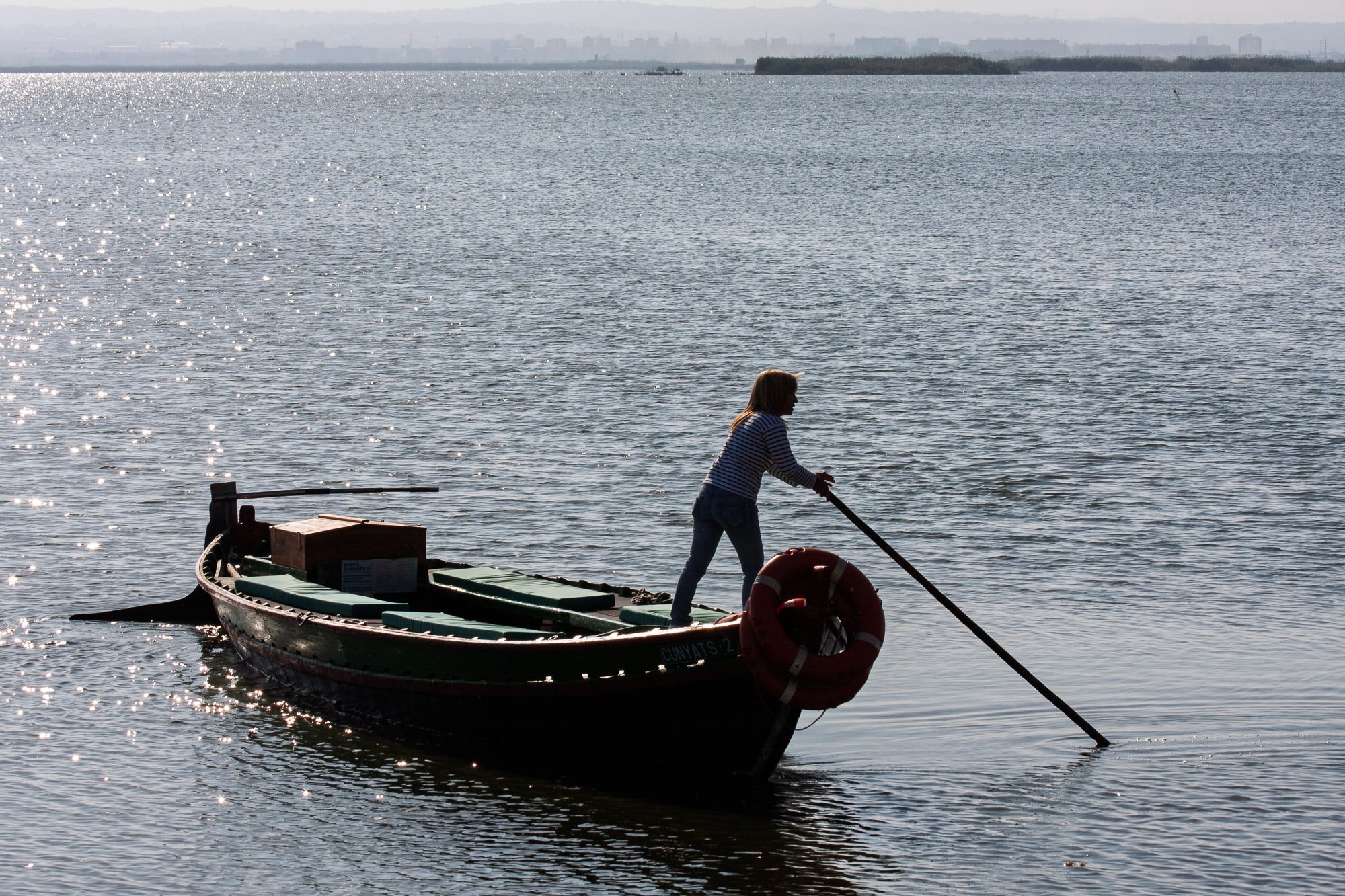
The perxa — Canon EOS 40D
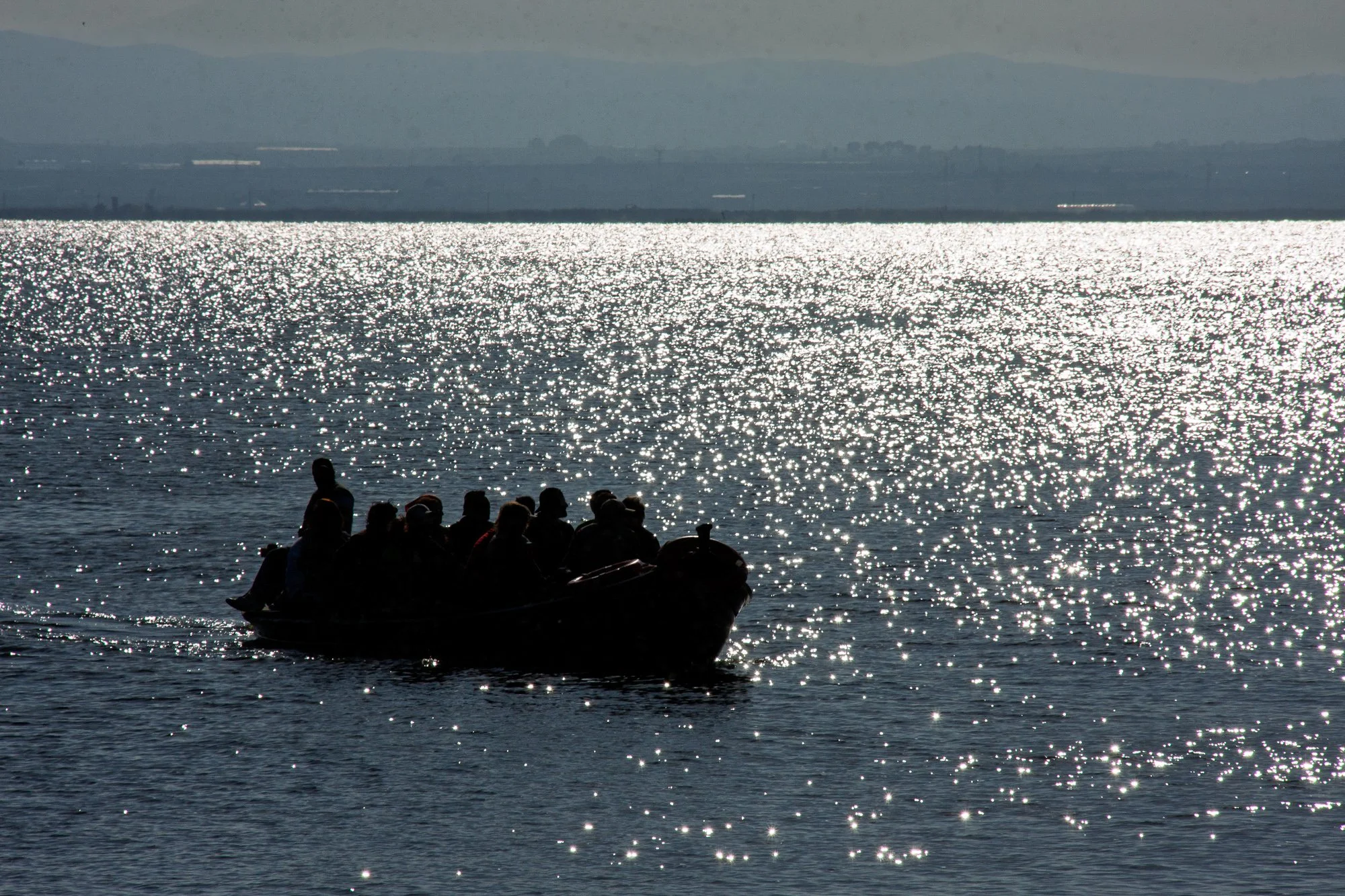
Coming in against the light — Canon EOS 40D
A young woman in a striped top stood at the bow of an empty boat and leaned her whole weight on the perxa, the lifebuoy hanging beside her and the city a grey line behind. Then the second boat appeared out of the glare, so full that the passengers were just one dark shape against water sparkling like foil. I exposed for the highlights and let the boat go black.
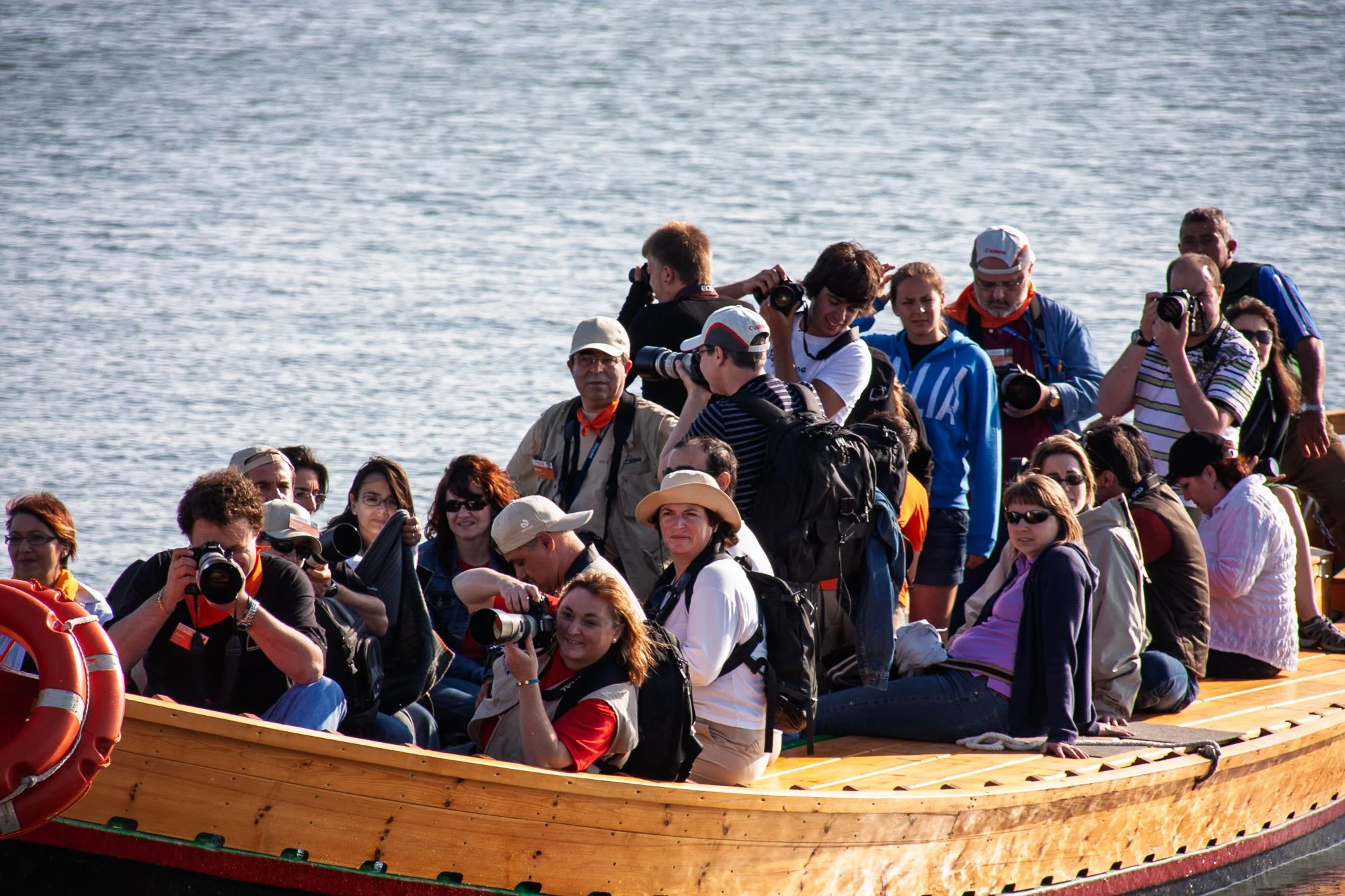
The other half of the group — Canon EOS 40D
When it came closer, the shape turned into faces. Our other half was packed into the boat shoulder to shoulder, orange neckerchiefs, Canon caps, white telephoto lenses, and almost all of them were photographing us on the jetty, while we photographed them. It is my favourite picture of the meet-up, because it shows exactly what we were: a boatload of people who could not stop looking through a viewfinder.
Albufera Sunset Photography from the Jetties
Before the sun went down, part of the group walked to the sea, a short way across the sand bar that separates the lagoon from the Mediterranean.
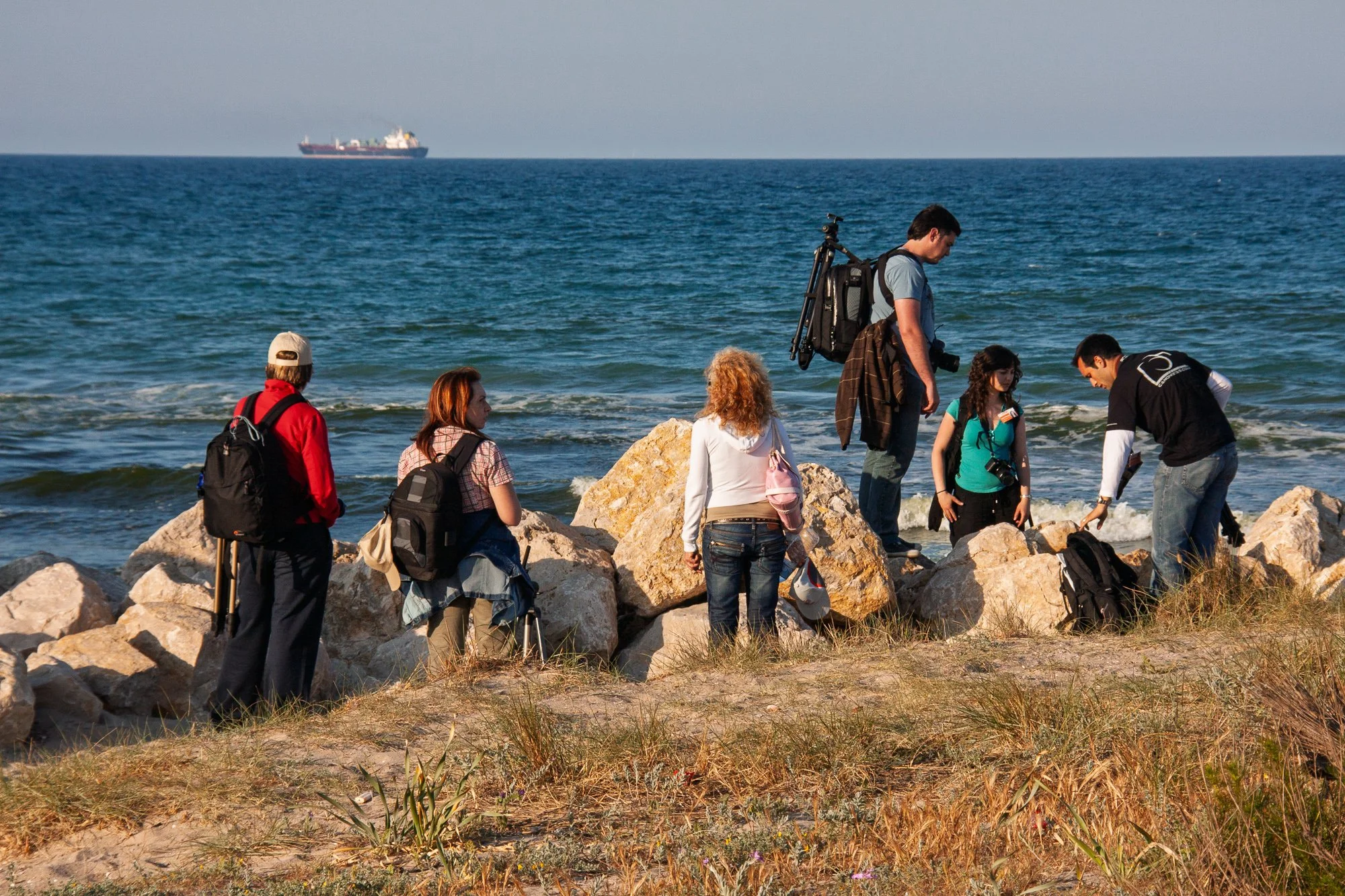
The other side of the sand bar — Canon EOS 40D
On that side everything changes. The water is deep blue and moving, the waves break on big pale rocks, and a tanker sat on the horizon as if painted there. We stood around on the rocks with our backpacks and tripods for a while, talking more than shooting, then walked back to the lagoon for the moment everyone had come for.
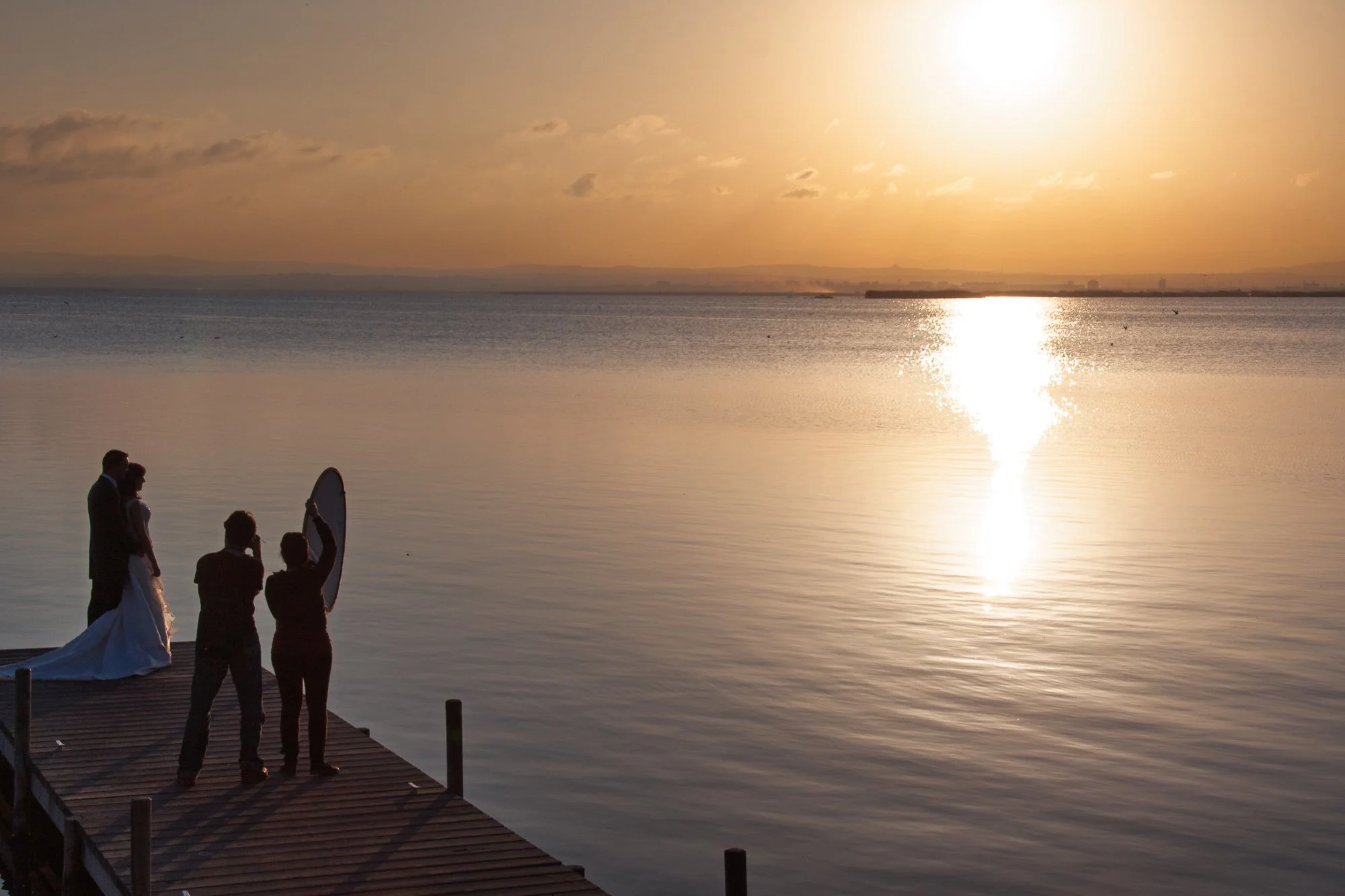
Someone else's photo shoot — Canon EOS 40D
We were not the only ones. At the end of a wooden pier, a bride and groom stood with their backs to the light, her train spread across the boards, while their photographer worked in front of them and an assistant held up a round reflector. Forty amateurs with tripods, and one professional with a wedding to deliver: we all had the same sun, and he was the only one under pressure.
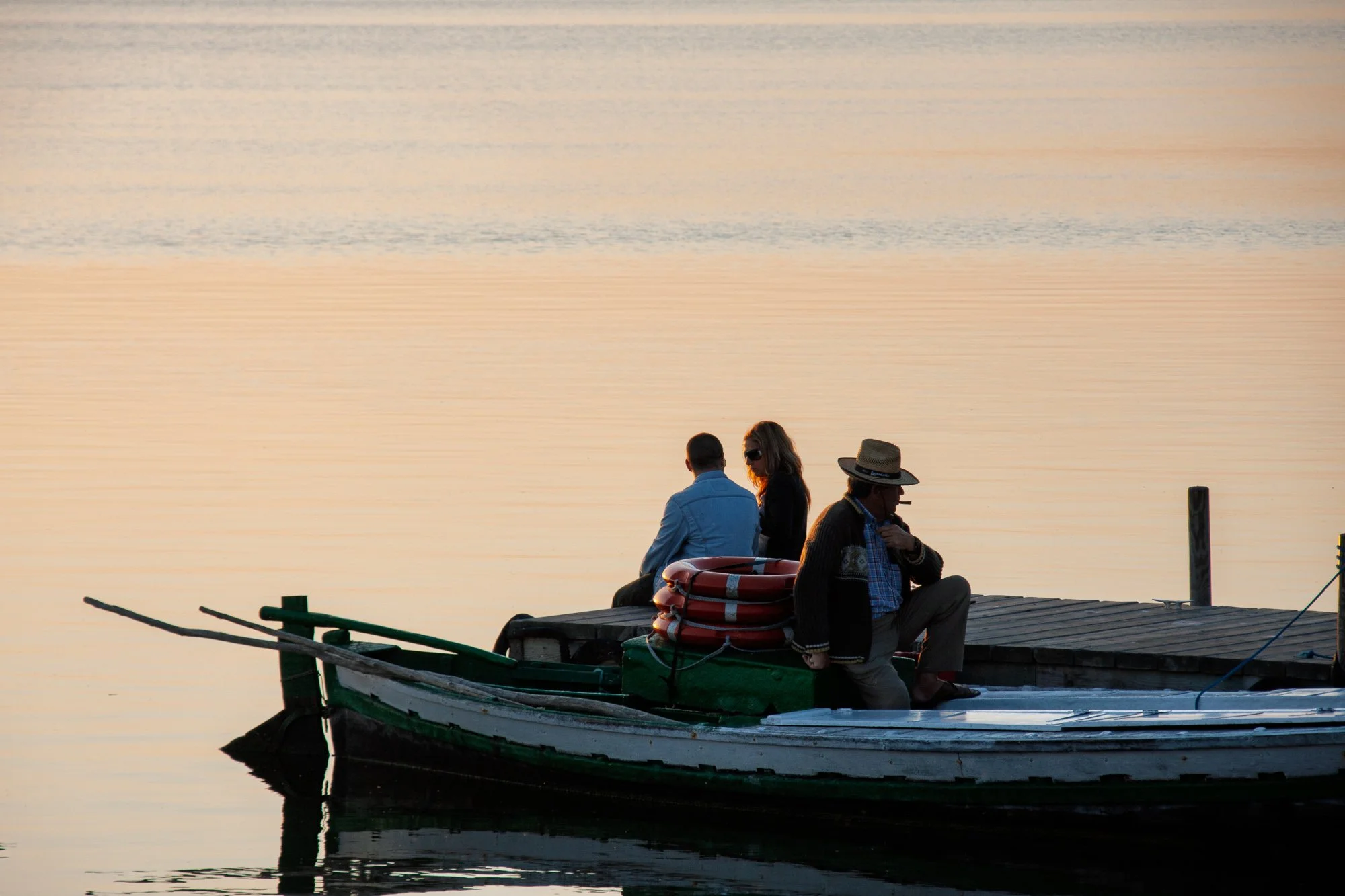
La Paloma — Canon EOS 40D
On the next pier, the boatman of the La Paloma had finished for the day. He sat on the side of his moored boat in a straw hat and a heavy cardigan, a cigar in his mouth, three lifebuoys stacked beside him, while a couple sat on the boards just behind, looking at the water. The light had gone soft and peach-coloured, and the surface of the lagoon was so still that the boat seemed to be resting on glass.
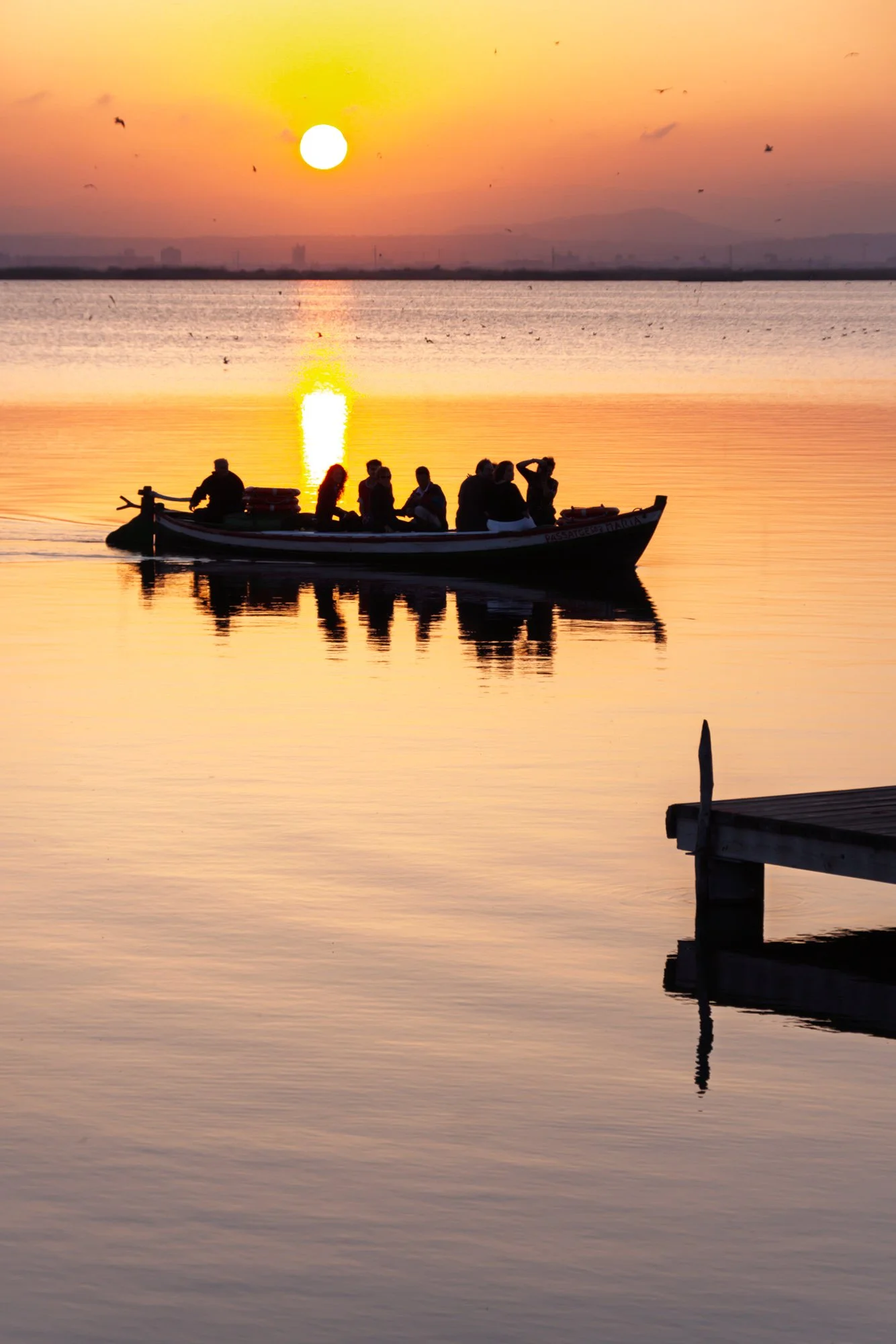
Across the sun path — Canon EOS 40D
The Light at the End of the Day
Then the sun dropped towards the hills behind Valencia and everyone went quiet, or at least as quiet as forty people with camera shutters can be. A boat full of passengers slid across the golden path on the water, with flocks of birds over the reeds and the corner of a pier in the frame. I had the camera on the tripod now, at ISO 100 and f/6 to f/11, and for once there was time to wait for the boat to reach exactly the right place.
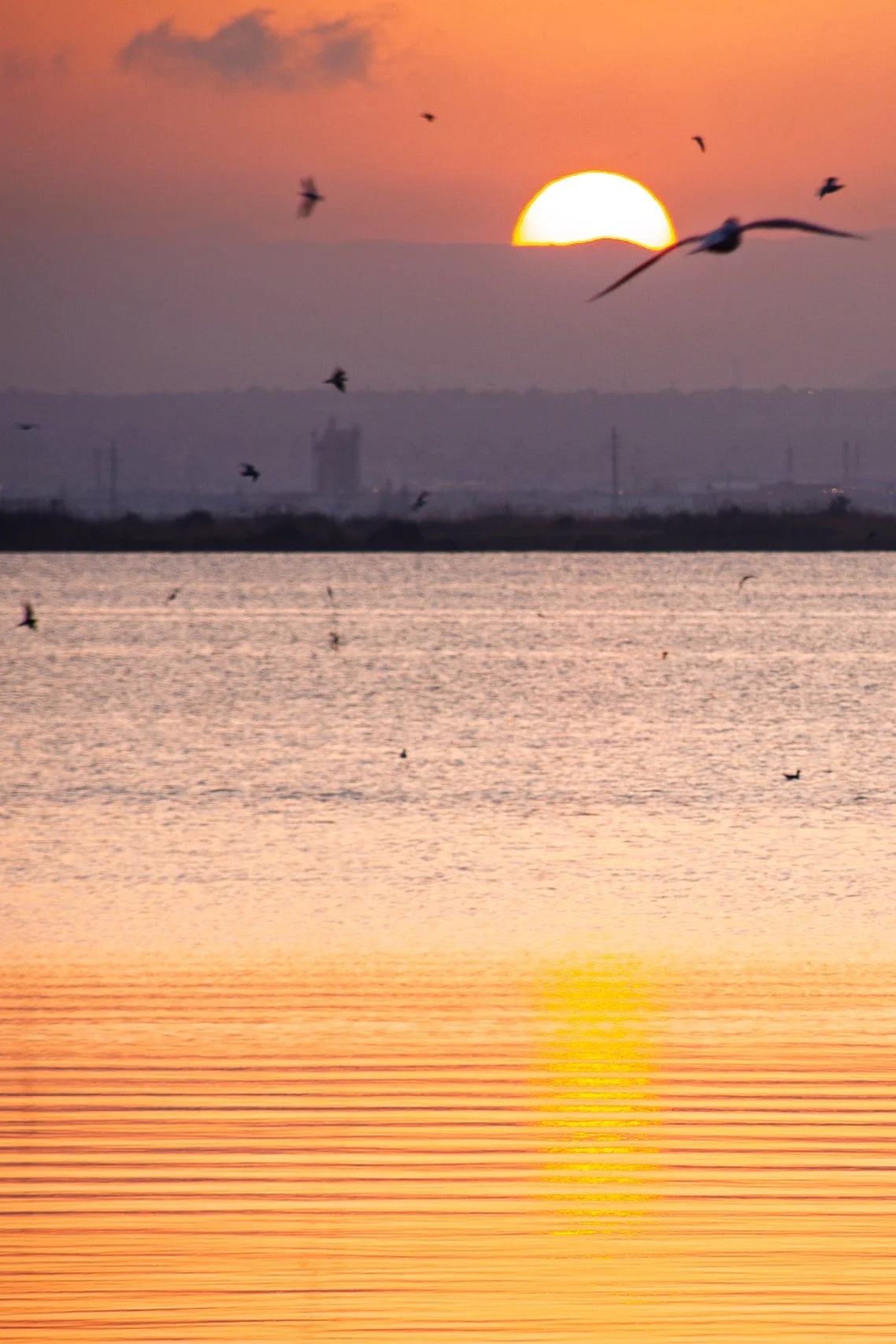
A gull across the sun — Canon EOS 40D
The Arabs called the lagoon al-buhayra, the little sea, and in some of their poems it is the mirror of the sun. In the last minutes it lives up to both. The sun sat half behind the hills, the water below it broke into long orange ripples, and a gull swept straight across it just as I pressed the shutter. It is the frame I would hang on a wall.
Blue hour, still shooting — Canon EOS 40D
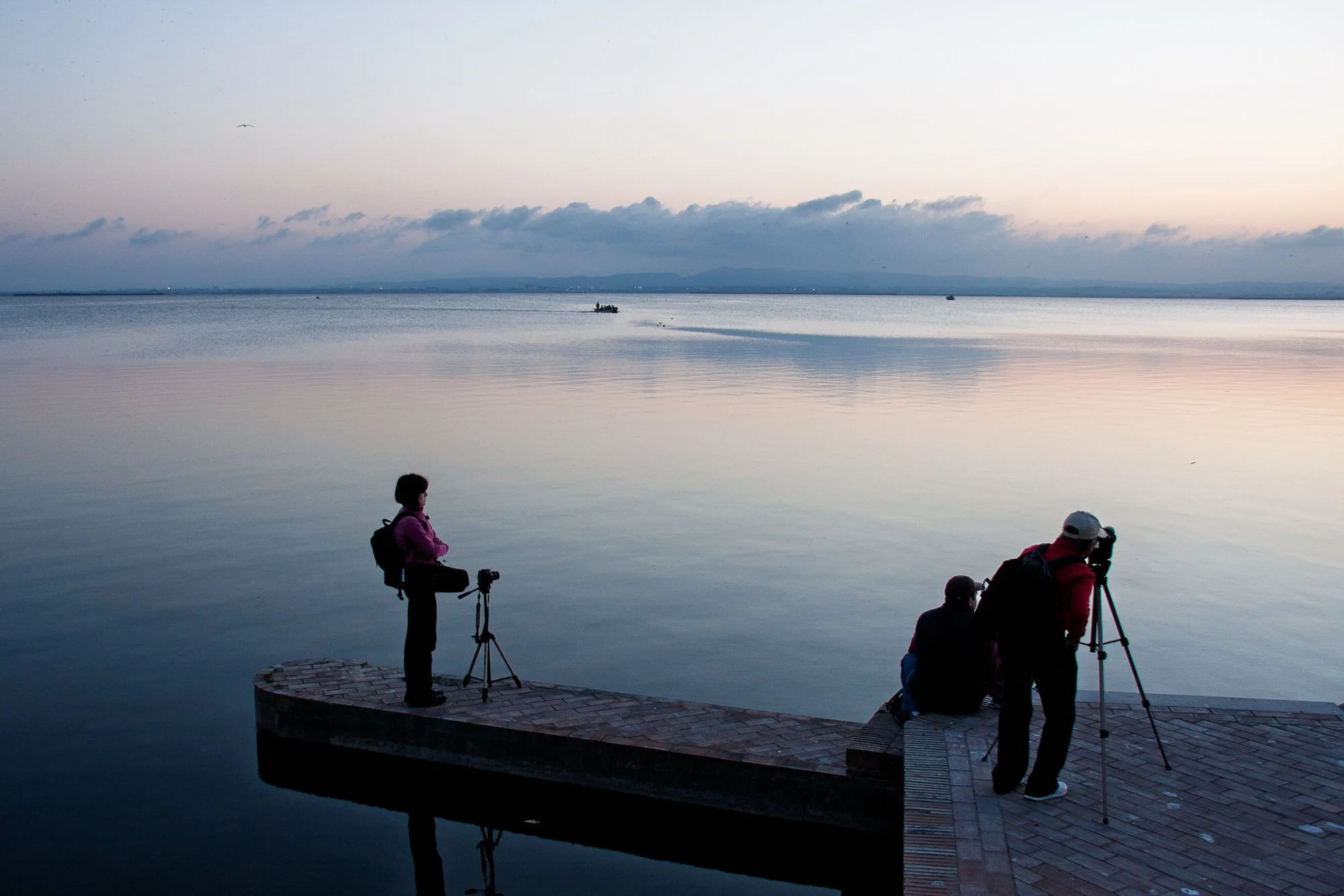
When the sun was gone, nobody left. The colour drained to pink and blue, the clouds settled into a long grey bank over the hills, and on the curved brick jetty a woman in a pink jacket stood beside her tripod, watching, while two men next to her kept shooting. A last boat crossed the lagoon in the distance. We had talked about photography all day and learned a few things from each other, and that, more than any single picture, is what I brought home from Valencia.
For a city where the light does the opposite, see how I photographed the Grand Bazaar of Istanbul with the same Canon EOS 40D, at 1/6s and with no daylight at all. The same weekend, the group also spent a night photographing the City of Arts and Sciences. And for still water in winter light, a long way north, see the Puigcerdà lake in the Cerdanya.
Three months later, with the same camera, I spent two days photographing Jaume Plensa’s Soul of the Ebro at Expo Zaragoza.
If you go, eat in El Palmar, take a boat out in the afternoon, and stay on the jetties until the sun has gone and the blue hour comes. Subscribe to the newsletter for new stories from the street, along with a free street photography guide.
Photos: Canon EOS 40D · ISO 100 · f/6–f/11 · 1/100s · 24–140mm · Albufera, Valencia, May 2008
See more travel photography in the portfolio. Every photograph in this post is also available as a fine art print.
Cosme Lapena is a Barcelona-based street and urban photographer and founder of bCLPhoto.
Exhibited at espai [b] since 2010 and PH21 Gallery · Published in The Eye of Photography and 35mmc.