Yerebatan Caddesi — Street Photography in Istanbul
ORIGINALLY PUBLISHED AUG 2023 — UPDATED MAY 2026
Istanbul — Into the Basilica Cistern
There are cities that overwhelm you from the moment you arrive, and Istanbul is one of them. July 27th, midday heat, the streets around Yerebatan Caddesi packed with people moving in every direction — tourists, locals, vendors, everyone with somewhere to be. The noise, the colour, the smell of food from the street stalls. The particular chaos of a city that has been layered over itself for three thousand years and shows no sign of stopping.
And then you descend the stairs into the Basilica Cistern, and everything changes.

Basilica Cistern interior with marble columns and atmospheric lighting, Istanbul – bCLPhoto
Underground
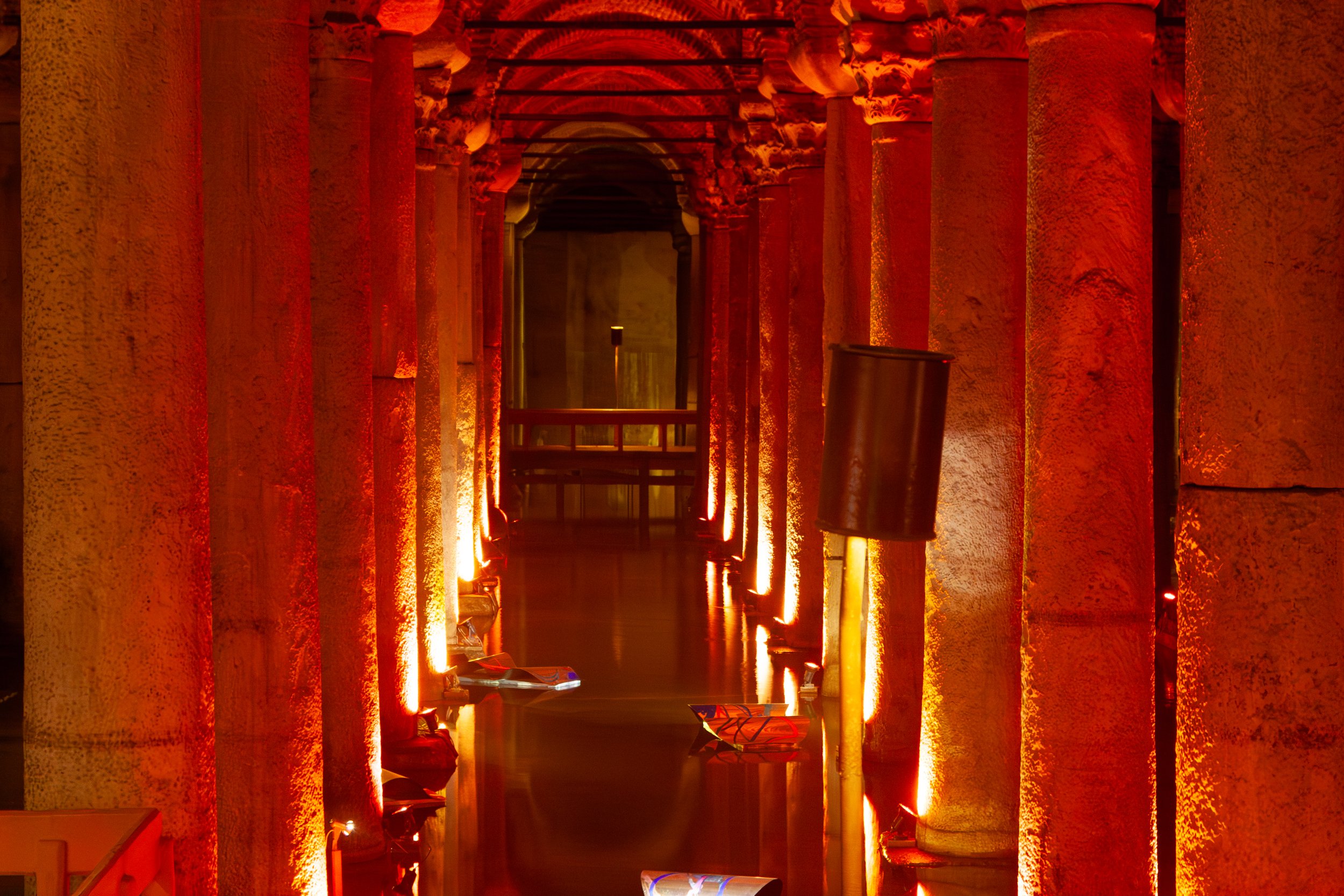
The cistern was built in the 6th century under Emperor Justinian I to supply water to the Great Palace of Constantinople. It is vast — 140 metres long, 70 metres wide, supported by 336 marble columns rising from shallow water, their reflections stretching downward into the dark. The air is cool and damp. The sound is different down here — the city above you disappears completely, replaced by the quiet lap of water and the low murmur of visitors moving through the dimness.
The light is deliberate and theatrical: specific columns illuminated from below, their capitals picked out in amber and gold against the surrounding dark. The reflections in the water are almost more vivid than the columns themselves — perfect mirror images that make the space feel twice as deep, twice as tall. I stood there trying to find the words for it and gave up. You have to see it. Describing it is beside the point.

Illuminated columns and vaulted brick ceiling of the Basilica Cistern, Istanbul – bCLPhoto
Photographing in the Dark
The cistern is one of the most photographically challenging spaces I've encountered. The light is extraordinary but scarce — pools of warmth surrounded by near-total darkness, with no possibility of adding your own light without destroying the atmosphere entirely. I left the flash in the bag.
I shot handheld throughout, leaning against whatever I could find — a railing, a wall, my own steadied breath. ISO 1250, 24mm, f/4, exposures between 0.8 and 2 seconds. At 2 seconds handheld you are pushing your luck, but sometimes luck holds. The key is to find something to brace against, exhale slowly, and press the shutter at the moment of stillness between breaths. Some frames were lost to camera shake. Others were not.
What the long exposures gave me was the reflections — the columns doubled in the dark water, the light bleeding slightly at the edges, a softness that no sharp frame could have captured. Sometimes the technical limitation becomes the aesthetic. The cistern photographs itself, in a way. Your job is mostly not to get in the way.
Street photography in Yerebatan Caddesi, Istanbul – bCLPhoto
The Street Above
Yerebatan Caddesi — the street that runs above the cistern — is everything the space below is not: loud, bright, crowded, relentless. Street vendors, tourist shops, the constant movement of a city that doesn't slow down in July regardless of the temperature. I walked it before and after the cistern visit, camera out, looking for the moments that the crowd produces without realising — a gesture, a glance, a figure moving through the light at the right angle.
The contrast between the two worlds — the frantic street above and the silent, ancient dark below — is one of those things that makes Istanbul unlike any other city I've visited. In the space of a single staircase, you move between centuries.
Practical information
The Basilica Cistern (Yerebatan Sarnıcı) is located at Yerebatan Caddesi 1/3, Sultanahmet, Istanbul. Open daily. Entry fee applies. Arrive early or late in the day to avoid the largest crowds — the space is more atmospheric with fewer people, and the photography is easier. A tripod is technically permitted but impractical in busy periods; a monopod or a steady hand against a column is the realistic alternative.
If Istanbul caught your eye, you might enjoy Snapshots of Lisbon — street photography in another city where ancient layers show through the surface — or Paris Photography, an earlier walk through Europe's most photographed capital.
See more street photography in the portfolio.
Cosme Lapena is a Barcelona-based street and urban photographer and founder of bCLPhoto. Browse the portfolio or read more on the blog