The Girl of Peace: A Sculpture That Was Censored for Being Too True
The Girl of Peace stopped me before I could read a single word on the label. At the Museum of Forbidden Art in Barcelona, among works that had been banned, seized, and threatened by governments across the world, this quiet ceramic figure held a particular kind of stillness — the kind that demands attention without asking for it.
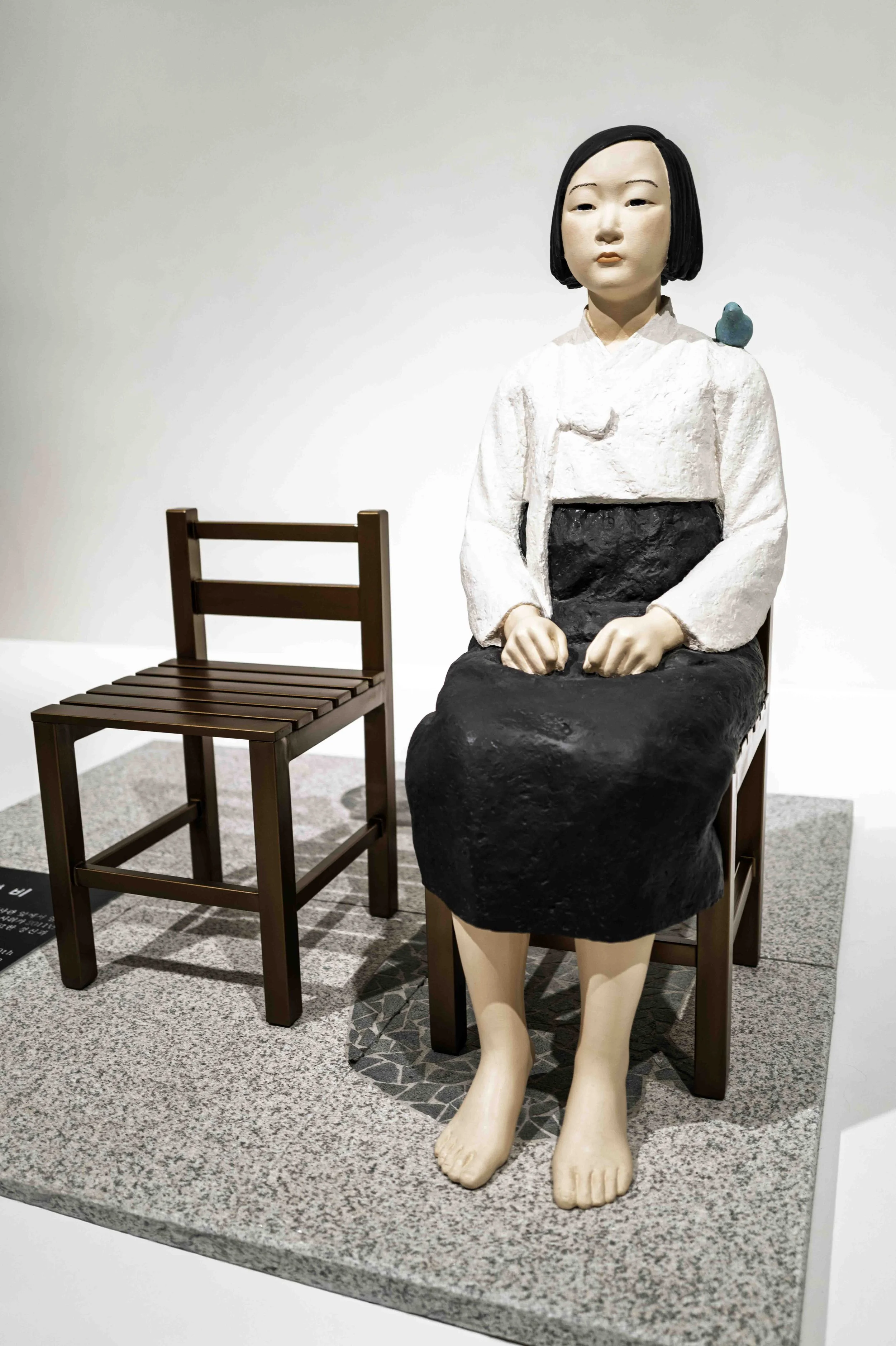
Girl of Peace — Leica Q3
A Museum Built Around Silence and Censorship
The Museu de l'Art Prohibit — the Museum of Forbidden Art — opened in Barcelona in 2022 with a simple but radical premise: to collect and exhibit works of art that had been censored, suppressed, or banned somewhere in the world. The collection spans painting, sculpture, photography and installation, and the range of reasons behind each prohibition is as varied as the works themselves: political inconvenience, religious offence, nationalist pressure, or simply the discomfort of being told an inconvenient truth.
Walking through its rooms is a strange experience. Each piece carries an extra layer of meaning — not just what it depicts, but the fact that someone, somewhere, decided it should not be seen. That context changes how you look at everything. You find yourself wondering not only what you feel, but what others feared.
The Sculpture and Its Makers
The Girl of Peace was created by Korean sculptor couple Kim Eun-sung and Kim Seo-kyung, and first unveiled in 2011 in front of the Japanese Embassy in Seoul. It was made to commemorate the women and girls who were forced into sexual slavery by the Imperial Japanese military during the 1930s and through the Second World War — victims commonly referred to as "comfort women," a term many survivors and scholars consider a euphemism that softens a systematic atrocity.
The figure is a young girl, seated, barefoot, with short black hair and her hands resting — almost clenched — on her lap. Beside her sits an empty chair. A small blue bird rests on her shoulder. Every element is deliberate: the bare feet suggest displacement and vulnerability; the clenched hands carry both trauma and resistance; the bird connects the living to the dead. The empty chair is perhaps the most affecting detail — an open invitation to sit beside her, to occupy the space of those who never received recognition, whose stories were suppressed for decades.
What struck me most, looking through the viewfinder of my Leica Q3, was the face. It is young, composed, and completely without sentimentality. It does not plead. It simply looks — forward, outward, with a steadiness that feels earned rather than given.
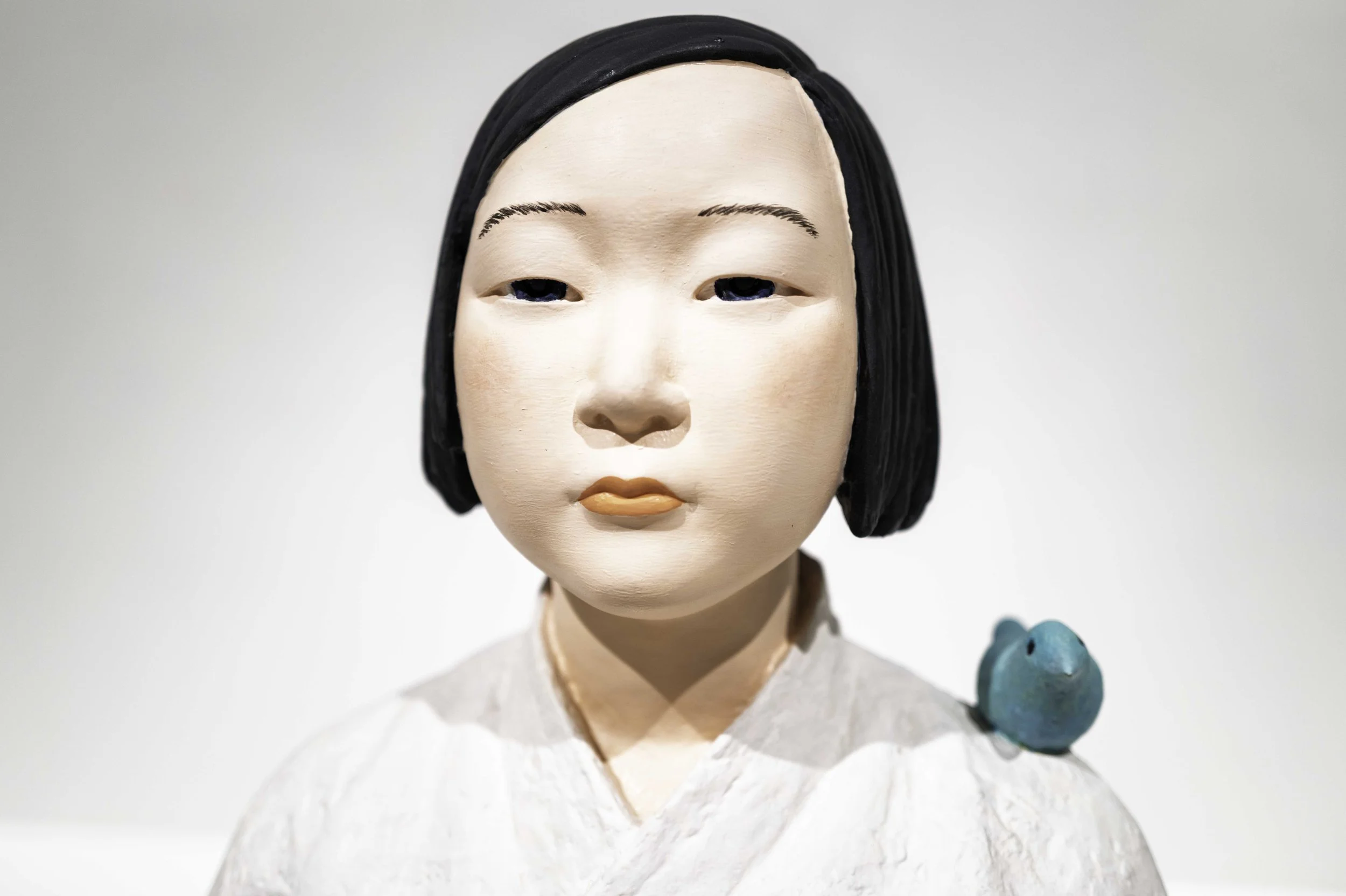
The face that does not plead — Leica Q3
A Work That Proved Too Uncomfortable to Show
The Girl of Peace has a history that mirrors the subject it commemorates: a history of being silenced.
In 2019, a replica of the sculpture was included in the Aichi Triennale in Japan, as part of an exhibition focused specifically on censored artworks. After threats and political pressure, the organisers temporarily closed the section of the exhibition containing the statue. The reaction from artists, curators, and free-expression advocates across the world was immediate — and the exhibition eventually reopened. The incident became one of the most discussed cases of artistic censorship in recent memory, a striking irony: a work about suppressed history, suppressed again.
The sculpture has spread far beyond South Korea. Replicas now stand in the United States, Germany, Australia, Canada and elsewhere, and almost every new installation has generated some form of diplomatic pressure from Japan and counter-campaigns from Korean civic groups. For the Japanese government, the statues placed near embassies and consulates are a violation of diplomatic norms. For survivors and the activists who support them, removing the statues would mean erasing the last public acknowledgment that these women existed.
The artists themselves have been consistent: they describe the work not as anti-Japanese propaganda, but as a symbol of peace and a protest against all forms of violence and historical denial. The fact that a sculpture of a seated girl with a bird on her shoulder has generated sustained international controversy for over a decade says something — not about the work, but about how uncomfortable certain truths remain.
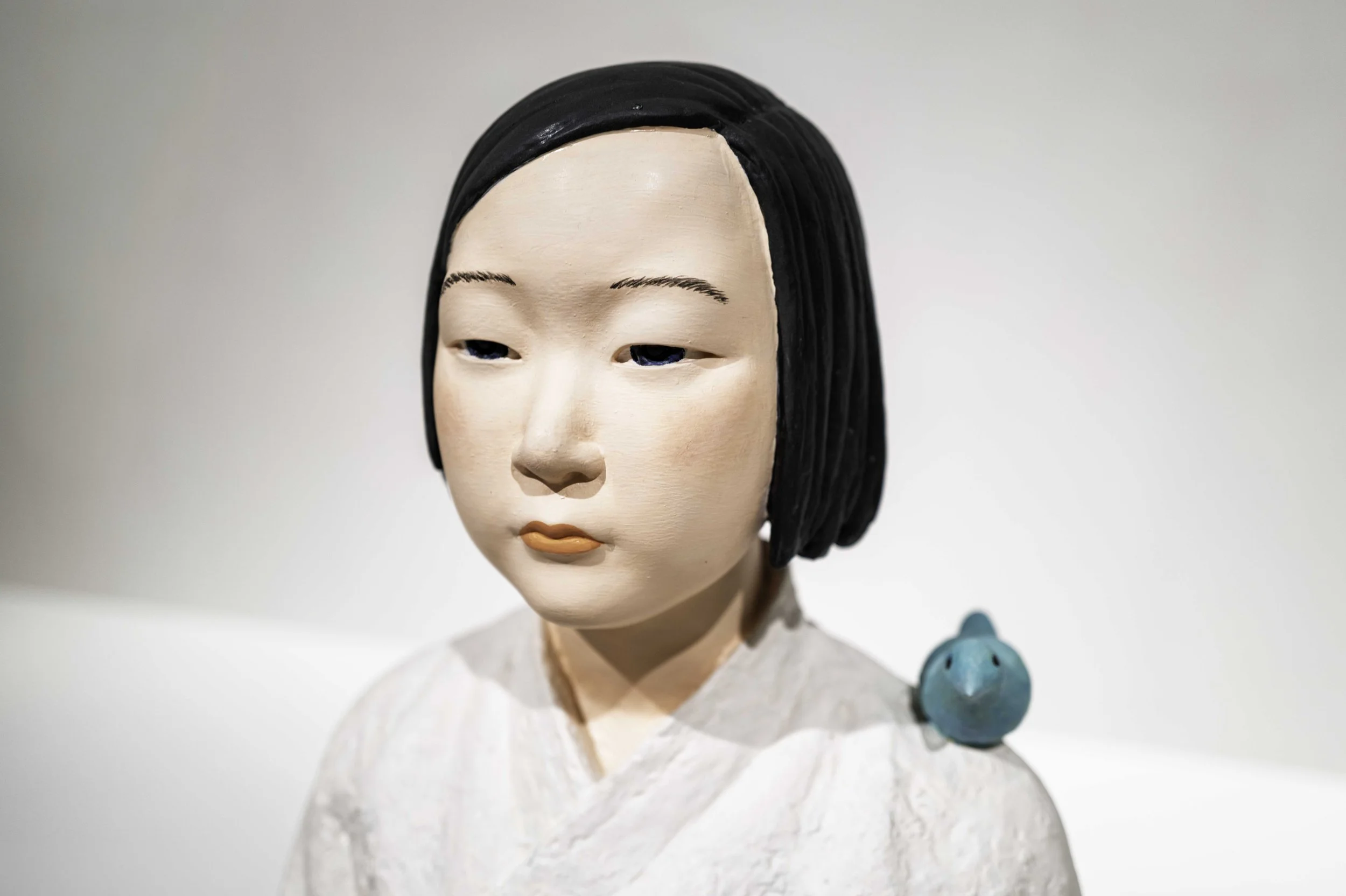
Stillness earned, not given — Leica Q3
Photographing the Unspeakable
I came to the Museum of Forbidden Art with my Leica Q3 looking for strong images, not a history lesson. What I found was both.
The challenge of photographing a work like the Girl of Peace is that it resists the kind of photography that performs emotion. She is not dramatic. She does not gesture. The power is entirely in her stillness and in the accumulated weight of what she represents. I worked close — first the full figure with the empty chair, then the face from different angles, then the hands. The hands, I think, are the most photographic element: rendered in a pale, almost flesh-like tone against the heavy black of her skirt, half-open, half-closed, caught between surrender and defiance.
The museum's light — controlled, diffuse, white — worked in the sculpture's favour. There were no shadows to dramatise, no golden hour to soften the edges. Just the figure, the chair, and the space between them.
If you find yourself in Barcelona, the Museu de l'Art Prohibit is one of the most thought-provoking exhibition spaces in the city — and the Girl of Peace is reason enough to go.
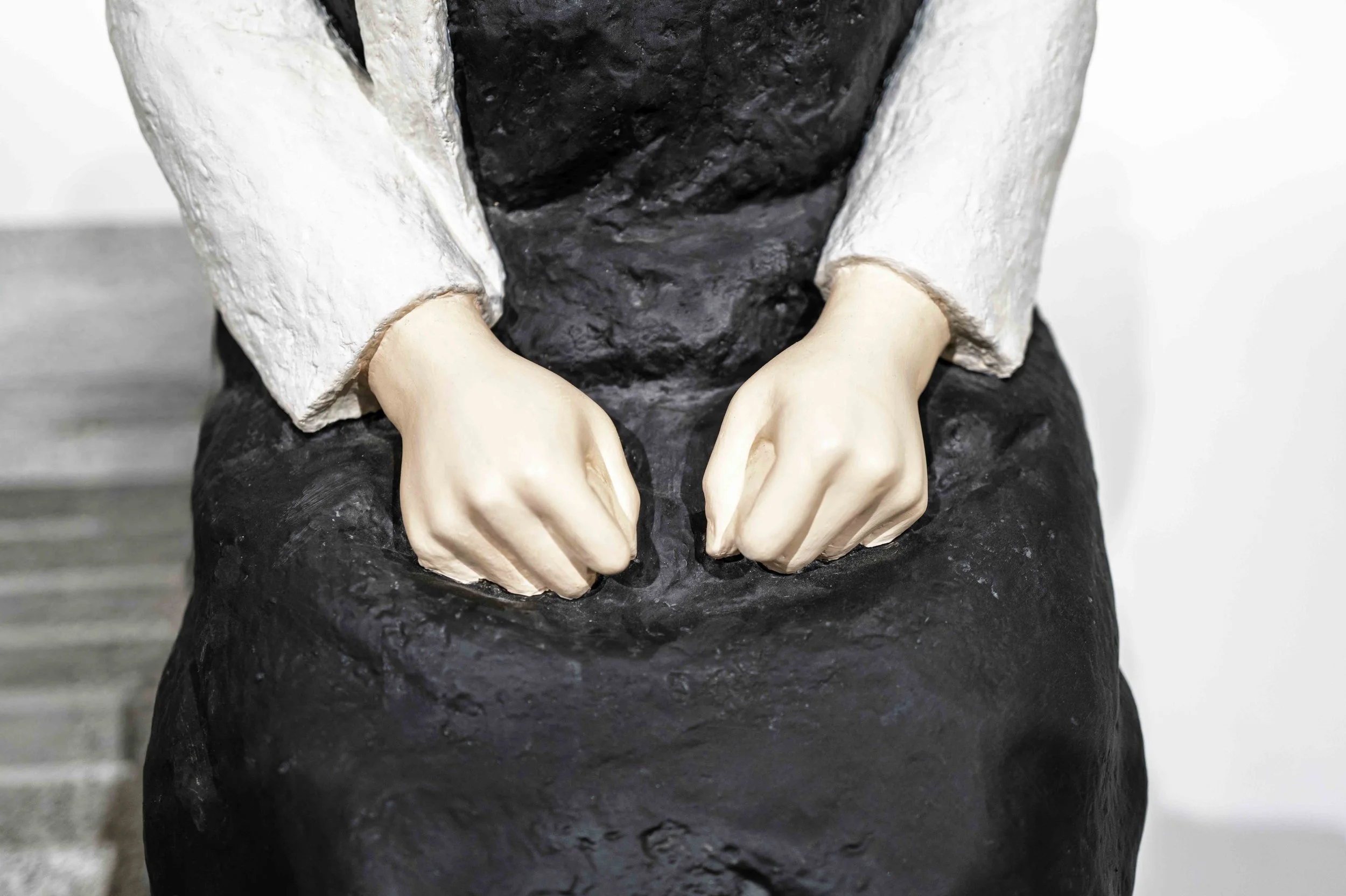
Between surrender and defiance — Leica Q3
Photos: Leica Q3 · ISO 250 · 28mm · f/2.8–5.6 · 1/250s
Museu de l'Art Prohibit Passeig de Gràcia 7, 08007 Barcelona
Metro: Passeig de Gràcia (L2, L3, L4)
Barcelona's public art is rarely neutral. For more encounters with sculpture that provokes, see Louise Nevelson — Big Black (1963) at MoMA in New York, or The Soul of the Ebro by Jaume Plensa — a Catalan artist whose work invites you inside, literally. For street photography from Barcelona, Barcelona Street Photography: Glimpses of a City in Full Summer captures the city in a very different mood.
See more street photography in the portfolio.
Cosme Lapena is a Barcelona-based street and urban photographer and founder of bCLPhoto.
Exhibited at espai [b] since 2010 · Published in The Eye of Photography and 35mmc. Browse the portfolio or read more on the blog.