Barcelona Street Photography: Glimpses of a City in Full Summer
There is a version of Barcelona that never appears on postcards. Barcelona street photography is, at its best, the art of finding that version — the one that exists between monuments, inside narrow alleys, at the edge of a crowded terrace on a Tuesday afternoon in July. This is the city we set out to document over one summer and early autumn: unhurried, imperfect, and entirely itself.
We shoot with a Leica Q3 and a fixed 28mm lens — a combination that forces proximity, patience, and a certain willingness to be wrong. Summer in Barcelona is loud and bright and relentless. The light arrives early and stays too long, bleaching the limestone facades of the Gothic Quarter to near-white by midday. By late afternoon it turns amber and raking, cutting hard shadows across cobblestones and faces alike. There is no soft golden hour here — just a slow descent from white to gold to dark, and you work with whatever the city gives you.
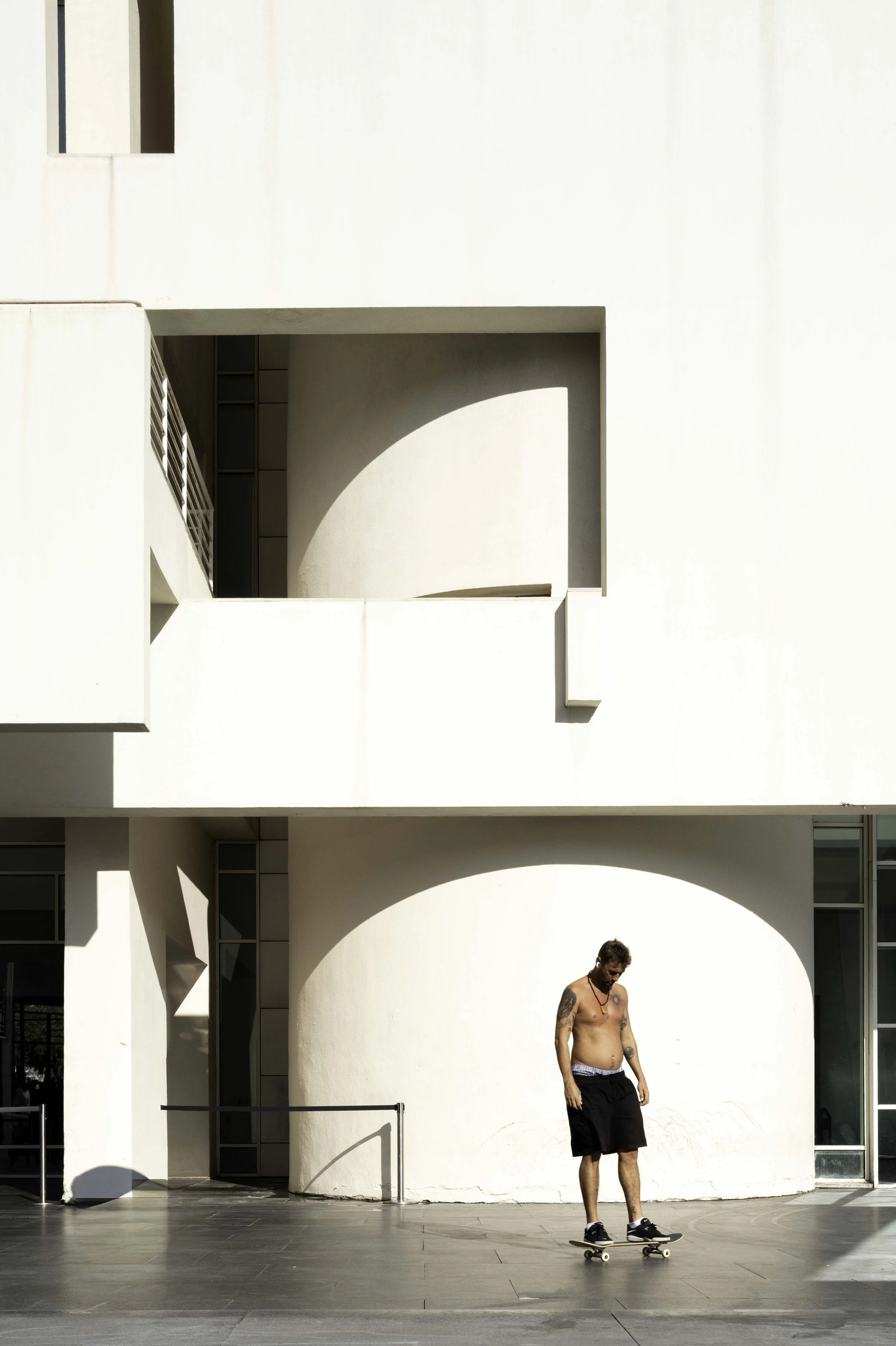
MACBA, midsummer — Leica Q3
The Old City: Barcelona Street Photography in the Gothic Quarter
The Barri Gòtic is the most photographed neighbourhood in Barcelona, and also one of the most difficult to photograph honestly. Every corner has been seen, every alley mapped by a thousand tourists with smartphones. The challenge is not finding a good composition — they are everywhere — but waiting for the moment when the composition becomes something more than architecture.
We found it at the Palau del Lloctinent, where the interior courtyard was hung with dozens of glowing lantern sculptures shaped like jellyfish and seeds. It was early morning, before the crowds arrived, and a single maintenance worker was sweeping the flagstones beneath the amber light. The medieval stone walls, the organic shapes suspended in mid-air, the solitary figure with a broom — it is the kind of scene that exists for about forty minutes each day, then vanishes entirely.
Elsewhere in the Gothic Quarter, the streets do the composing for you. At the Pont del Bisbe — the ornate neo-Gothic bridge that crosses Carrer del Bisbe — we simply waited. The bridge frames whoever passes beneath it so perfectly that the camera becomes almost incidental. At street level, the narrow alleys of the Barri Gòtic funnel pedestrians into long corridors of light and shade, where summer dresses and linen shirts float past walls of ancient stone.
For a black-and-white take on these same medieval lanes, see our three-part series on black and white photography in Barcelona, including a dedicated look at the Gothic Quarter after dark.
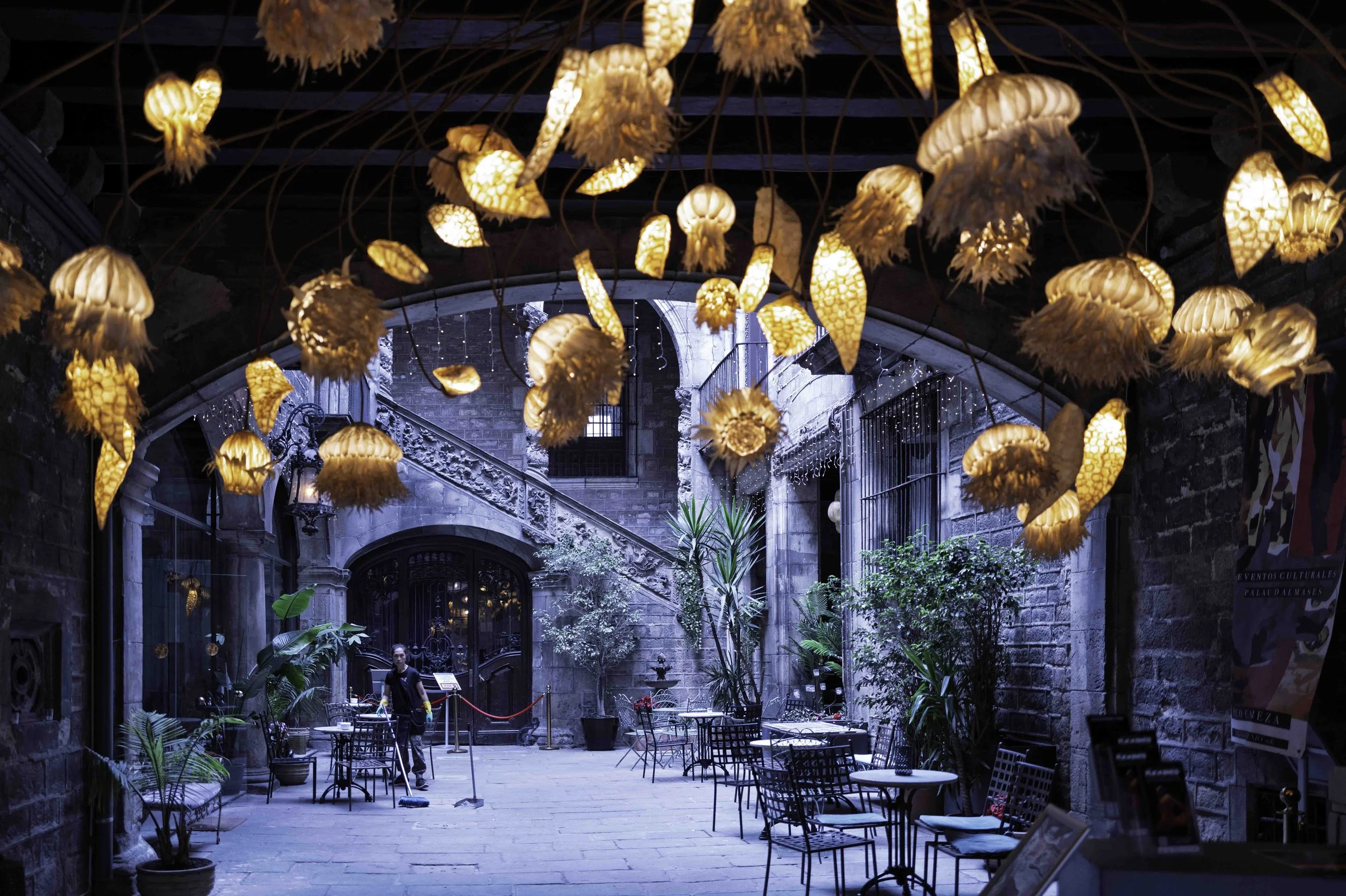
Palau del Lloctinent, before the crowds — Leica Q3
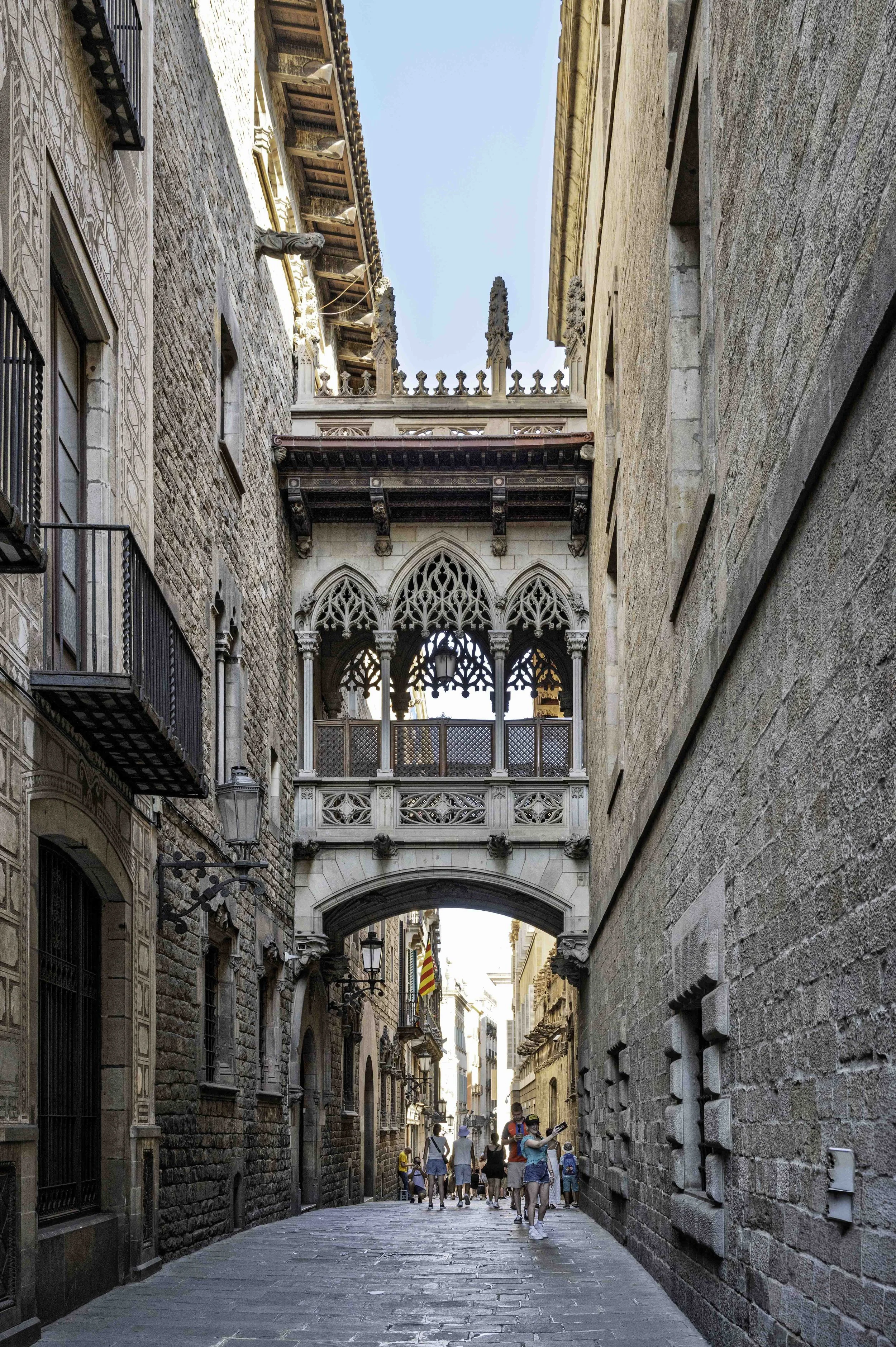
Pont del Bisbe, Barri Gòtic — Leica Q3
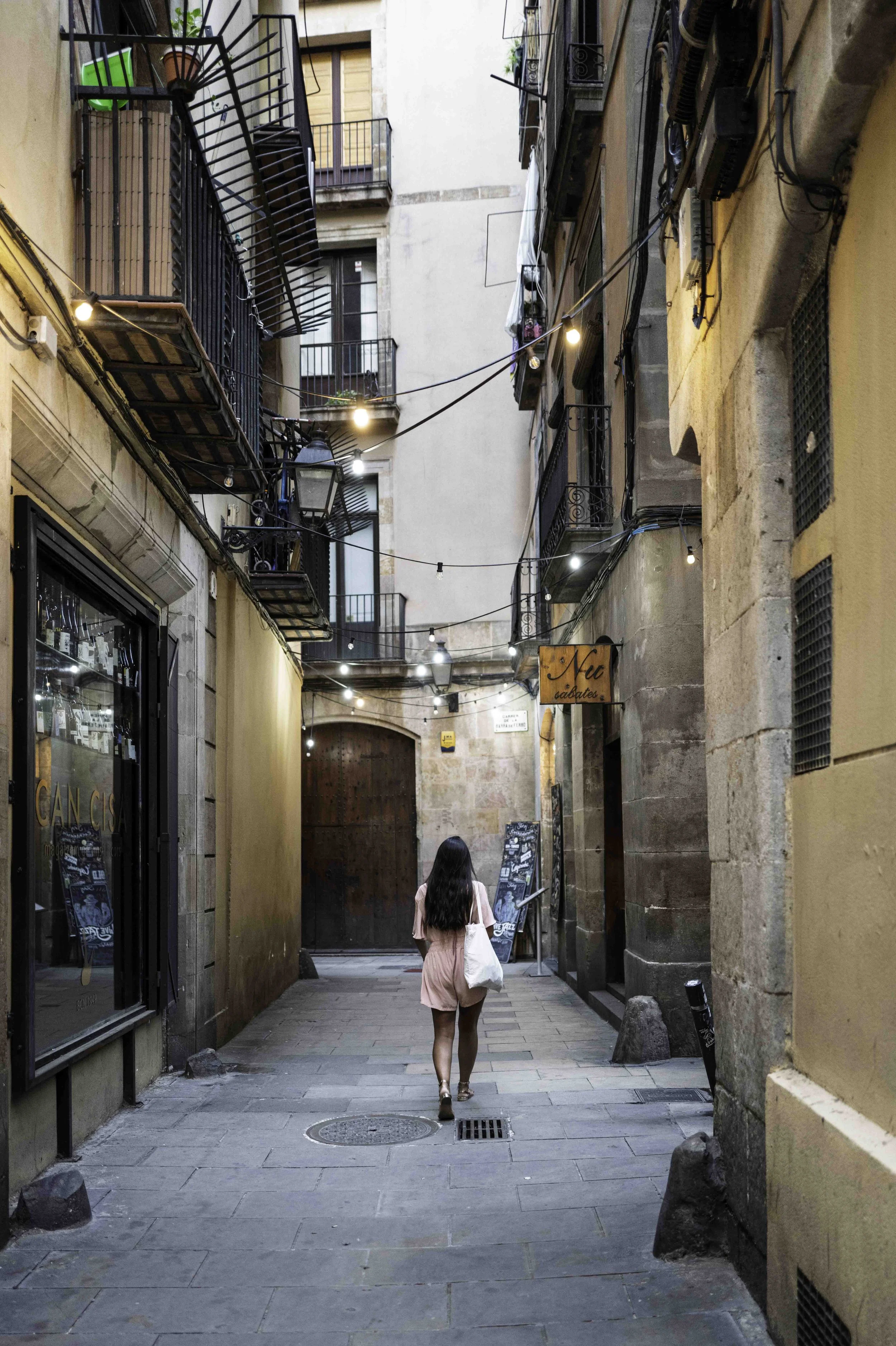
Barri Gòtic after dark — Leica Q3
Plaça Catalunya and the Energy of the City Centre
If the Gothic Quarter belongs to history, Plaça Catalunya belongs to everyone at once. It is the loudest, most chaotic square in Barcelona — and one of the most fertile for street photography. The pigeons alone are a subject unto themselves.
On one visit we watched a small child in a red tracksuit sprint through a flock of several hundred birds, scattering them in every direction. A few minutes later, a woman in a green polka-dot dress stood perfectly still in the centre of the square, arms outstretched, with birds landing on both hands. Two scenes, the same square, barely five minutes apart. This is what makes Barcelona so generous to the street photographer: the city is perpetually staging itself, and all you have to do is pay attention.
From Plaça Catalunya, the Passeig de Gràcia stretches south in a wide boulevard lined with plane trees and, increasingly, tourists. We photographed three young women posing for each other's phones in front of Casa Batlló — the Gaudí facade rising behind them in waves of blue ceramic and wrought iron — and the image became something unexpected: not a critique of tourism, but a portrait of how people relate to beauty, how we reach for it with our phones before we have even processed it with our eyes. We saw the same ritual, multiplied by thousands, in Prague's Old Town Square.
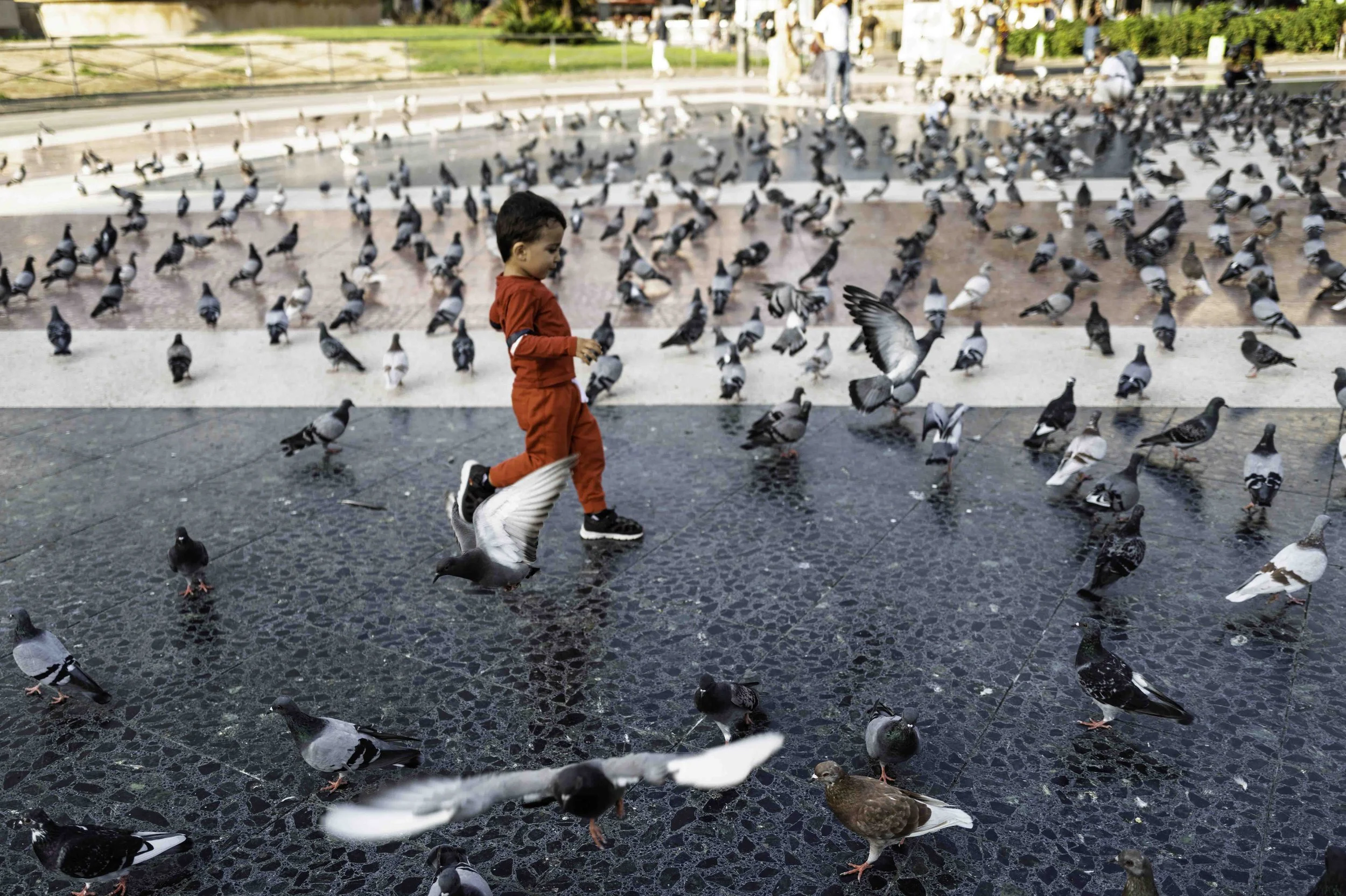
Plaça Catalunya, summer morning — Leica Q3
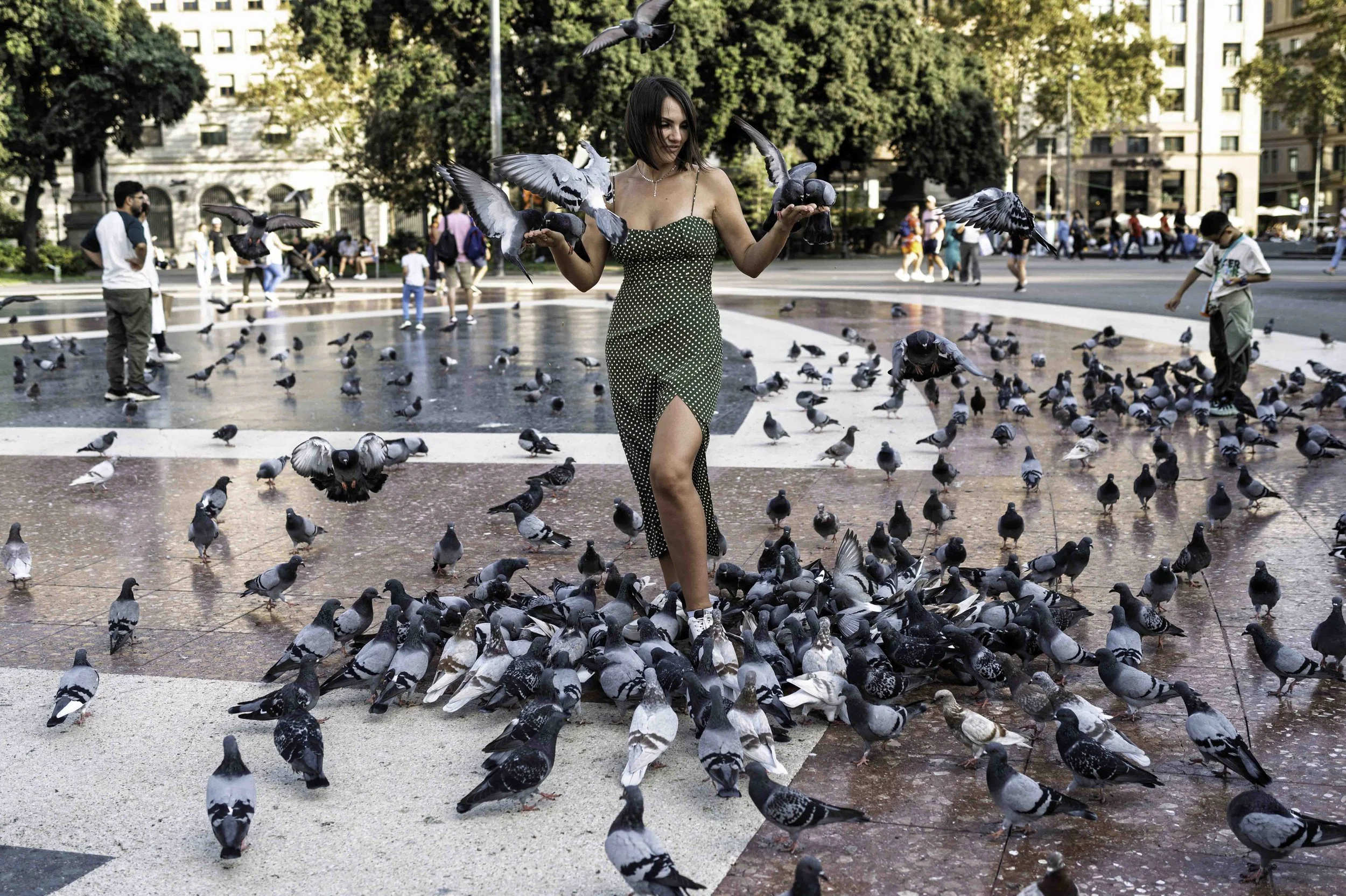
Plaça Catalunya, two scenes apart — Leica Q3
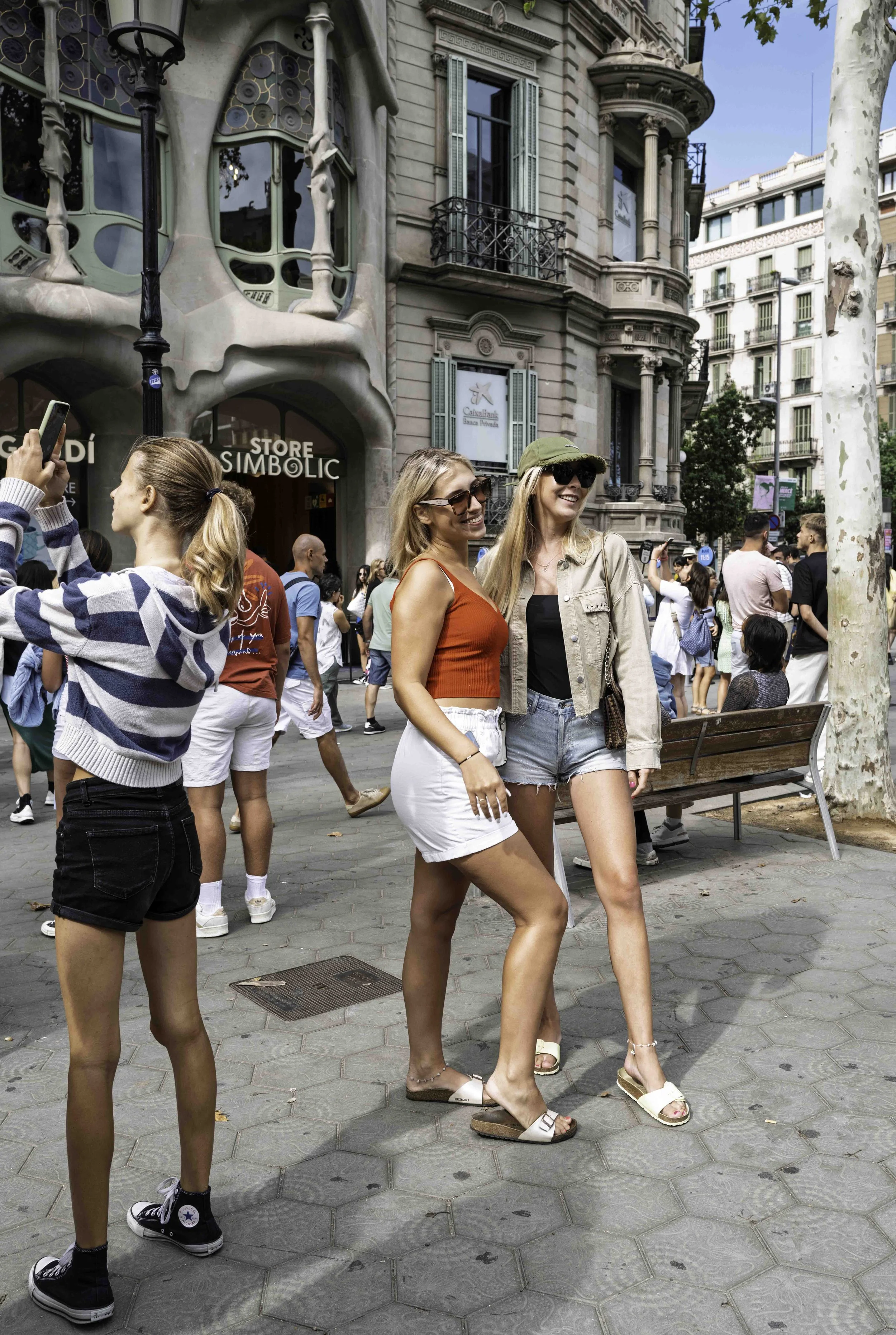
Casa Batlló, Passeig de Gràcia — Leica Q3
La Boqueria and the Life of the Mercats
The Mercat de la Boqueria is, famously, overrun. Most of the stalls cater primarily to tourists, and the locals who once shopped here have largely moved on to quieter neighbourhood markets. And yet. Step past the first rows of overpriced fruit cups and you find a long bar where people sit shoulder to shoulder on bentwood stools, eating plates of razor clams and drinking cold white wine at eleven in the morning. The kitchen fires, the hiss of a gas burner, the particular smell of a market that has been in the same place since 1840 — it is irreplaceable, and it still belongs to the people who use it daily.
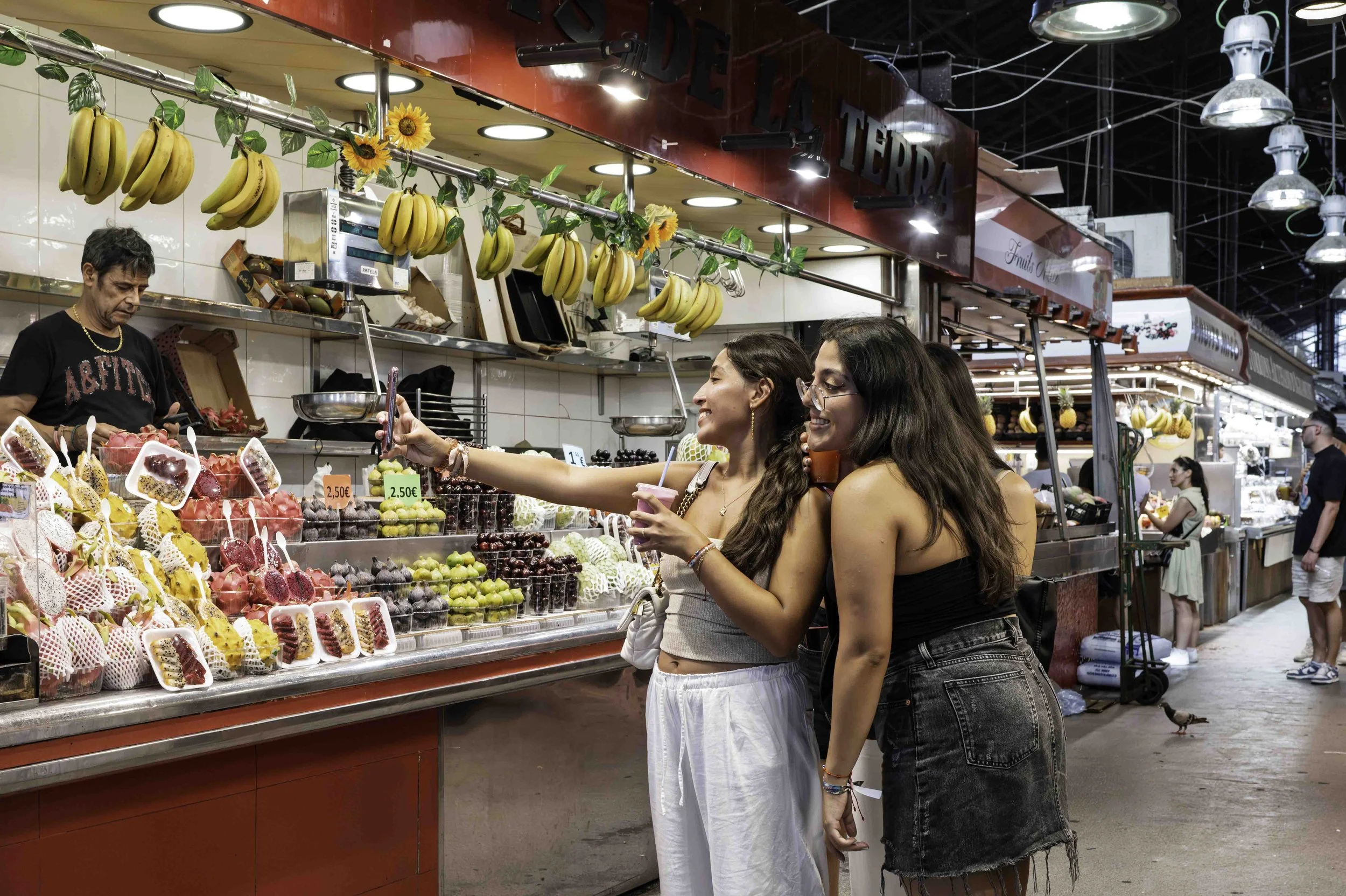
La Boqueria, as it exists now — Leica Q3
Two young women at a fruit stand, selfie phone extended, the vendor behind them glancing down at his display without interest. This is the Boqueria as it exists now: a place that has absorbed its own mythology and carries on regardless.
For the market's history and a closer look at its stalls, Carlos Lorenzo's guide to La Boqueria on Barcelona Photoblog is worth a read. And for a sense of how another Iberian city handles the tension between tourism and everyday life, see our Snapshots of Lisbon post.
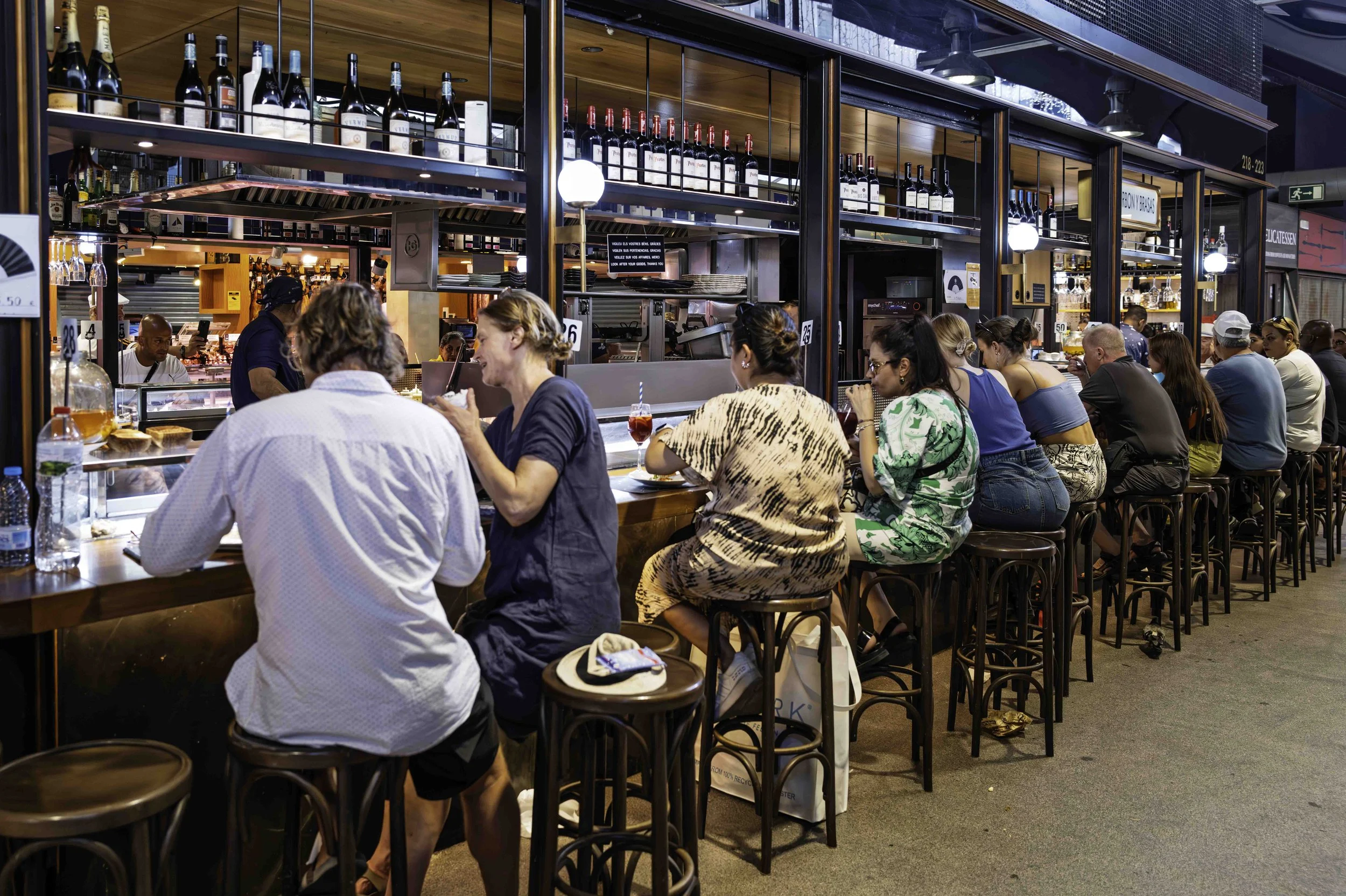
La Boqueria, eleven in the morning — Leica Q3
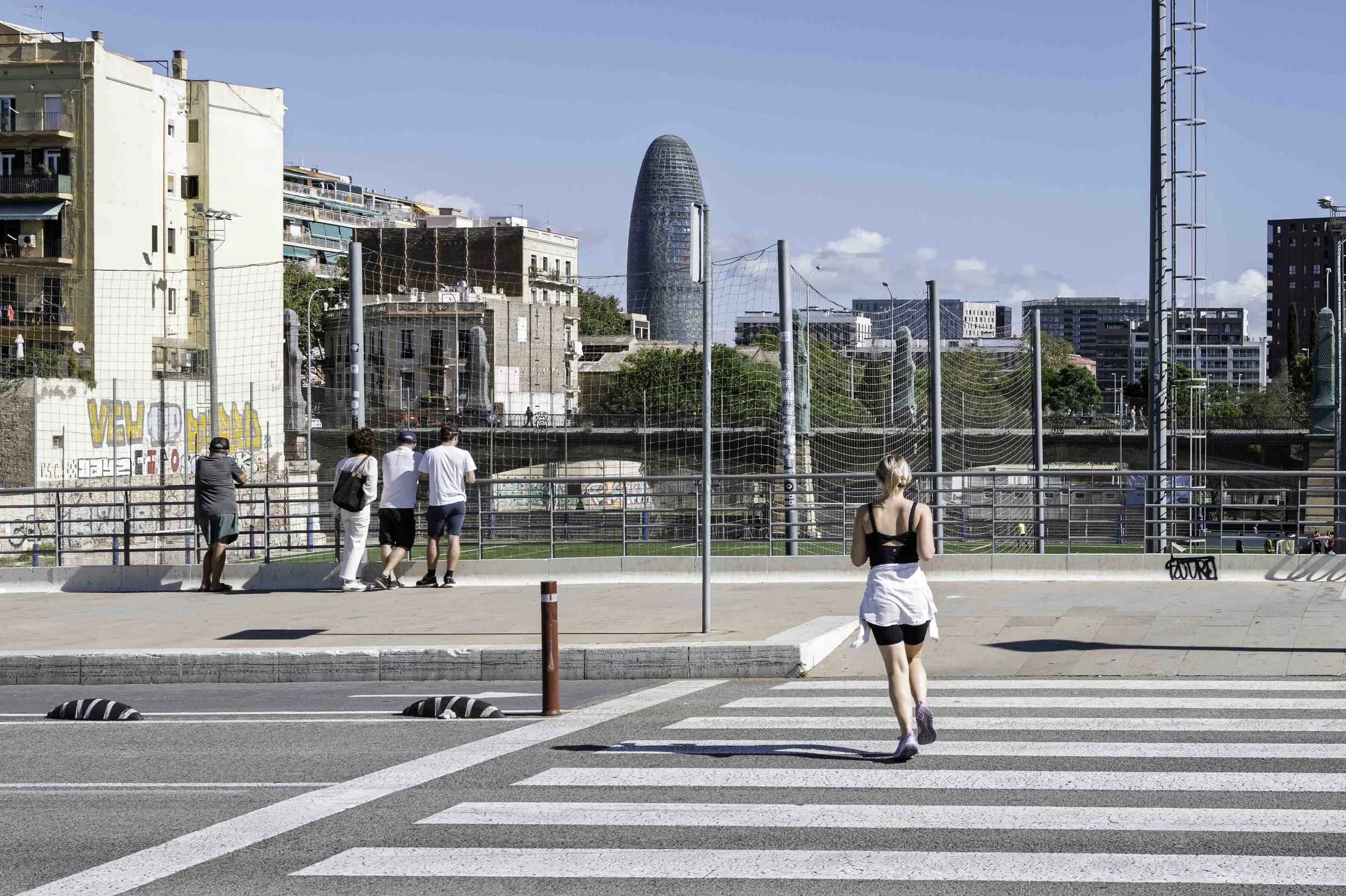
Poblenou, Torre Agbar in the distance — Leica Q3
A City That Belongs to Its People
The most honest Barcelona street photography is not made at the monuments. It is made at the edges — at the port of Barceloneta at dusk, where four young men sit with their backs to the city, staring at the water, one of them wearing a Messi 10 Inter Miami jersey. It is made at the Arenes de Barcelona on a September afternoon, where a group of castellers — the human tower builders who are as Catalan as the language itself — raise a column of bodies against the sky, the child at the top raising one arm in the moment of completion.
It is made in a narrow alley at night, where a woman in a pink dress walks away from the camera under a string of bare bulbs, and the medieval city feels briefly, improbably intimate. Barcelona is a city that has always been good at this: giving you a moment that feels private even when it is entirely public, a glimpse of daily life that you somehow feel privileged to have witnessed.
The Poblenou neighbourhood offers a different Barcelona entirely — wider streets, the Torre Agbar rising in the background, a woman jogging across a zebra crossing with the old working-class buildings behind her. The city is never one thing. It is a sequence of neighbourhoods, each with its own light and pace, each with its own version of what it means to live here in the heat of summer.
If you have never walked Barcelona with no particular destination in mind, do it once in late summer — when the heat has softened by early evening and the city comes back outside, and every street is a photograph waiting to be made.
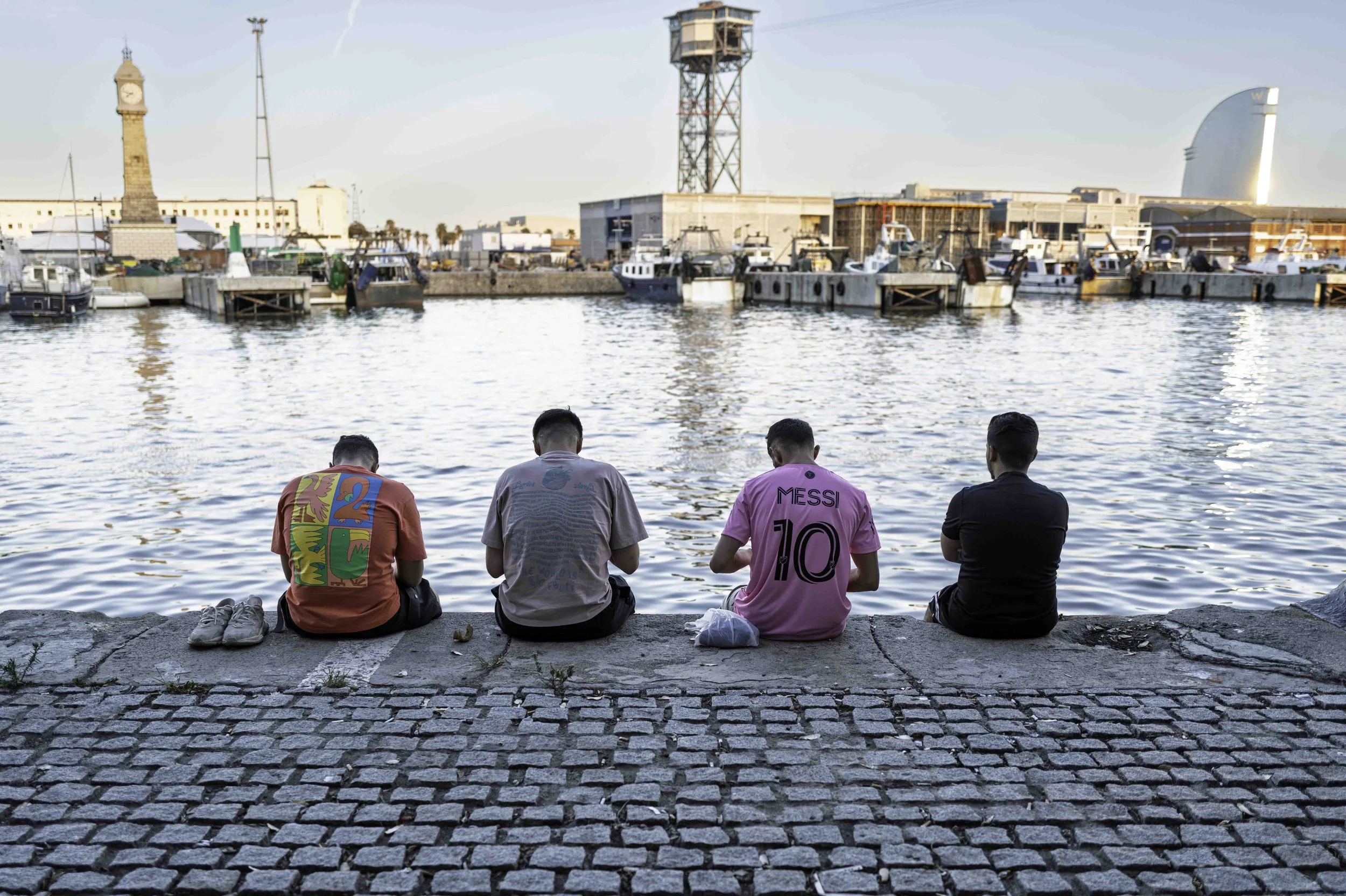
Port Vell, end of day — Leica Q3
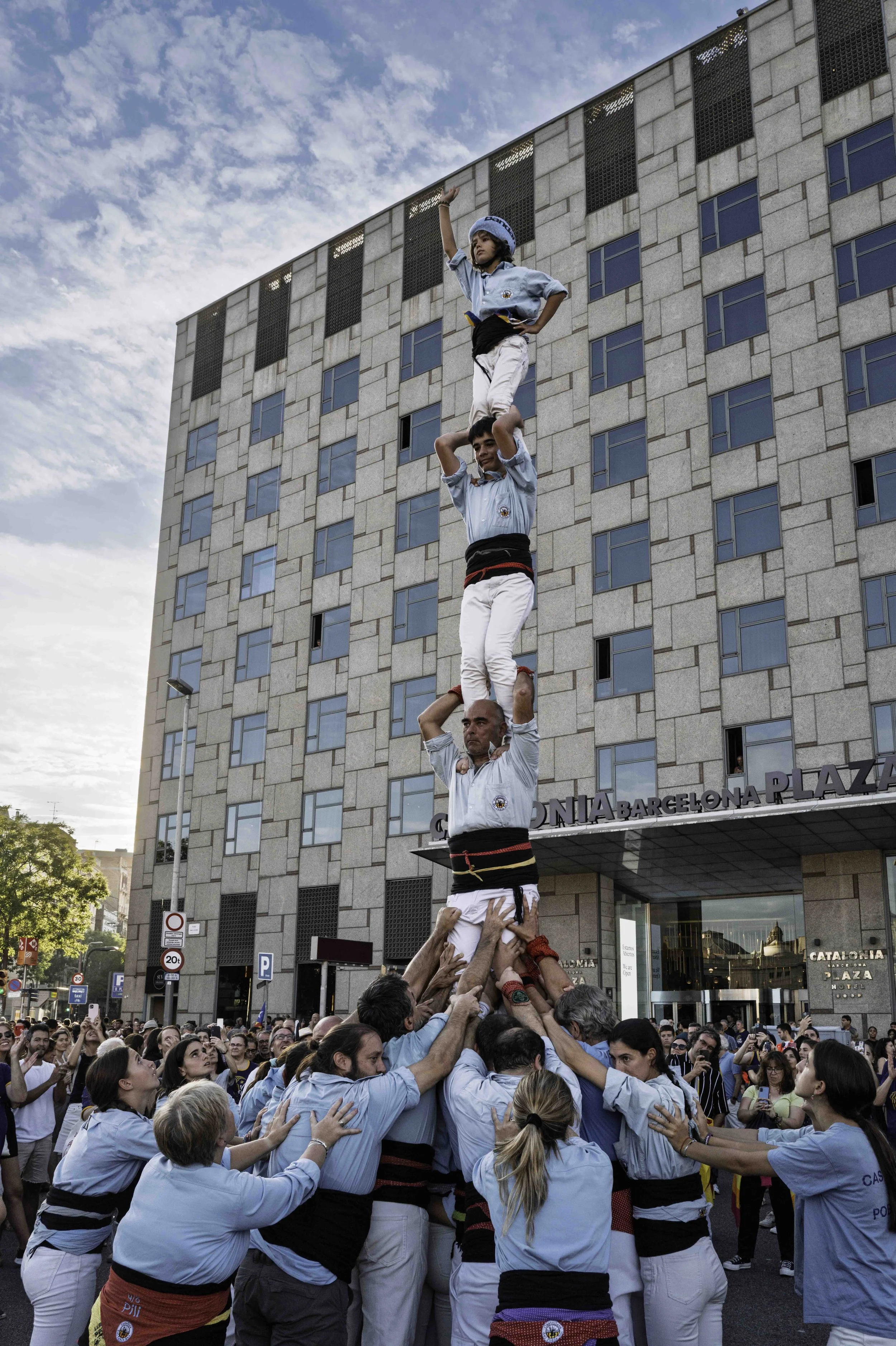
Castellers, Las Arenas, September — Leica Q3
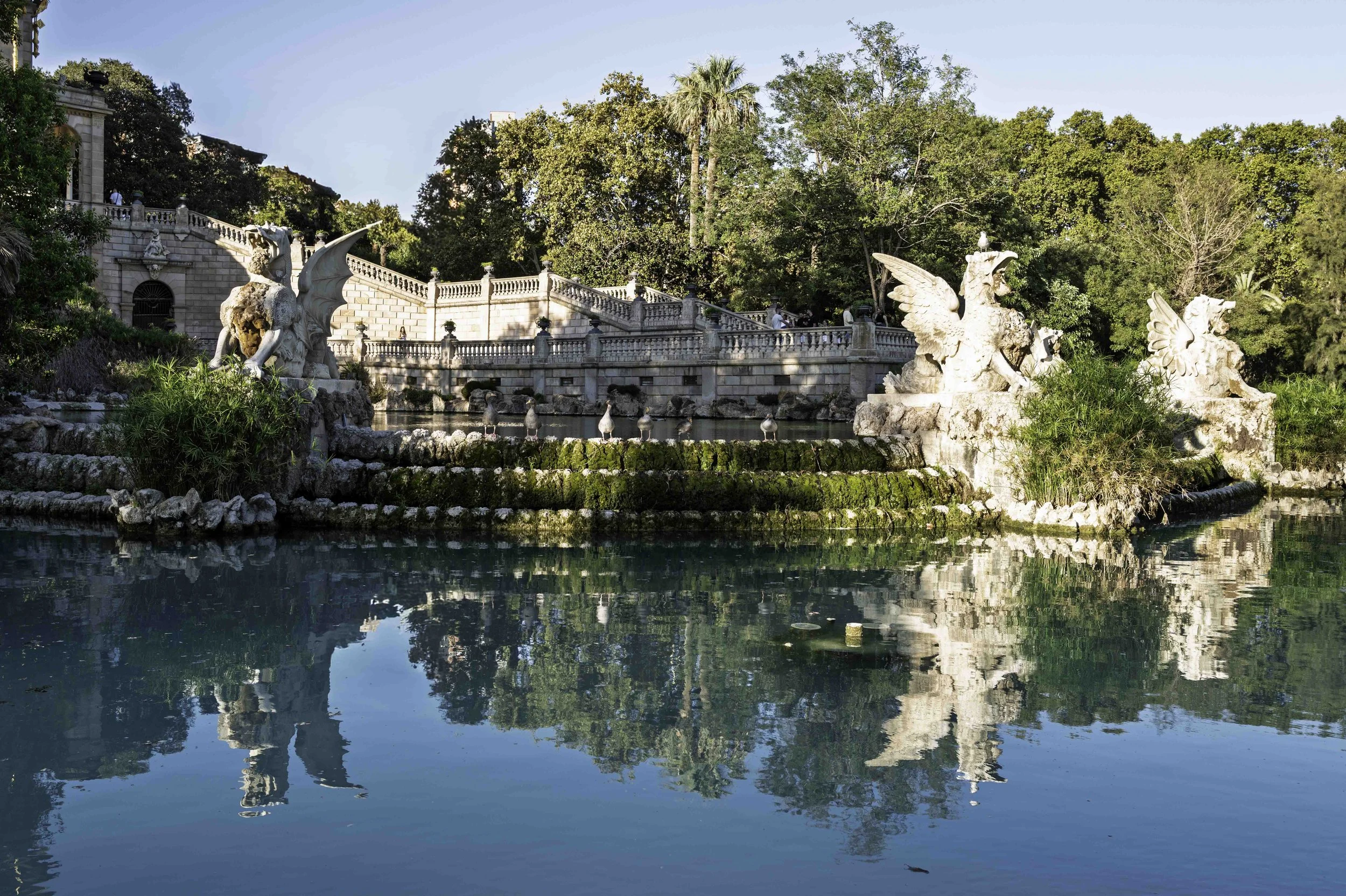
Parc de la Ciutadella, late afternoon — Leica Q3
Photos: Leica Q3 · ISO 250 · 28mm · f/2.8–8 · 1/250s
Barcelona rewards the photographer who slows down — the best moments happen between landmarks. For more Barcelona photography, The Girl of Peace captures a very different side of the city, inside one of its most unusual museums. For street photography further afield, Snapshots of Lisbon offers a similar rhythm in a different Atlantic capital.
Some of those walls have since become destinations in their own right — El Beso and the murals of El Born pull crowds that the Gothic archways never do.
For another city that rewards wandering with a camera, see our Lisbon street photography from a rainy winter week.
See more street photography from Barcelona in the portfolio.
Want one of these on your wall?
Every photo on this site can be printed — archival paper, signed and numbered. Browse prints →
Cosme Lapena is a Barcelona-based street and urban photographer and founder of bCLPhoto.
Exhibited at espai [b] since 2010 · Published in The Eye of Photography and 35mmc. Browse the portfolio or read more on the blog.