Madrid Street Photography: A Saturday from Lavapiés to the Plaza Mayor
ORIGINALLY PUBLISHED SEPTEMBER 2023 — REWRITTEN OCTOBER 2026
Madrid street photography, for me, will always begin with a Saturday in May 2015 and a wall in Lavapiés. A woman's face in grey, enormous, with a crown of coloured shards exploding from her head and three drips of paint running from her eye like tears. And then, from the left, a small girl in red trousers and a sun hat, walking straight past it without looking up, something soft tucked under her arm.
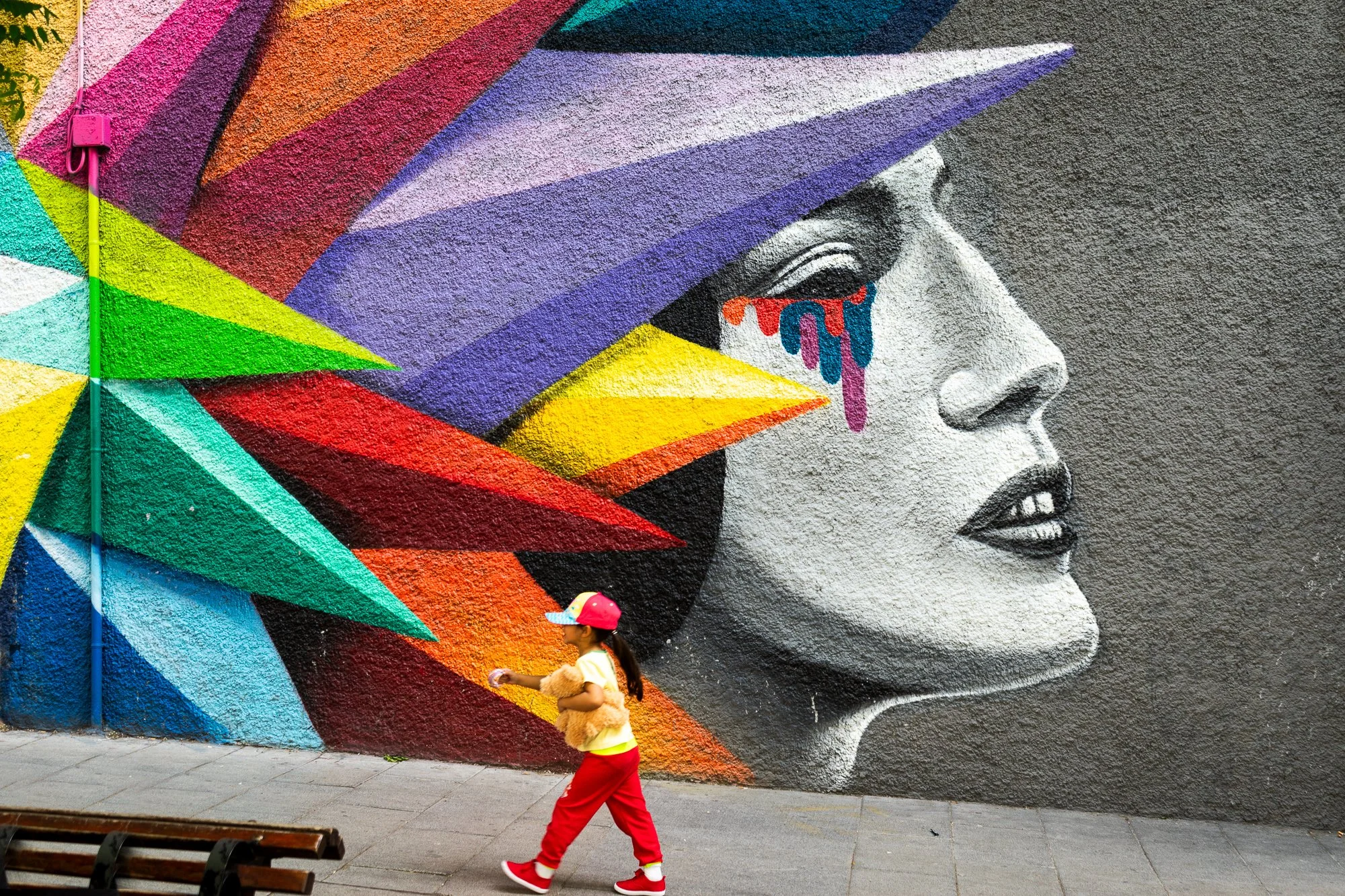
She didn't look up — Sony a7II
I have a weakness for this kind of wall. Not the tags sprayed on shutters, the quick signatures that say only that someone passed by, but the walls someone has turned into a picture big enough to stop you in the street. Lavapiés has plenty of them, and what I like most is that the neighbourhood does not treat them as art. The painted wall is just the wall. People walk past it, sit in front of it, lean on it, and that indifference is exactly what makes it photographable.
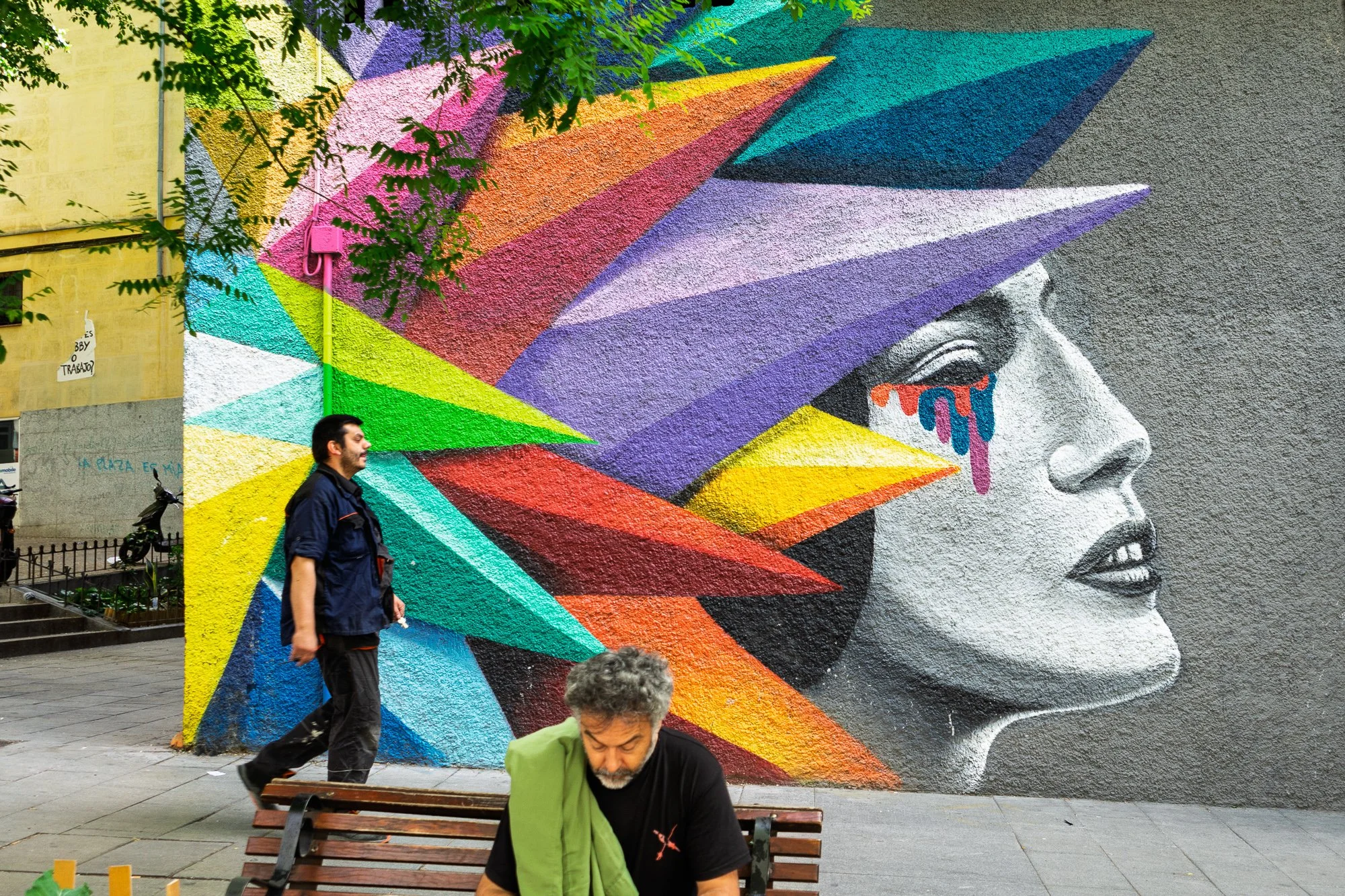
The wall is just the wall — Sony a7II
I stayed by the same wall a little longer. A man in a dark shirt walked through the frame at the height of the coloured shards; another sat on the bench below the face with a green towel over his shoulder, looking at something only he could see. Neither of them gave the painting a glance. Two frames, two minutes apart, and the mural plays a different role in each: in the first it is a backdrop to a child, in the second it is the living room of the street.
Plaza de Cascorro, the Day Before the Rastro
From there I walked uphill to the Plaza de Cascorro, where Lavapiés runs into the Rastro. The first thing you see, at the corner of Calle de Embajadores, is another painted wall, very different from the one I had just left. It covers the whole side of the building at Embajadores 3 and shows the Rastro itself: market awnings, old façades, and a crowd of faces sitting at café tables, as if the neighbourhood had posed for a group portrait.
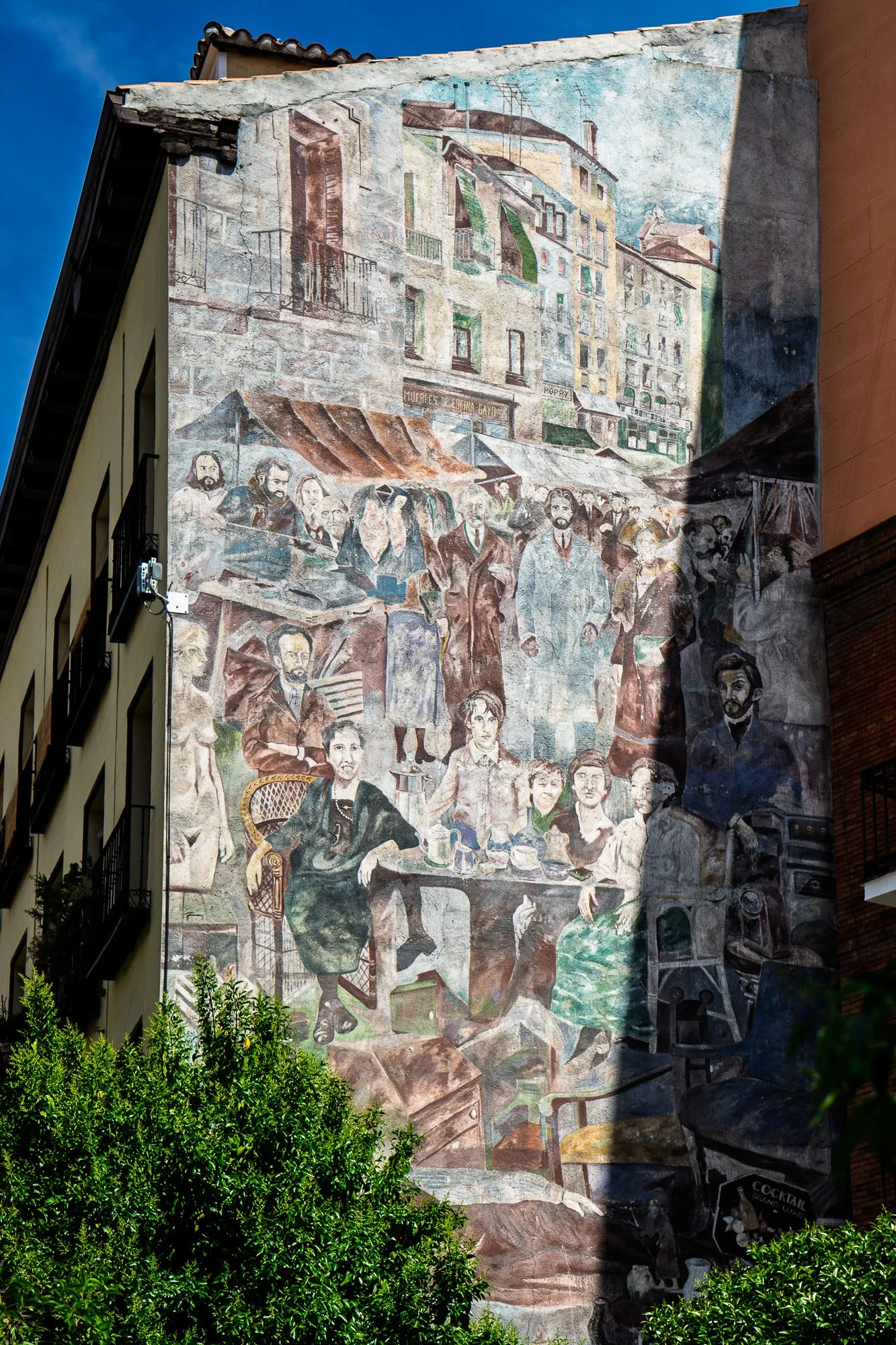
The Rastro inside the Rastro — Sony a7II
The mural is by the artist Enrique Cavestany, who signs as Enrius. In 1982 the city invited artists to paint the party walls of the centre, and the one at Embajadores 3 fell to him. He called it El Rastro dentro del Rastro, the Rastro inside the Rastro, and filled it with friends, family and regulars of the market, among them people from La Mandrágora, the La Latina bar where Joaquín Sabina, Javier Krahe and Alberto Pérez used to play in the basement (Cavestany on the mural). Forty years on, the paint has faded and the plaster has cracked, but the faces are still there, watching the square.
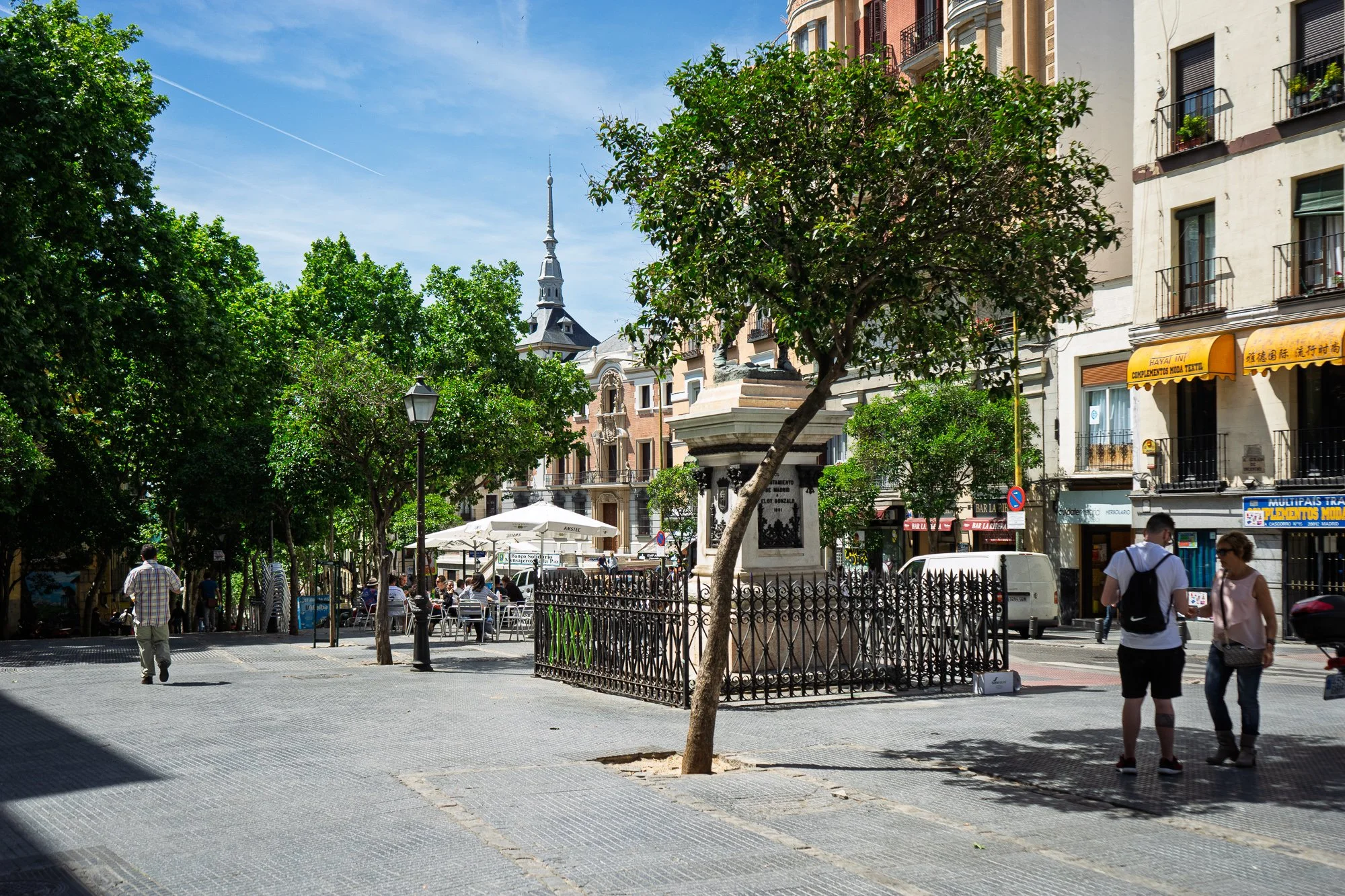
Plaza de Cascorro — Sony a7II
The square takes its name from a village in Cuba. In 1896, during the siege of Cascorro, a Spanish soldier called Eloy Gonzalo volunteered to crawl to the enemy lines with a can of petrol and a rope tied around his waist, so that his body could be recovered if he fell, and set fire to their position. He survived the action and died of illness the following year. His bronze statue by Aniceto Marinas has stood here since 1902, petrol can in one arm, torch in the other (Monument to Eloy Gonzalo). That Saturday the monument was fenced off, a young tree leaned into the frame, and a couple stood by the kerb comparing something in their hands.
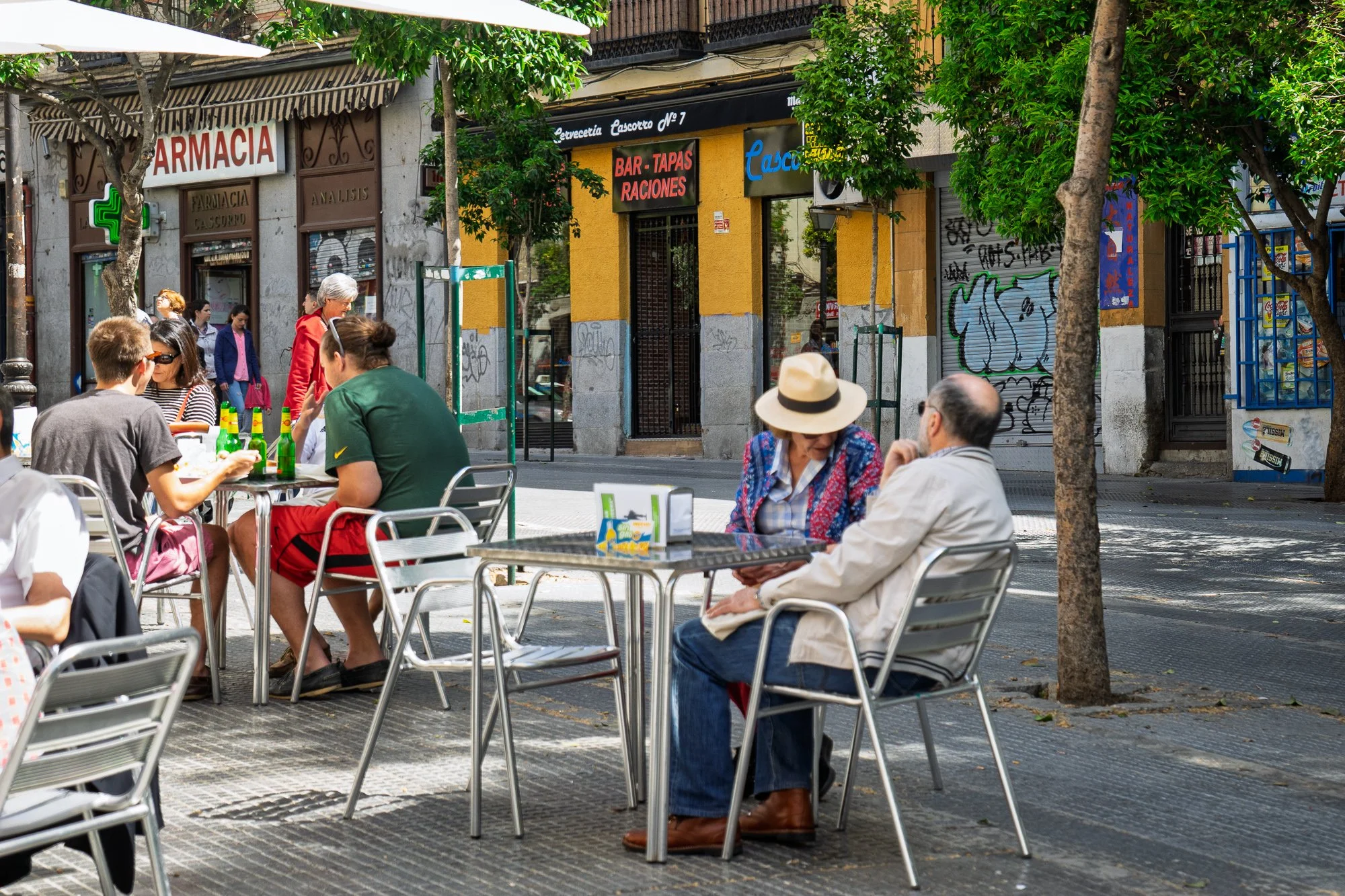
Saturday terraces — Sony a7II
On a Sunday this square disappears under the market. On a Saturday it belongs to the people who live around it. The terraces were half full: young men with bottles of beer, an older couple deep in conversation, a woman in a straw hat leaning in to hear. Behind them, the yellow front of the Cervecería Cascorro Nº 7 and, on the corner, the Farmacia Cascorro, with its old carved lettering above the door.
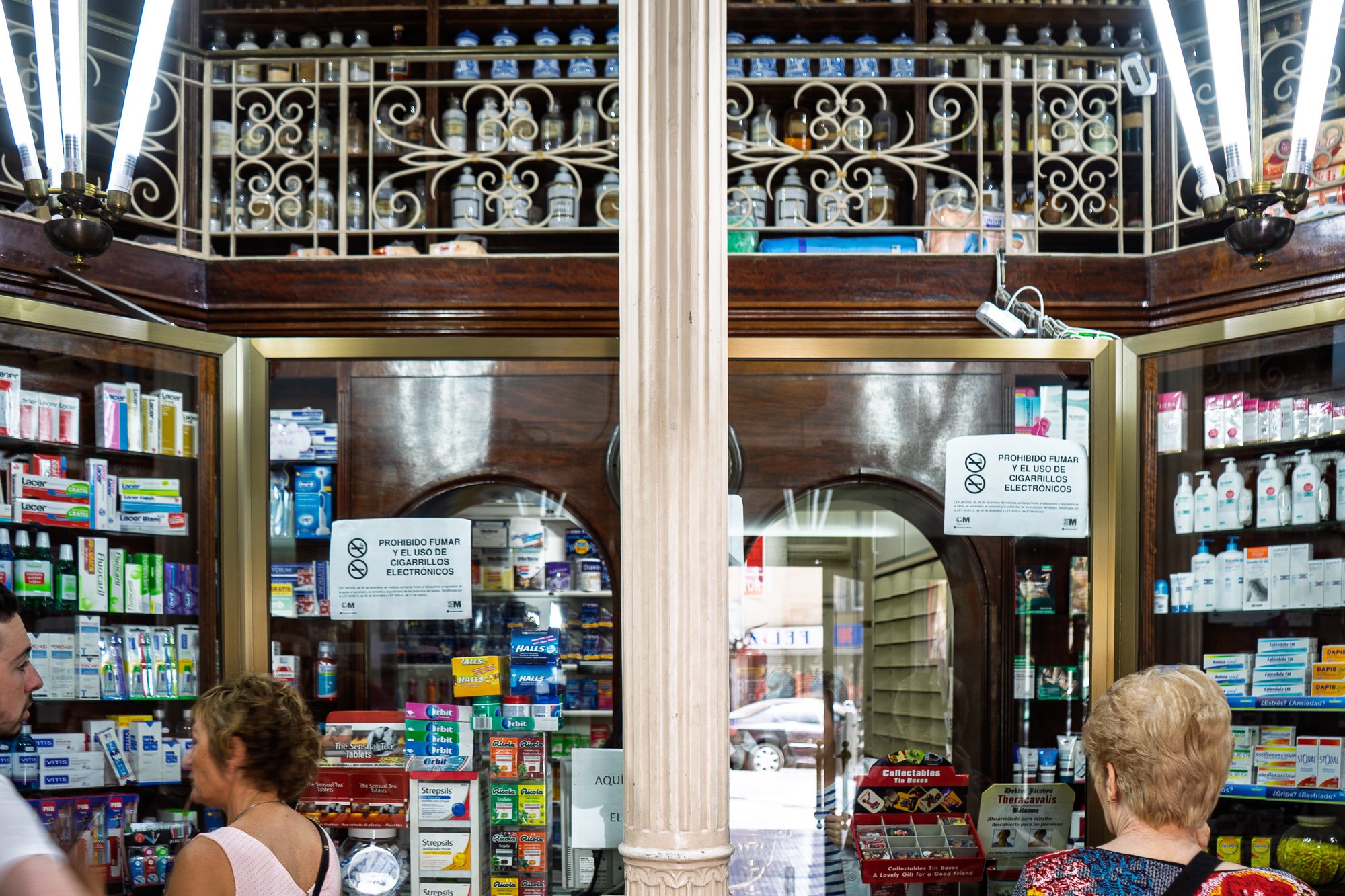
Two centuries of shelves — Sony a7II
I went in. Inside, the pharmacy is two shops stacked on top of each other. Below, the counter, the toothpaste, the cough sweets and a pair of no-smoking notices. Above, behind a cream-painted iron railing, rows of white porcelain jars and glass bottles from another century, kept on the dark wooden shelves as if someone might still need them. A fluted column runs up the middle of the frame and divides the two worlds neatly, and two women waiting at the counter give it scale.
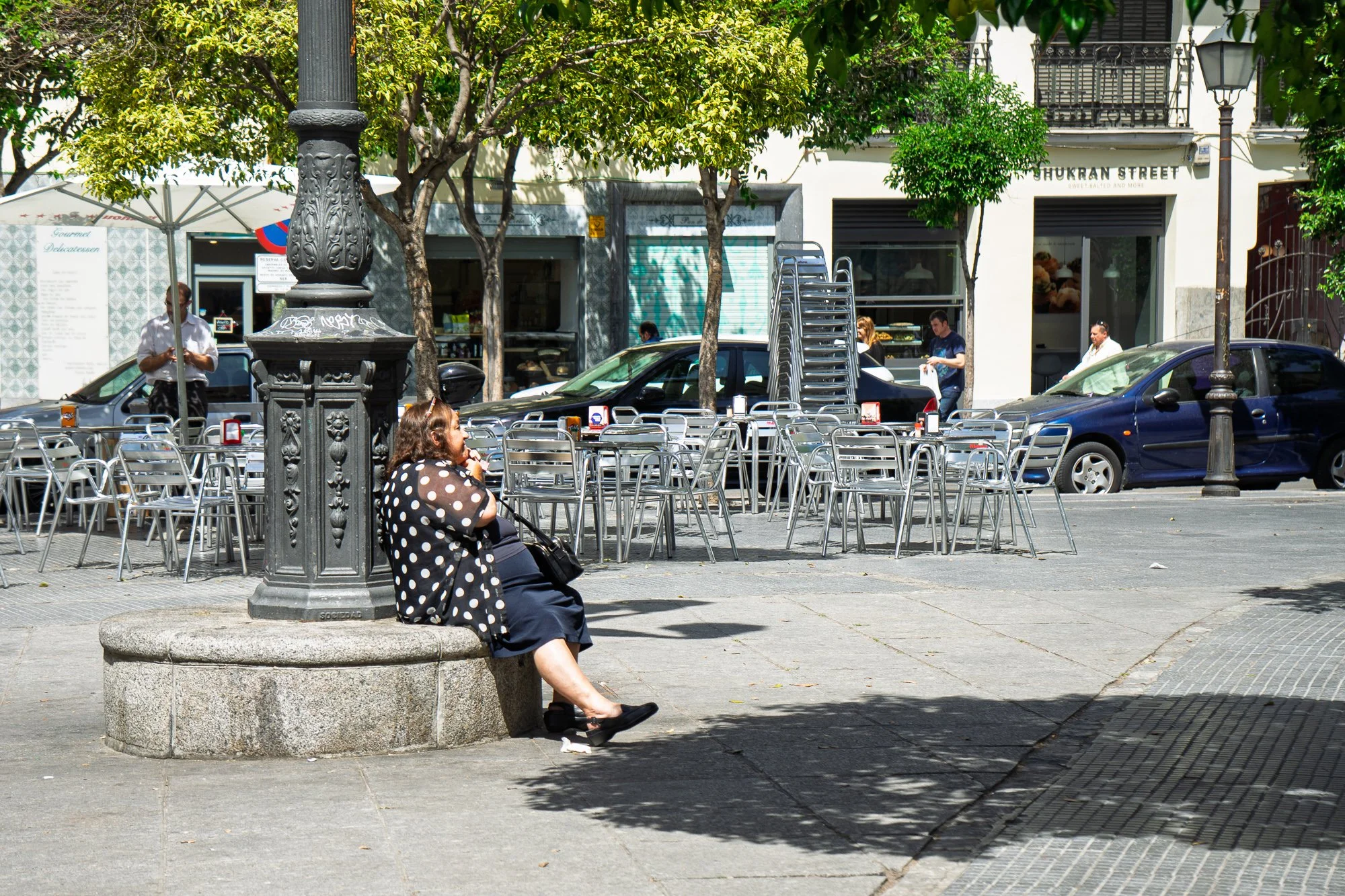
The quiet before Sunday — Sony a7II
Back outside, a woman in a polka-dot blouse had settled against the stone base of a cast-iron lamppost, in the only patch of shade, one hand at her chin. Behind her, rows of empty aluminium chairs waited in the sun and a waiter stood at the edge of the terrace with nothing to do yet. It is the frame I keep coming back to from that day: the square at rest, a few hours before it fills.
El Rastro: Ribera de Curtidores
From Cascorro, the Ribera de Curtidores runs downhill, and that slope is the Rastro. The name means "riverside of the tanners", and the market's own name is usually traced to the trail left by cattle driven between the old slaughterhouse and the tanneries that once lined this street (El Rastro). On Sundays the street fills with stalls from top to bottom. On a Saturday it is the antique dealers who keep it alive.
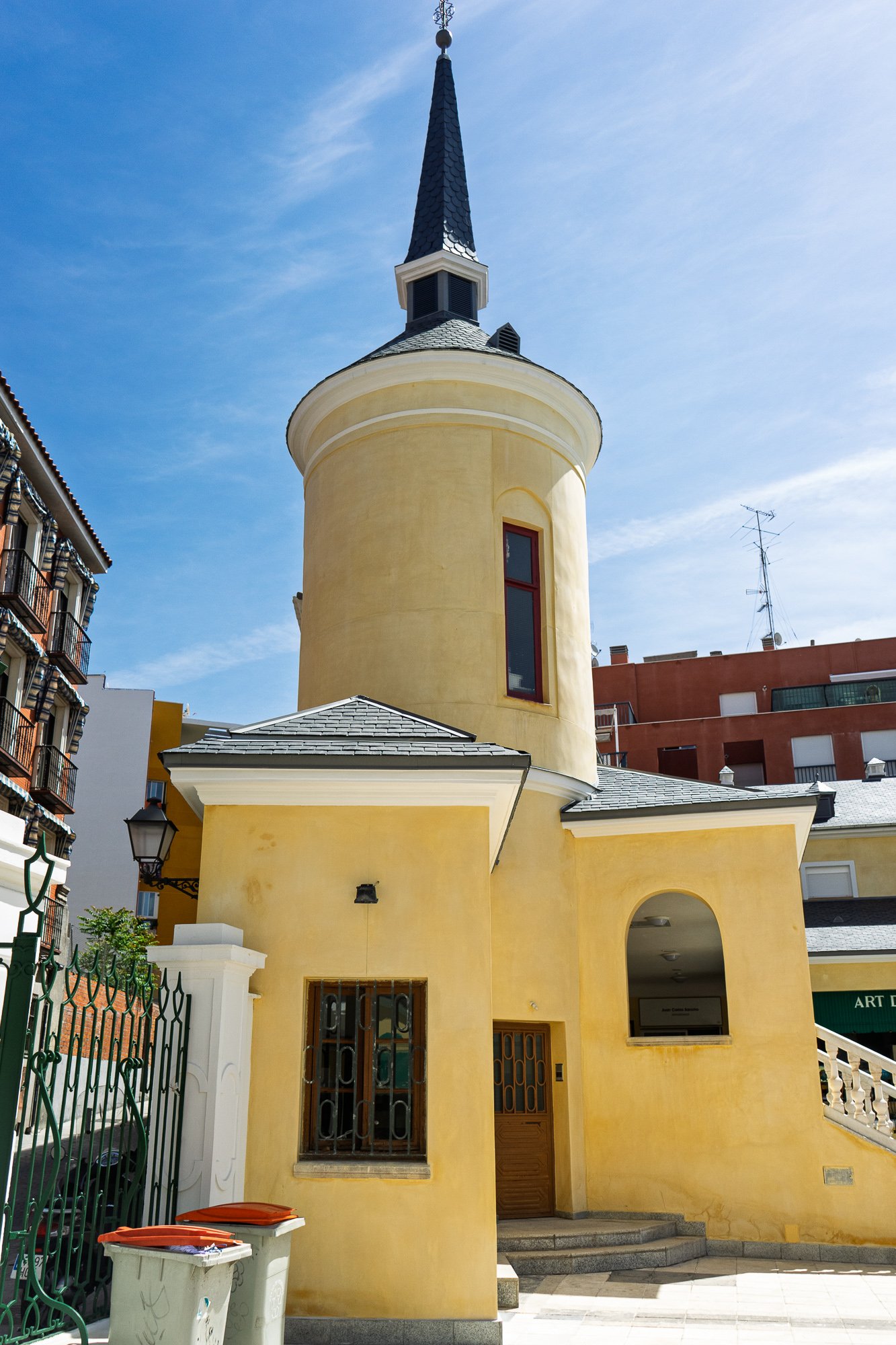
The door to Galerías Piquer — Sony a7II
Halfway down, behind a green iron gate, a yellow round tower with a slate spire marks the entrance to the Galerías Piquer. It looks more like a village church than the door to a shopping arcade. The galleries opened in 1950 as Galerías Isla de Cuba, and were later renamed after the singer Concha Piquer (esMadrid).
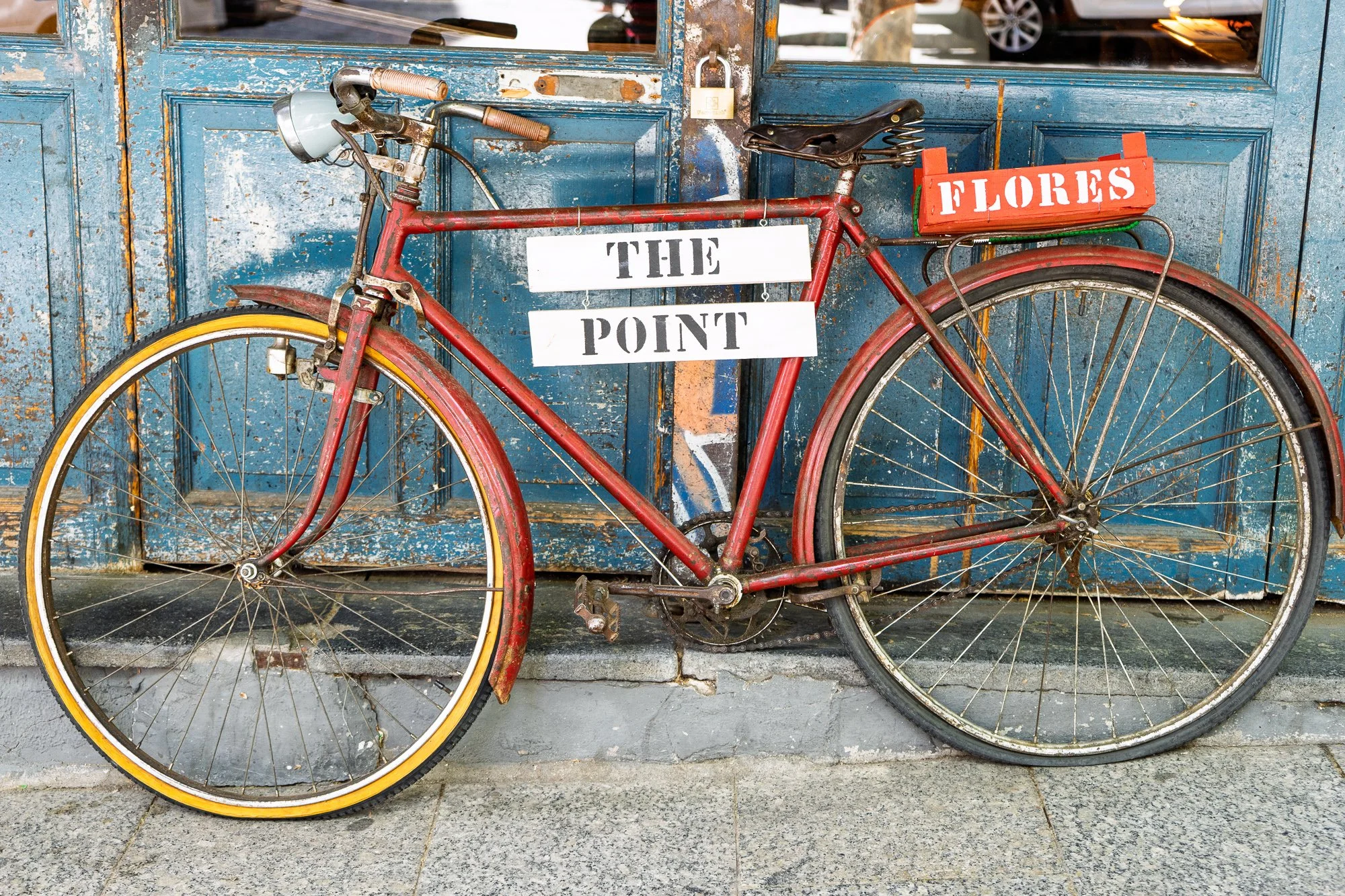
The Point — Sony a7II
Inside the galleries, an old red bicycle leaned against a pair of peeling blue doors. Someone had hung a stencilled sign from its crossbar, THE POINT, and fixed a red crate stencilled FLORES to the rack. The tyres were flat, the paint had gone to rust at every joint, and the whole thing had clearly not moved in years. As a shop sign it was perfect: nothing says antiques like an object that has stopped being useful and become beautiful instead.
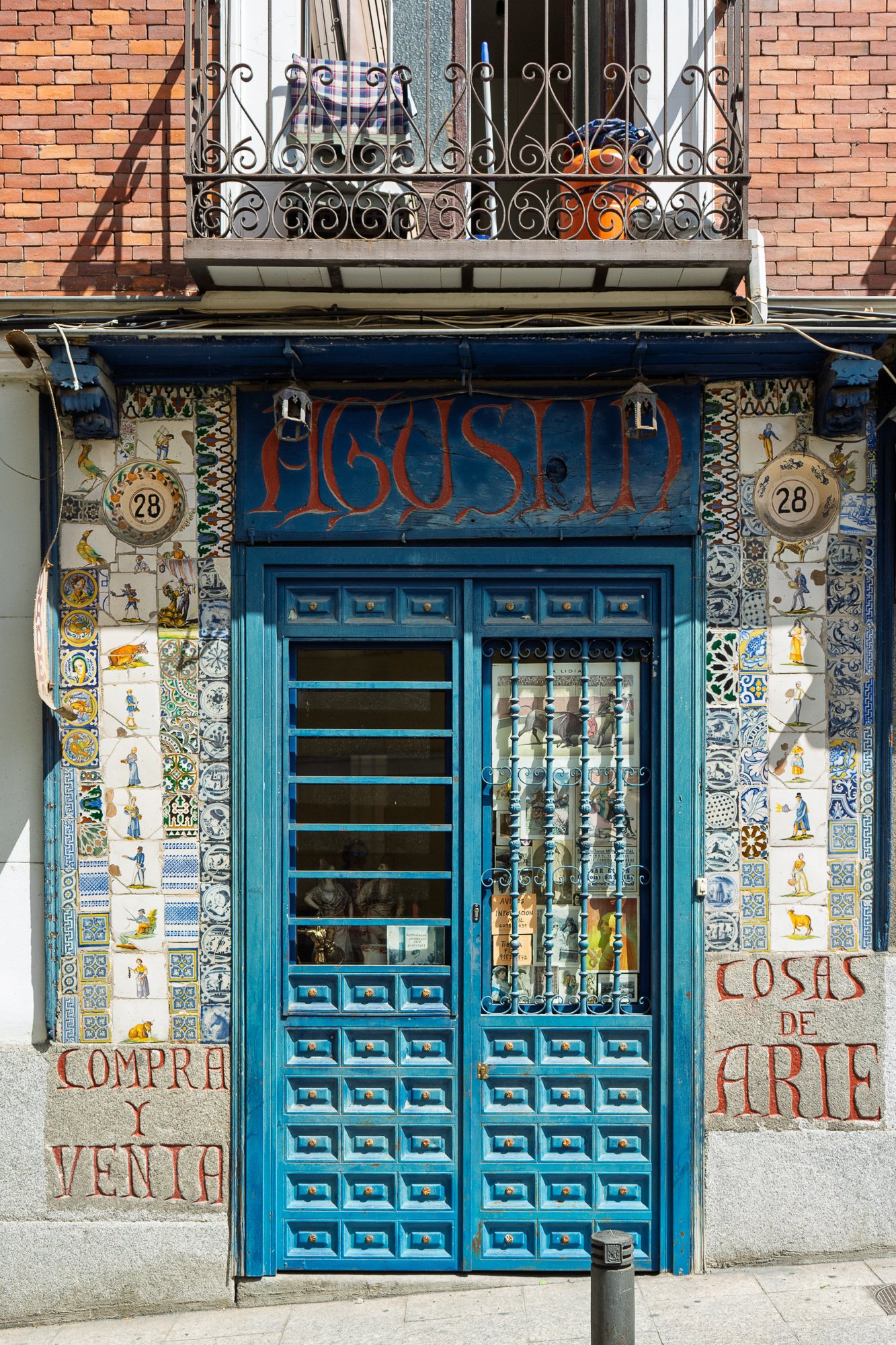
Agustín, number 28 — Sony a7II
Across the street, at number 28, the Agustín shop has the best façade on the Ribera. The doors are deep blue and coffered, the name is painted in red Gothic letters on a wooden board above them, and on either side the walls are covered in hand-painted tiles: bullfighters, water carriers, birds, a bull, two ceramic plates carrying the number 28. Carved into the stone below are the words Compra y venta on one side and Cosas de arte on the other. Buying and selling, things of art. That is the whole Rastro in six words.
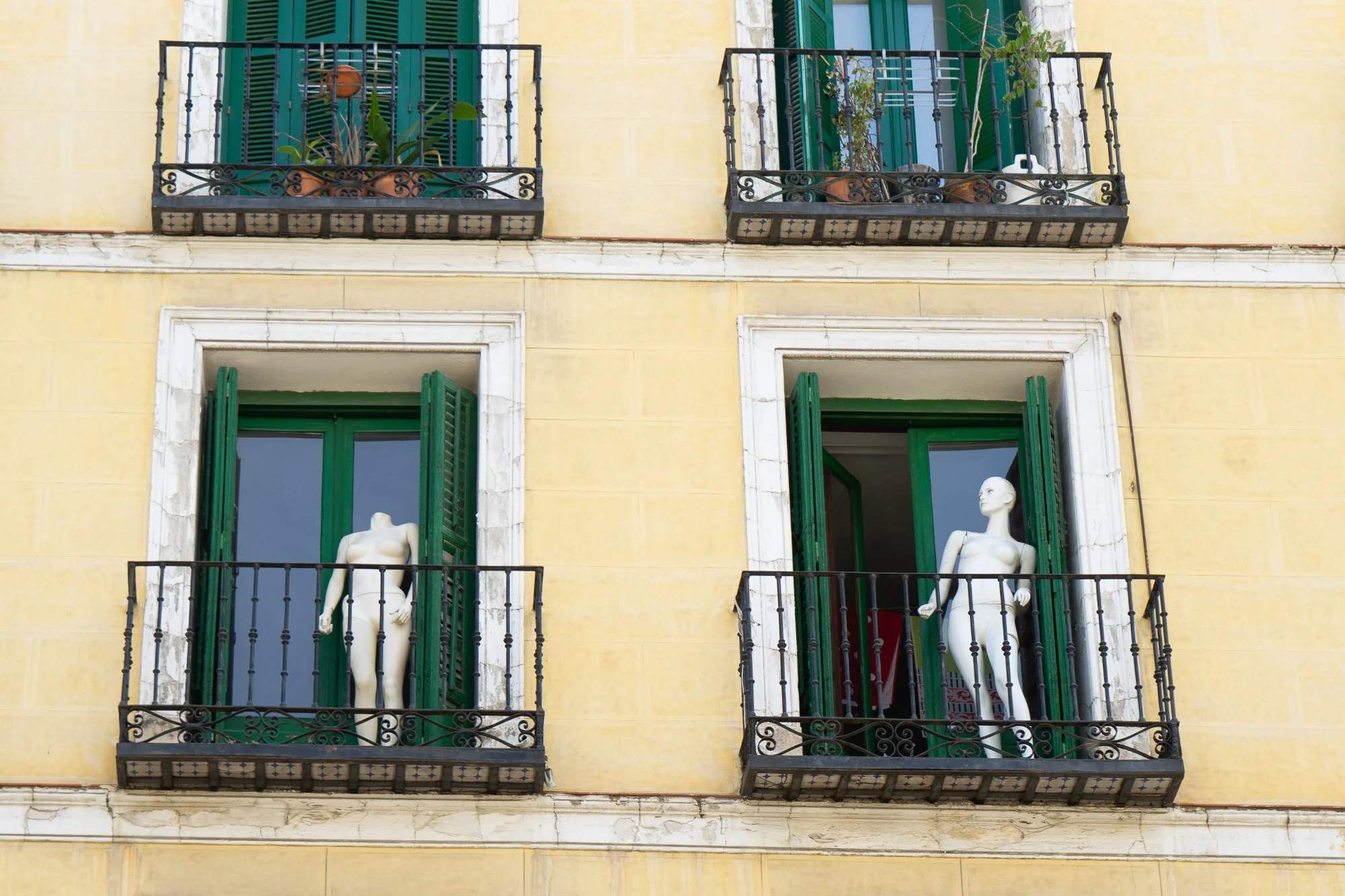
Window shopping, upstairs — Sony a7II
Look up in the Rastro and the market continues on the upper floors. On a yellow façade, two white mannequins stood in open balcony windows between green shutters, one headless and one gazing off to the side, while the balconies above them held flowerpots and a drying rack. Whether they were for sale, on display, or just stored where there was room, I never found out. I liked them better not knowing.
Up Calle de Toledo to the Plaza Mayor
To finish, I walked north up the Calle de Toledo, the old road that climbs from the Rastro towards the centre. It is wider, louder and busier than anything I had seen that morning: cars, motorbikes, cyclists, shoppers with bags, people stepping off the kerb wherever there is a gap. At the top, framed between the tall façades, a yellow arch opens into the Plaza Mayor.
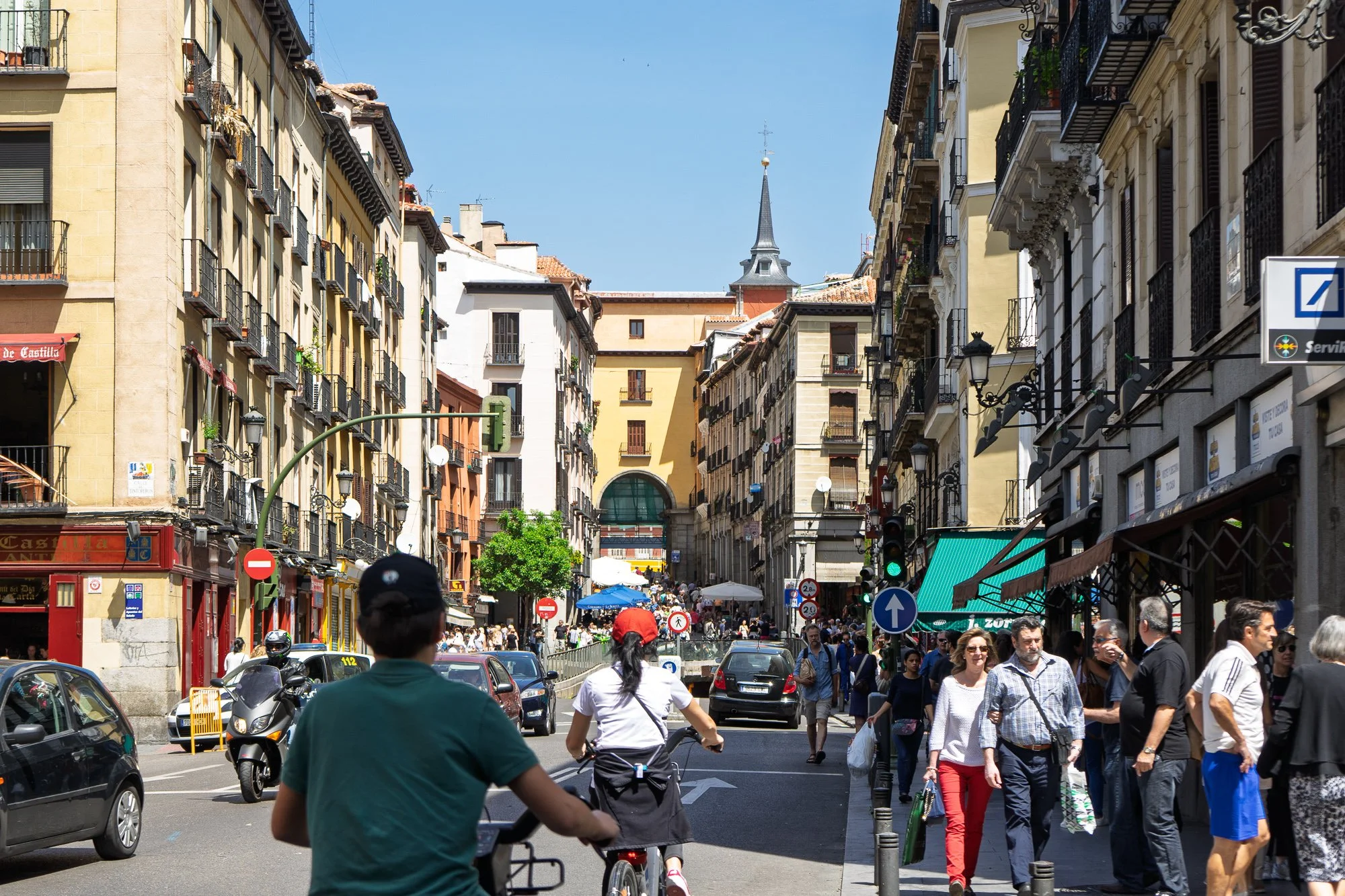
Uphill to the centre — Sony a7II
I photographed it from behind two cyclists, a boy in a green T-shirt and a girl in a red cap, both pushing up the slope towards the arch. They give the picture its direction. The street does the rest, with its iron balconies, shop awnings and traffic signs all converging on the same point.
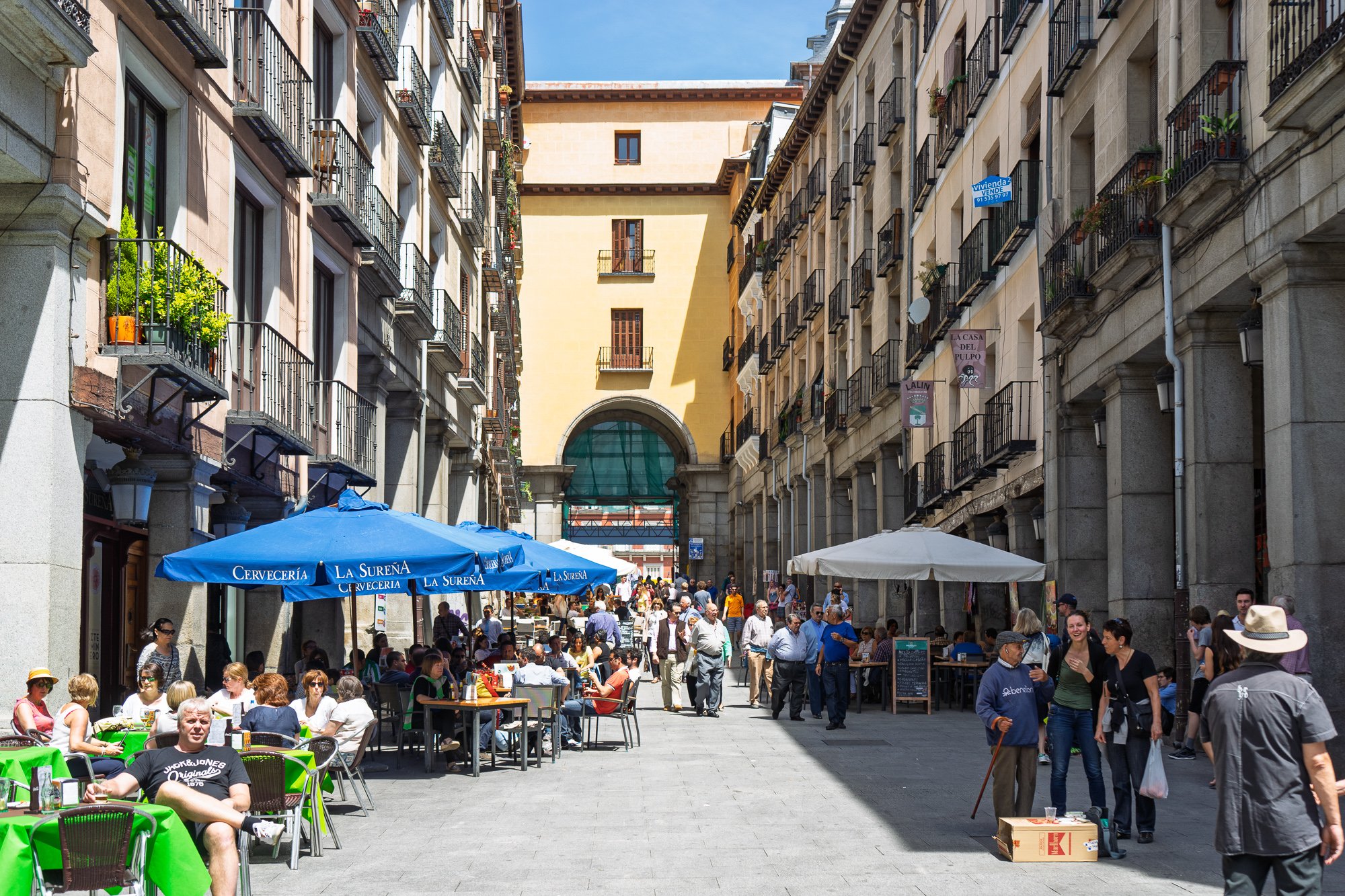
The last terrace before the square — Sony a7II
The last stretch, just below the Arco de Toledo, is all terraces: blue umbrellas, green tablecloths, people with their faces turned to the sun, and an old man with a walking stick standing by a cardboard box on the pavement, holding the middle of the frame. One morning had taken me from a mural in Lavapiés to the most photographed square in Madrid, and the further uphill I went, the more the city performed for visitors. The best Madrid street photography of the day had happened down the hill, on a Saturday, in a market that was not open yet.
If you go, do it twice: once on a Sunday for the Rastro in full, and once on a Saturday, to see the neighbourhood that holds it up. Subscribe to the newsletter for new stories from the street, along with a free street photography guide.
Photos: Sony a7II · Madrid, 9 May 2015
See more street photography in the portfolio, and more painted walls in Graffiti & Street Art.
Every photograph in this post is also available as a fine art print.
Cosme Lapena is a Barcelona-based street and urban photographer and founder of bCLPhoto.
Exhibited at espai [b] since 2010 · Published in The Eye of Photography and 35mmc. Browse the portfolio or read more on the blog.