The Warsaw Royal Route begins where my walk through Warsaw's Old Town ended, at Castle Square, and runs south towards Wilanów along Krakowskie Przedmieście and Nowy Świat. For centuries it was the road kings took between their residences; today it is the city's grand avenue, lined with palaces, churches, ministries and the gates of the university. My wife and I walked it twice in May 2025: on a quiet Saturday evening that stretched into the night, and again the next day, when the same street filled with flags.
Like the Old Town, most of what you see here was rebuilt after 1944, and the Royal Route is protected today as part of the same historic ensemble. But where the Old Town felt like a set waiting for actors, the Royal Route felt like a working street that happened to be beautiful. People here were not performing for anyone. They were going somewhere.
Krakowskie Przedmieście on a Saturday Evening
The first frame of the evening was two young people on bicycles, seen from behind as they rolled down the cobbles. She wore a checked beige jacket and had a wicker basket on her rack; he had navy dungarees over a white and navy striped jumper, a leather saddlebag and a mint-green crate strapped behind him. Their bikes were as old-fashioned as their clothes, and for a moment the whole picture could have belonged to another decade. Only the plastic crate gave them away.
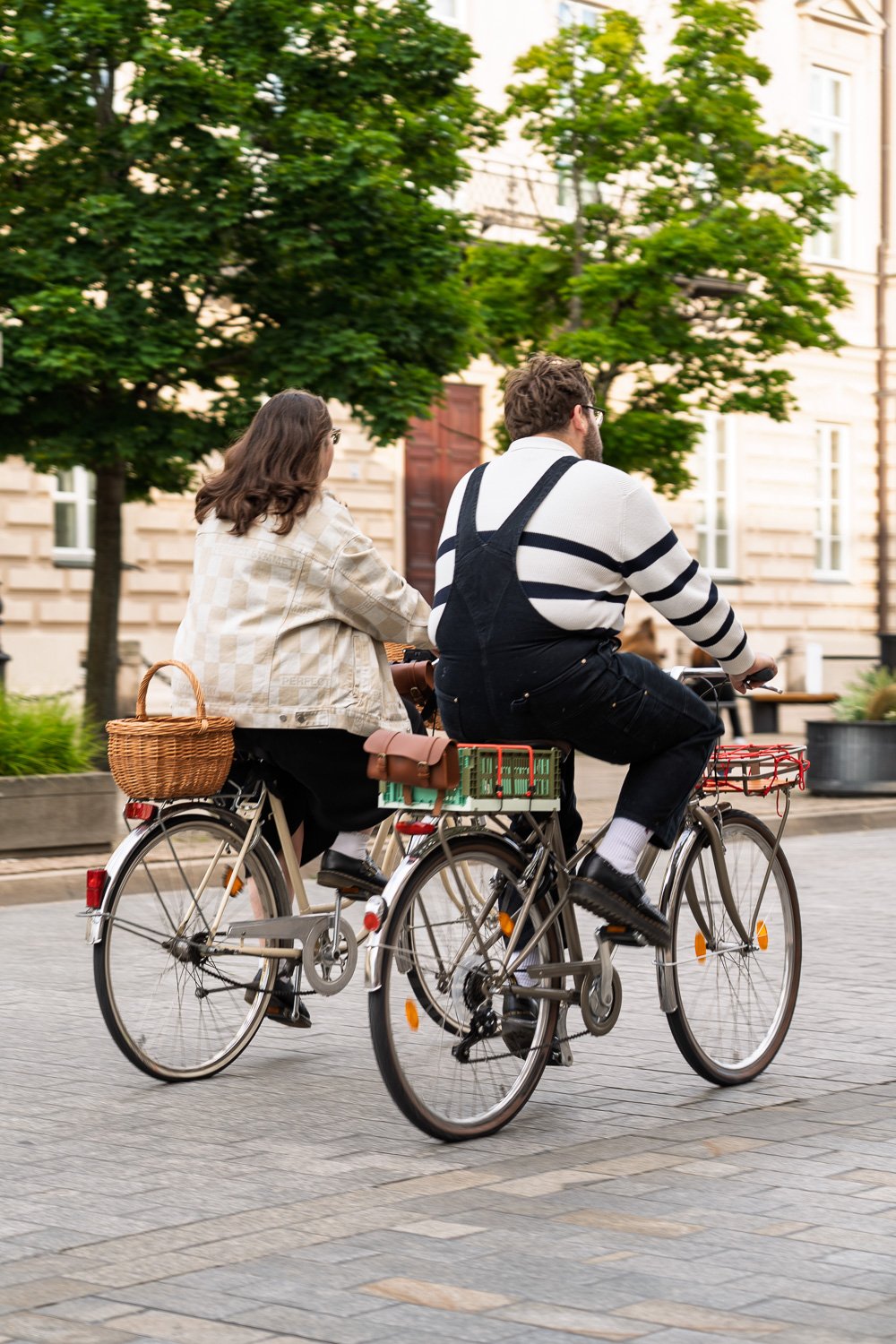
Another Decade — Sony a7R IV
A little further on, the low sun was throwing the shadows of the young trees onto a pale neoclassical façade, the leaves printed across the plaster like a second set of windows. A couple dressed in black walked through it, in step, past stone bollards linked by heavy chains and a cast-iron lamp post. I waited until they reached the gap between the bollards. The light did the rest: in May the evenings in Warsaw are long, and the sun stays on the façades late into the evening.
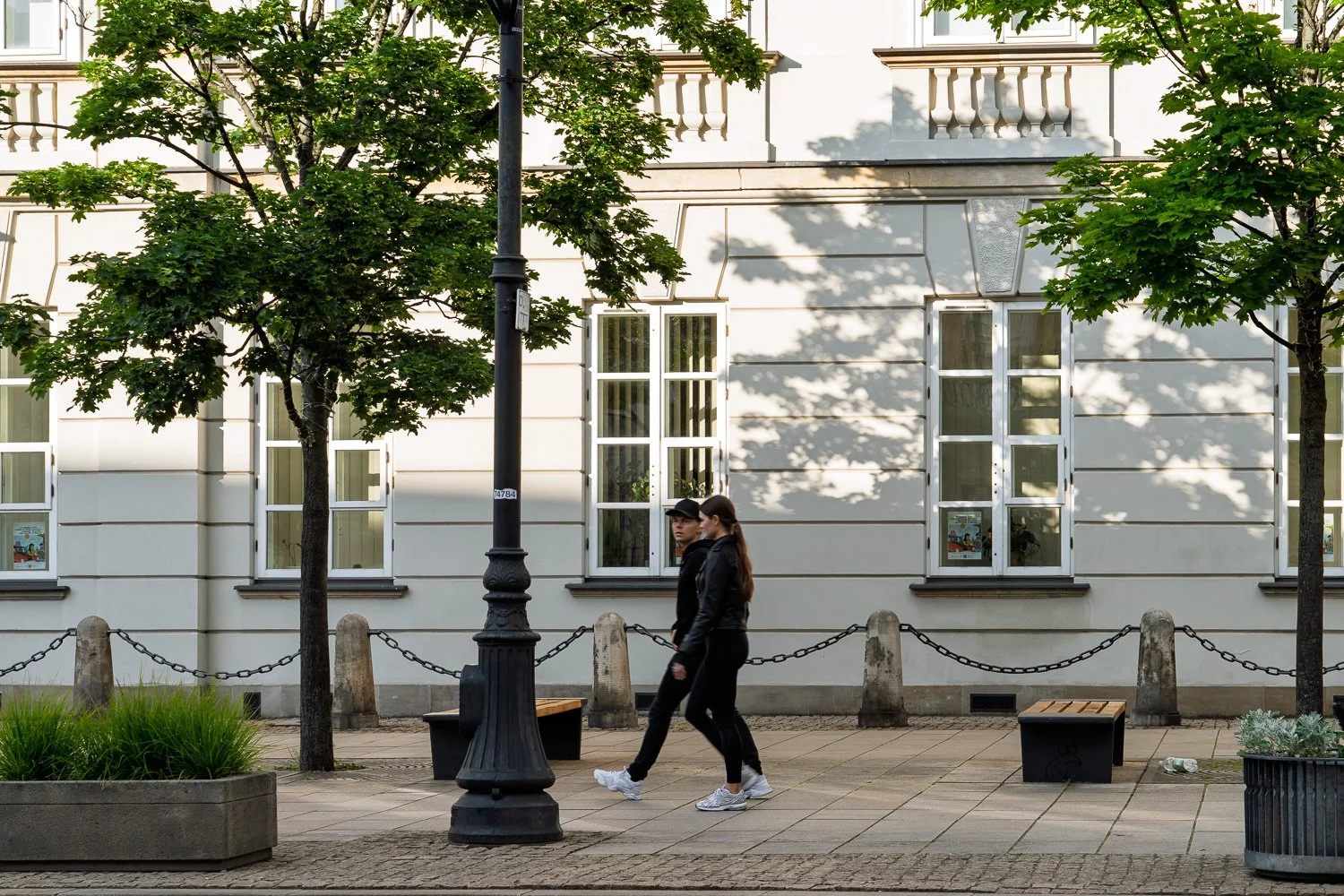
Evening Shadows — Sony a7R IV
Outside the Ministry of Culture and National Heritage, two Polish flags hung over the entrance, and a gilded lantern crowned the gatepost beside a wrought-iron gate. Three women crossed the frame at different speeds: one in a black hoodie, head bowed over her phone, and two friends walking together, one in a grey trench coat and cap, the other dressed entirely in white, from beret to trainers. The flags were the first sign of what the next day would bring, though I did not know it yet.
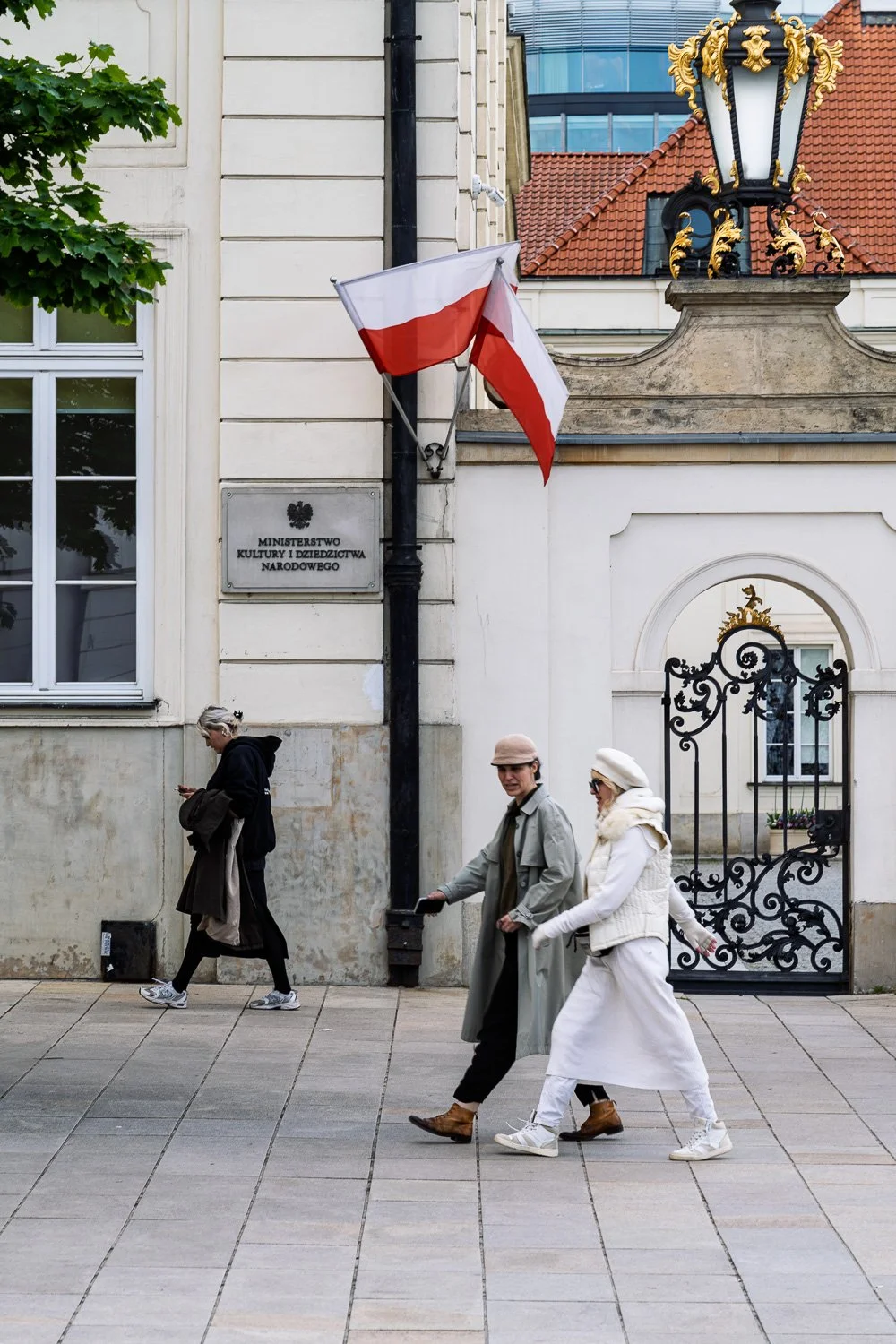
Three Speeds — Sony a7R IV
The Royal Route After Dark
When the light went, the Royal Route changed character completely. Under the trees, the front of Cafe Trakt lit up: since 1959 in white neon, a long red neon sign hung with fairy lights, and smaller signs for zapiekanki, tortillas and natural ice cream. People sat at the terrace tables while others crossed in front of the camera, blurred by a slow shutter. It is the kind of light that turns ordinary movement into something theatrical without anyone trying.
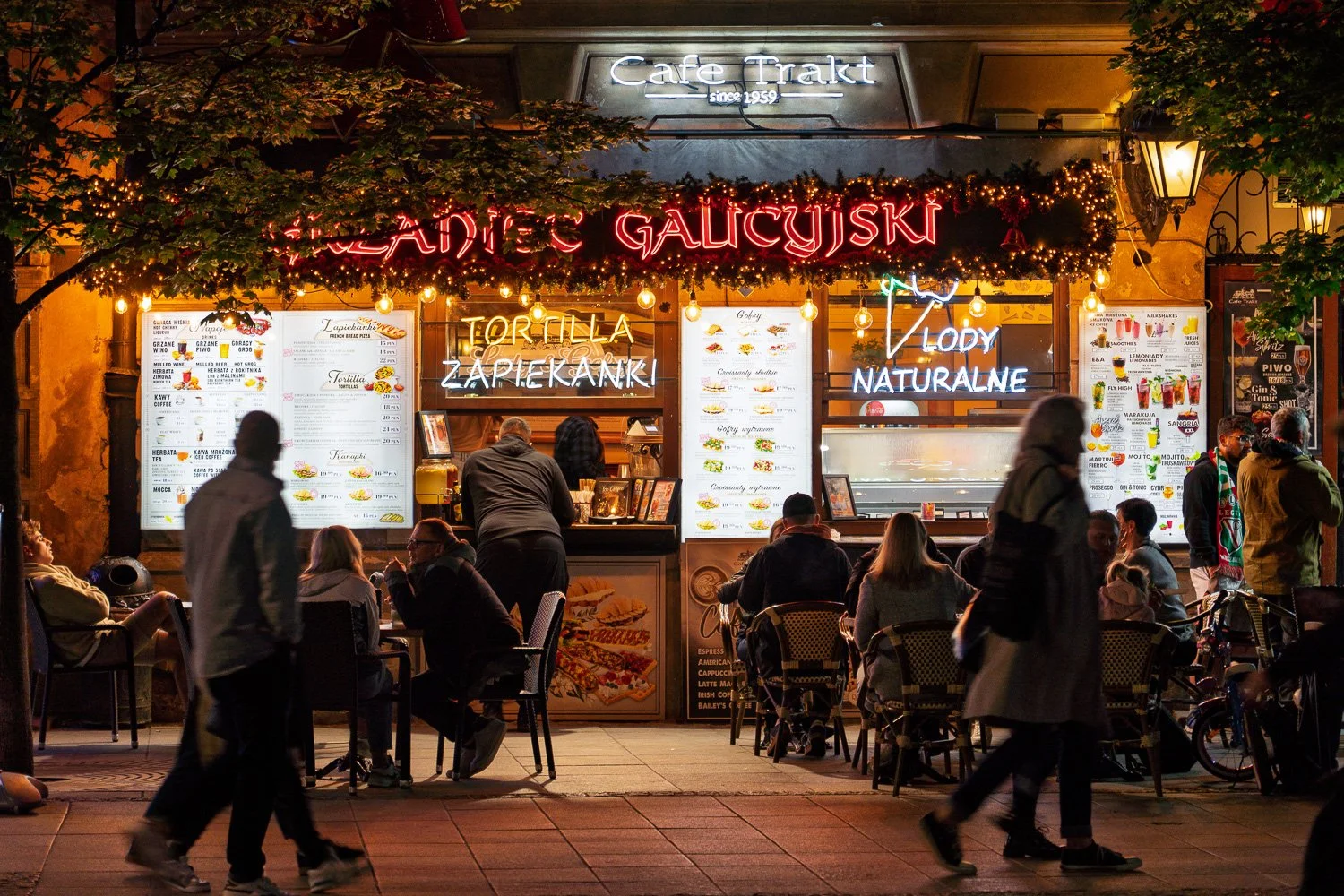
Since 1959 — Sony a7R IV
Further down, the pierogi restaurant Zapiecek glowed red and orange from end to end: arched neon signs, flags, a striped awning and a long terrace full of people under strings of bulbs. Two waitresses in red dresses scattered with bright folk-coloured dots moved between the tables. I photographed it straight on, the way you would photograph a stage at the end of a show, with the pavement empty in front and the whole cast lit behind.
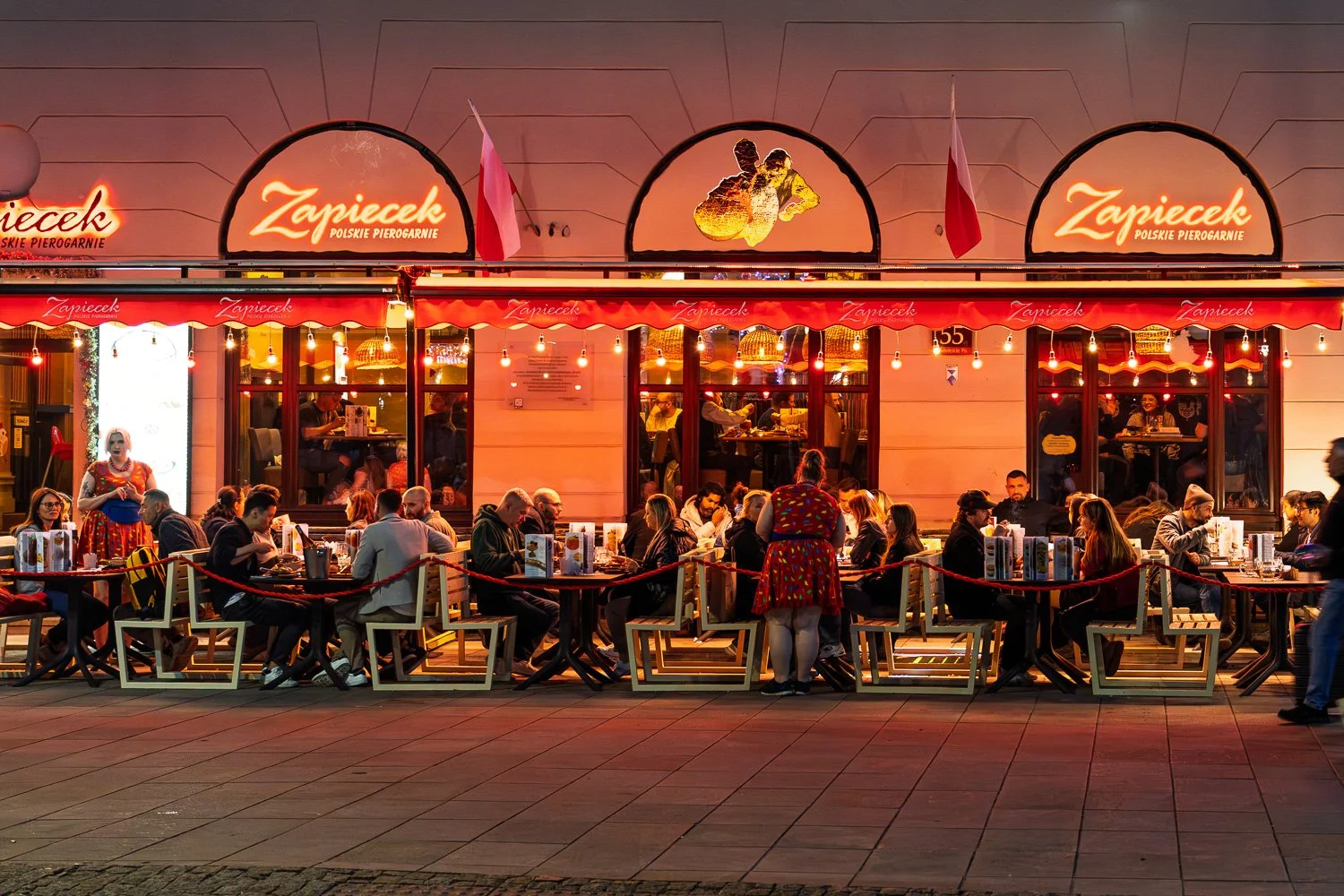
End of the Show — Sony a7R IV
Next door, a musician in a backwards white cap and a denim shirt sat under a wall of artificial jungle leaves, singing into a microphone with an acoustic guitar on his knee. Above him, the letters KLAR glowed in marquee bulbs. In front of him, nobody seemed to be listening: the diners in the foreground talked among themselves, and a waiter in a black T-shirt leaned across a table with a grin. Street music on a terrace is always half concert and half background, and this frame sits exactly on that line.
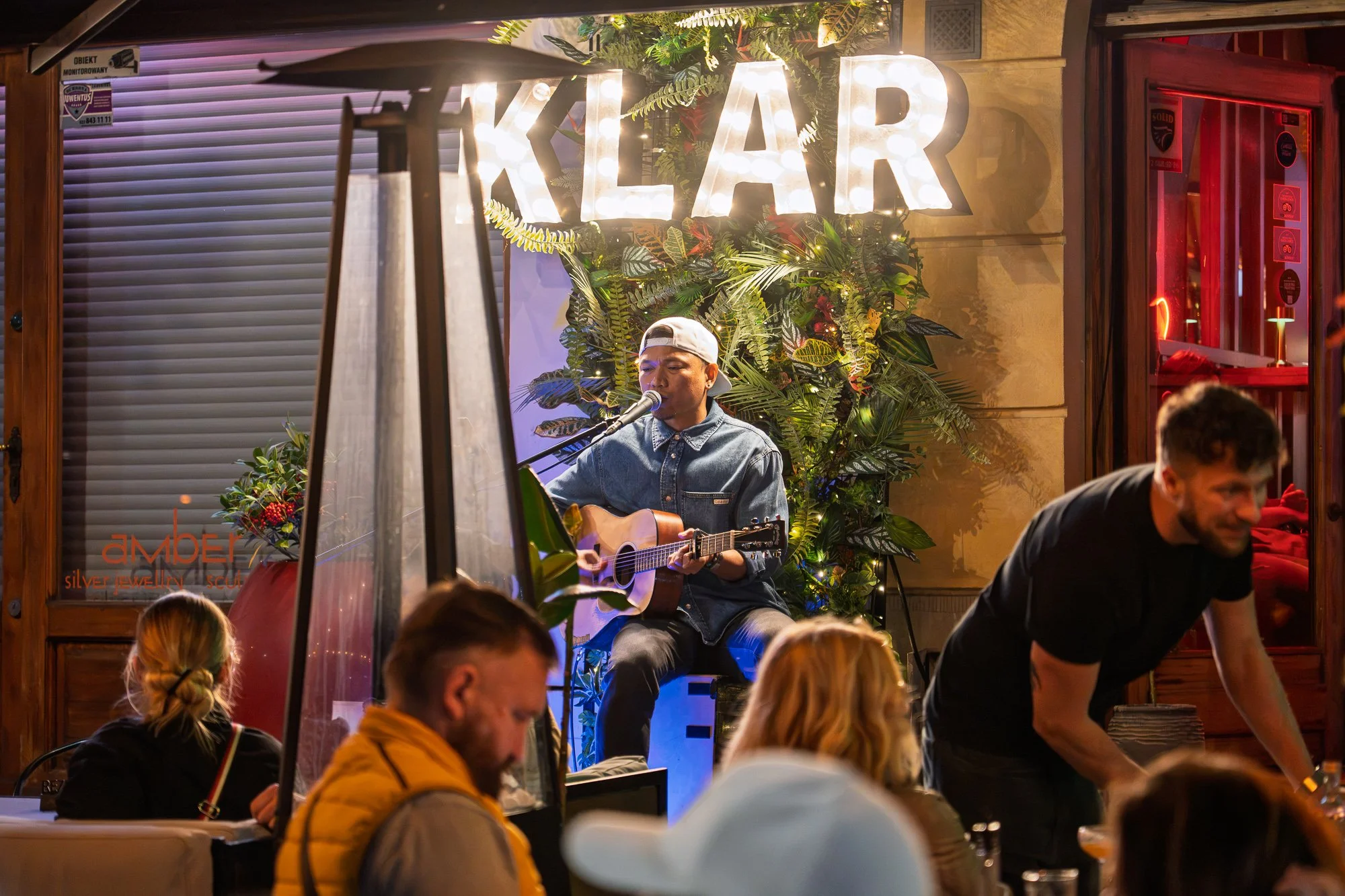
Half Concert, Half Background — Sony a7R IV
Sunday: The Royal Route Under Flags
The next morning the same street looked different. It was Sunday 25 May, a week before the second round of Poland's presidential election, and two rival marches crossed the centre of Warsaw. We had expected tension. What we found surprised us: both marches were calm, good-humoured, almost festive. Families walked with children, older couples carried small paper flags, and people stepped aside for each other on the pavements. The courtesy and civic spirit of the day stayed with us long after we left.
At the edge of the crowd, an older woman in a magenta ruffled coat over a pink lace dress stood still to check her phone, a small red and white flag tucked against her chest, her hair lifted by the wind. Behind her, the dark green of the yews made the colour almost unreal. She was part of the march and outside it at the same time, looking for someone, or for a message.
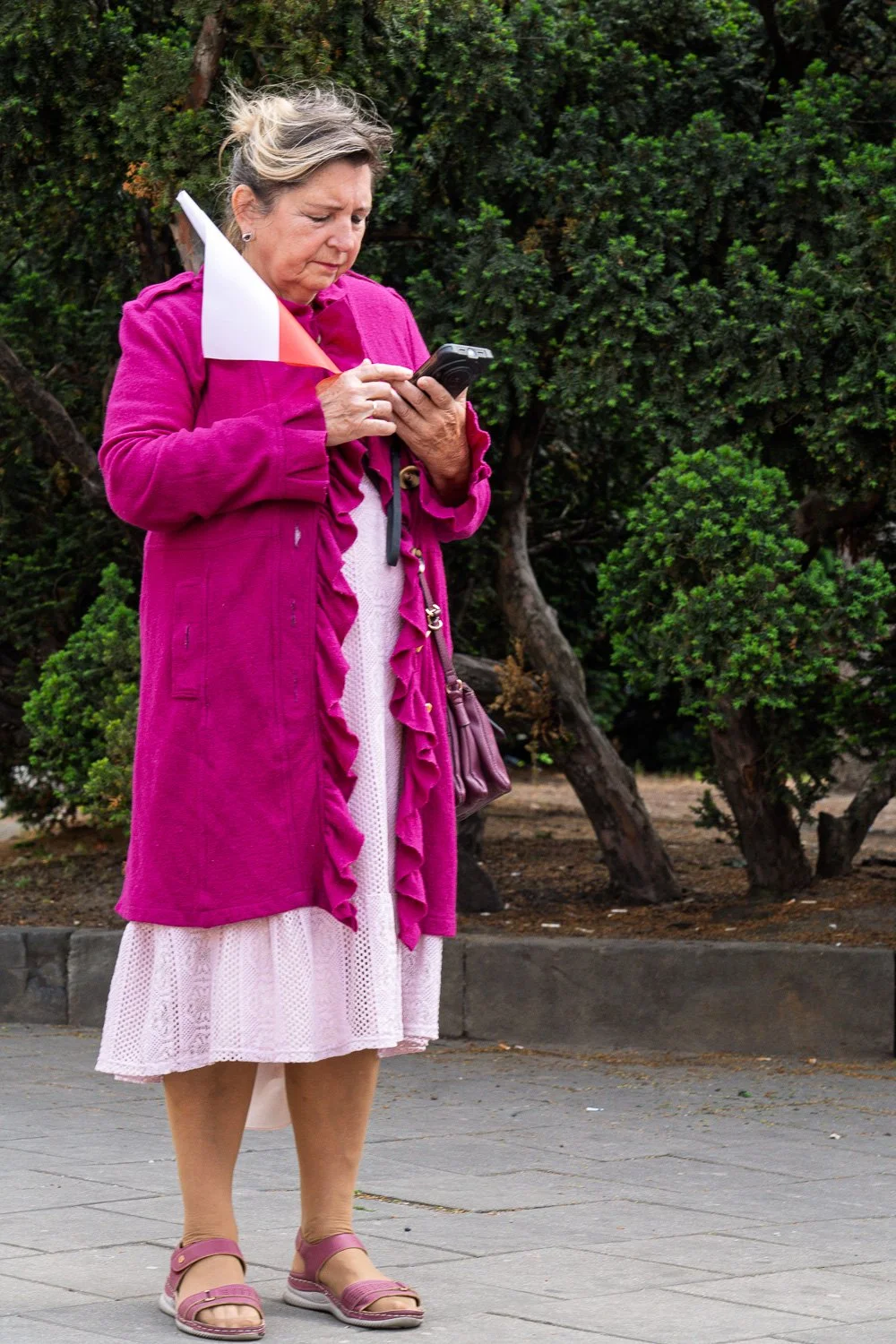
Looking for Someone — Sony a7R IV
The street did not stop being a street. Two young women in white sweatshirts walked along the pavement carrying enormous holographic Lancôme bags, part of a cosmetics promotion, laughing to each other. Behind them, on the road, the march went by with its flags. Neither group paid the other any attention, and that indifference is the photograph: one Sunday, two completely different reasons to be on the same pavement.
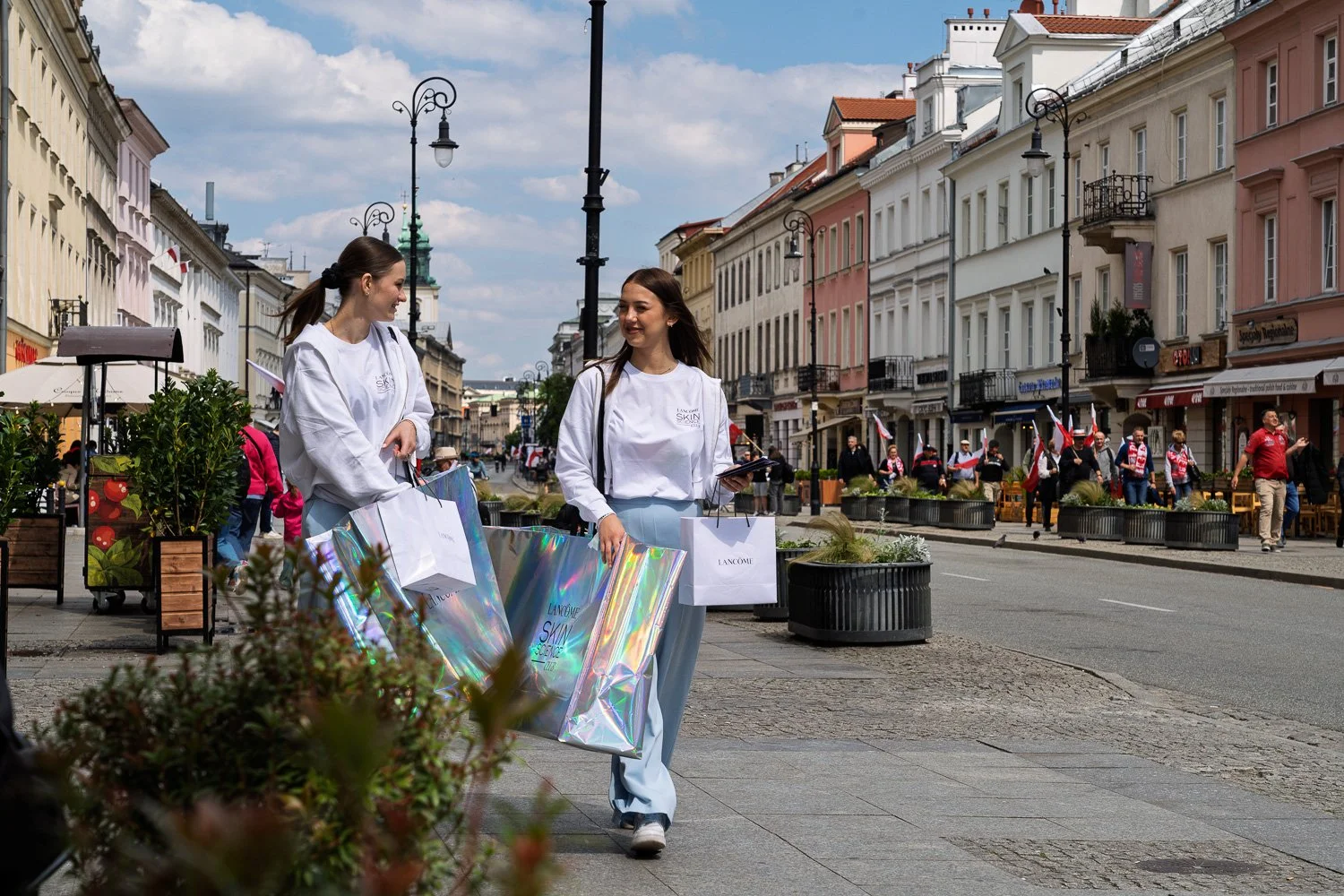
Same Pavement — Sony a7R IV
In front of the main gate of the University of Warsaw, with its baroque pavilions and statues, marchers with flags passed under the lamp posts. A cyclist in a teal jacket and helmet rode through the foreground looking down at his phone, as if none of it were happening. With the 24–105mm zoom on the Sony a7R IV I could stay on the opposite pavement and let the layers build: cyclist, crowd, gate, flags, and the white building on the right closing the frame.
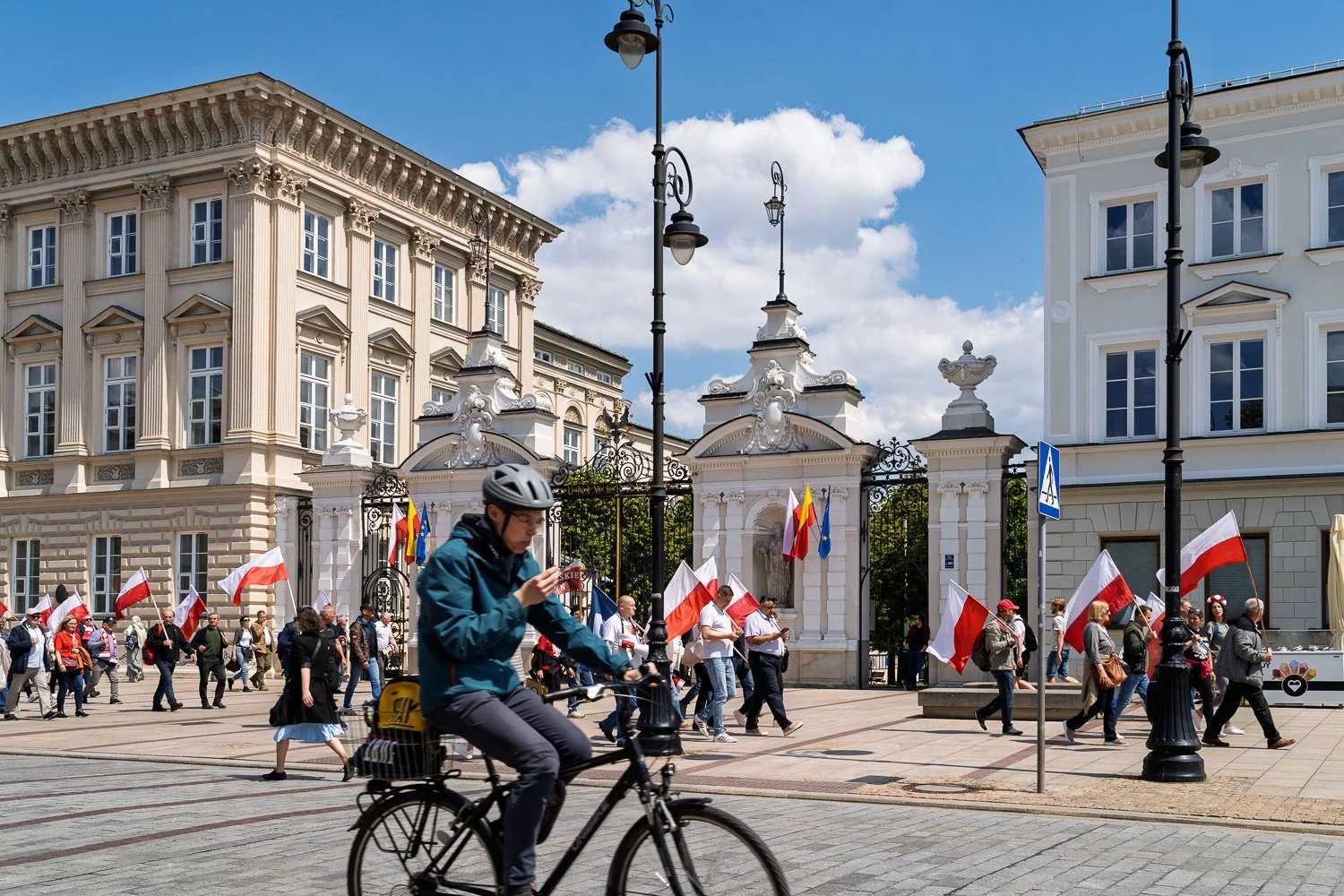
Layers — Sony a7R IV
The Tomb of the Unknown Soldier and the Woman in Flowers
A short walk west of the Royal Route, on Piłsudski Square, stands the Tomb of the Unknown Soldier, the only surviving fragment of the Saxon Palace, which German troops blew up in December 1944. The palace itself is now being rebuilt, and large panels with old photographs of its arcades stood around the square. A guard has stood here almost without interruption since 1925, and on some Sundays the ceremonial change is carried out by other uniformed services. That day the patches on their sleeves belonged to the customs and tax service.
The officer leading them marched with his sabre held out across his body, gloved hand on the hilt, his black boots catching the light. Behind him, the photograph of the vanished palace filled the background. A man in uniform, a weapon held for ceremony, and the image of a building that no longer exists but is being built again: it is the whole of Warsaw in one frame.
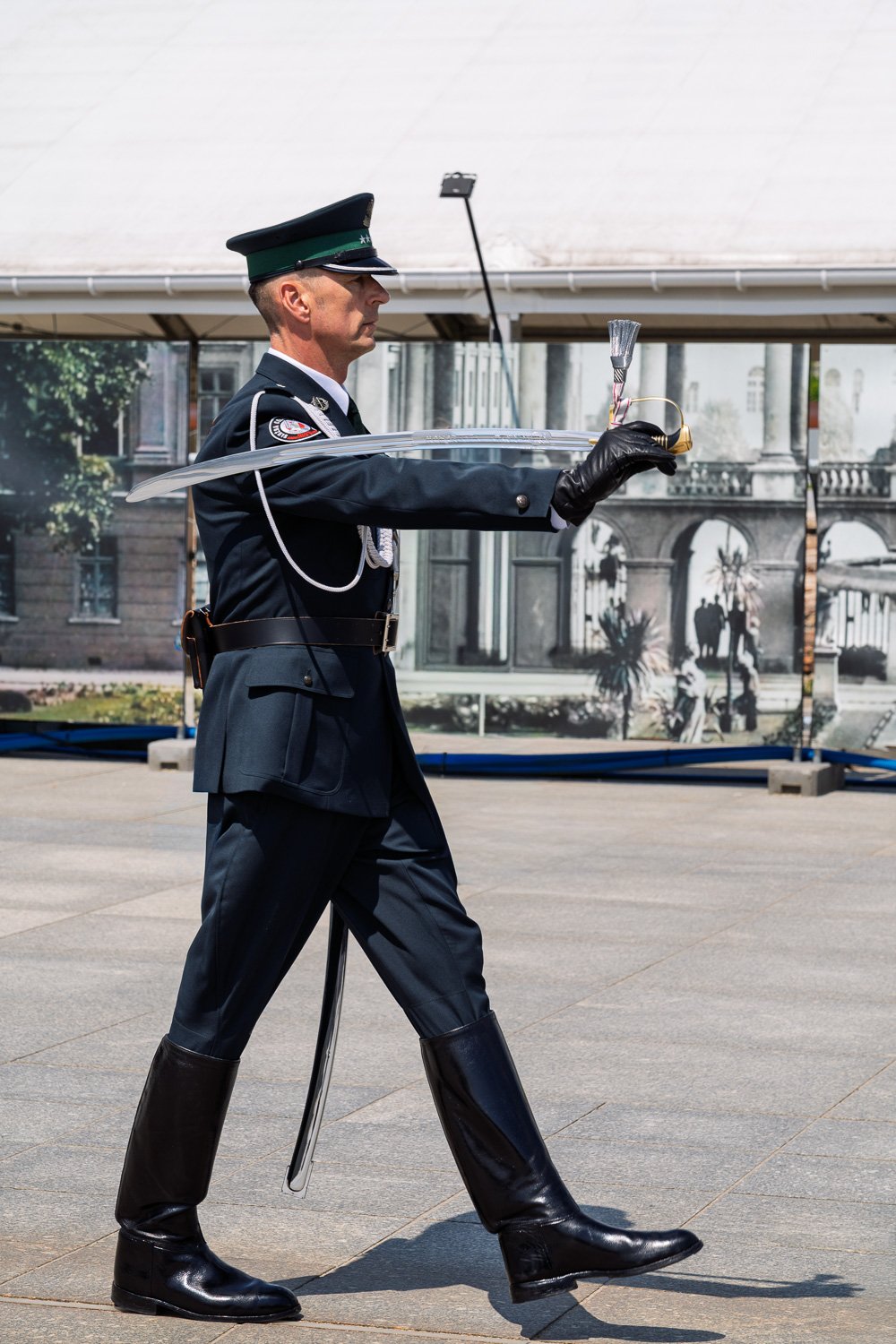
The Vanished Palace — Sony a7R IV
Under the colonnade, against the white of the sky, the soldiers standing permanent guard became silhouettes: a peaked cap, a rifle with a fixed bayonet, the white eagle on a sleeve, and the dark shapes of the braziers on either side. I underexposed for the sky and let everything else go black.
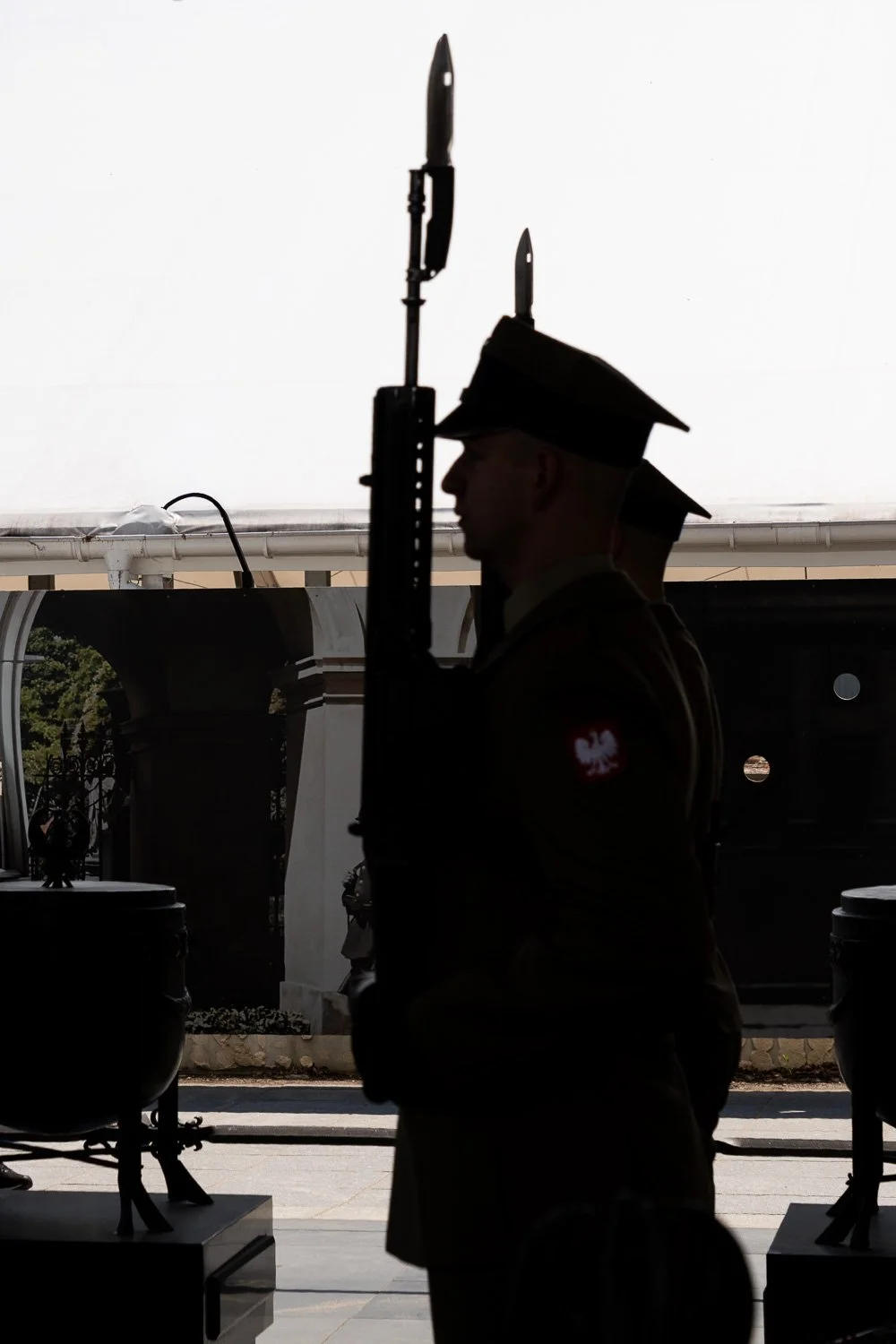
Permanent Guard — Sony a7R IV
And then, back on Krakowskie Przedmieście, the day ended with the most extraordinary costume of the whole trip. A woman sat on a bench dressed entirely in artificial flowers: hat, dress, gloves and shoes covered in roses, peonies and hydrangeas, a large butterfly pinned to her chest. Her bicycle, parked beside the bench and decorated to match, carried a sign that read Wiosna pozdrawia, spring sends its greetings. She laughed at something beyond the frame, completely at ease. After two days of flags, uniforms and neon, spring had the last word.
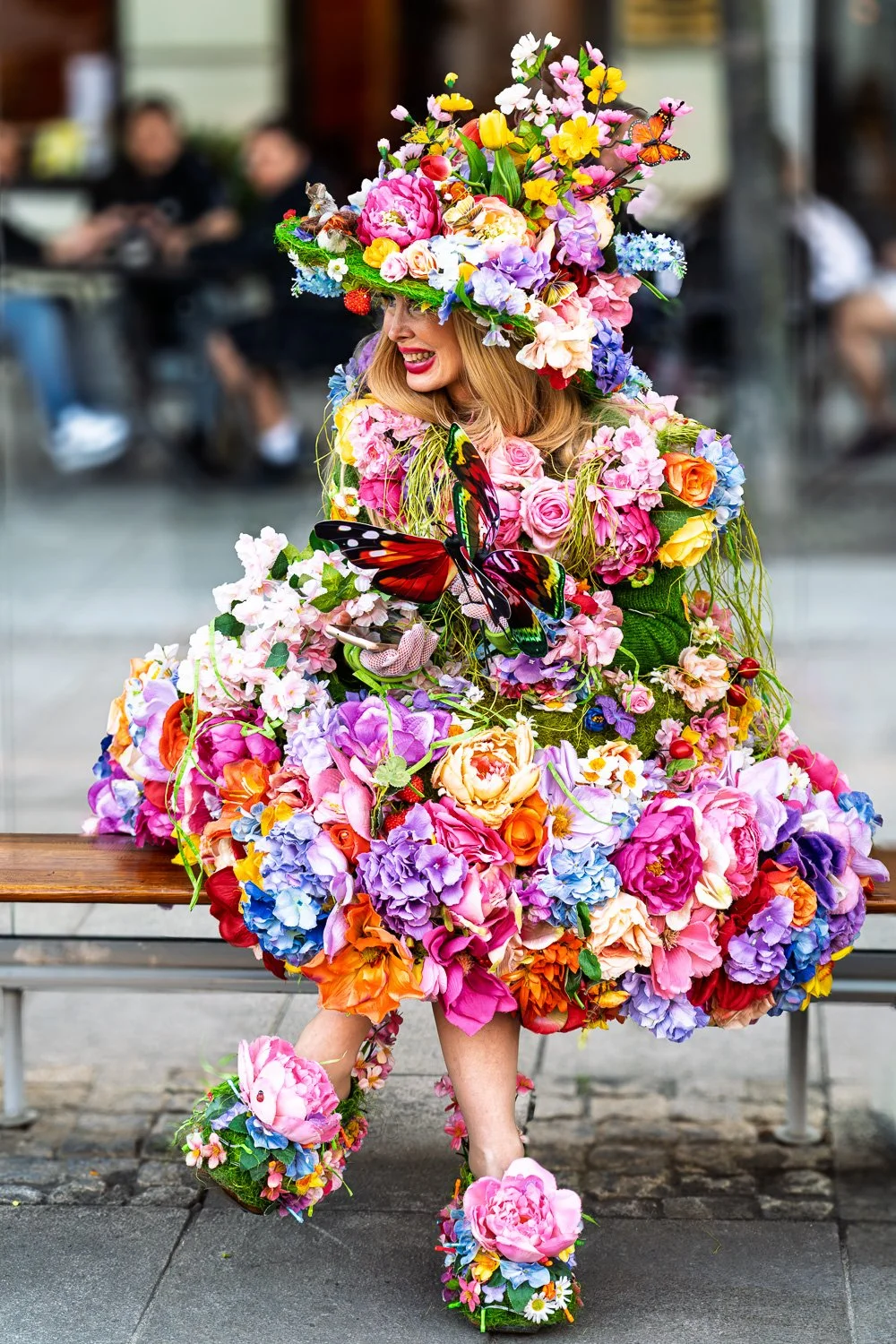
Spring Has the Last Word — Sony a7R IV
If you go, walk the Royal Route twice: once in the long evening light, and once on a Sunday, when the whole city seems to come out onto it.
This is the second part of my Warsaw walk. The first, through the costumed cast of the Old Town, is in Warsaw Old Town Street Photography: A City in Costume.
Subscribe to the newsletter to receive new walks first, along with a free street photography guide.
Photos: Sony a7R IV · Sony FE 24-105mm f/4 G OSS · Warsaw, May 2025
See more street photography in the portfolio. Every photograph in this post is also available as a fine art print.
Cosme Lapena is a Barcelona-based street and urban photographer and founder of bCLPhoto.
Exhibited at espai [b] since 2010 · Contributor at 35mmc. Browse the portfolio or read more on the blog.