Barceloneta Street Photography: Life on Four Sides
Barceloneta street photography starts from one simple fact: this neighborhood lives on all four sides. People here love the street. They carry a chair outside to talk with the neighbors, they walk the promenade, they swim in November. Between the port and the Mediterranean, La Barceloneta has a light of its own, and the sea gives it its character.
It is a fishermen's quarter that has always lived from the sea, laid out in the 18th century for families displaced by the building of the Ciutadella, as the neighborhood's history records. The changes that came with the 1992 Olympic Games opened the beach to the rest of the city and to the millions of visitors who arrive every year. Today the sea belongs less to the fishermen than to swimmers, walkers, runners and athletes, and to people who come to sit in the sun or to see what is happening on the promenade. Something always is.
These photographs come from Sunday 19 November 2023, with the Leica Q3, plus one evening at the fishermen's wharf, in the order I took them.
Where Barceloneta Street Photography Begins: Joan de Borbó
On Passeig de Joan de Borbó, the first thing I found was the season. A chestnut seller had opened her wooden kiosk under the plane trees: two blackened roasting drums at the curb, a broom and a mop hanging on the door, a hand-lettered sign inside that reads Solo efectivo, only cash. Under her feet are the flower-pattern paving tiles of Barcelona. It is a frame about autumn in a city where autumn barely shows.
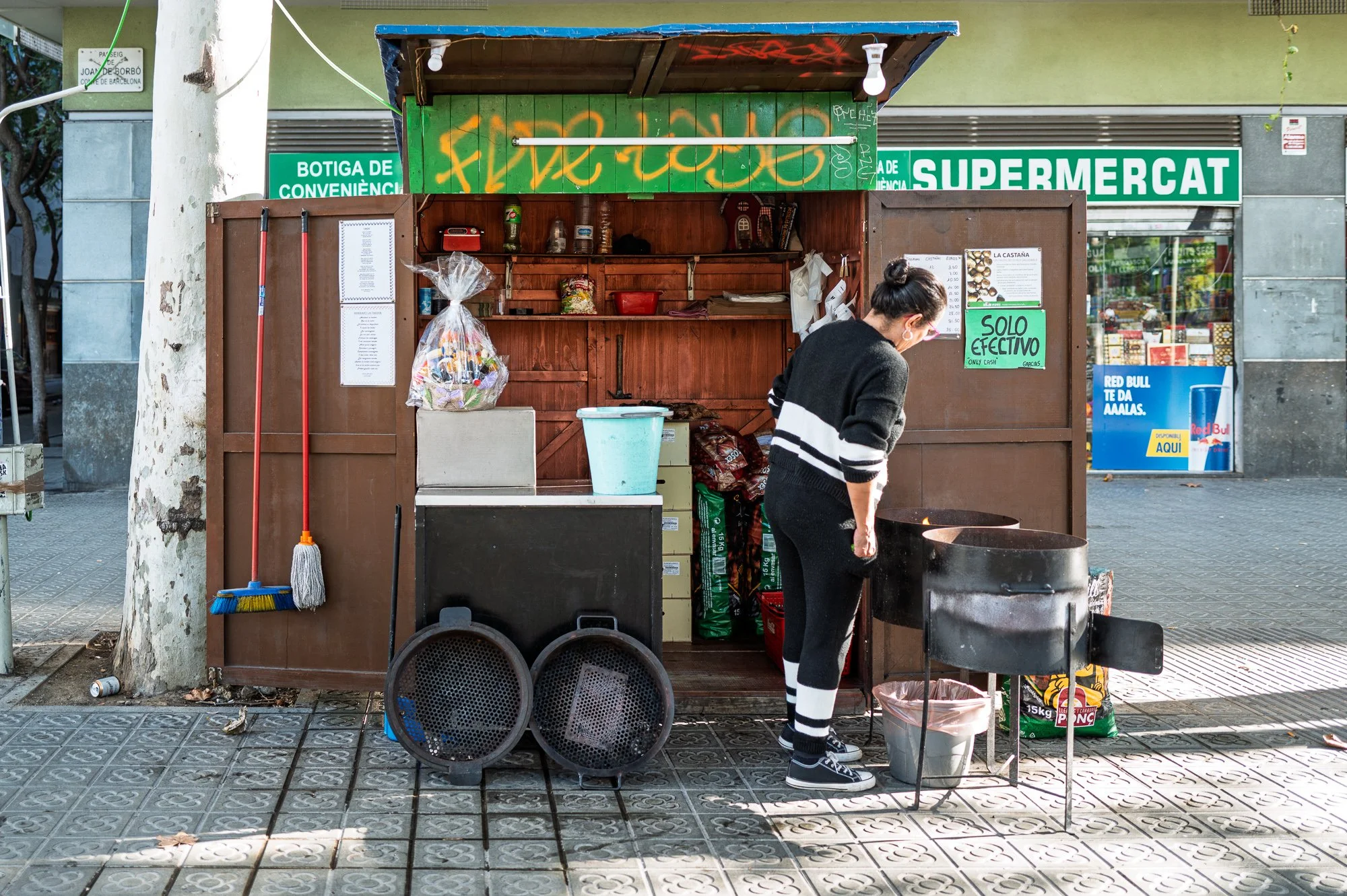
Chestnut Season on Joan de Borbó — Leica Q3
In a narrow side street, three people in respirator masks were painting the metal shutters of two shops. One sprayed a large green, blue and ochre shutter, another worked from a stepladder at the next one, and a third watched in a geometric-print tracksuit, the cans lined up on brown paper at their feet. When the shops close, the shutters become the face of the street, and here I watched one being made.
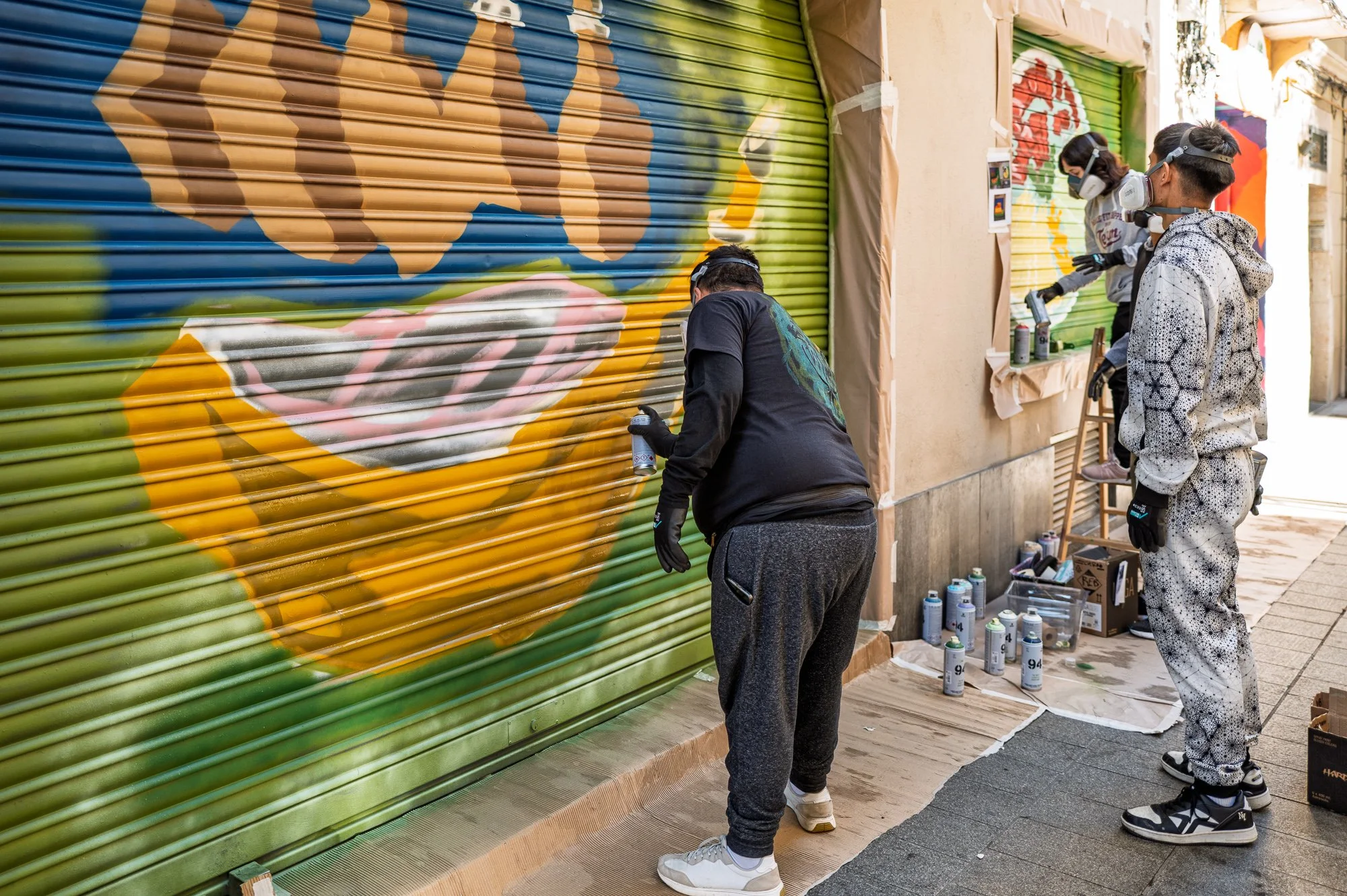
Painting the Shutters — Leica Q3
The Promenade and the Beach in November
On the promenade, the scale opens up. The railing runs straight toward the W hotel at the far end of the beach, its top covered in stickers, and the low November sun throws its shadow across the paving in hard diagonal stripes. A man in black walks away from the camera. The frame holds both halves of the neighborhood: the sand on one side, the city on the other, and a straight line between them.
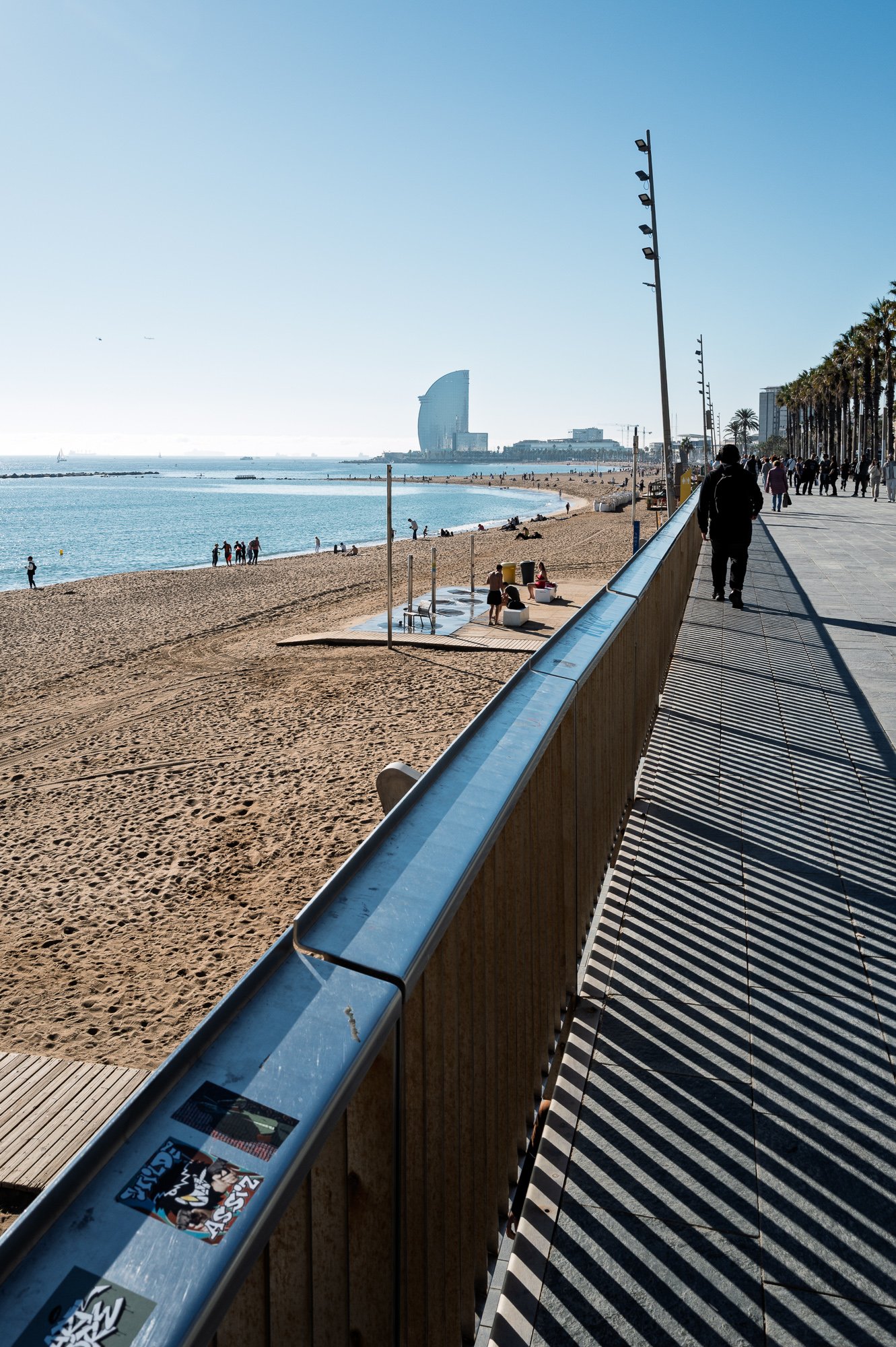
Between Sand and City — Leica Q3
Toward the northern end of the beach, a field of concrete loungers faces the sun, and that Sunday every one was taken. People read, scrolled, closed their eyes or put their feet up, and a small dog waited between two chairs. Behind them stand the lifeguard post, the palms, the two towers of the Port Olímpic and Frank Gehry's golden fish. It is the beach used as a living room, which is how the neighbors use it.
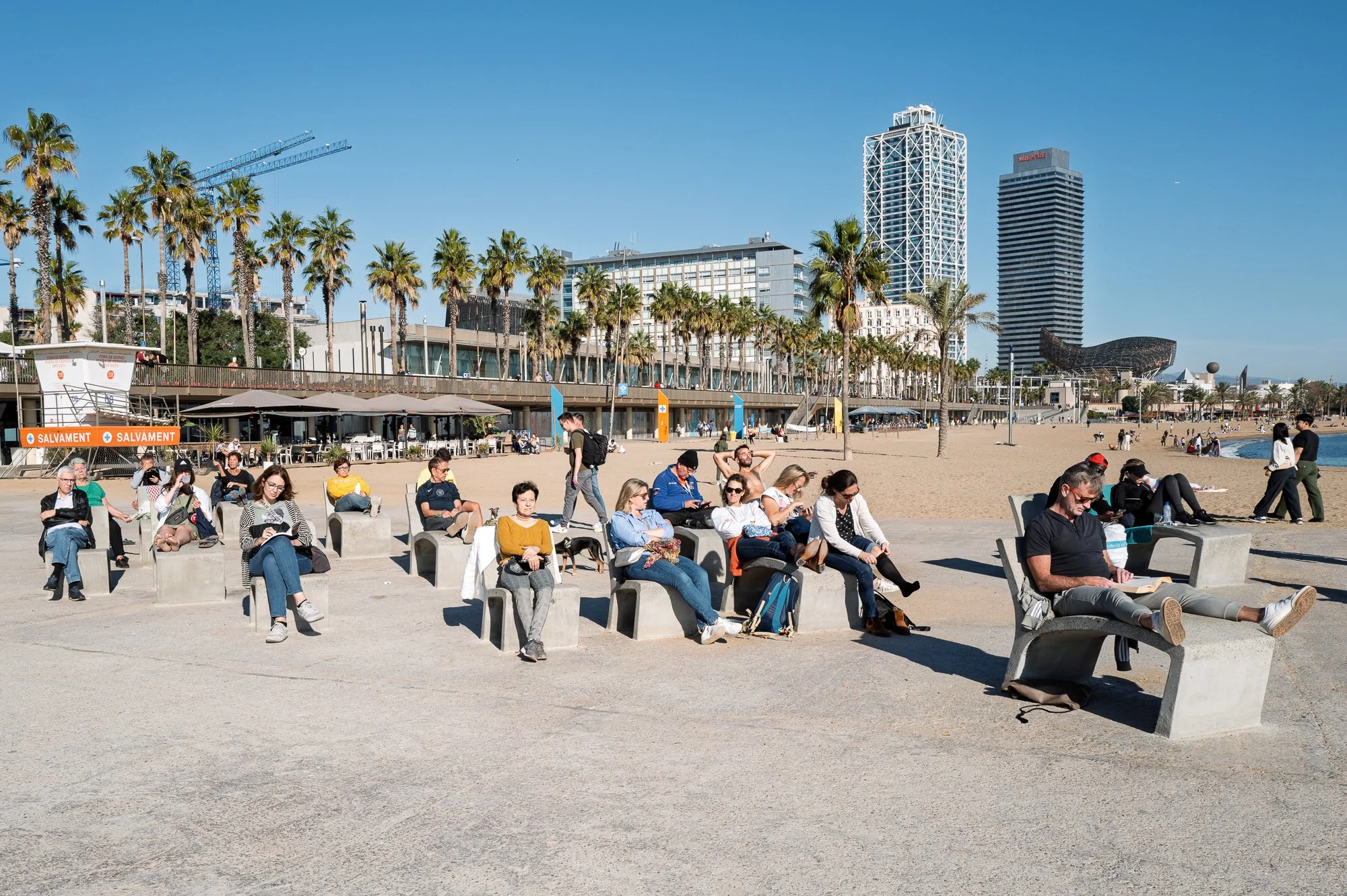
Beach as a Living Room — Leica Q3
A Calisthenics Park in the Middle of the Beach
The calisthenics park in the middle of the beach is something you don't expect. That day it was full of young people doing impossible things with sculpted bodies, and they plainly enjoyed showing them. A woman worked the suspension straps, a man rested on a mat, and the white steel frame threw long shadows across the green floor. I took a few photographs, discreetly. One person gave me a look that was not very friendly, so I stopped, although I think most of them would have been happy with a much fuller report.
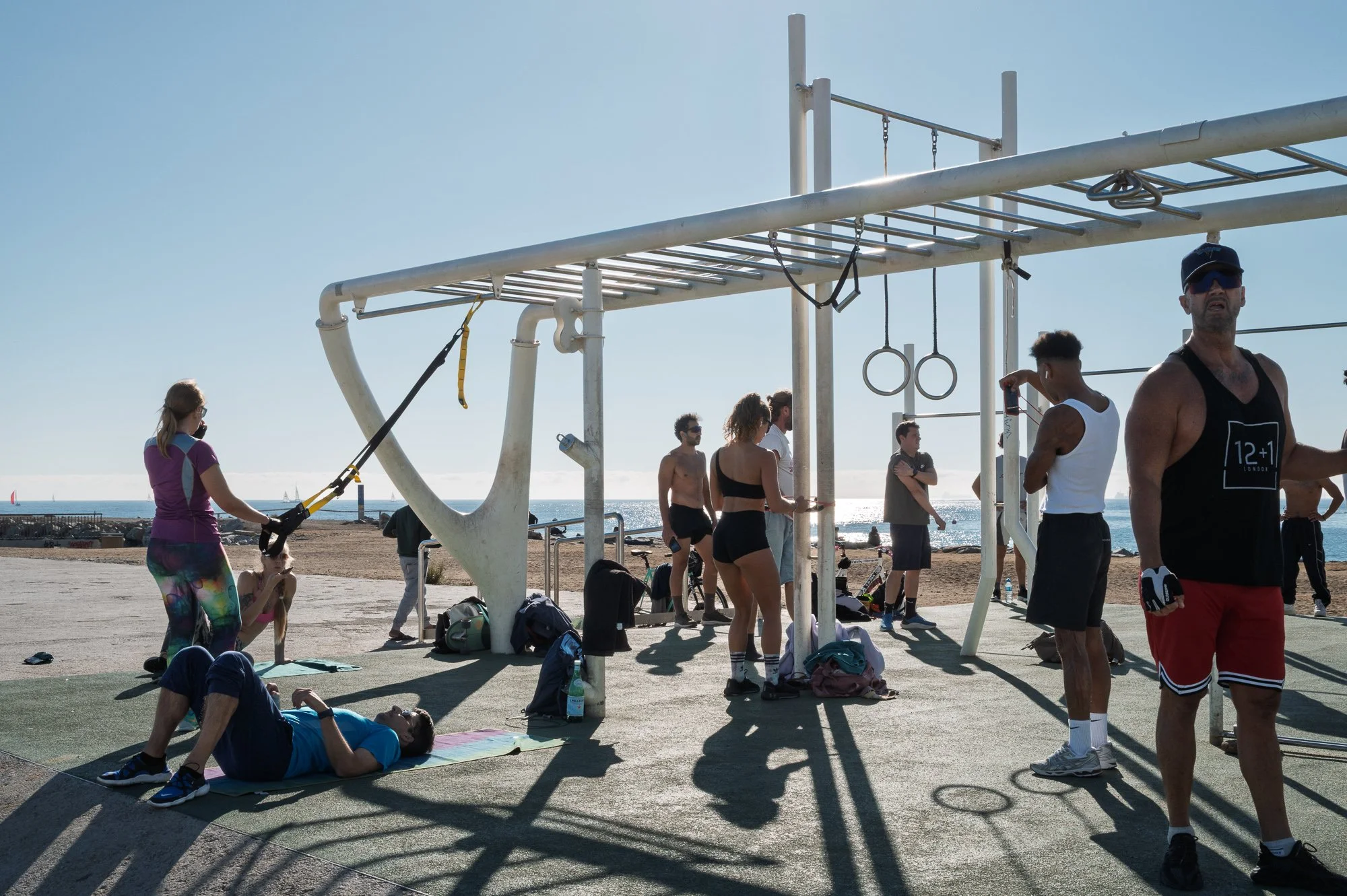
The Calisthenics Park — Leica Q3
A little apart, a young man was jumping rope. Shooting straight into the sun turned him into a silhouette: yellow rope, white socks, feet just off the ground, his shadow stretching back toward me. The curve of the W hotel enters at the right edge. Backlight is easy to overuse on a beach, but here it reduced everything to one figure and one shadow.
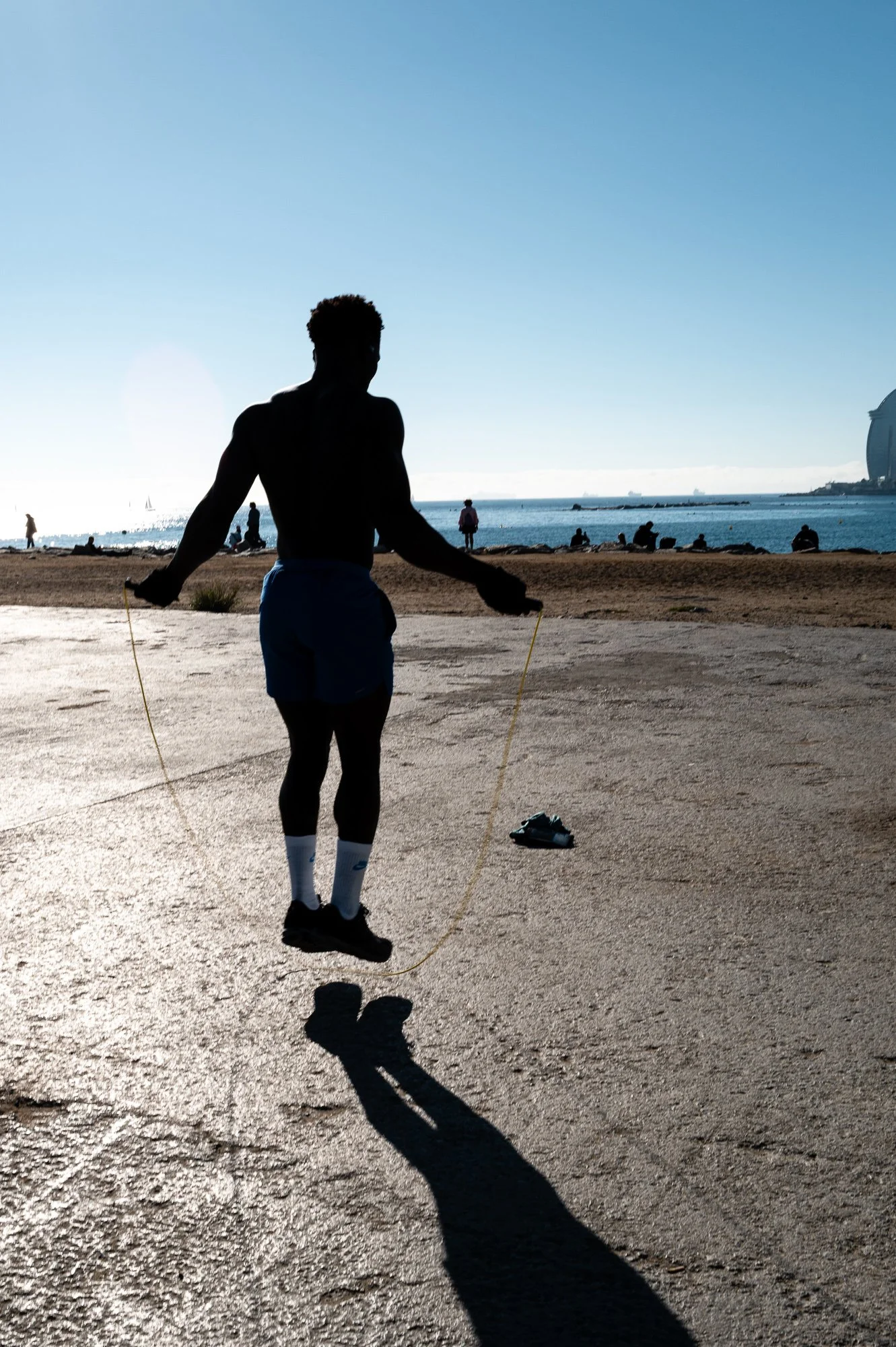
Jumping into the Light — Leica Q3
Out on the breakwater was a reminder of who the sea used to belong to. A fisherman in a white jacket and cap stood with his long rod angled into an empty blue sky, a folding stool and a shopping trolley beside him, while a plane's contrail cut across toward the tip of the rod. Of everything I photographed that day, this is the quietest frame.
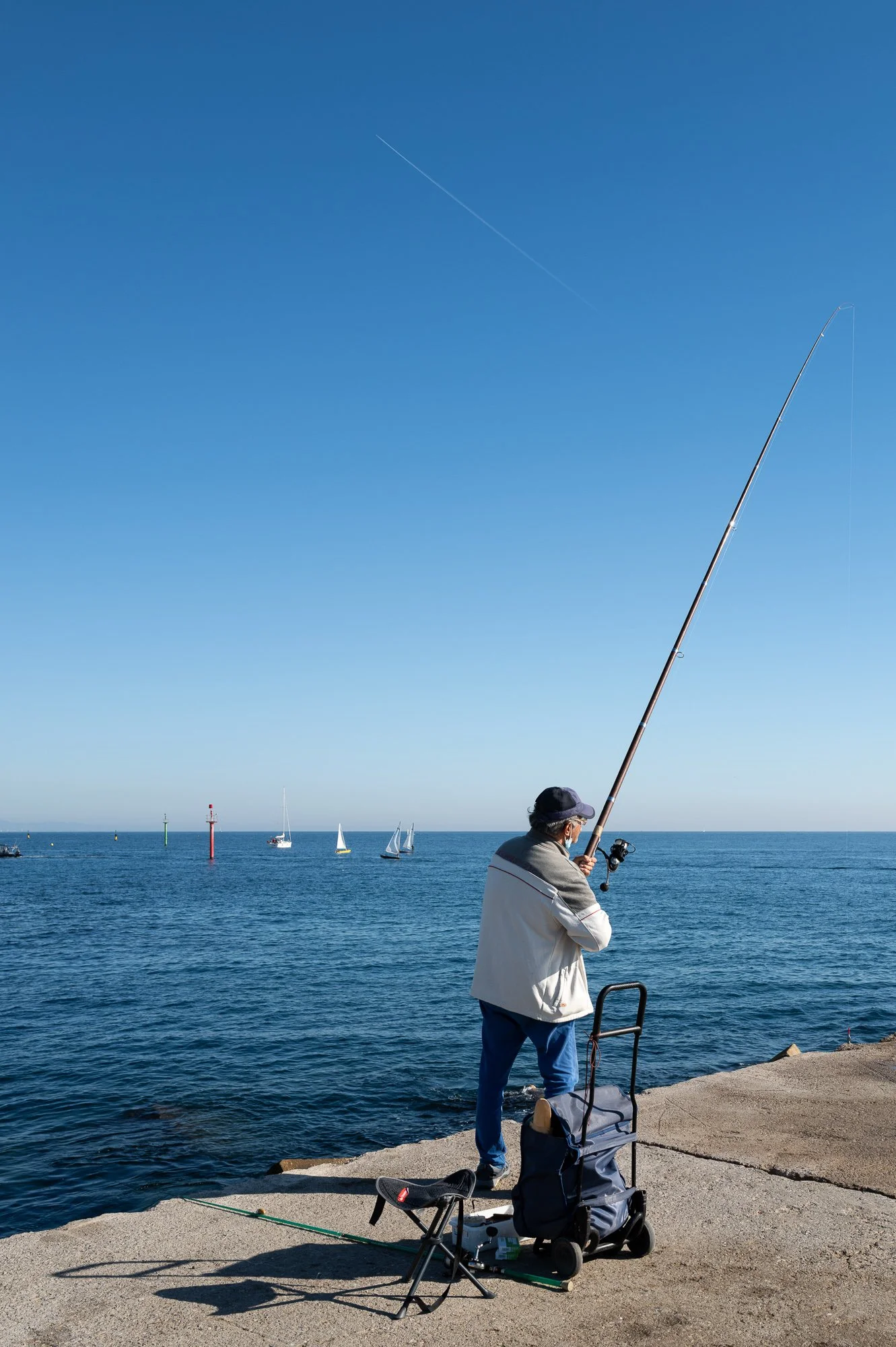
The Last Fisherman on the Breakwater — Leica Q3
Looking Down from the Promenade
Walking back, the promenade rises above the sand, and from up there the neighborhood shows another face. A group of men had set out plastic and folding chairs, half on the sand and half on the paving, and were doing what Barceloneta does best: talking with the neighbors. One checked his phone, one laughed, a few bottles stood in the sand, and a man in a cap walked straight through the middle. From above, the chairs and their shadows make the pattern, and the people make the story.
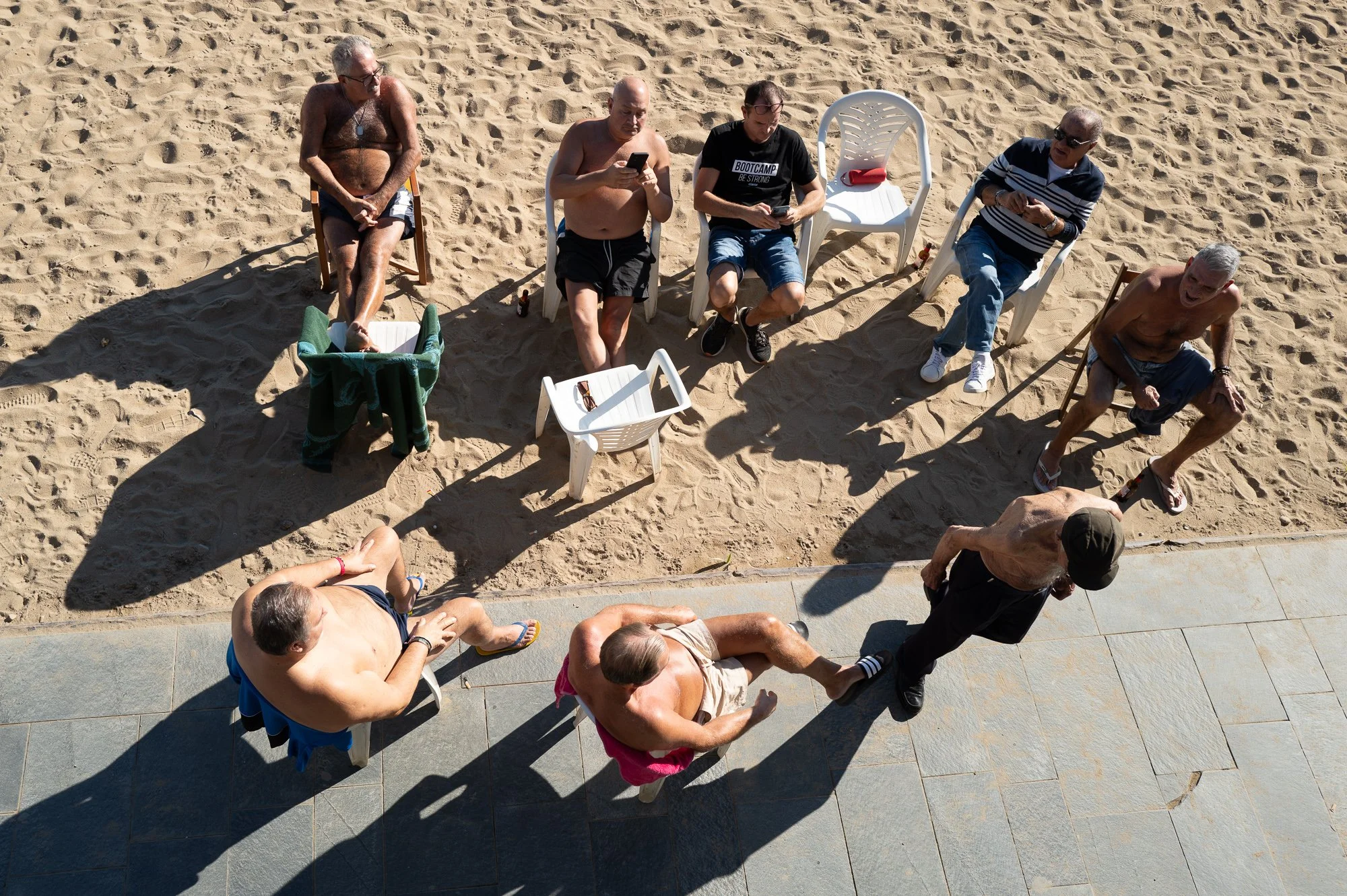
Talking with the Neighbors — Leica Q3
The beach furniture works from above too. A steel shower post stands in a circular drain cut with radiating lines, its shadow falling across them like the hand of a sundial. A woman with a backpack sat on the white bench beside it, facing the sea, while two women crossed the sand behind her with a lead stretched all the way to a small dog at the edge of the frame. Three separate stories, held together by geometry.
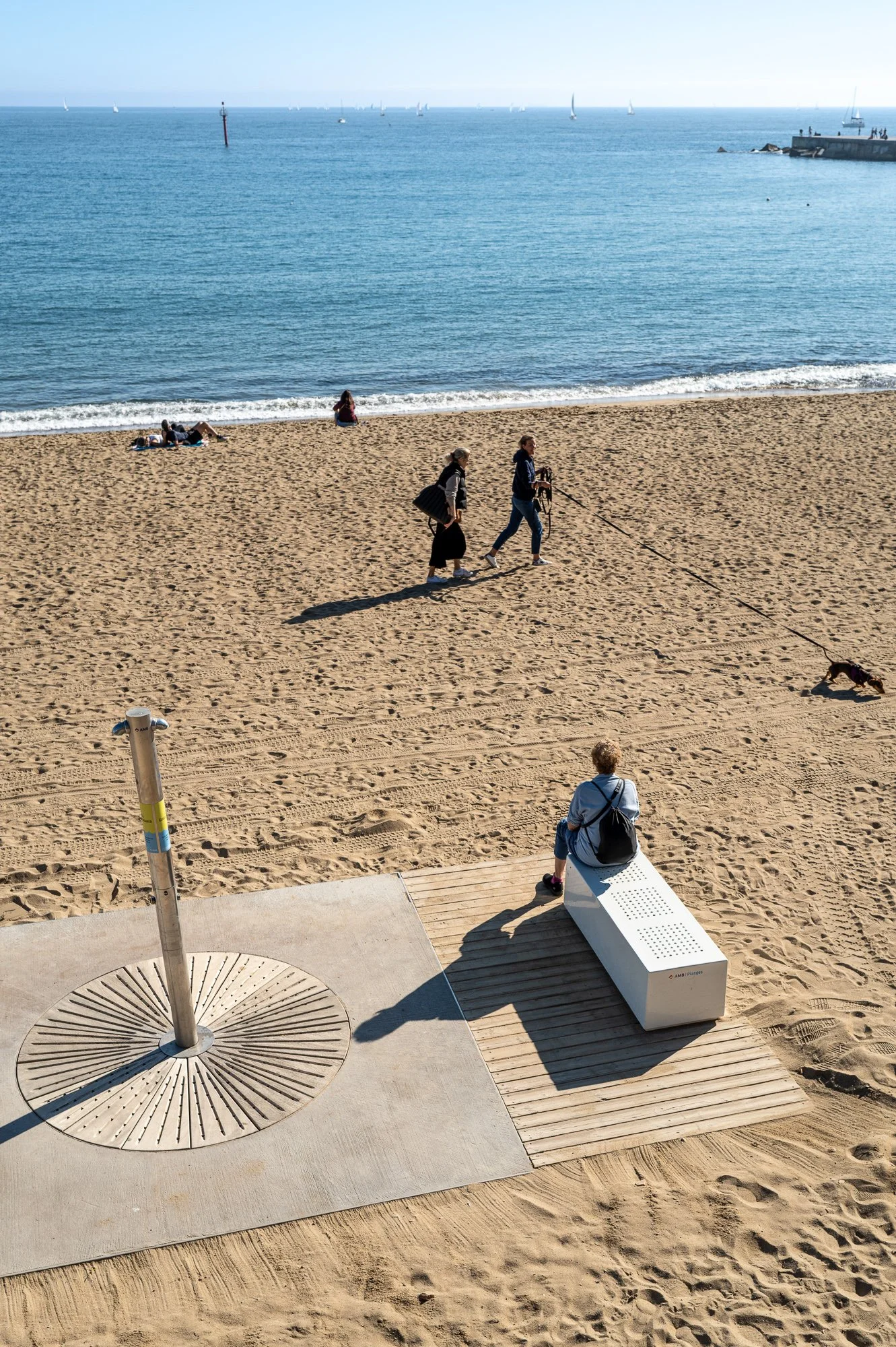
Beach Geometry — Leica Q3
A few steps on, I looked straight down onto a beach-bar terrace. Two women sat over beers at a table with orange chairs and green placemats, deep in conversation, while a sparrow perched on the rail. Beyond the decking, a line of white sandbags separated the terrace from the beach, and one swimmer was out in the sea. That morning I had photographed a chestnut seller. That is November in Barceloneta.
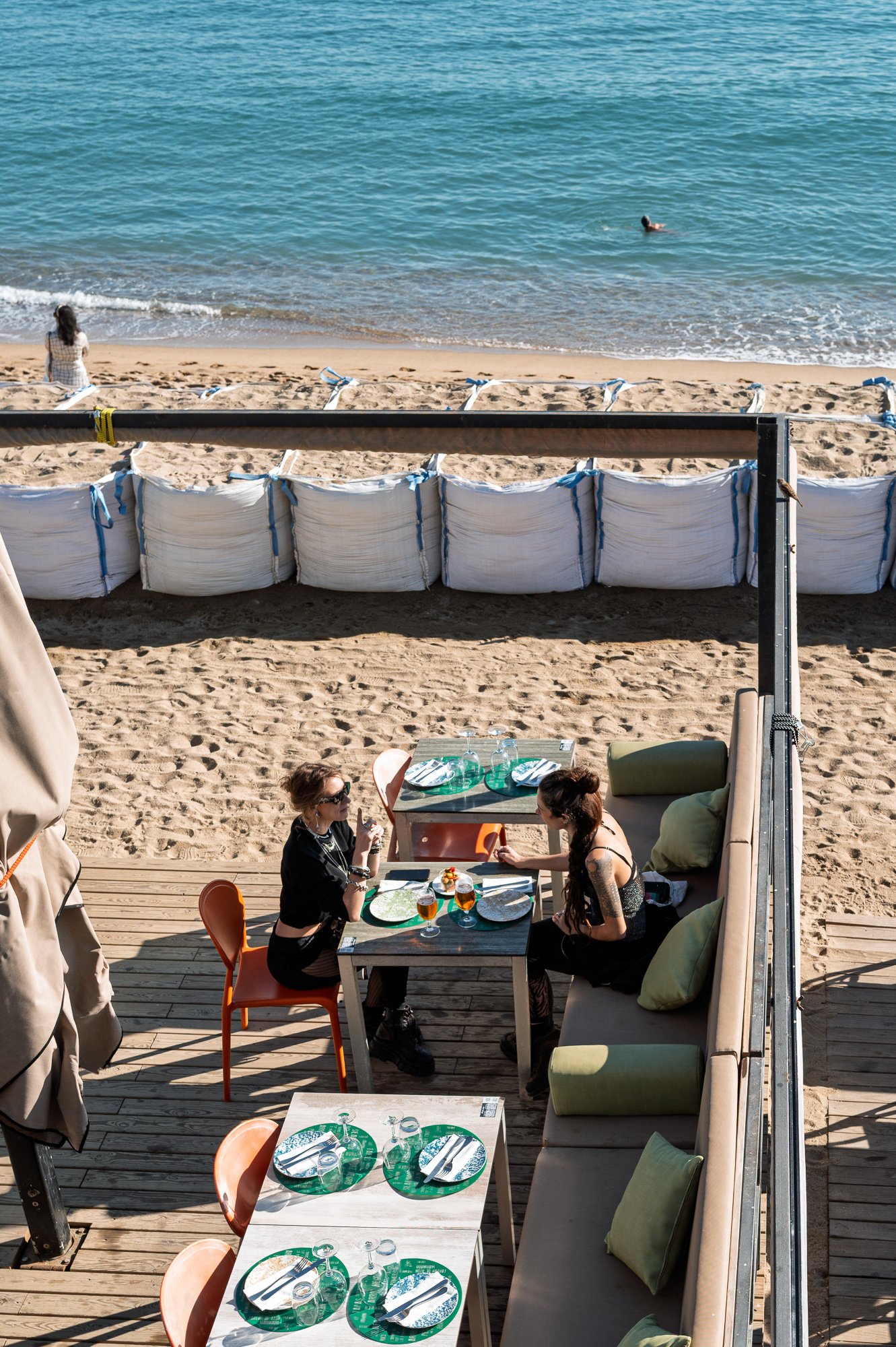
Lunch Above the Sandbags — Leica Q3
Then the seagull, perfectly still on top of a steel pole in the exact center of the frame, above a beach where nobody else was still at all: a young man standing bare-chested on the sand, a woman lying on a towel at his feet, paddle boarders on the water and dozens of white sails on the horizon, with a single red one at the far right. I composed it symmetrically on purpose. The pole divides the picture, and the gull sits on top like a full stop.
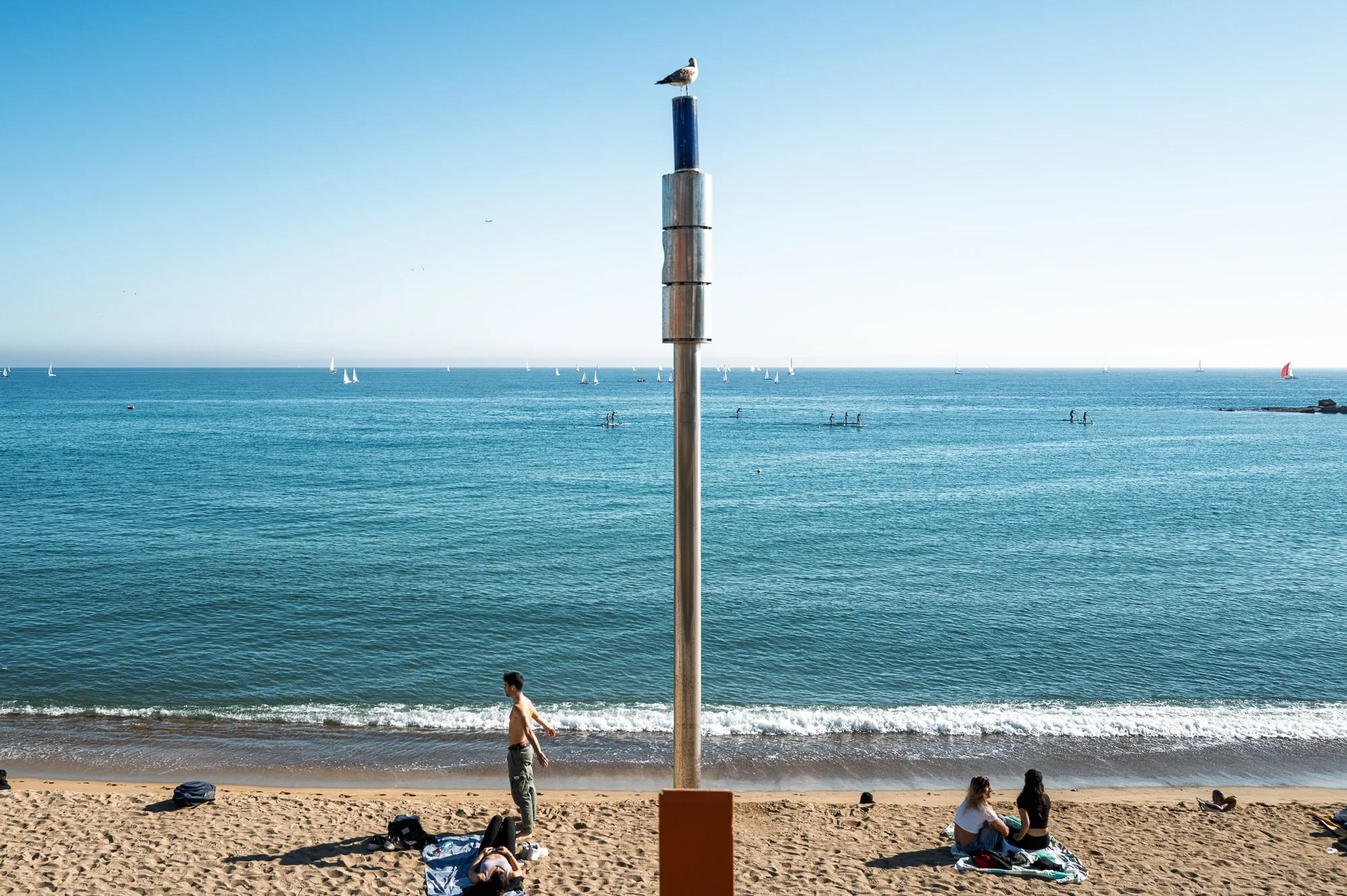
The Full Stop — Leica Q3
Joan de Borbó and the Fishermen's Wharf
I finished the day back on Passeig de Joan de Borbó, the street of restaurants that faces the port. Through one window, the glass did two jobs at once. Inside, an elderly woman in a red scarf smiled across the table, a hand reached for a beer and a waiter took an order. Over them, the window reflected the trees and the brick building across the street, under lettering that promised traditional paellas. Reflections are one of my constant subjects, and here one sheet of glass held the meal and the street together.
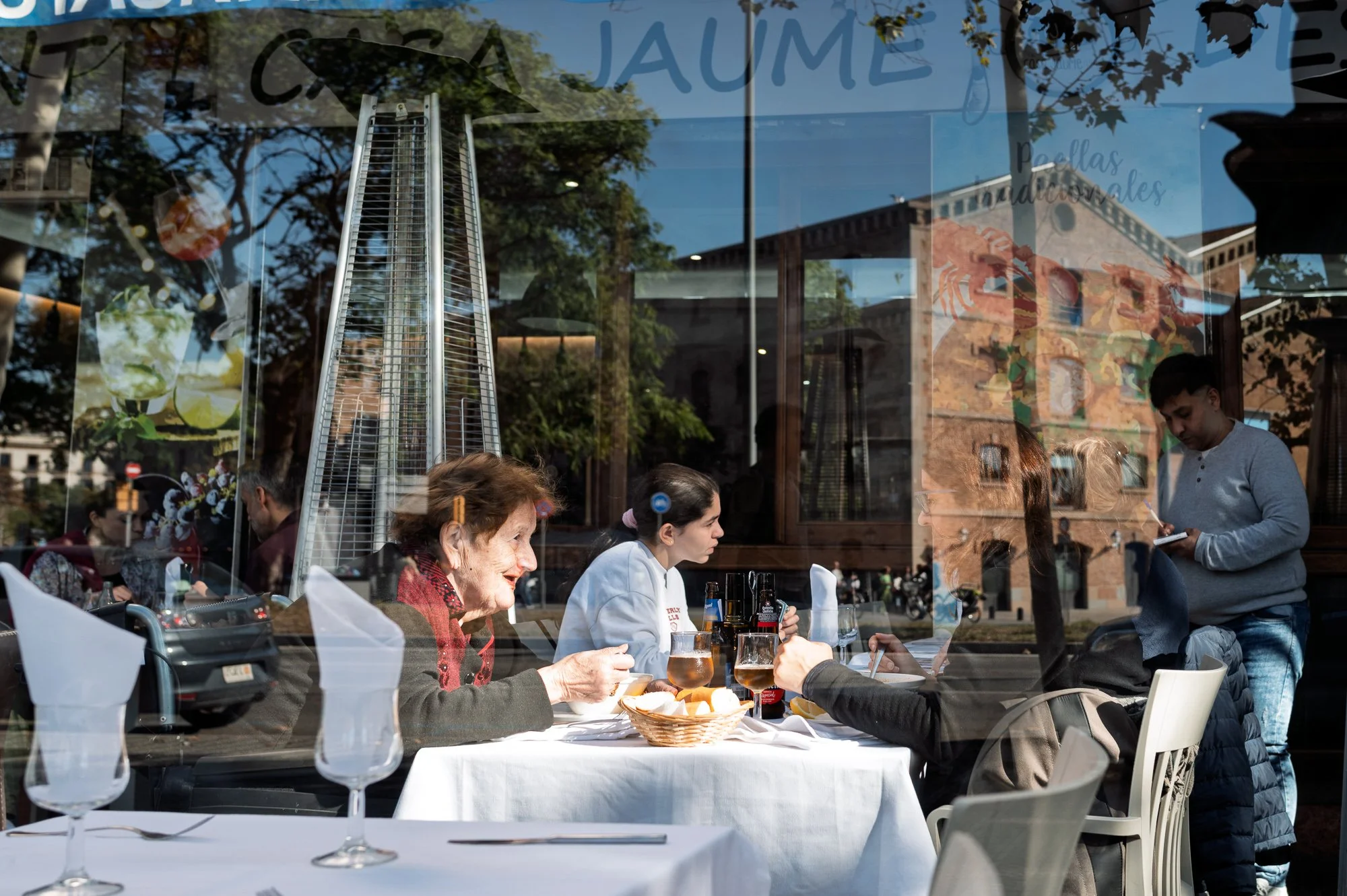
Paella and Reflections — Leica Q3
The fishermen's wharf belongs to another day, a September evening, and it is where the neighborhood's old trade is still visible. Fishing boats sit moored along the concrete pontoons, and the wharf still has its Torre del Rellotge, a lighthouse built in 1772 and later turned into a clock tower. Across the water, the Torre de Sant Sebastià, where the Port Vell cable car ends, a red crane, a long brick warehouse and the curved glass of the W hotel, lit by the last sun, all sit on one line above the boats. It is the most postcard-like frame here, and I kept it because it shows what Barceloneta still is underneath the beach: a fishermen's quarter that lives from the sea.
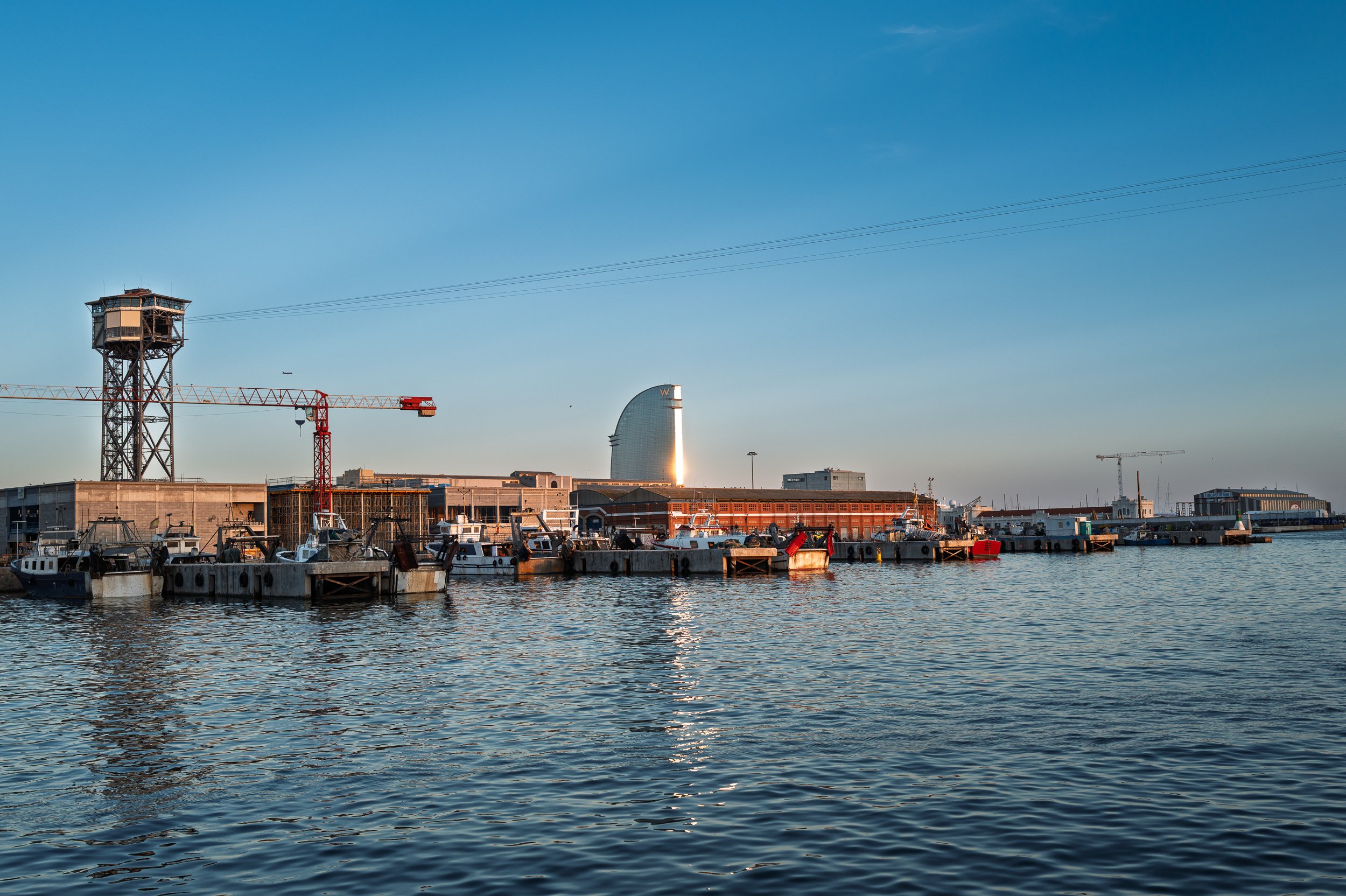
Evening at the Fishermen's Wharf — Leica Q3
It had been too long since I last went to Barceloneta to take photographs. I always come back with at least one good frame and a spectacular day spent outdoors. If you come to Barcelona, don't hesitate: Barceloneta is worth the trip, and it is easy to reach by metro (line 4, Barceloneta station) and by bus. For the rest of the city, see my guide to the best street photography spots in Barcelona.
Walk from Joan de Borbó to the far end of the beach, and look down from the promenade as often as you look out to sea.
Subscribe to the newsletter to get new Barcelona walks like this one, along with a free street photography guide.
Photos: Leica Q3 · 28mm · La Barceloneta, Barcelona, 2023
See more street photography in the portfolio. Every photograph in this post is also available as a fine art print.
Cosme Lapena is a Barcelona-based street and urban photographer and founder of bCLPhoto.
Exhibited at espai [b] since 2010 · Published in The Eye of Photography and 35mmc. Browse the portfolio or read more on the blog.