Dresden street photography was not the reason my wife and I took the train from Prague on Saturday 19 September. We went for the city itself. But Dresden is a city that was destroyed and built again, and a rebuilt city is always full of people looking at it. By the time we caught the train back, the day had given me photographs that had more to do with the people than with the domes.
From the Elbe to Prager Straße
North of Děčín the railway follows the river into a gorge of sandstone, the landscape known as Saxon Switzerland. Just before the border, Hřensko appeared across the water: half-timbered houses squeezed between two walls of rock and the whole village repeated upside down in the river. The sun was flaring into the lens through the carriage window, and I kept the flare. Landscape is not what this blog is about, but this frame belongs at the start: it is the door into the day.
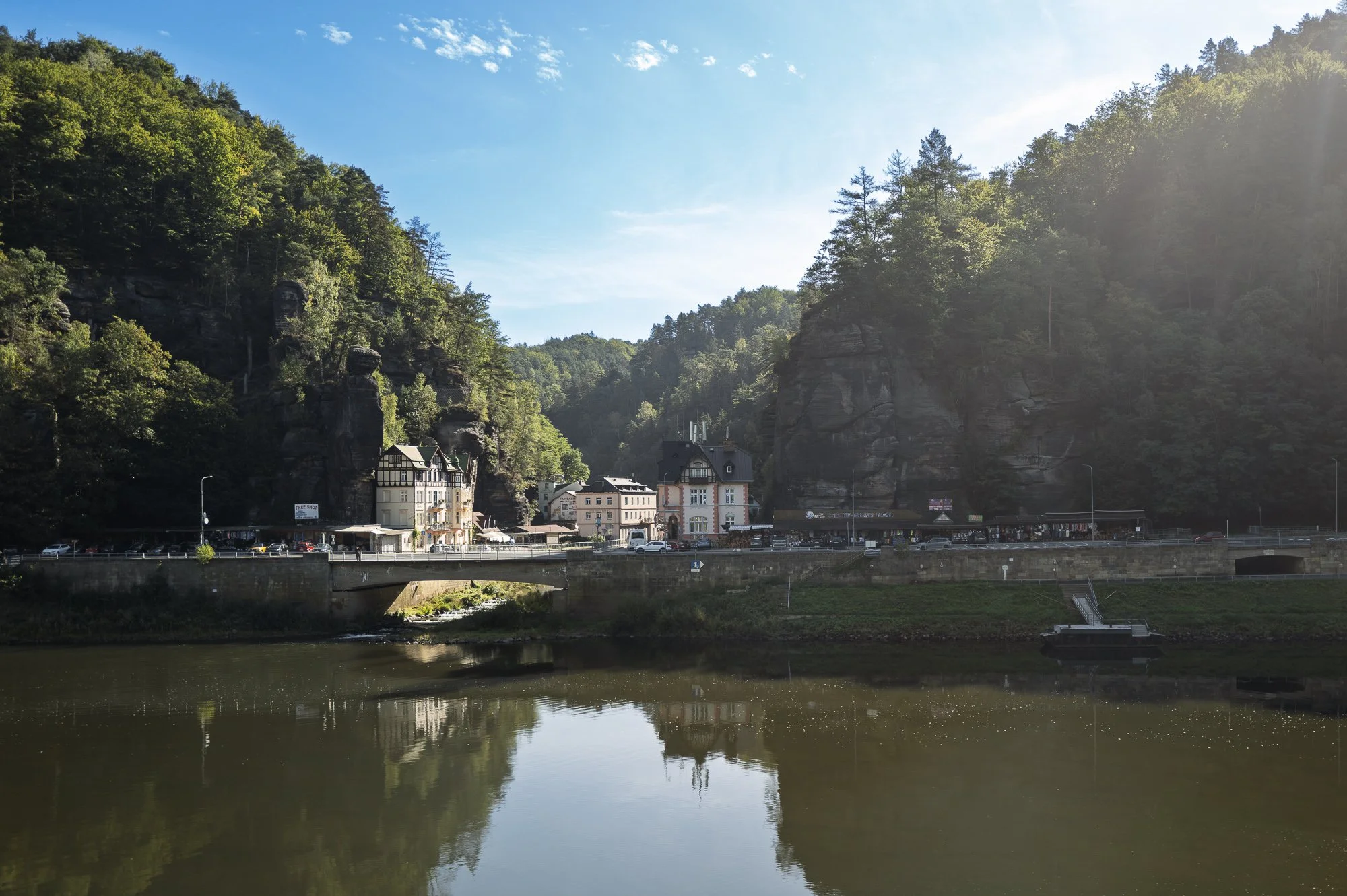
The Door into the Day — Leica Q3
Dresden Hauptbahnhof opens onto Prager Straße, the pedestrian boulevard into the old town, and that morning it was full of saris. Under the trees, members of the city's Indian community were getting ready for something: men tying saffron turbans, women adjusting pleats and bangles. Two dancers in red harem trousers, black tops and gold belts, red and gold crowns pinned into their hair, were working barefoot around a tree. One leaned on the trunk on one leg and brushed the sole of her foot, half her face painted red; the other bent forward beside her in the same pose, a step behind. At their feet lay a small archive of the morning: flip-flops, Crocs, trainers and gold sandals, all left on the gravel.
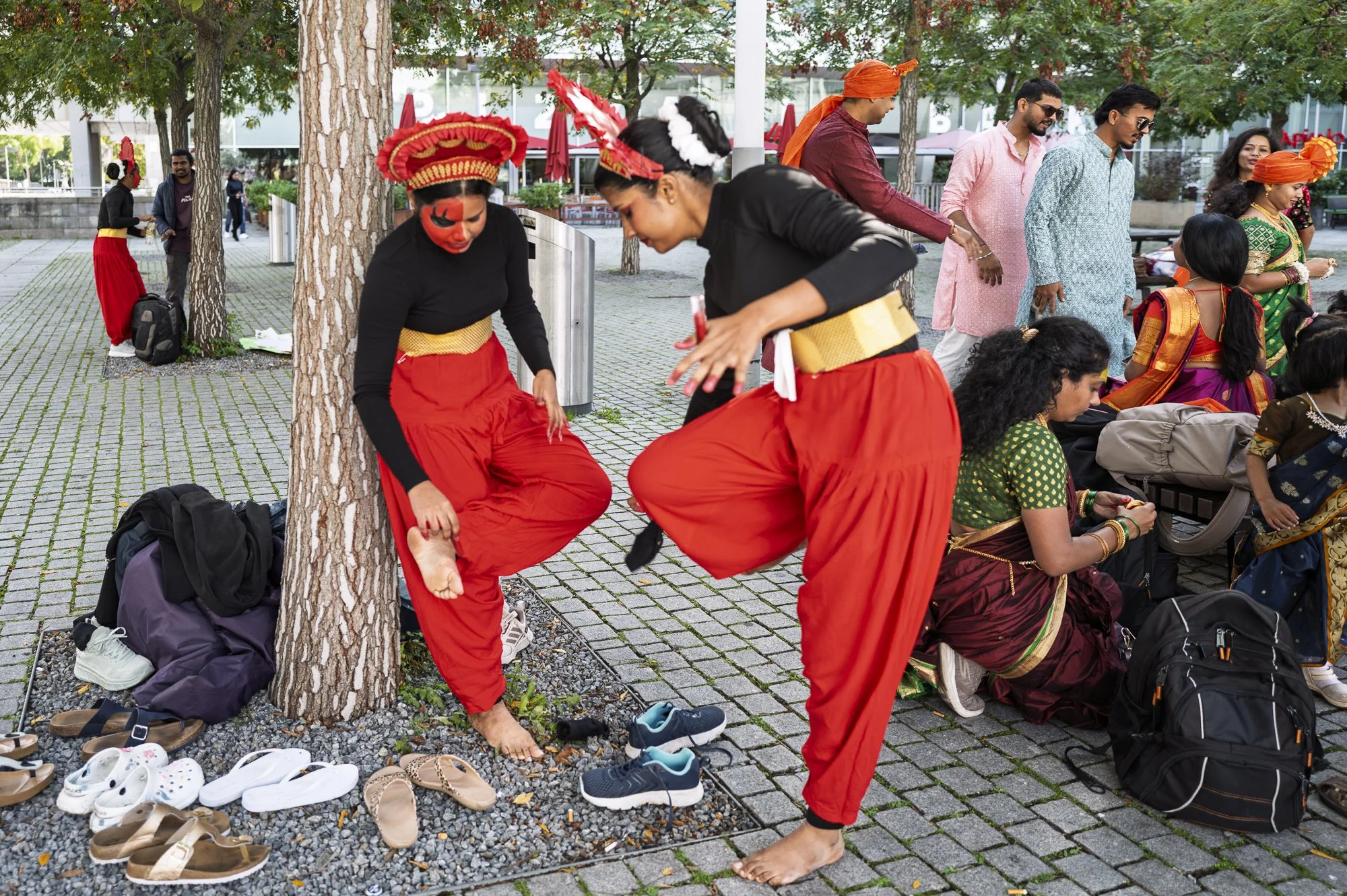
Before the Dance — Leica Q3
On the granite steps nearby, two young women sat close together. One, in a white top and a red skirt, had her earphones in and her eyes on her phone. Her friend, in a red sari with yellow puffed sleeves, rested a hand on her shoulder and looked straight into my lens through her glasses, a large inflatable globe lying beside them. I did not yet know what they were celebrating.
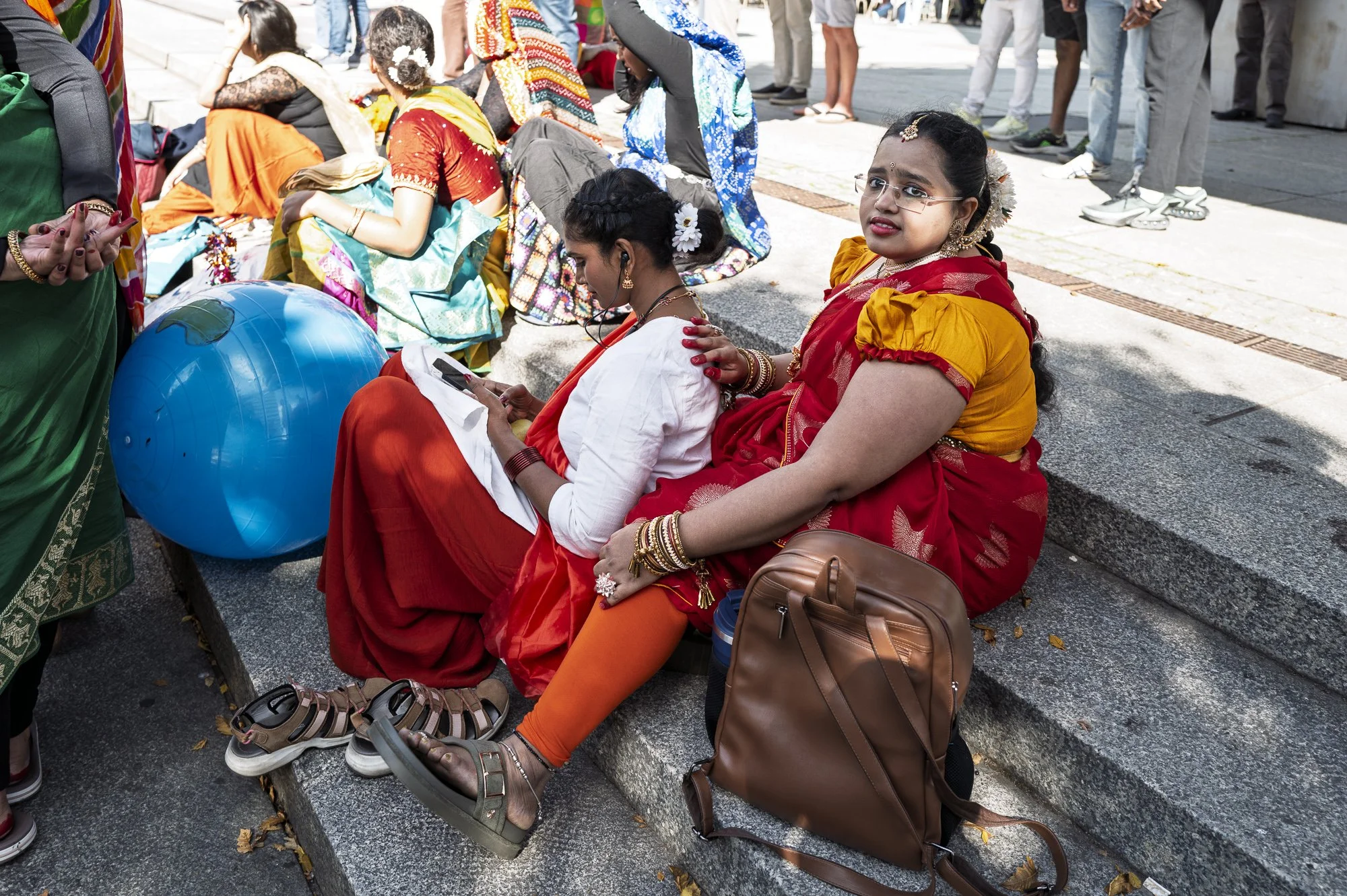
A Portrait I Did Not Ask For — Leica Q3
Dresden Street Photography in the Rebuilt Old Town
The Fürstenzug, the Procession of Princes, runs 102 metres along the outer wall of the Stallhof: 35 rulers of the House of Wettin on horseback, painted on some 23,000 tiles of Meissen porcelain, a mural that survived the bombing of 1945 almost intact. That day the procession had a second one in front of it. Visitors stood along the cobbles with their phones raised, a woman in a pale blue shirt stretching her arm as high as it would go. I stepped back far enough to keep both processions in the same frame.
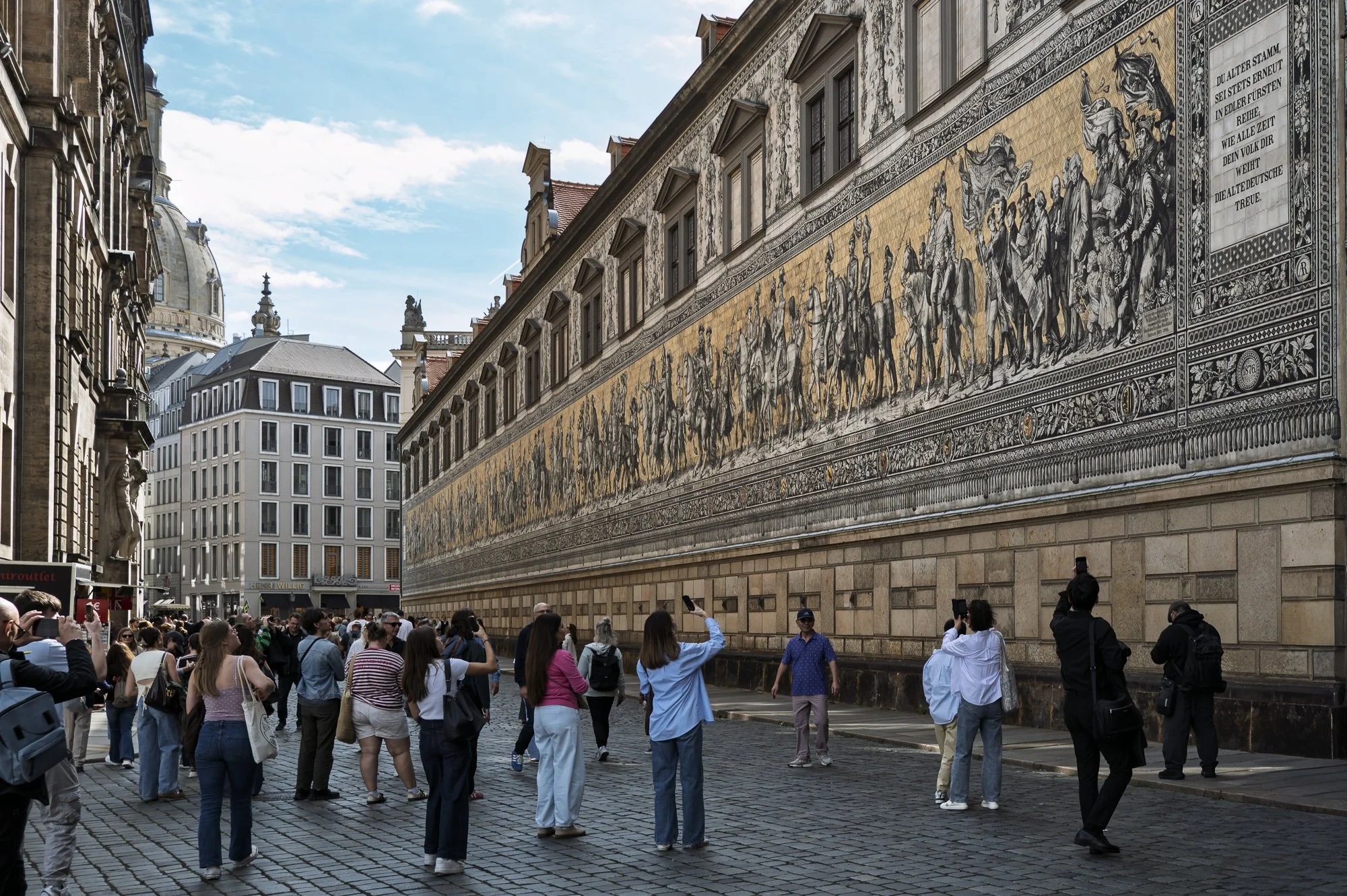
Two Processions — Leica Q3
A little further along the same wall, someone had laid a table on the pavement. Two mannequins were having dinner: one in sunglasses and a black and white striped jacket, the other in a shaggy wig with her back to me, a salad and two candles between them. Their waiter came striding along the kerb in a black waistcoat and a white shirt, rouge on his cheeks, his tie standing straight out behind him as if he had walked into a gale. A small wooden box waited on the kerb for coins. Under eight centuries of princes, the best act on the street was a dinner nobody would ever eat.
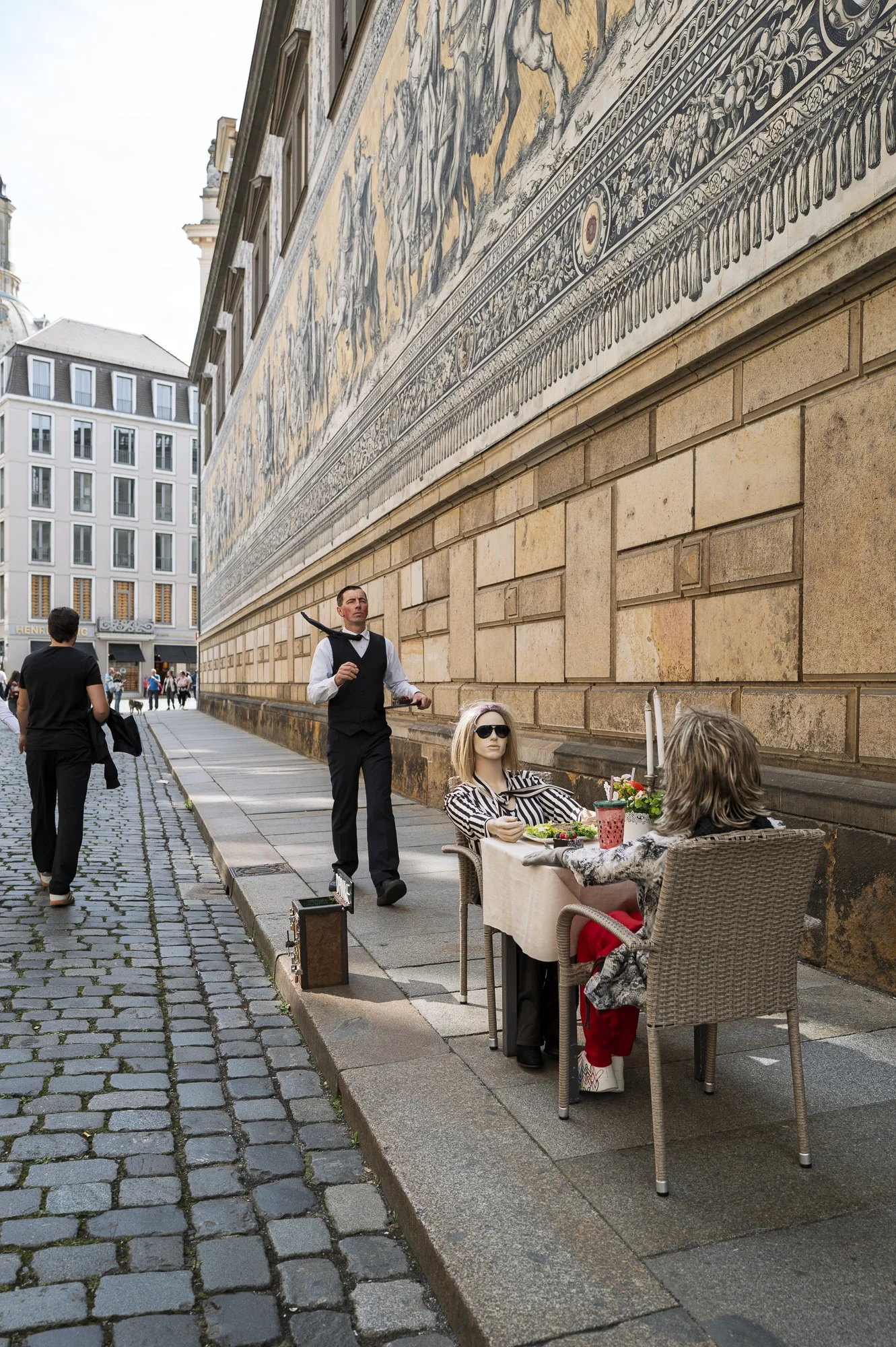
Dinner Nobody Will Eat — Leica Q3
The Frauenkirche collapsed two days after the air raids of February 1945 and stayed a heap of rubble for almost fifty years. When it was rebuilt between 1994 and 2005, the original stones that could be saved went back into the walls,, still darker than the new ones: the façade reads like a map of what survived. In my frame, Martin Luther stands on his plinth to the right, visitors rest on its base, and at the very edge my wife raises her phone to the dome. Like Warsaw's Old Town, Dresden rebuilt its past stone by stone, and everyone who comes to see it ends up photographing the reconstruction.
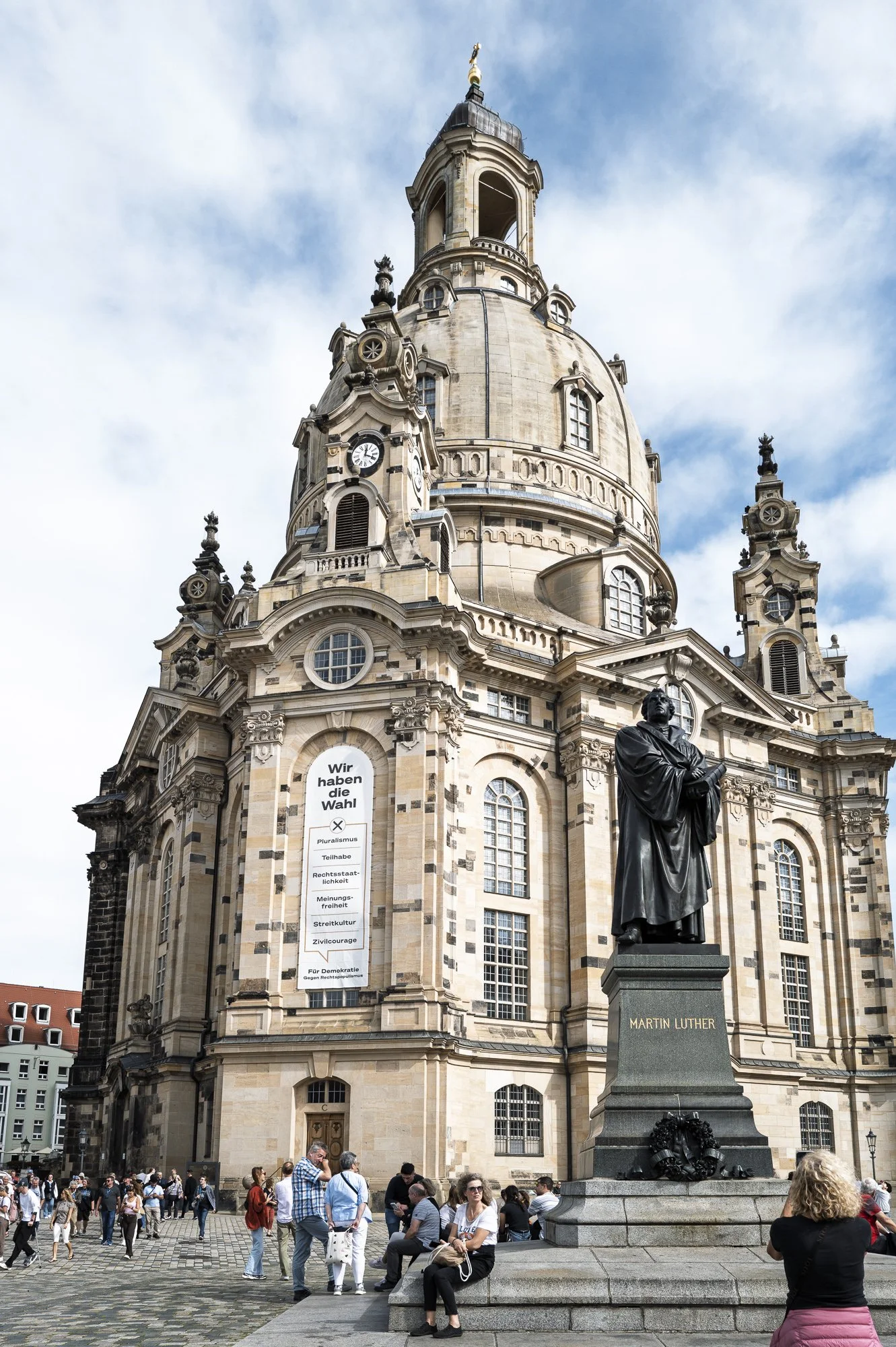
A Map of What Survived — Leica Q3
Across the Augustusbrücke
By early afternoon the sky had clouded over, and the soft, even light suited the sandstone better than the morning sun. With the 28mm of the Q3 there is no zoom to hide behind: on a wide bridge you either walk close or let the space become part of the picture. On the Augustusbrücke, the old stone bridge to the Neustadt, I chose space. A young saxophonist in a white T-shirt and shorts played into a small speaker at his feet. His case lay open on the paving with a sign that read CD – 10 €, and the parapet behind him was covered in graffiti. In a city this polished, the scrawl on the bridge was almost a relief.
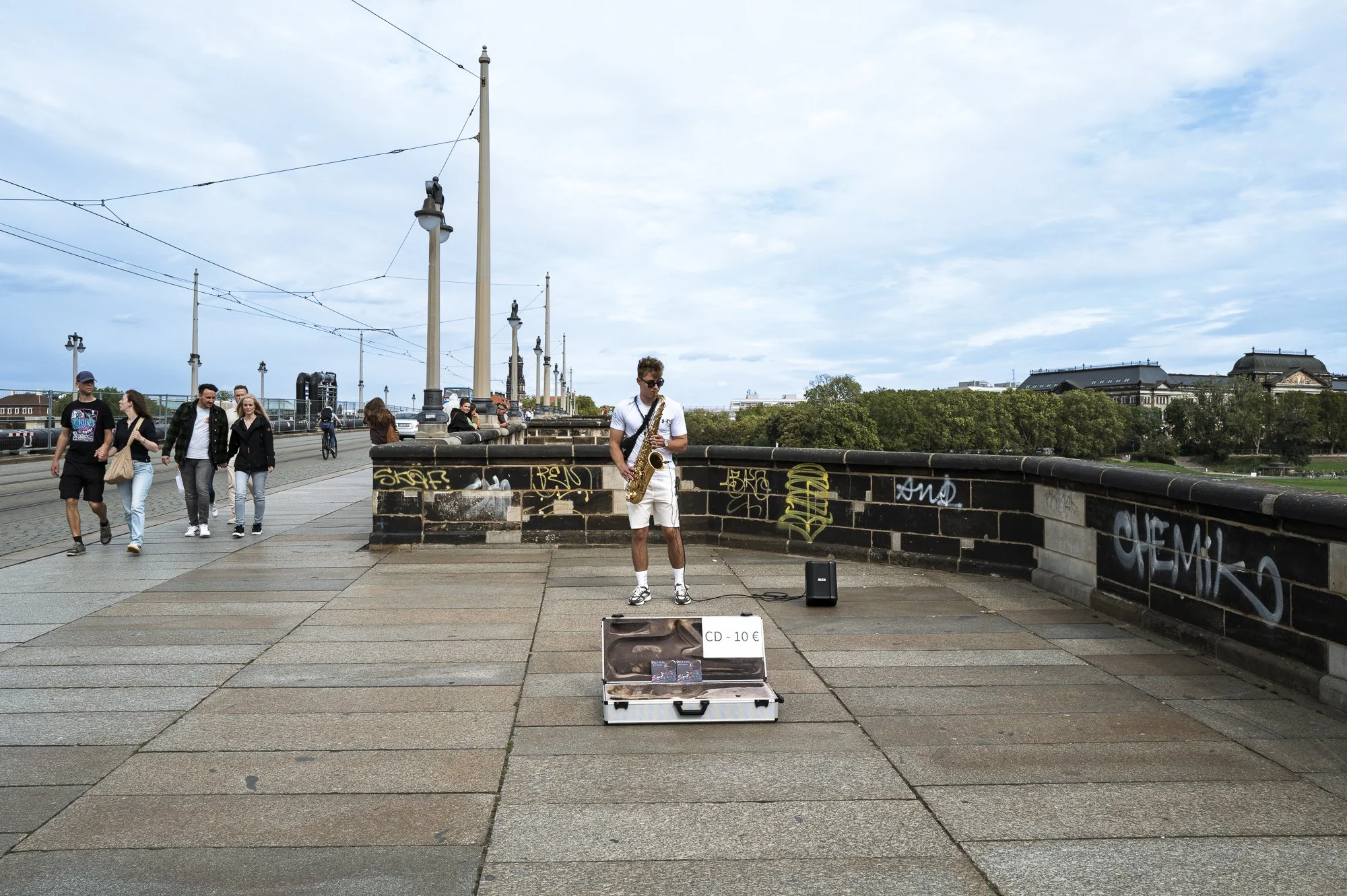
CD – 10 € — Leica Q3
Arches, a Painting and a Choir
The Zwinger is reached from the Theaterplatz through a passage under the Semper Gallery, a tall coffered vault of pale stone. Looking in, the arch framed the Crown Gate with its gilded crown and a courtyard full of visitors. A while later, walking out, the same arch framed the equestrian statue of King Johann on the Theaterplatz, with a family walking in towards me. Same arch, two directions: a king's baroque garden on one side, the square in front of the opera on the other.
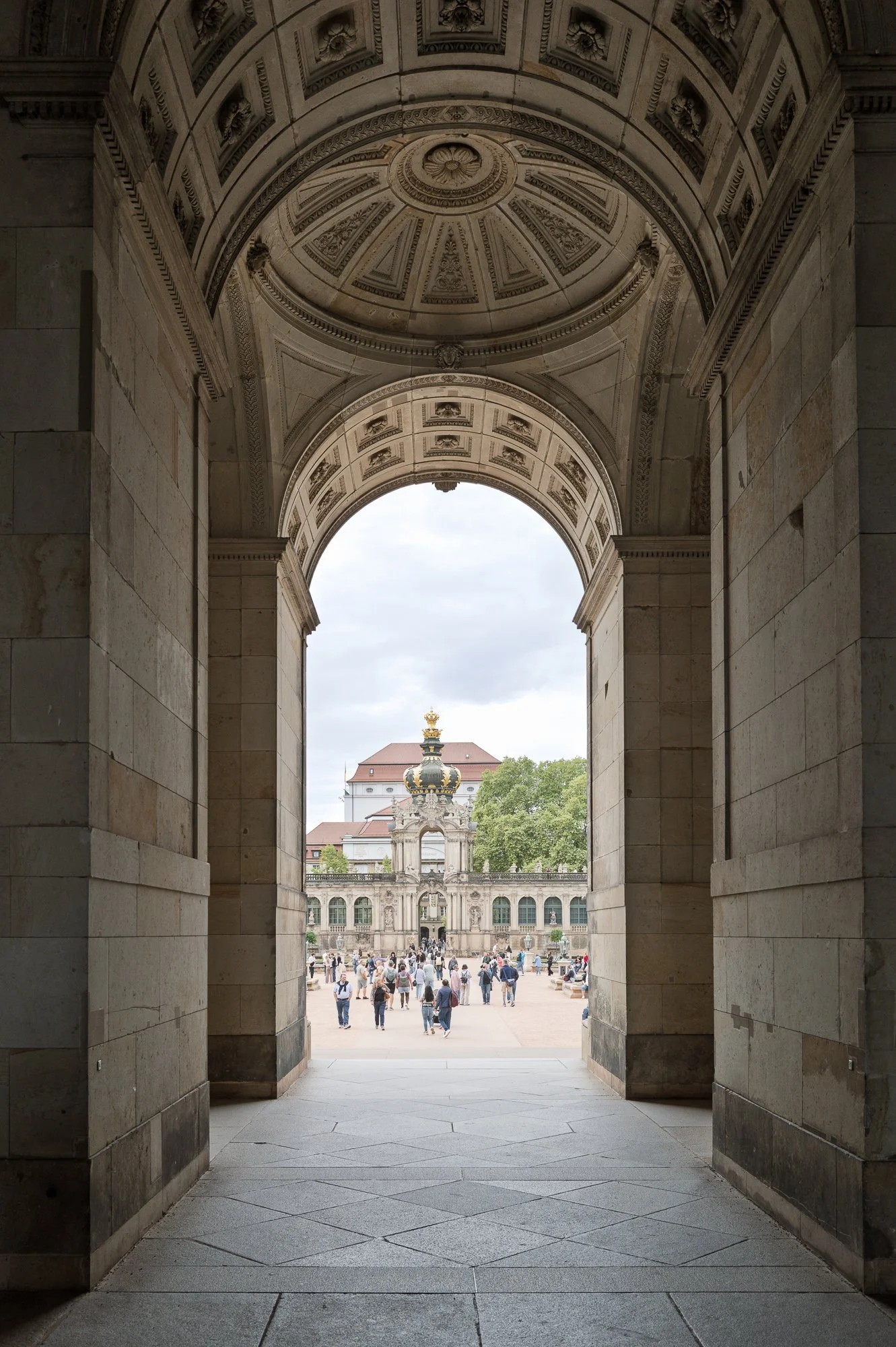
Looking In — Leica Q3
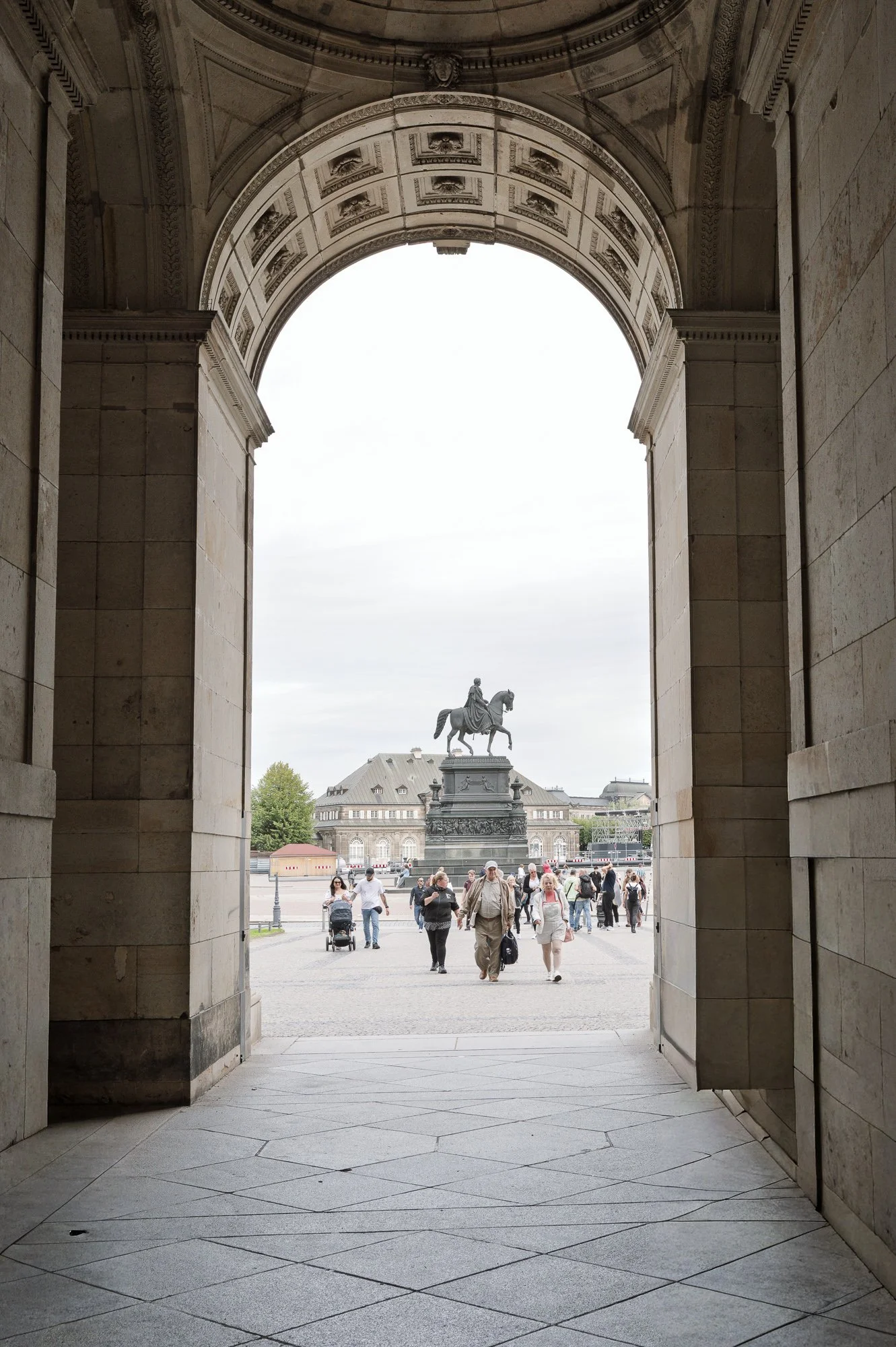
Looking Out — Leica Q3
The Semper Gallery houses the Old Masters, and we had no time for them. In the entrance hall, a woman in a long green dress printed with flowers stood with her back to me beside a shelf of catalogues. Next to her, a backlit poster for the museum's multimedia guide showed Raphael's Sistine Madonna, with two women in front of the painting looking at it on a phone screen. It was the closest I came to Raphael that day, and perhaps the more honest picture of how we look at art now.
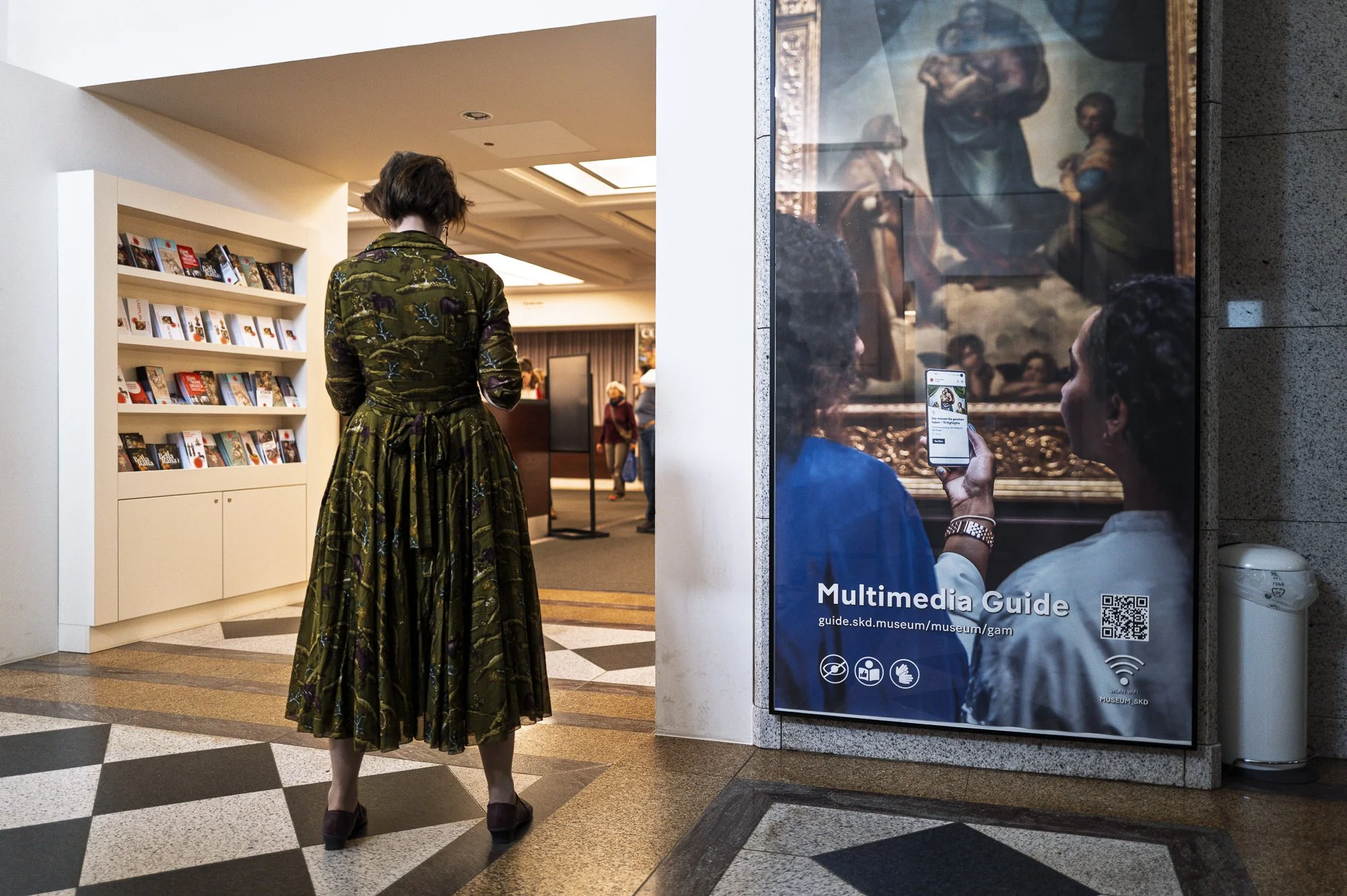
The Closest I Came to Raphael — Leica Q3
The Kreuzkirche, on the Altmarkt, was gutted in 1945 like almost everything around it. When it reopened in 1955, the interior was left in plain grey scratch-coat plaster without ornament, and it has stayed that way. It is the home of the Kreuzchor, the boys' choir that has sung here for some seven hundred years, but that afternoon the singers in front of the altar were men and women with scores in hand, a conductor in white facing them. We stayed and listened for a long time. It sounded like a final rehearsal: stopping, starting again, the same bars until they were right. I photographed it from the central aisle, empty pews in front, the Crucifixion above the singers.
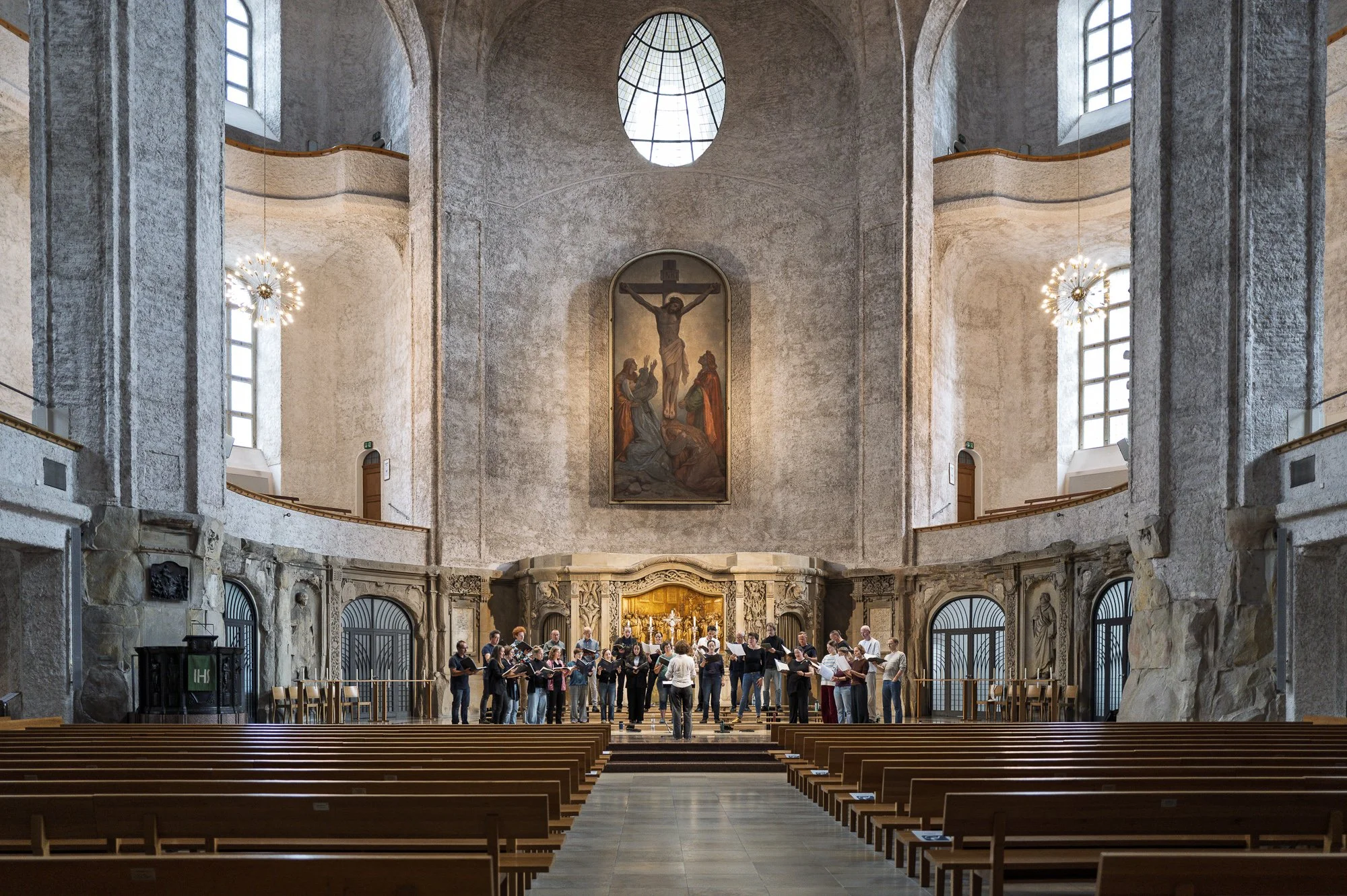
Final Rehearsal — Leica Q3
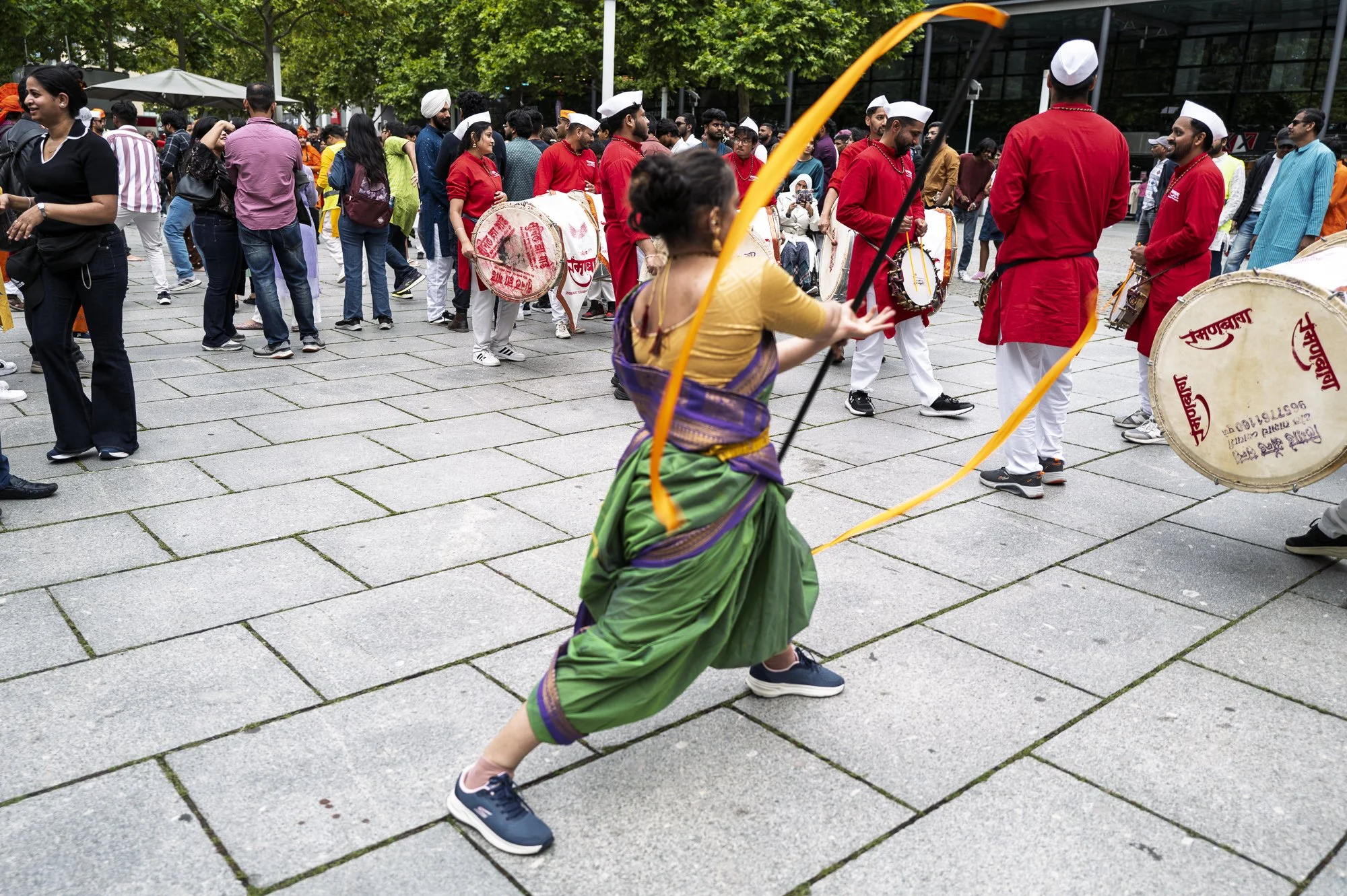
When we walked back down Prager Straße towards the station, the morning's preparations had turned into a party, and I finally understood what I had seen. It was Ganeshotsav, the festival of Ganesh, the elephant-headed god, as it is celebrated in Maharashtra and wherever Marathi families have settled; Ganesh Chaturthi had fallen on 14 September. A dhol-tasha troupe in red kurtas, white caps and red bead necklaces stood in a ring with their big barrel drums, Ramanbaug painted on the skins in Devanagari: a Pune troupe that now has a branch in Germany. Behind them rose one of the long East German housing blocks of Prager Straße; the drums were loud enough to feel in the chest.
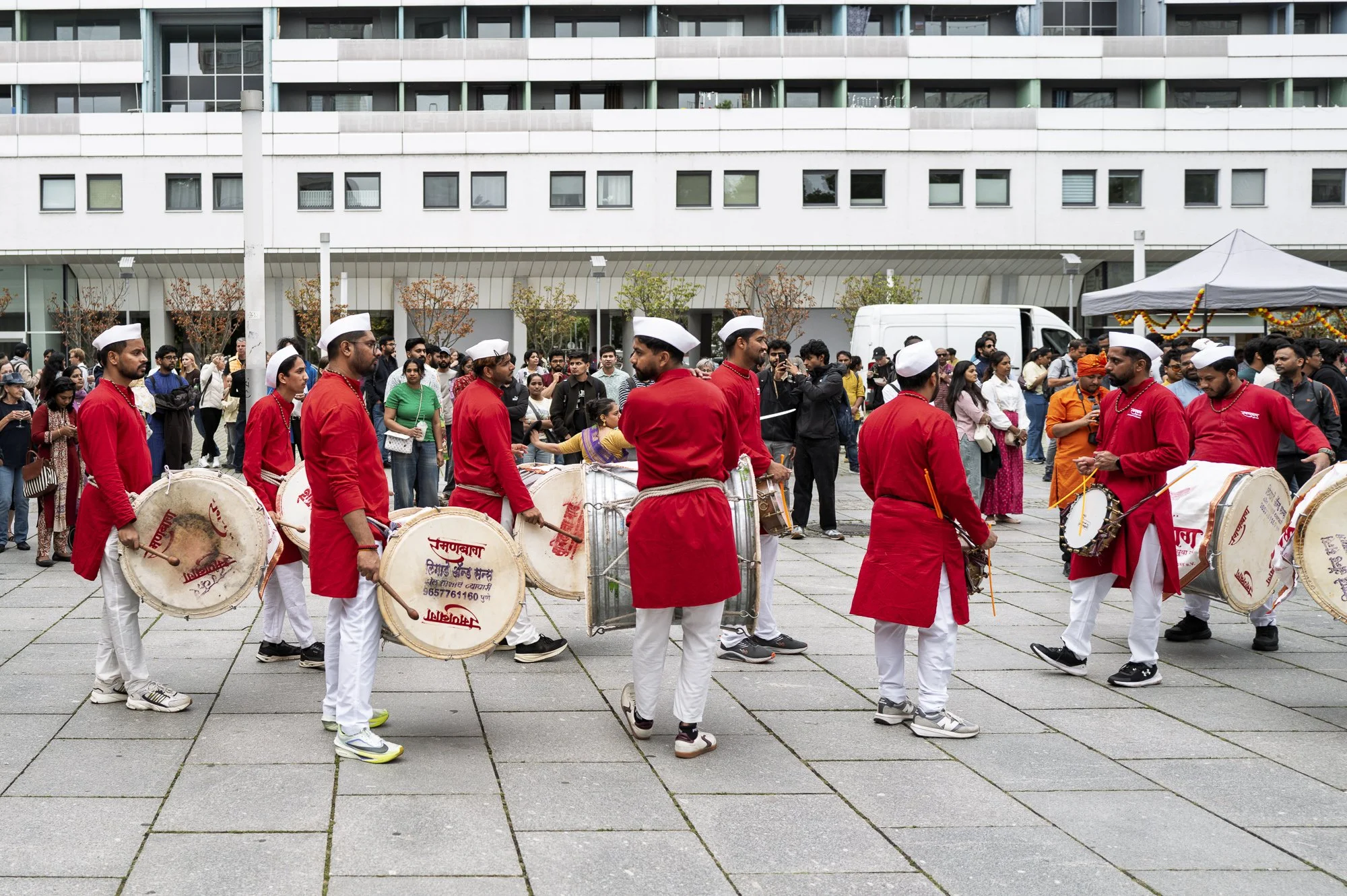
Ramanbaug — Leica Q3
Around the drummers, the crowd danced. A woman in a green sari, worn in the nine-yard Maharashtrian style with a gold blouse and a purple sash, dropped into a deep lunge and swung a long pole with a saffron ribbon in a full circle, the ribbon frozen in two arcs across the frame. Behind her, a woman in a headscarf filmed her on her phone. Of the whole day, this is the frame I would keep if I could keep only one.
The Frame of the Day — Leica Q3
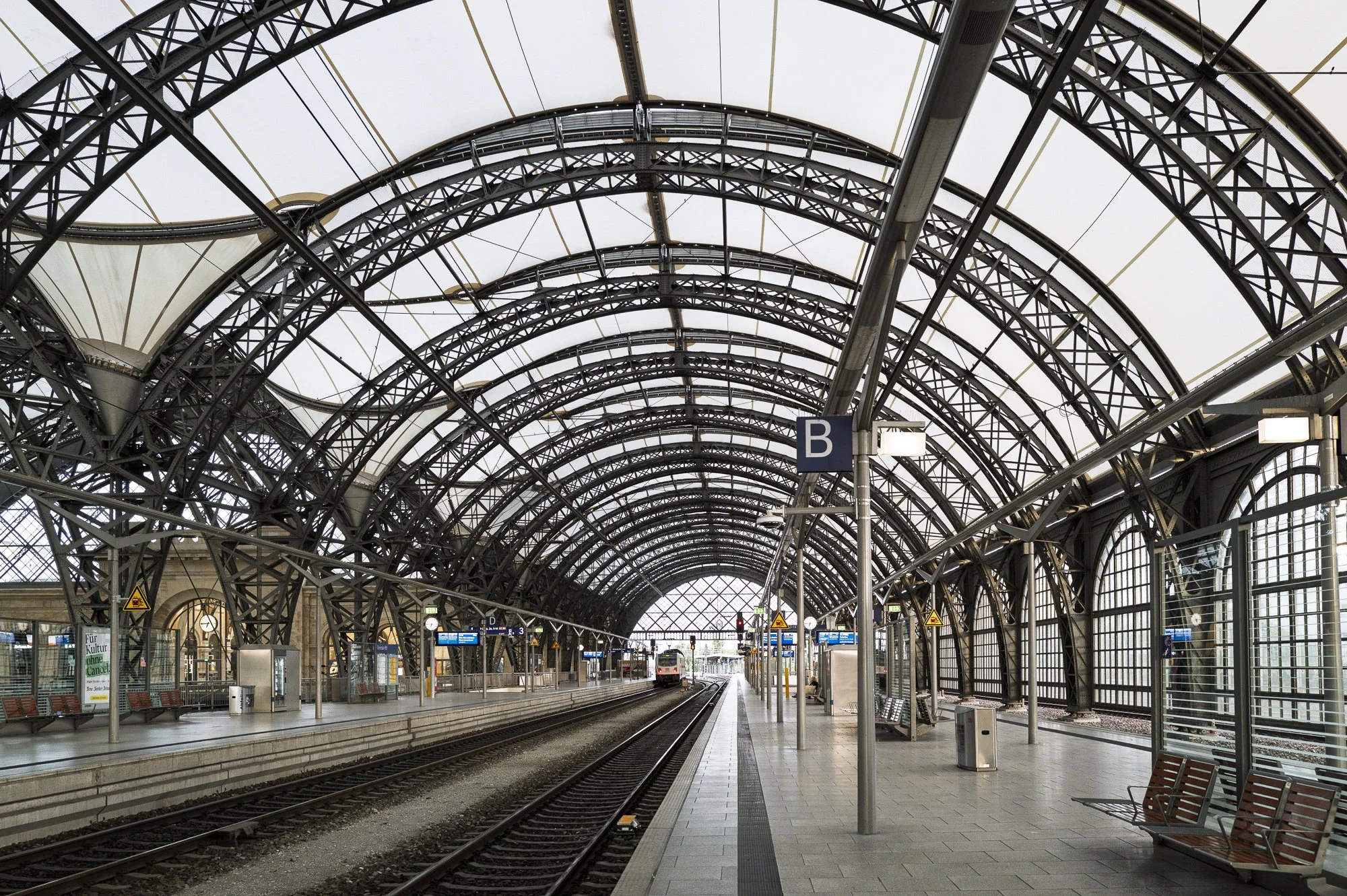
Then we had a train to catch. Dresden Hauptbahnhof is a nineteenth-century station in a new skin: Foster + Partners covered its iron arches with a translucent membrane, and from platform B the vault runs away in a tunnel of white light. After a day of crowds, the platform was almost empty. Prague had felt like a city behaving like a stage; Dresden felt like a city that had rebuilt its own theatre, and on that Saturday the most memorable performance came from people who had brought their own music from much farther away.
Platform B — Leica Q3
If you go, take the train along the Elbe rather than the motorway, and walk Prager Straße twice: in the morning and again on your way home.
Subscribe to the newsletter to receive new walks first, along with a free street photography guide.
Photos: Leica Q3 · 28mm · Dresden, September 2026
See more street photography in the portfolio. Every photograph in this post is also available as a fine art print.
Cosme Lapena is a Barcelona-based street and urban photographer and founder of bCLPhoto.
Exhibited at espai [b] since 2010 and PH21 Gallery · Published in The Eye of Photography, 35mmc, Macfilos and Street Photography Magazine.