Prague Street Photography: The City as a Stage
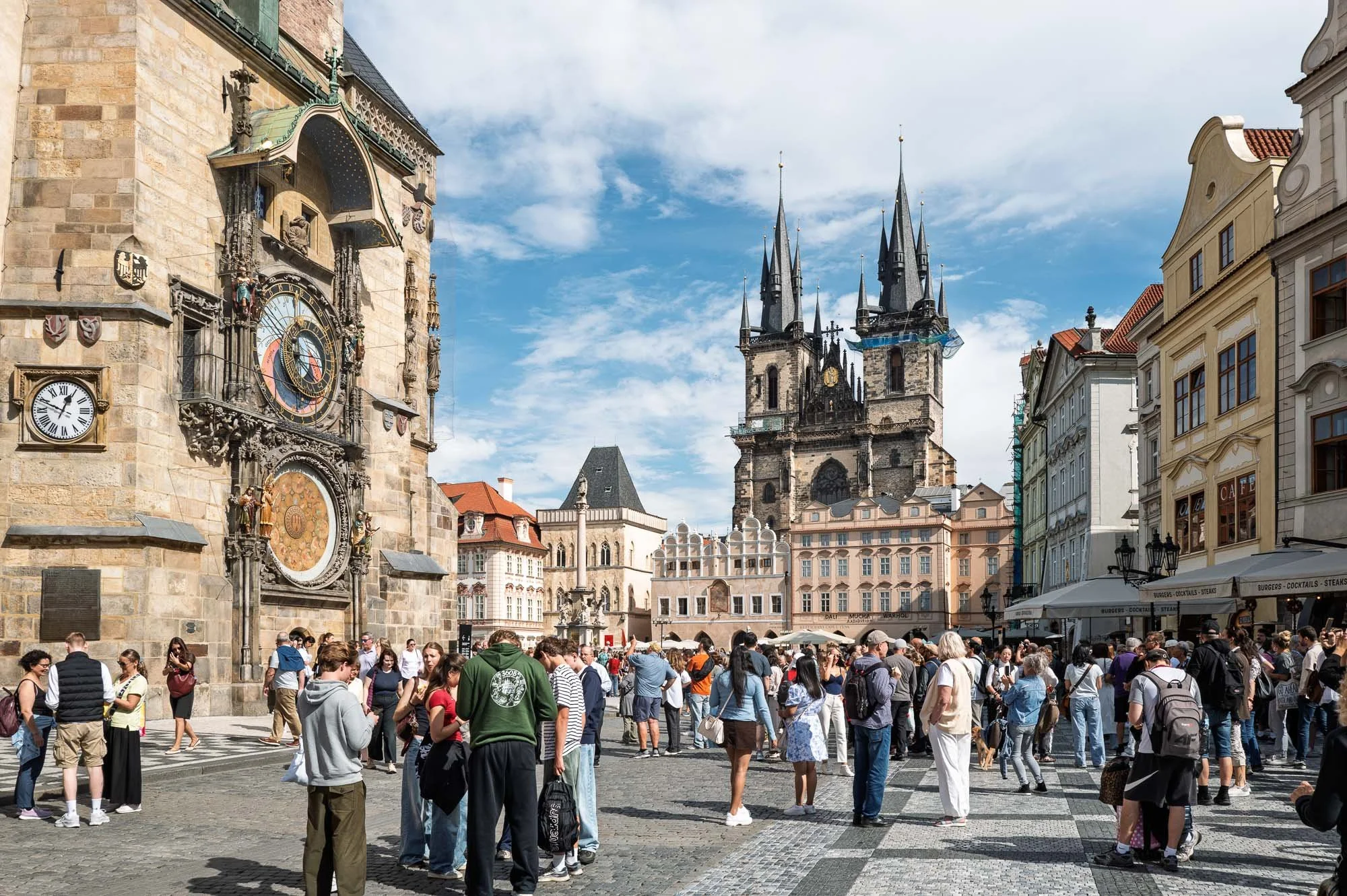
The Stage Is Set — Leica Q3
Every city has its postcard. Prague has several, and on a bright September afternoon it feels as if half of Europe has come to stand in front of them at the same time. We went to photograph the monuments and ended up doing Prague street photography of a different kind: pointing the camera not at the towers and statues, but at the people facing them. The Old Town Square is the place to begin. The Astronomical Clock on one side, the twin Gothic spires of the Church of Our Lady before Týn rising over the rooftops, and between them a slow tide of visitors, turning, pausing, raising their phones. The buildings stay still. The show is on the cobbles.
The Hourly Ritual at the Astronomical Clock
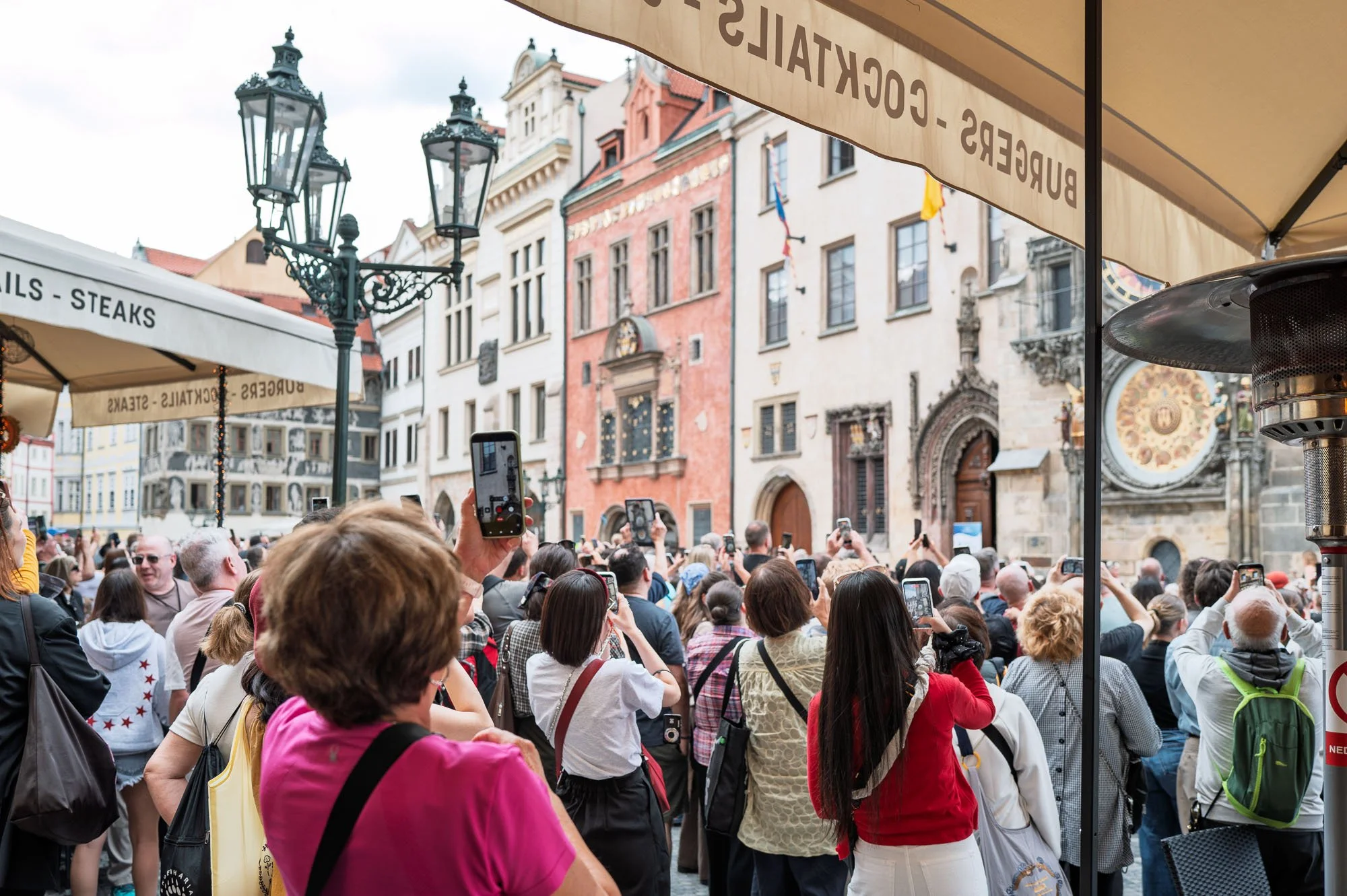
A Forest of Screens — Leica Q3
A few minutes before the hour, the square changes shape. People drift towards the Old Town Hall tower and settle into a loose crowd facing the dial, and the terrace umbrellas across the way become the best seats in the house. We watched from underneath one of them: a forest of raised arms, each ending in a small glowing screen, all aimed at the same painted clock face. The Prague astronomical clock has been keeping time here since 1410. For the brief moment when the apostles appear in its windows, it is probably the most photographed object in the city.
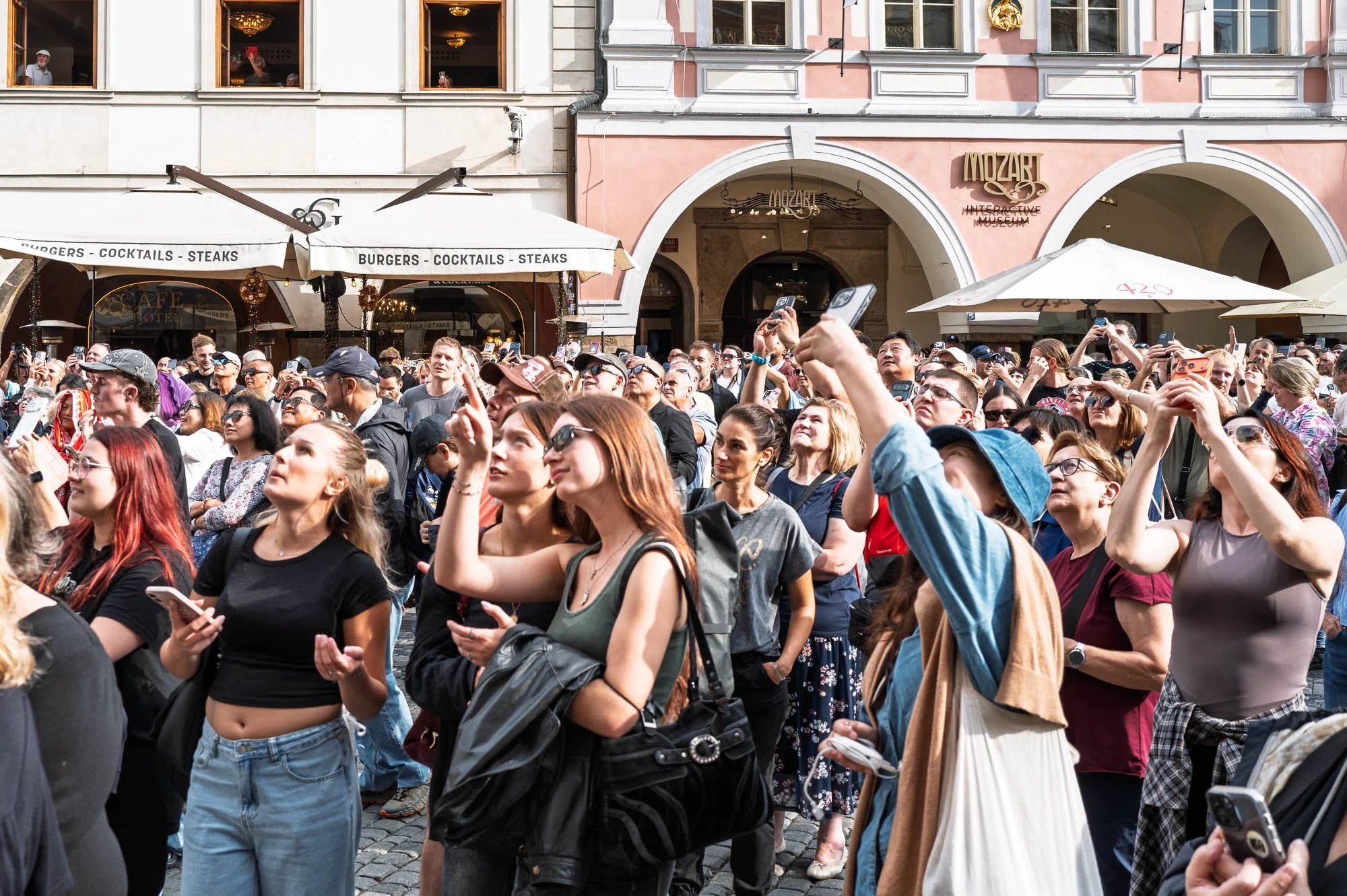
Where Everyone Looks — Leica Q3
Turn around, and the picture gets better. Faces tilted upwards, mouths half open, fingers pointing at something above our heads. Some watch through a screen, some watch directly, a few manage both at once. Nobody looks at anyone else. It is the one moment in the day when thousands of strangers agree on exactly where to look. For a street photographer that is a gift: a crowd that has forgotten itself.
Outside the Ritual — Leica Q3
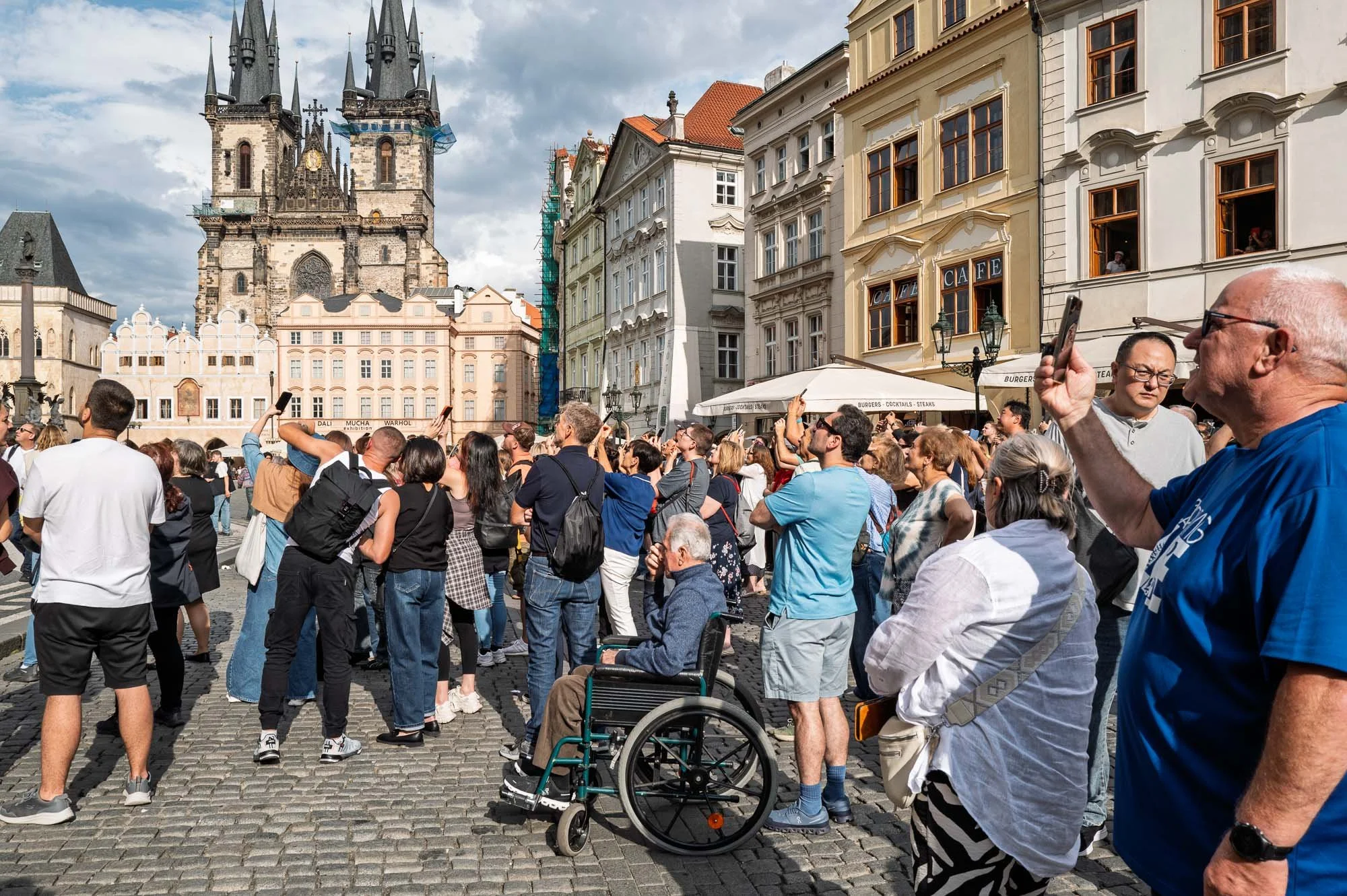
The wider view shows the scale. With the spires of Týn behind them, a whole row of people stands with arms raised, phones lifted above the heads in front. In the middle of it all, a man in a wheelchair watches the tower with no phone in his hands. In the foreground, a man in a blue T-shirt holds his camera at full stretch, as if it could see further than he can. This is the frame we kept coming back to: the ritual, and the one person quietly outside it.
Prague Street Photography in a City of Photographers
Everyone in Prague is a photographer, and that changes the job. With a Leica Q3 and its fixed 28mm lens there is no hiding at a distance. We have to be close, inside the crowd, one more camera among thousands. Oddly, that makes us invisible, because nobody notices a lens when every hand holds one. We know this choreography well from home, where Barcelona's summer streets play host to the same raised arms every July. The September light helped too. It was bright but often softened by passing cloud, with enough contrast on the pastel façades to hold colour without burning out the whites. We worked at the edges of the action, waiting for the moment someone stepped into our frame to make their own picture.
Standing Still Before a Building That Dances — Leica Q3
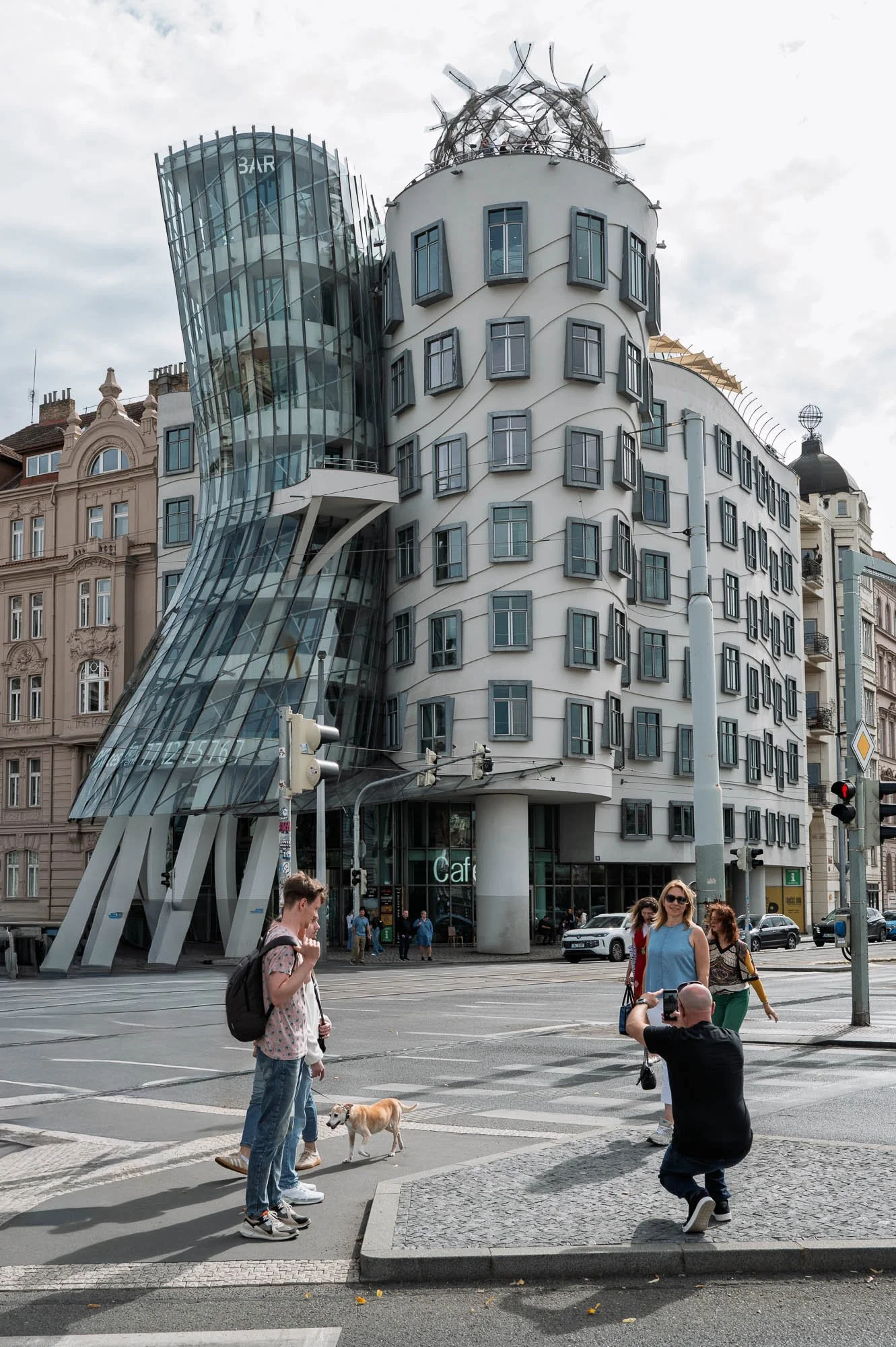
At the Dancing House, the curving glass-and-concrete building designed by Frank Gehry and Vlado Milunić, the pattern repeats in miniature. A man crouches low on the kerb to photograph three women posing on the pavement, the glass tower leaning over them. A few steps away, a young couple waits with their dog, in no hurry at all. It is architecture built to suggest movement, with people standing perfectly still in front of it.
A Wall Made to Stand In Front Of — Leica Q3
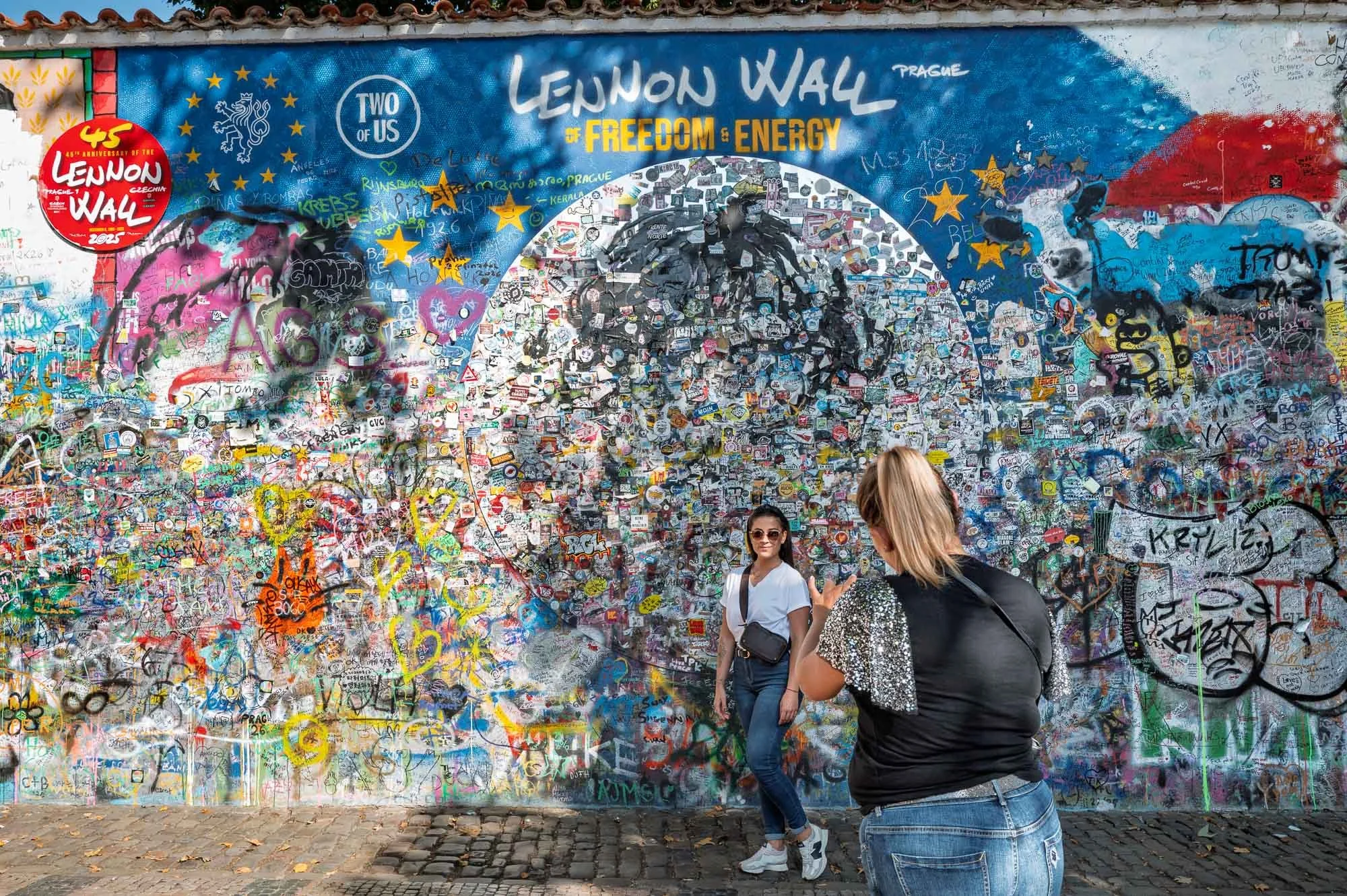
At the Lennon Wall, the monument is the backdrop by design. The wall has been painted over so many times that it is less a mural than a sediment of messages, stickers and slogans, and it exists above all to be stood in front of. A young woman in sunglasses takes her place against it while her friend, in a sequinned top, gives directions with one hand. The whole composition takes seconds. Behind them, decades of graffiti wait for the next visitor.
A City on a Screen — Leica Q3
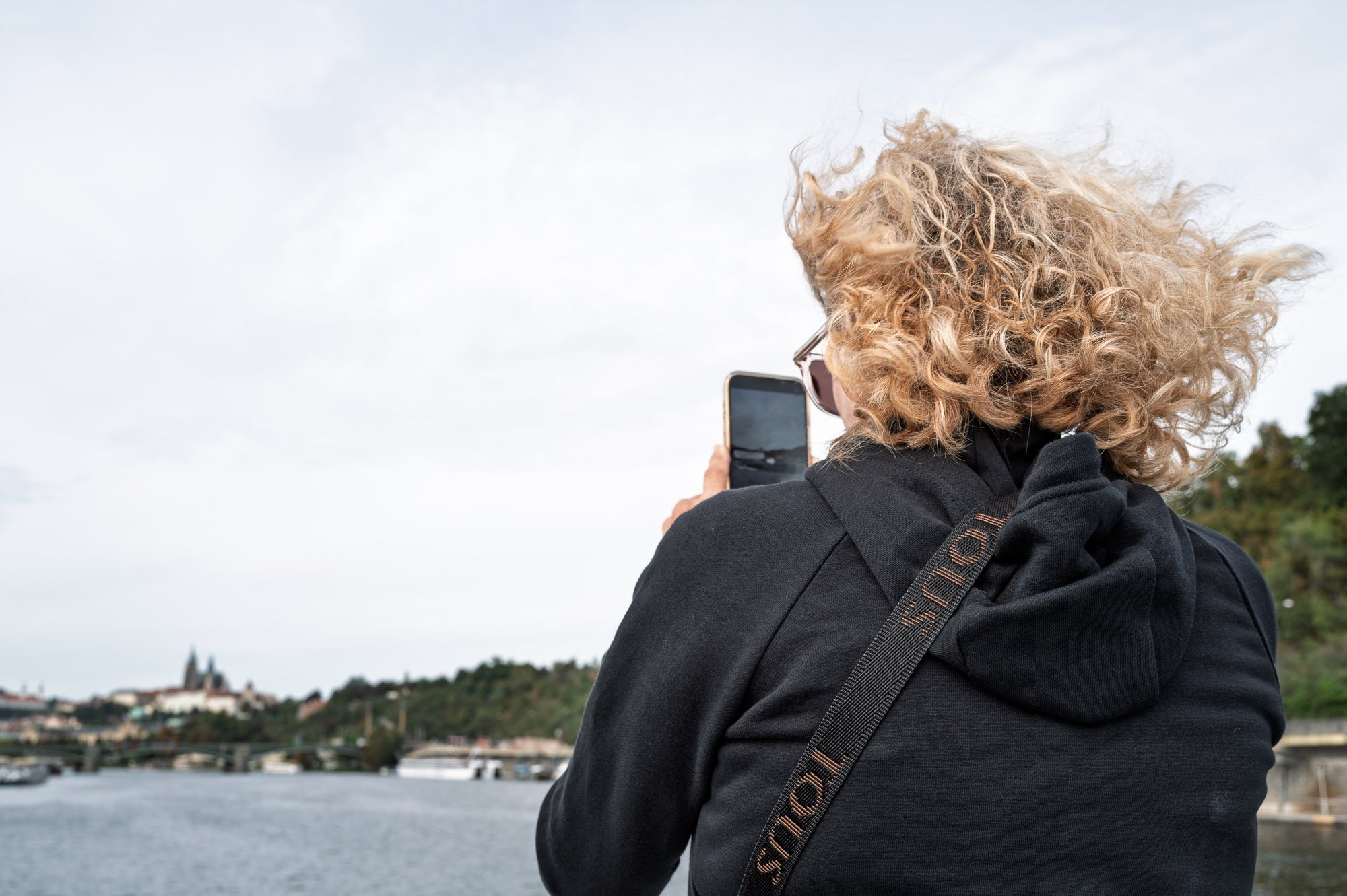
Some of our favourite frames leave the monument almost out of the picture. By the Vltava, the wind caught a woman's blond curls just as she lifted her phone towards Prague Castle, a small grey silhouette on the far bank. The castle is barely there. What stays is the gesture: the hair, the phone, the effort of trying to hold a whole city on a screen the size of a hand.
Photographing the Photographers — Leica Q3
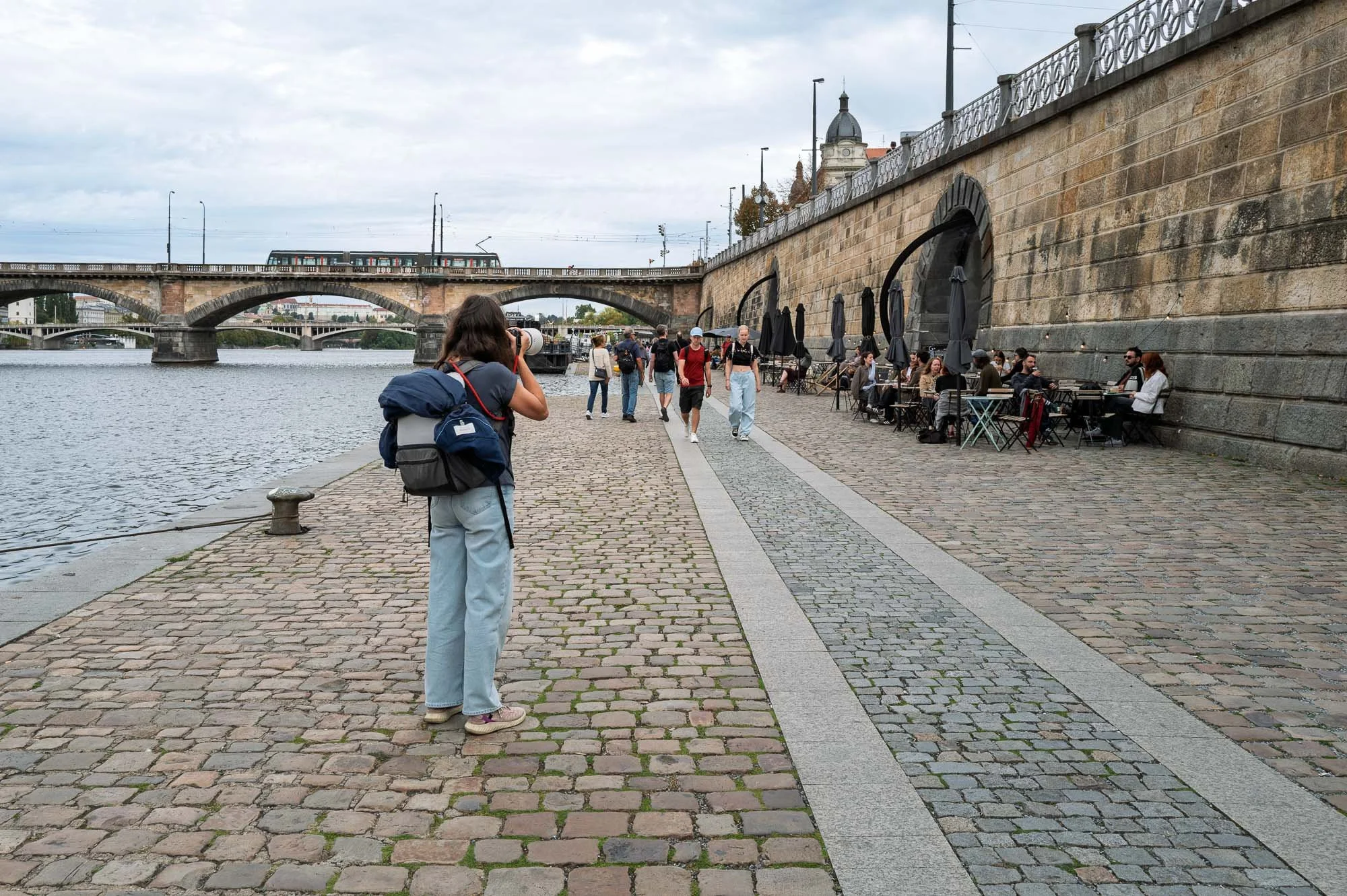
Further along the river, the café tables under the stone arches of the Náplavka embankment were busy. In the middle of the cobbles, a young woman stood with a long white telephoto lens, aimed down the embankment towards the walkers. We photographed her photographing. Someone, somewhere, was probably photographing us.
Hanging Out — Leica Q3
Holding Up Freud — Leica Q3
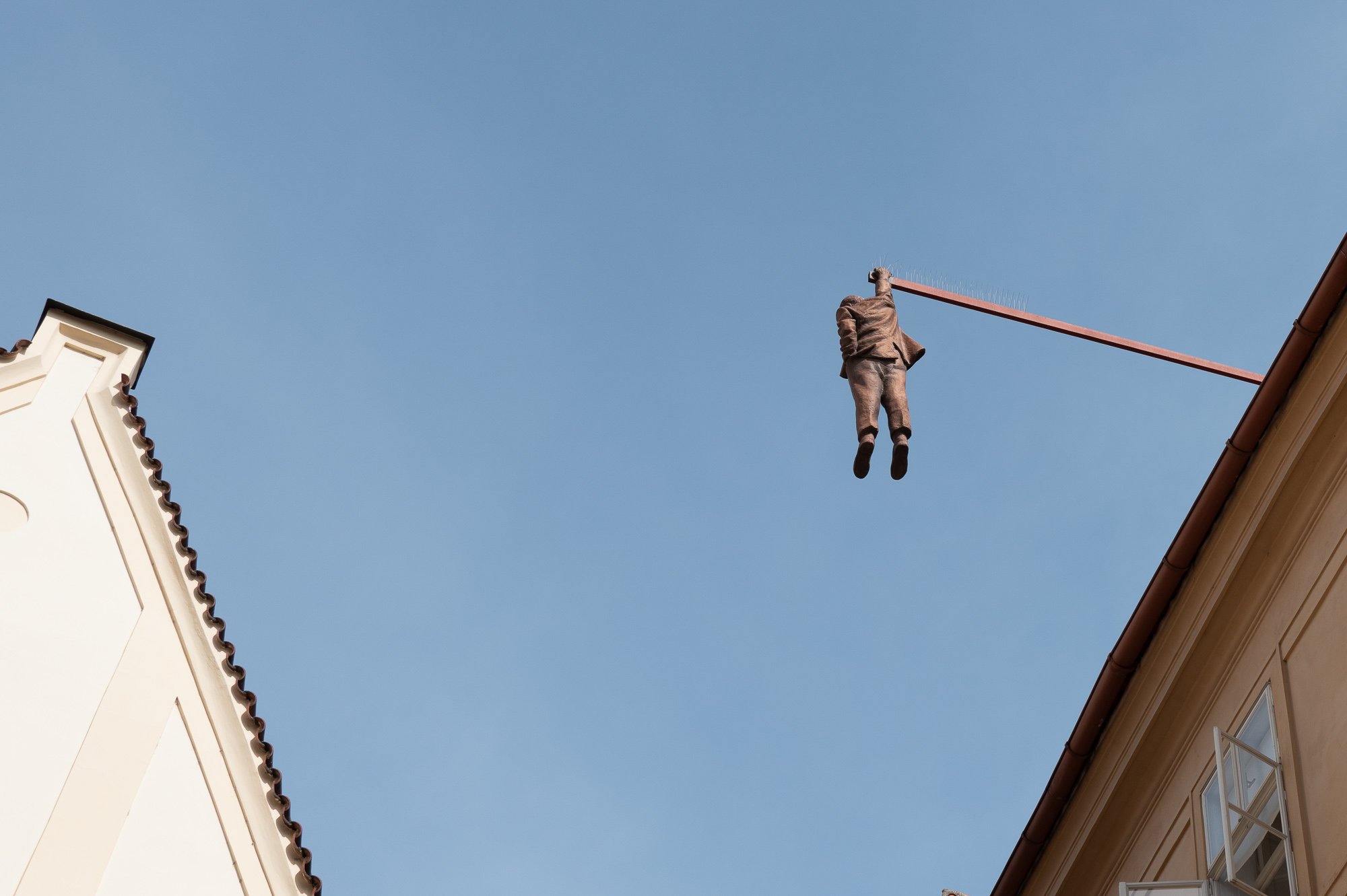
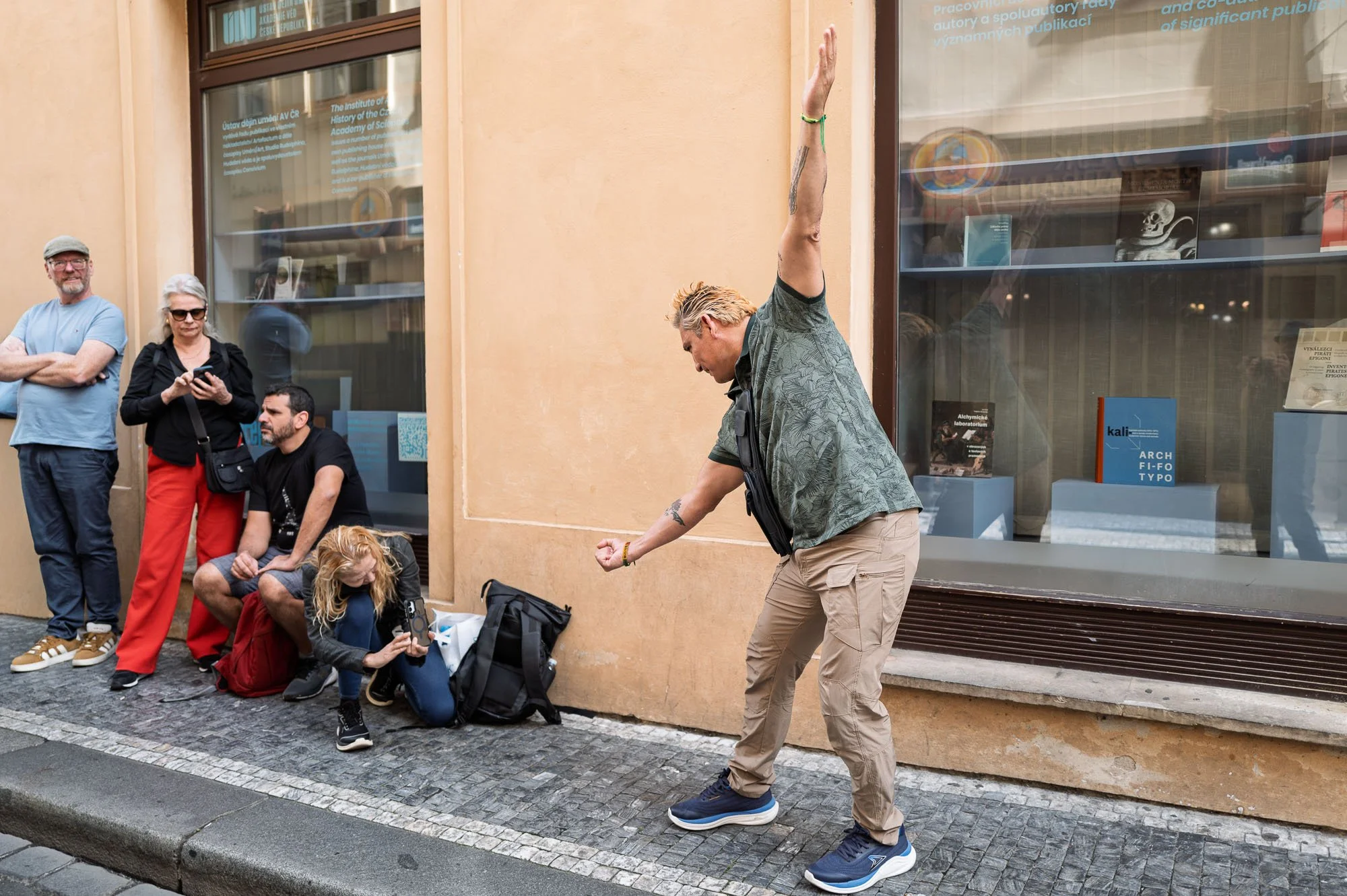
Prague also invites people to play. High above Husova Street, David Černý's figure of Sigmund Freud hangs from a beam by one hand, dangling over the passers-by. Down on the pavement, a man in a green shirt stretched one arm skywards and braced the other, pretending to hold Freud up by his own strength, while the people sitting against the wall looked on and checked their phones. It is the oldest trick in travel photography, the same one tourists play with the Leaning Tower of Pisa, and it still works.
Off Stage: Guides, Queues and Quiet Corners
Follow the Flag — Leica Q3
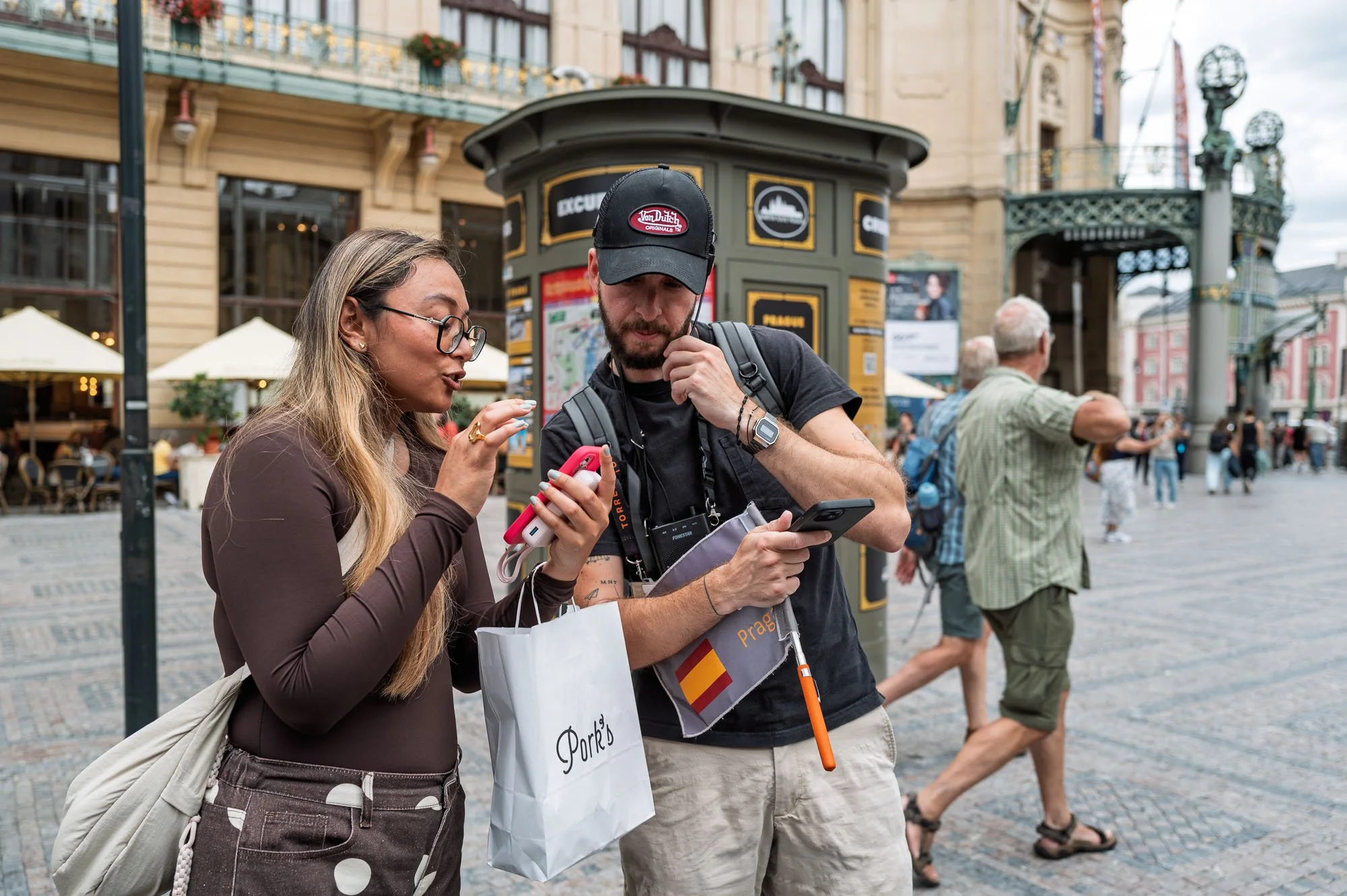
Near the Municipal House we met the other half of the ritual: the guides. A free-tour guide held up a small Spanish flag on an orange pole so his Spanish-speaking group could find him in the crowd, a phone in one hand and the other at his ear. Beside him, a young woman with a bag over her shoulder held up her own phone and asked him something, one question among the hundreds he must answer every day. Free walking tours run on tips and move through the Old Town in half a dozen languages, each group following its own small flag from one landmark to the next.
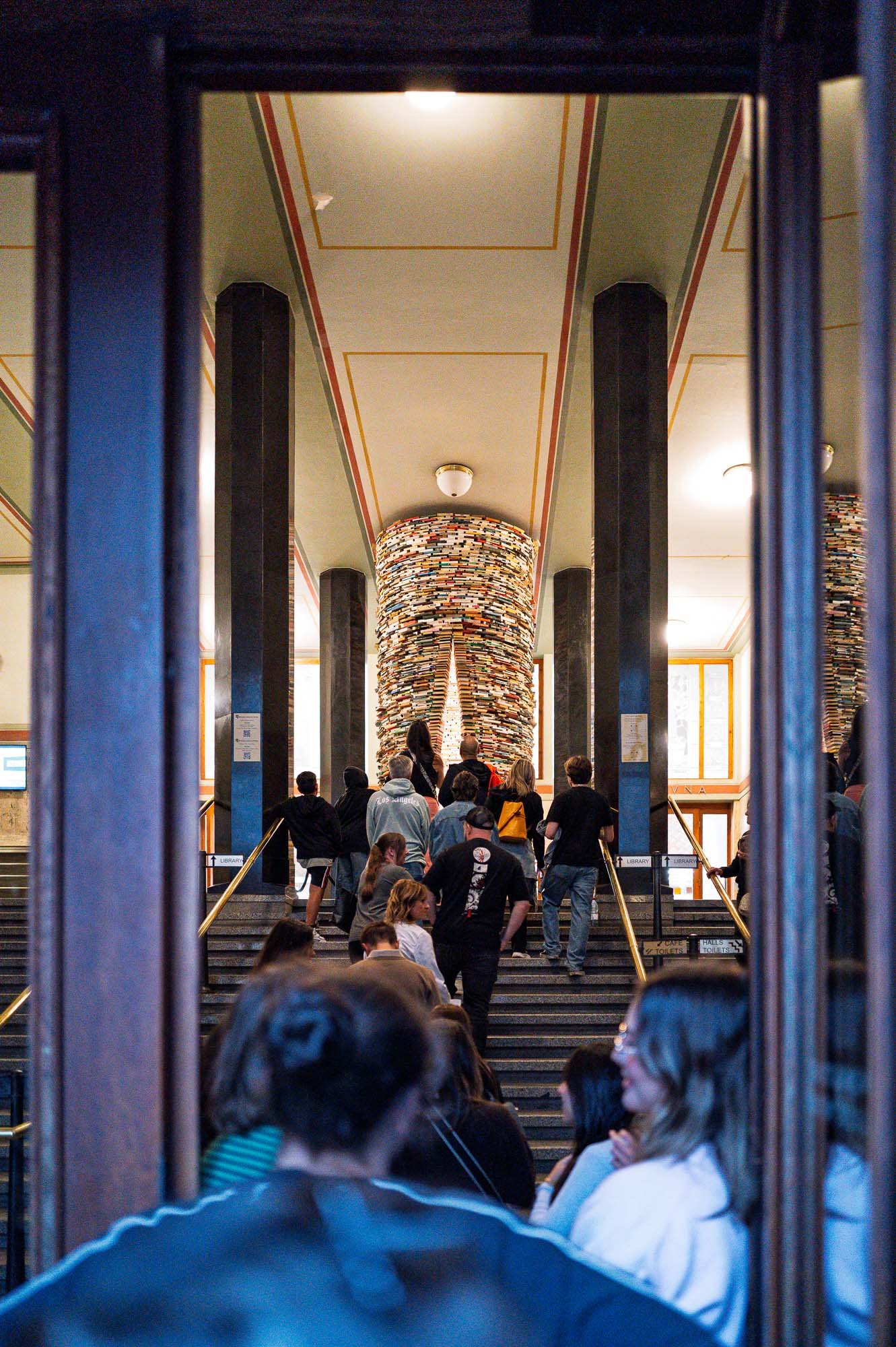
The Queue for Books — Leica Q3
At the Municipal Library, the queue was for a tower of books: Matej Krén's Idiom, a column of stacked volumes that seems to go on forever when you look inside it. We framed it through the dark wooden doorway. The line of visitors climbing the stairs towards it keeps the same patient order as the crowd at the clock.
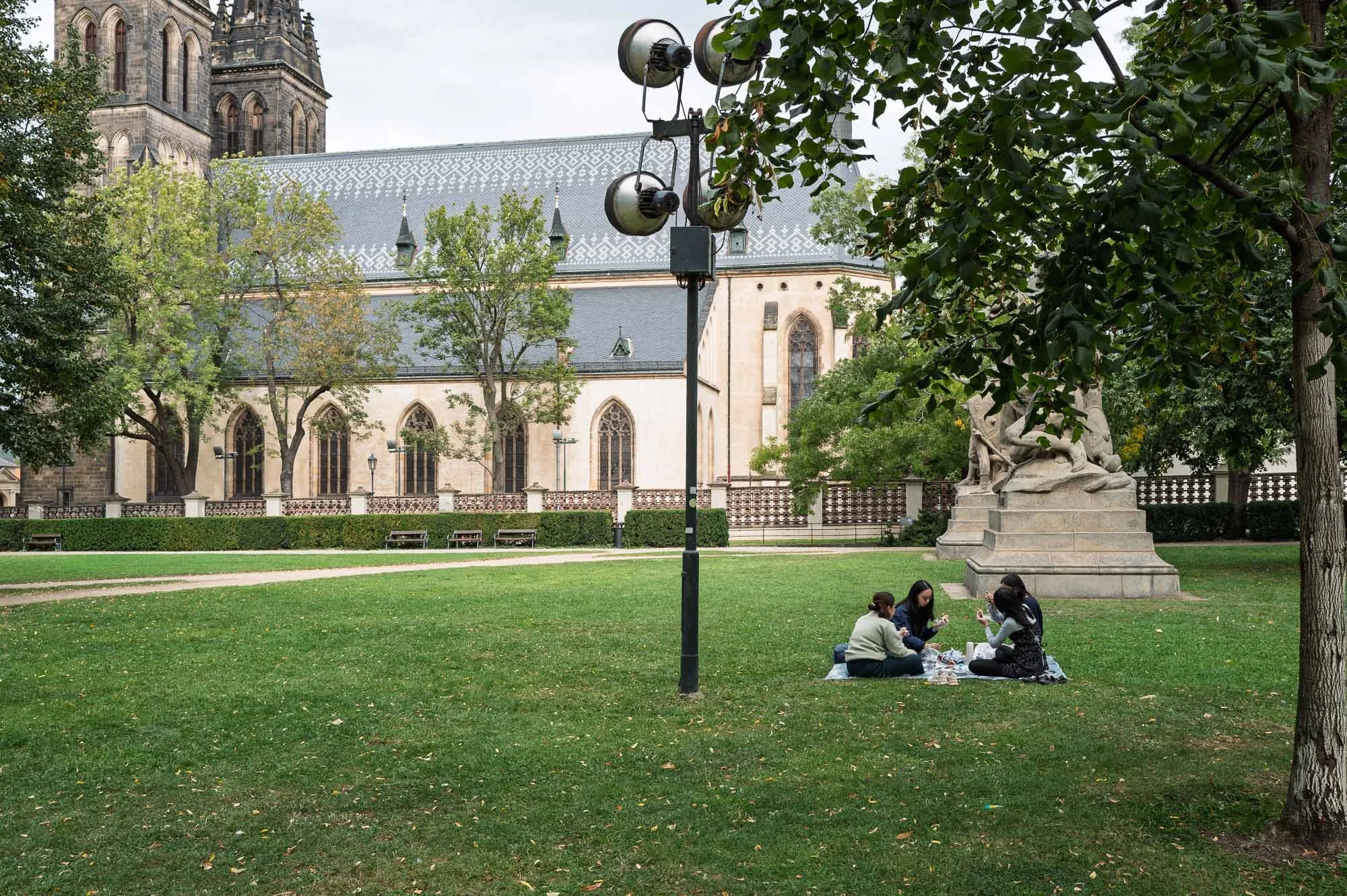
Back to the Monument — Leica Q3
Sometimes the best frame has its back to the monument. Up at Vyšehrad, below the Basilica of St Peter and St Paul, four young women sat on a blanket on the grass sharing a picnic beside a stone statue. The church was right there, and nobody was looking at it. After the Old Town, the quiet was almost startling.
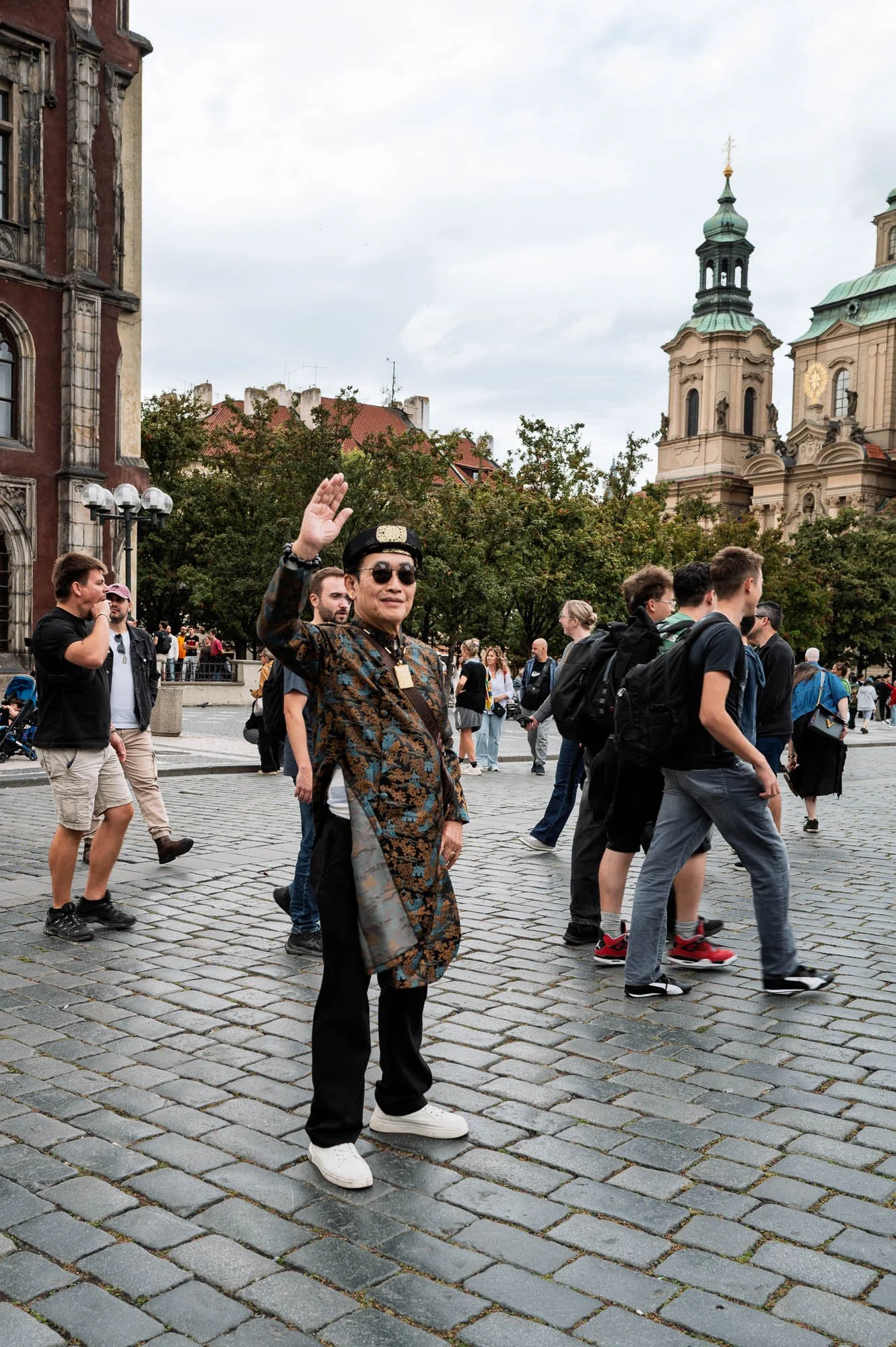
The Stage Looks Back — Leica Q3
Back in the Old Town Square, just once, the stage looked back. A man in a long patterned coat and dark glasses saw the camera and raised his hand in a wide, theatrical wave, with the towers of St Nicholas behind him and a group of young men walking past, oblivious. For a moment the roles were reversed, and we were the ones being watched. It is not Prague that makes people raise their phones; it is the way we all travel now, and we are no exception.
Go to Prague for the clock, the bridges and the spires, then turn around: the most interesting view in the Old Town is the crowd.
Photos: Leica Q3 · 28mm · f/2.8–8 · 1/250s · ISO 250 · Prague, September 2026
See more street photography in the Street Photography gallery.
Every photo on this site can be printed — archival paper, signed and numbered. Browse prints →
Cosme Lapena is a Barcelona-based street and urban photographer and founder of bCLPhoto. Browse the portfolio or read more on the blog.