I have known Poblenou for more than fifty years, and few parts of Barcelona have changed as much in that time. This is a guide to Poblenou street photography from someone who remembers the neighbourhood before the towers: a walk from Plaça de les Glòries into the 22@ district, where old factories and new architecture now share the same blocks. Most of these photographs were taken on the street photography walks Anton leads for the Barcelona Street Photography Group. I have done his Glòries route two or three times, in August 2023, April 2024 and October 2026, and since the route is always similar, the same corners return here in different seasons.
Plaça de les Glòries: A Square Rebuilt
Glòries has gone through several redesigns in my lifetime. Today the traffic of the Gran Via runs entirely underground, through tunnels that opened fully in 2022, and the surface has become a large open space for walking and playing. Above it stands Torre Glòries, opened twenty-one years ago, the building that changed the whole face of this part of the city. It is the neighbourhood's icon now, and everyone photographs it. I did too, from the edge of the long pool beside the Disseny Hub, where the white and green band of the museum leads the eye to the tower and the water repeats both.
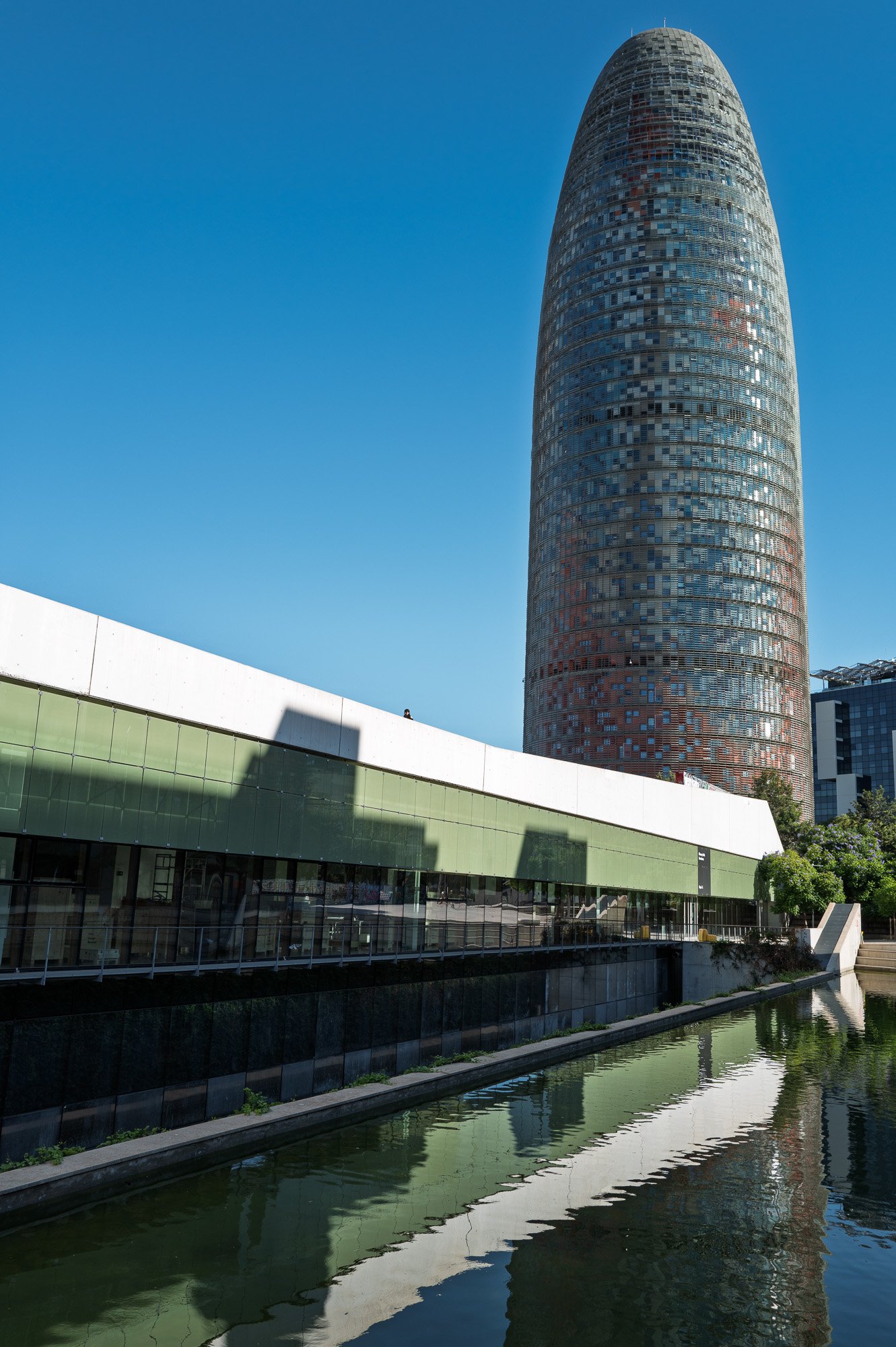
The Tower and the Pool — Leica Q3
The Disseny Hub is a gift for anyone who likes hard geometry. Its upper volume juts out over the pool like a block that has slid off its base, and on a calm October morning the water turns that grey mass into a soft, slightly broken copy of itself, with the mirrored canopy of the Els Encants flea market behind. I stood low at the water's edge so the building would seem to rest on its own image.
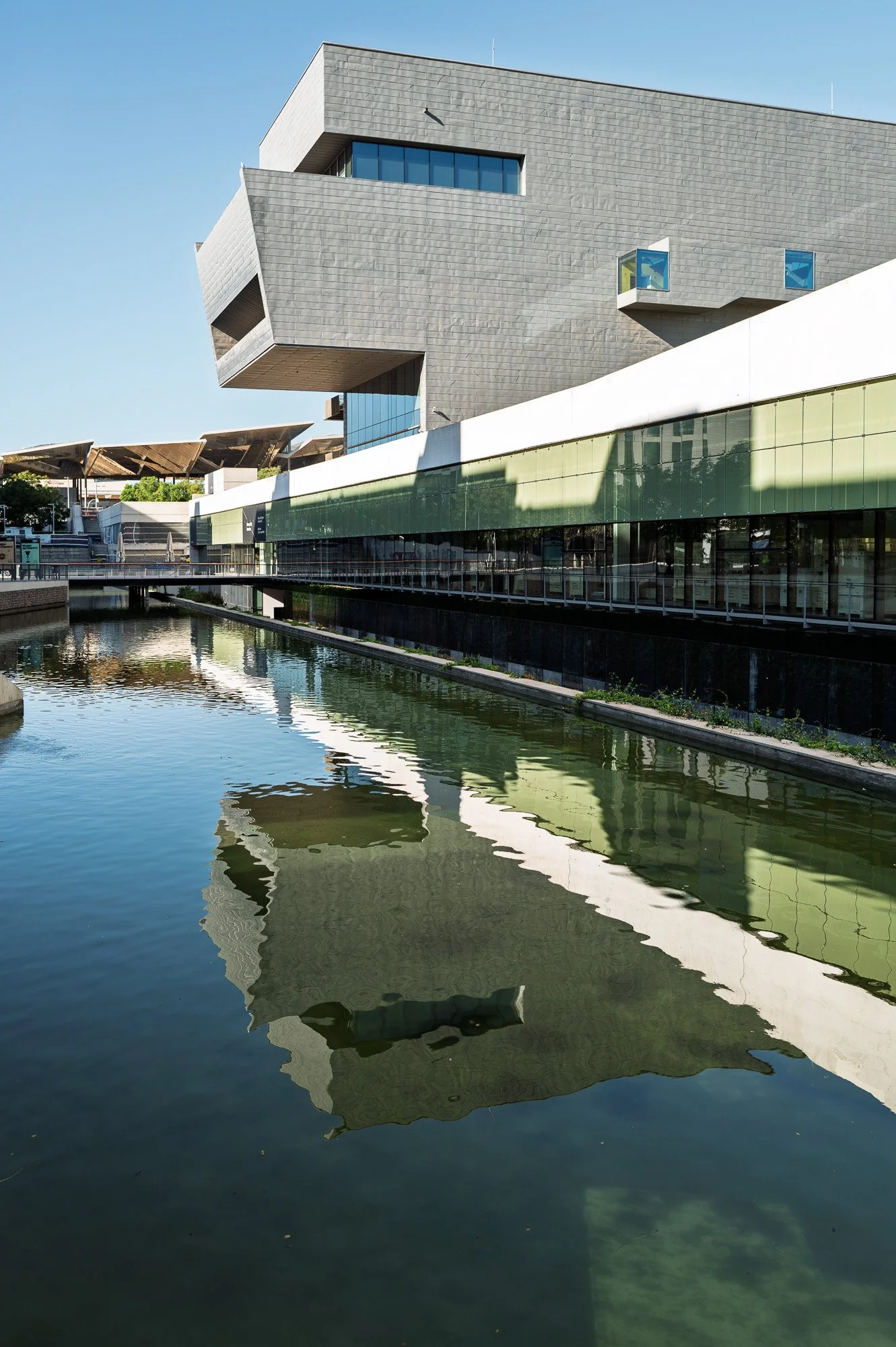
Resting on Its Own Image — Leica Q3
A few steps away, the tram lines run straight towards the horizon. I put the camera close to the ground, between the rails, and let the groove of the track pull the eye forward past the Encants canopy on the left and the dark wedge of the Disseny Hub on the right, with a tram far in the distance. It is the kind of composition the 28mm lens of the Leica Q3 rewards: one strong line and enough space on either side to tell you where you are.
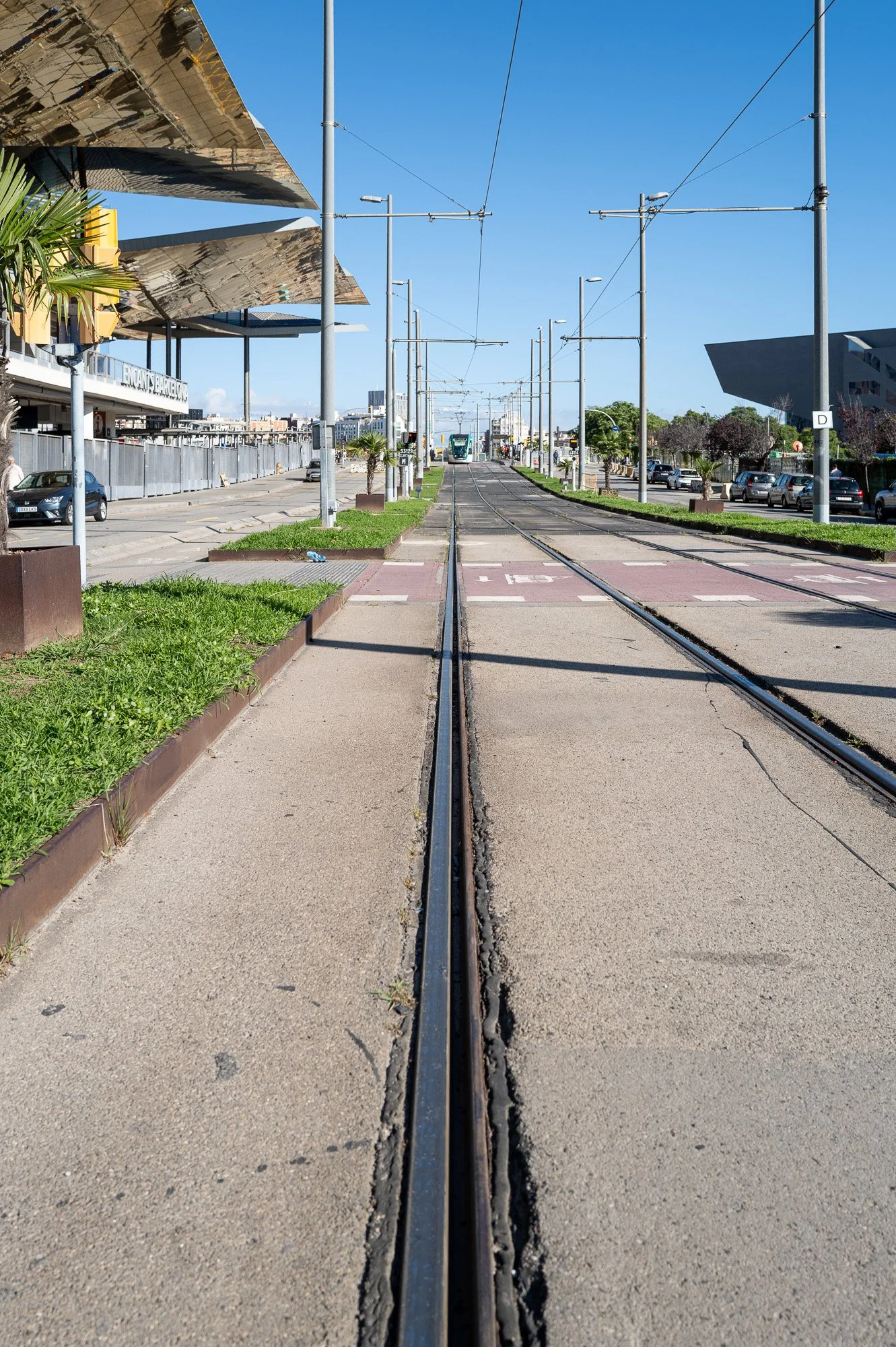
One Line to Glòries — Leica Q3
Glòries is not all polish. Next to the rails, a stretch of rough ground still carries graffiti on every wall and on a small utility hut, with tram wires cutting across the frame and the golden canopy of the Encants above the trees. It shows the square as it is today: finished in some corners, still waiting in others.
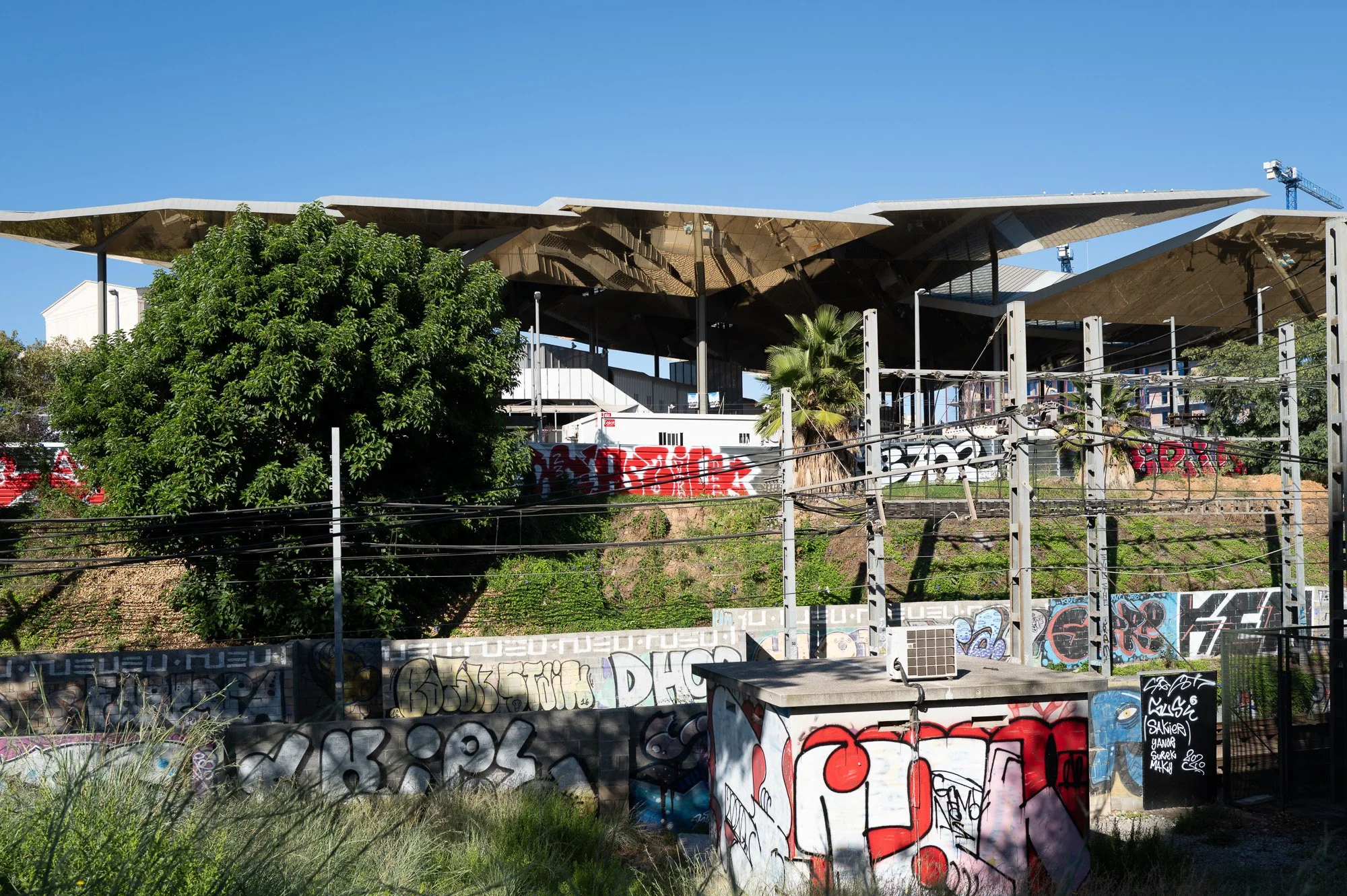
Still Waiting — Leica Q3
On the other side of Glòries, the Teatre Nacional de Catalunya carries the words "Una porta al món", a door to the world, in giant letters across its glass façade. A single figure stood on the wide steps beneath them, enough to give the building its scale.
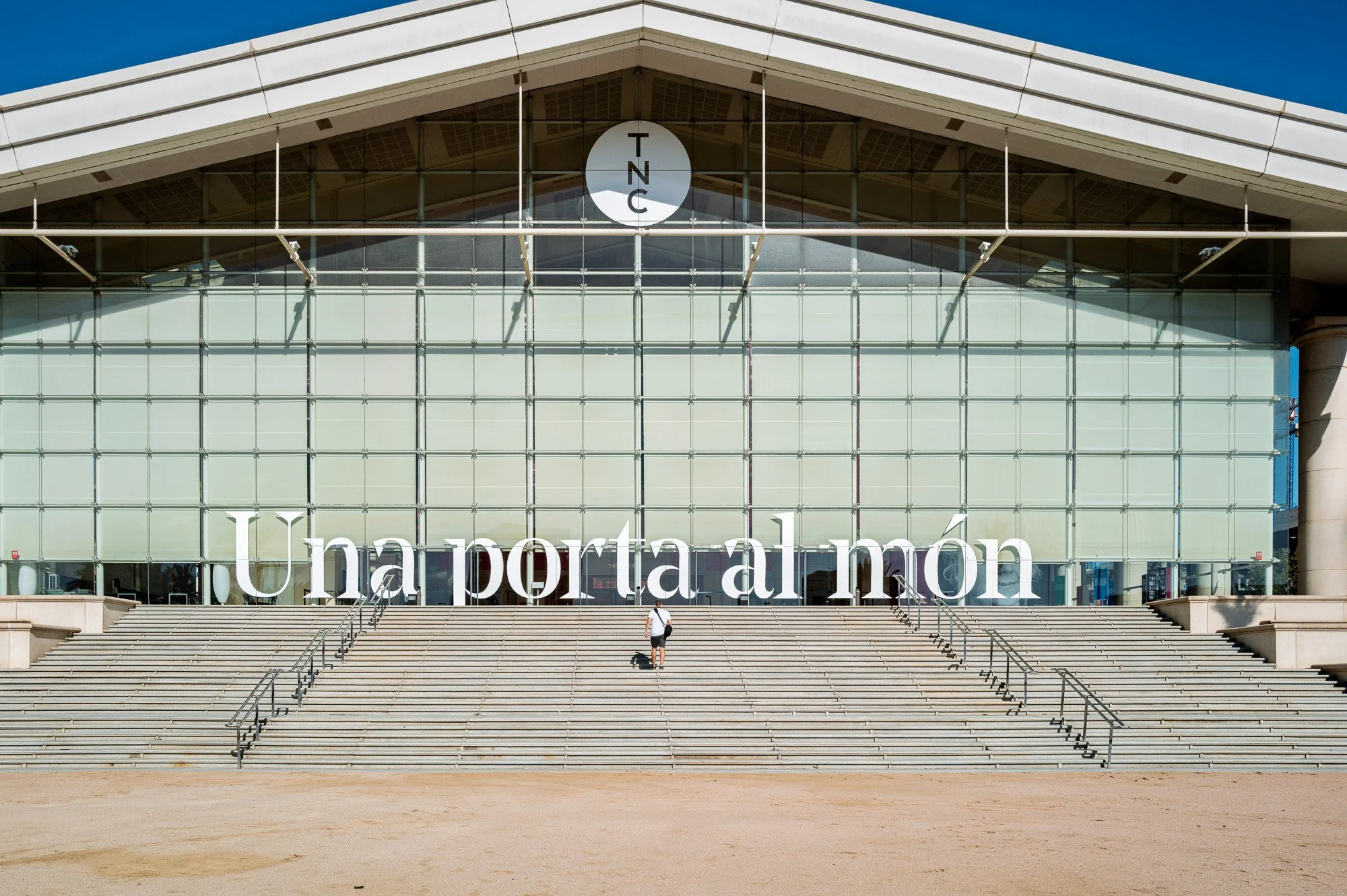
A Door to the World — Leica Q3
The 22@ District: New Architecture in an Old Grid
Poblenou was a working-class neighbourhood full of factories through most of the twentieth century. In 2000 the city council approved the plan that turned its old industrial land into the 22@ innovation district, and the factories have been giving way to offices, apartments and the places where the people who work in them eat and drink. For a photographer interested in 22@ Barcelona architecture, the result is a catalogue of façades. Near Glòries, one residential block is built entirely in a deep red frame, each window a white-curtained square. The balconies are where the building comes alive: yellow chairs, a few pots of plants, and a child's blue bicycle parked behind the railing.
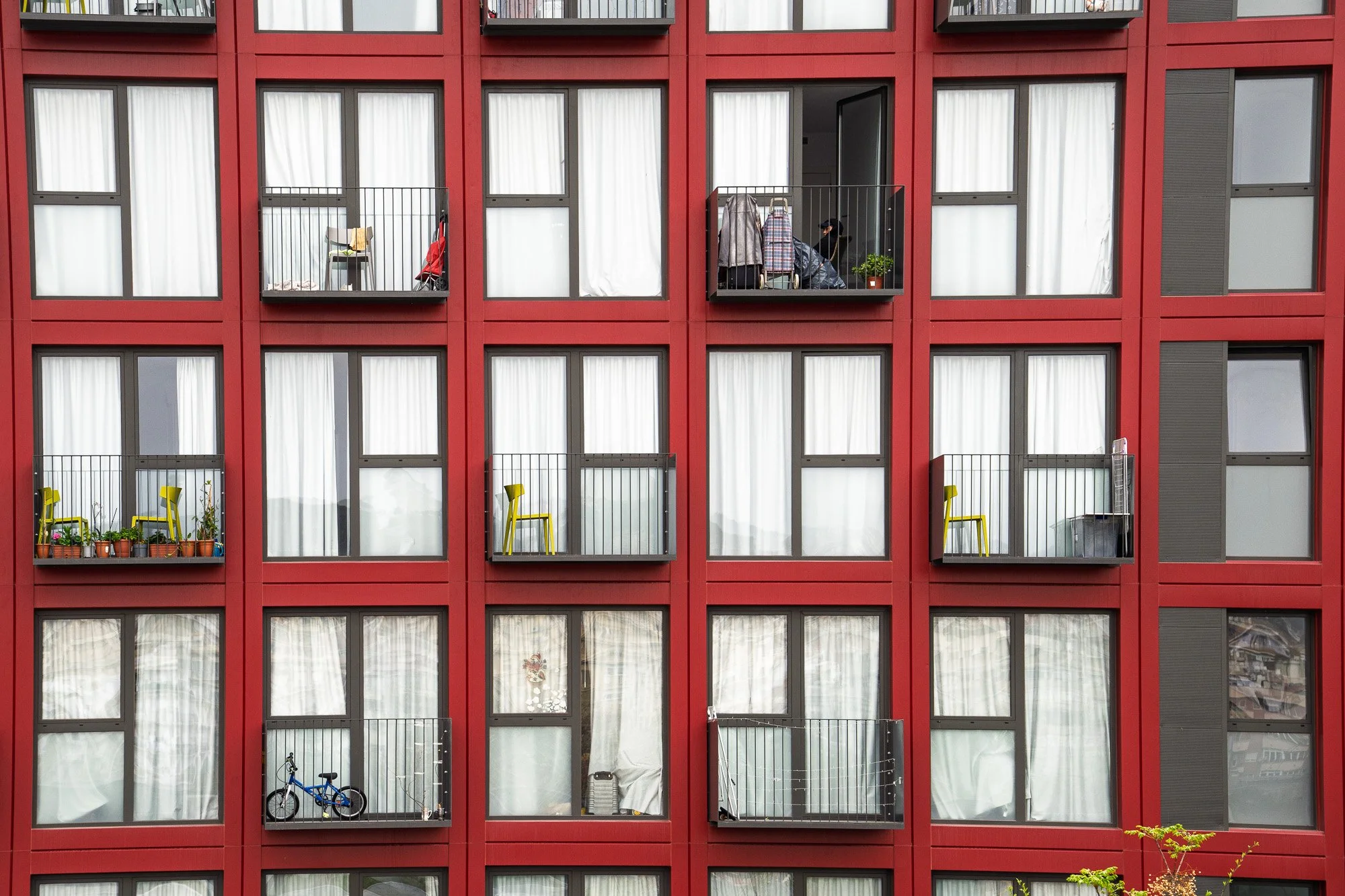
Life in the Grid — Sony a7R IV
A few streets further on, a corner of horizontal rust-coloured louvres rises against a clear blue sky. Shot from below, the slats become a stack of thin lines narrowing towards the top of the frame, and the neighbourhood feels less like a street than an architectural drawing.
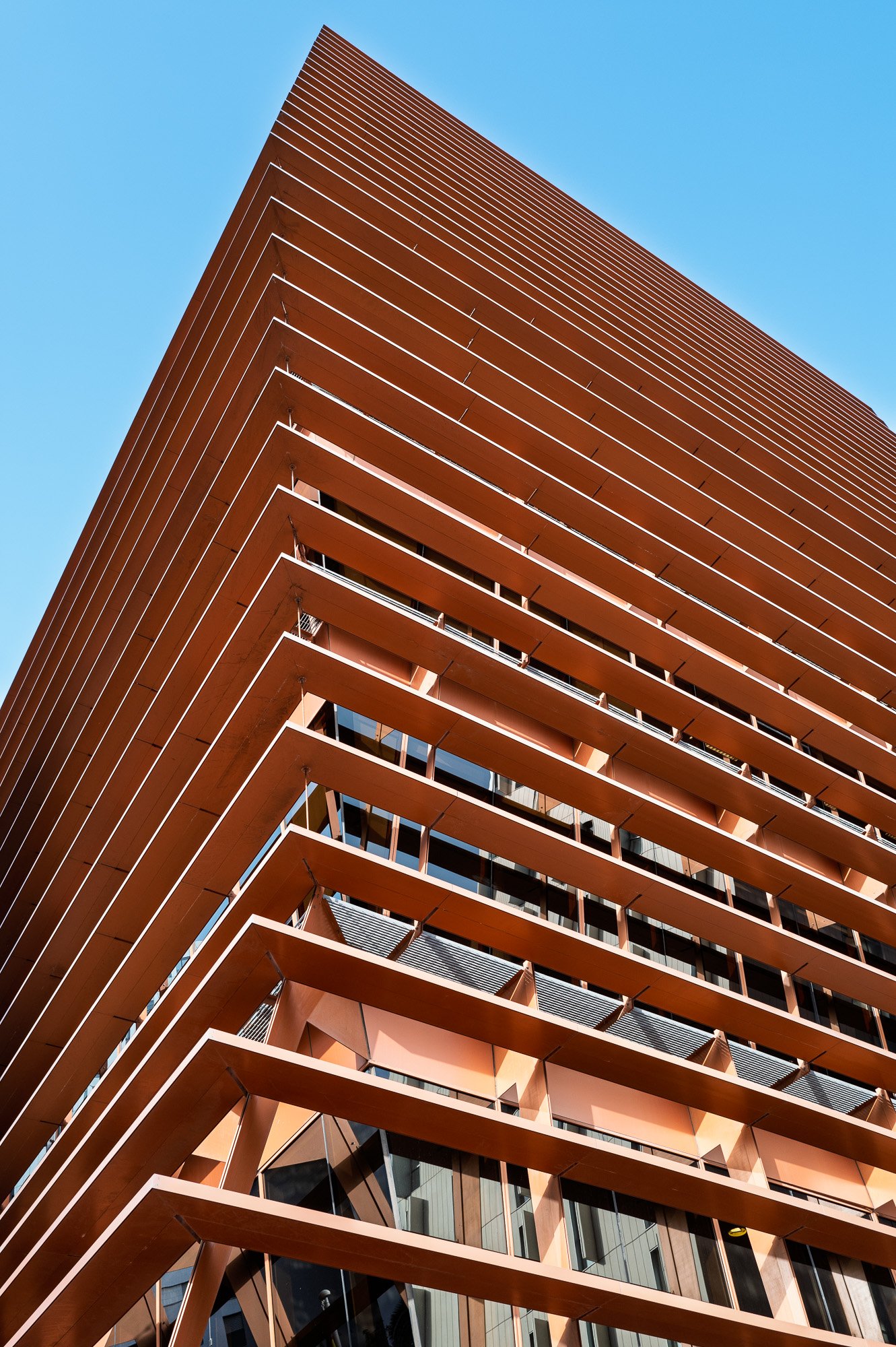
Architectural Drawing — Leica Q3
Old Factories and New Towers in Poblenou
What makes Poblenou worth a long walk is that the old buildings have not all gone. In one passage a low brick factory with peeling walls and a row of drainpipes faces a new building clad in copper-coloured metal. Two small figures at the far end give it depth, and the frame says in one glance what this neighbourhood is about.
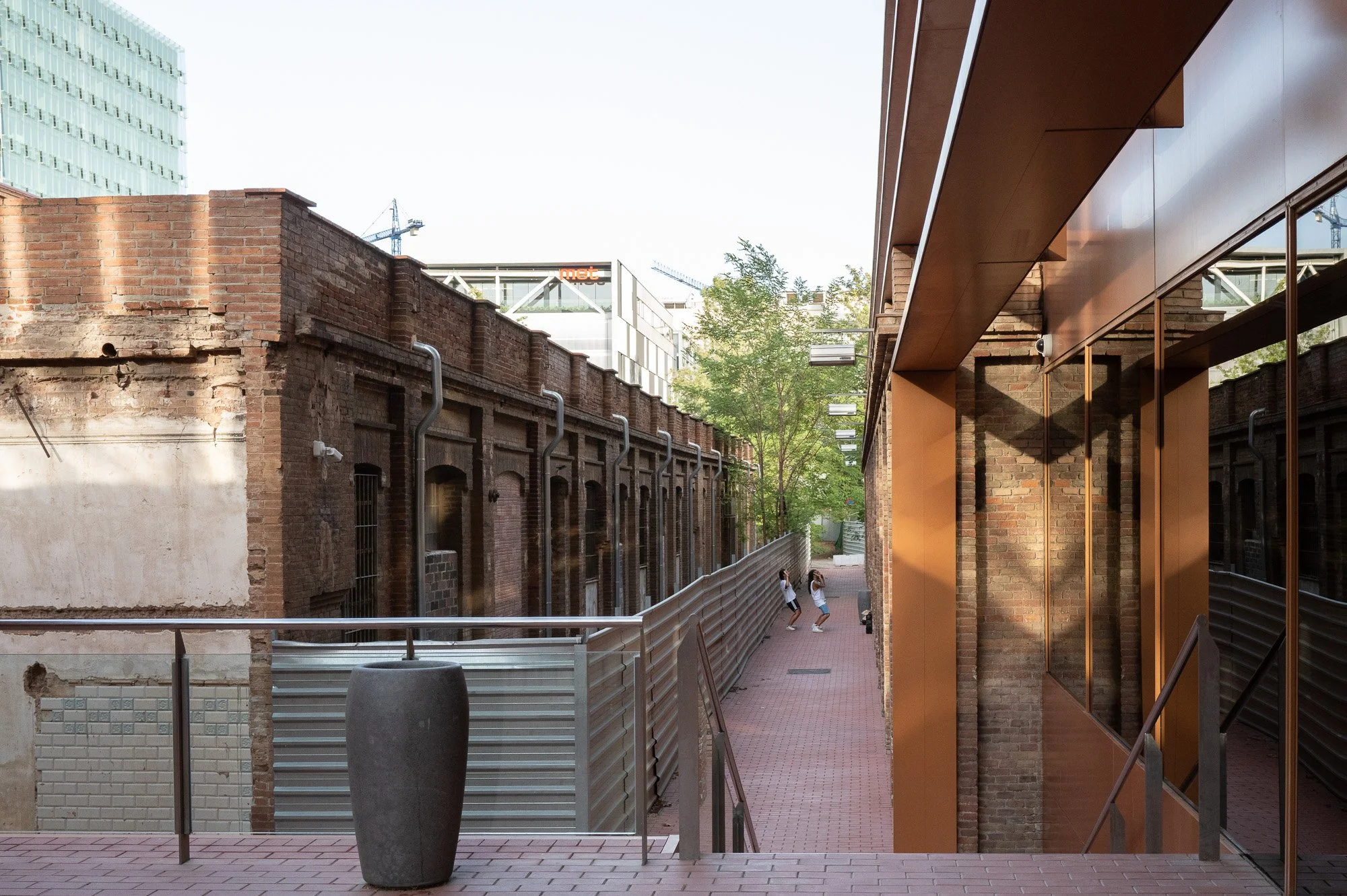
Brick and Copper — Leica Q3
The clearest example is the Poblenou campus of Pompeu Fabra University, built around Ca l'Aranyó, a cotton mill from 1877 that worked until 1986. The new grey blocks with red accents leave a tall gap in the middle, and through it rises the factory's old brick chimney, now inside the campus. I stood across the street, square to the façade, so the chimney would sit in the centre of that opening, framed by the university that took over its factory.
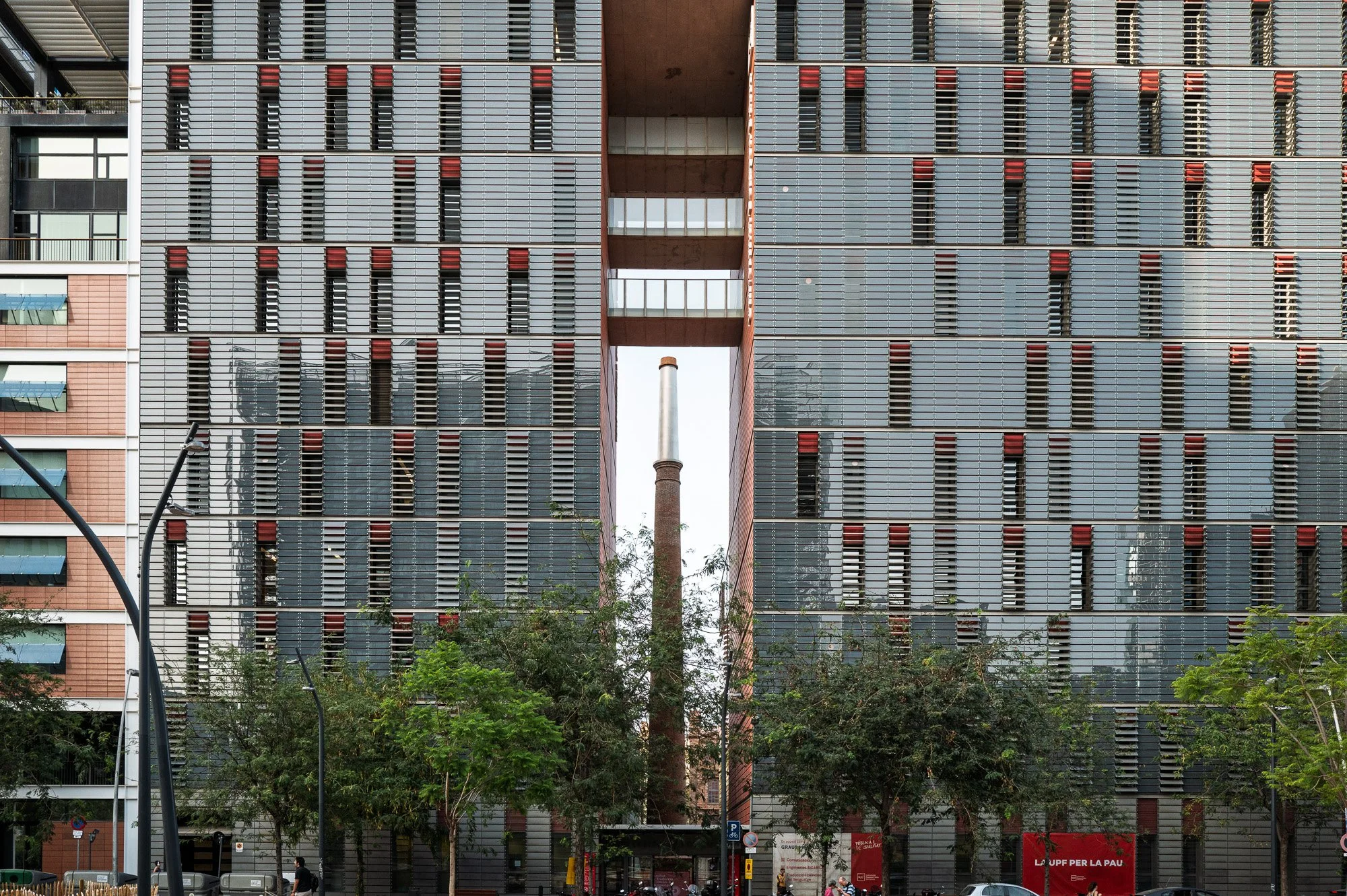
The Chimney of Ca l'Aranyó — Leica Q3
Some of the older buildings survive almost untouched. A whitewashed industrial building with a red barred window and a scrawl of graffiti still carries a concrete water tower on its roof. A woman walked past carrying a potted plant, and her step gave the wall the movement it needed.
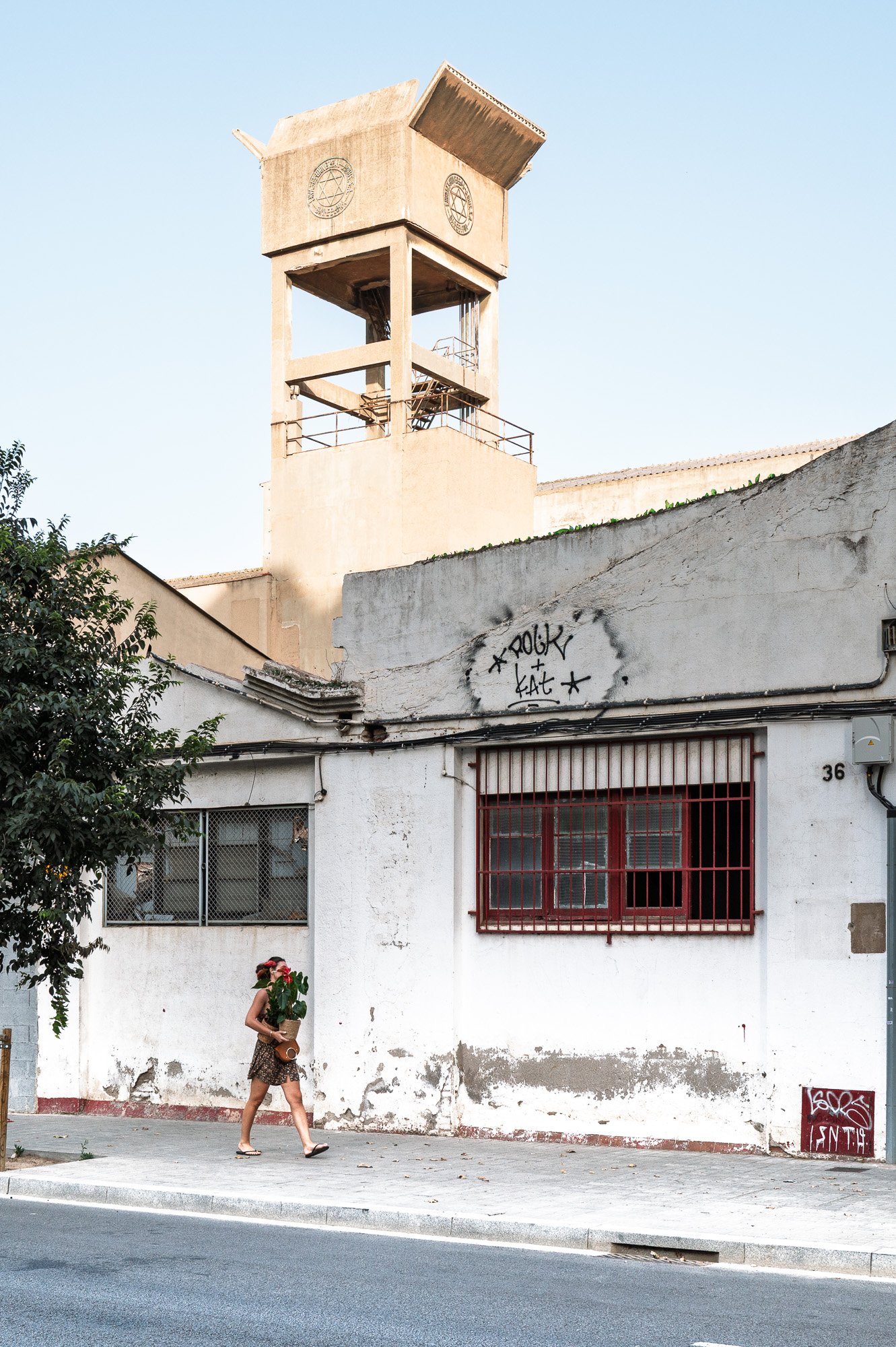
The Water Tower — Leica Q3
Poblenou Street Photography: People in a Changing Neighbourhood
The change in Poblenou is not only in the buildings. Many of the people who now walk these streets came to Barcelona from abroad to study or work, and they have made the neighbourhood their own, to the point that in some streets you hear more English than Catalan, the language that was spoken here all my life. It is a neighbourhood full of contrasts, and the old and new manage to live together in a certain harmony.
On an overcast April day around Glòries I found an orange shared bike parked against a row of concrete benches. Behind it a woman in a red jumper and scarf was walking home with her shopping bags. The orange bike and her red jumper are the only strong colours in a grey frame.
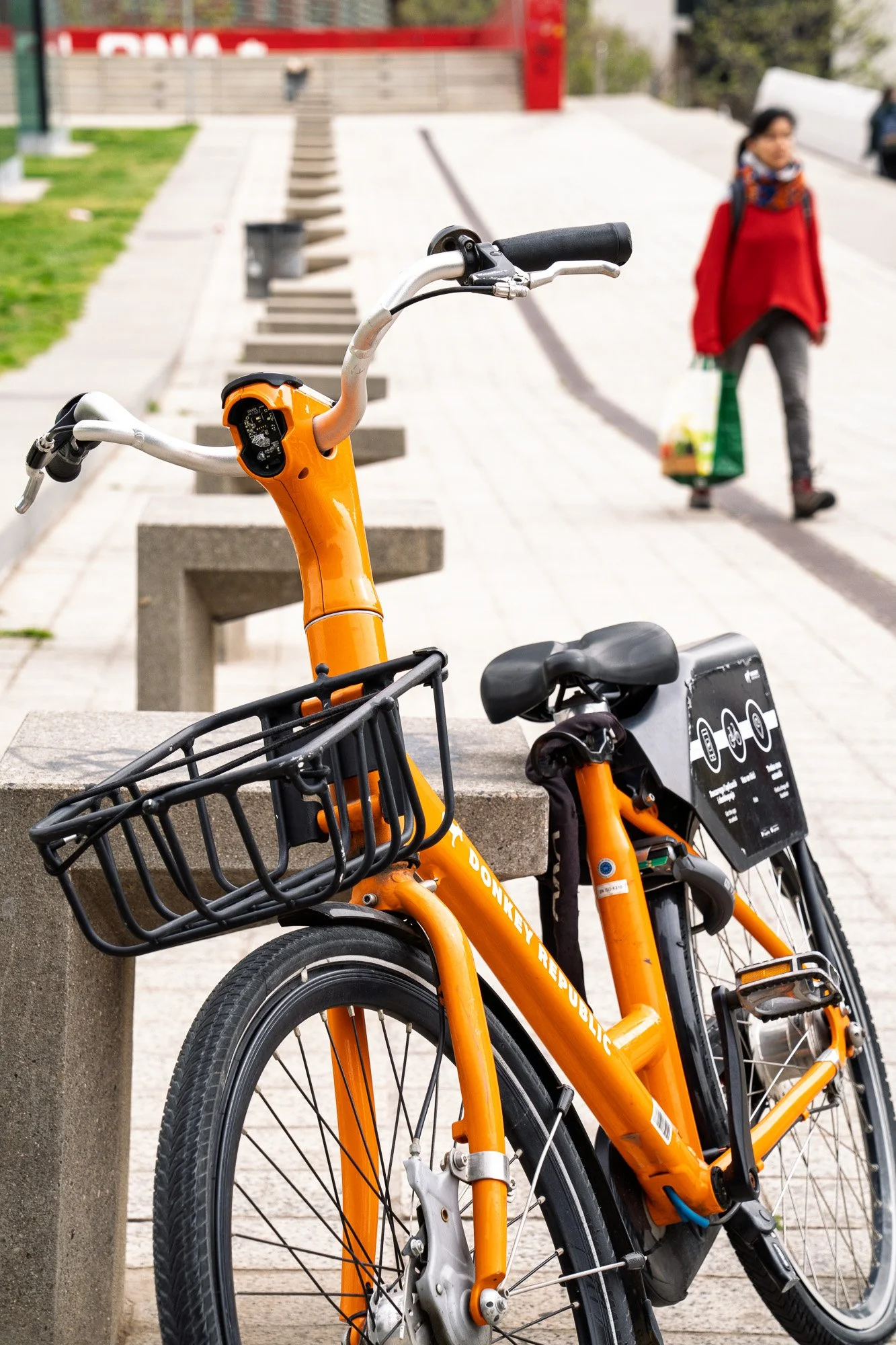
Orange and Red — Sony a7R IV
On a set of concrete steps, three people were exercising in front of a graffiti wall, arms out and legs stretched back in the same movement, as if rehearsing a dance. The dripping black letters and bright tags behind them make it look staged. It was not.
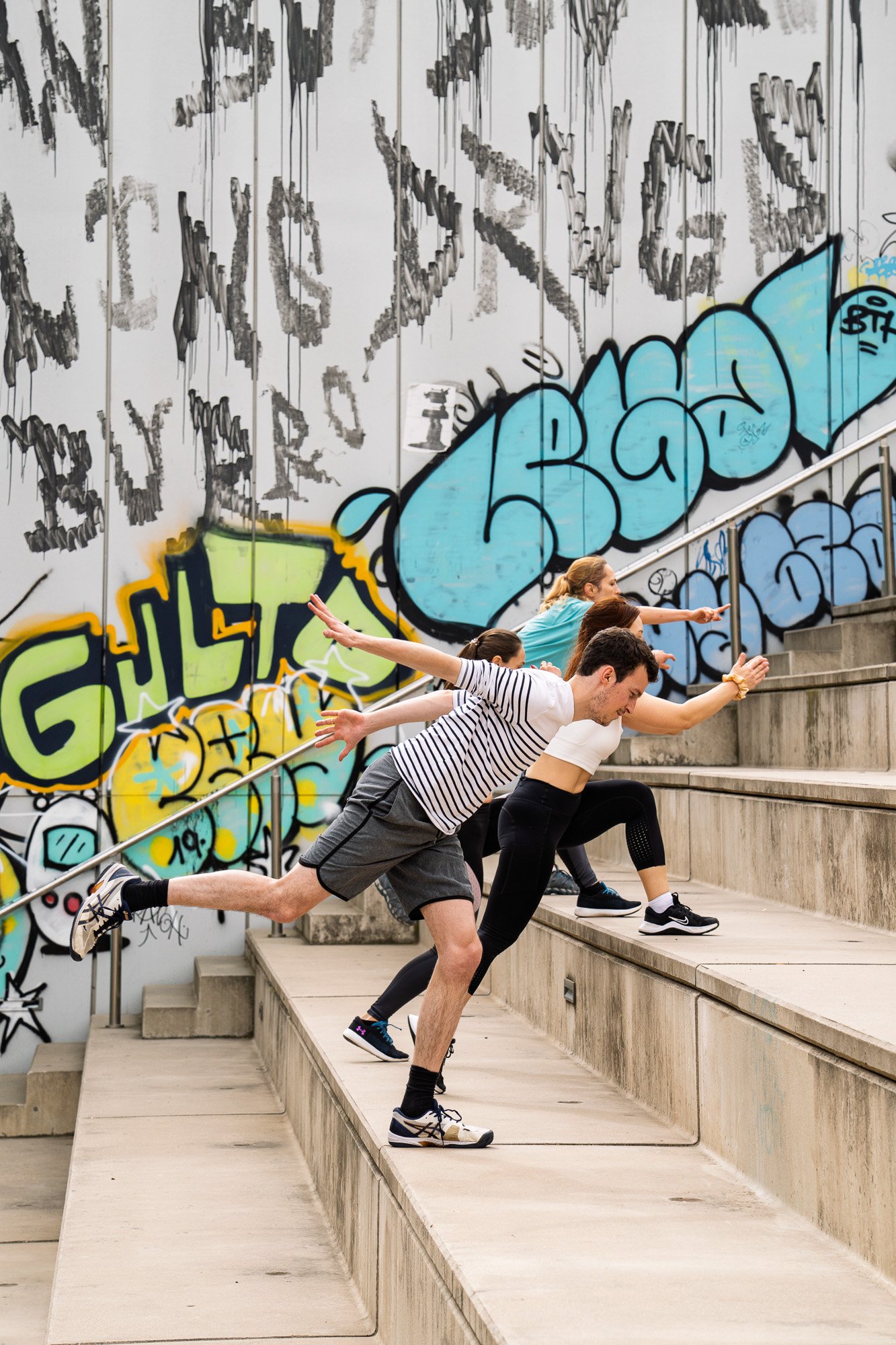
The Rehearsal — Sony a7R IV
Another April frame is all about colour. A café terrace with wooden director's chairs and a closed parasol sits in front of a mural of red and pink stripes and blue, yellow and pink circles, with still water below. A blonde woman in a green jacket crossed it looking at her phone and became part of the painting.
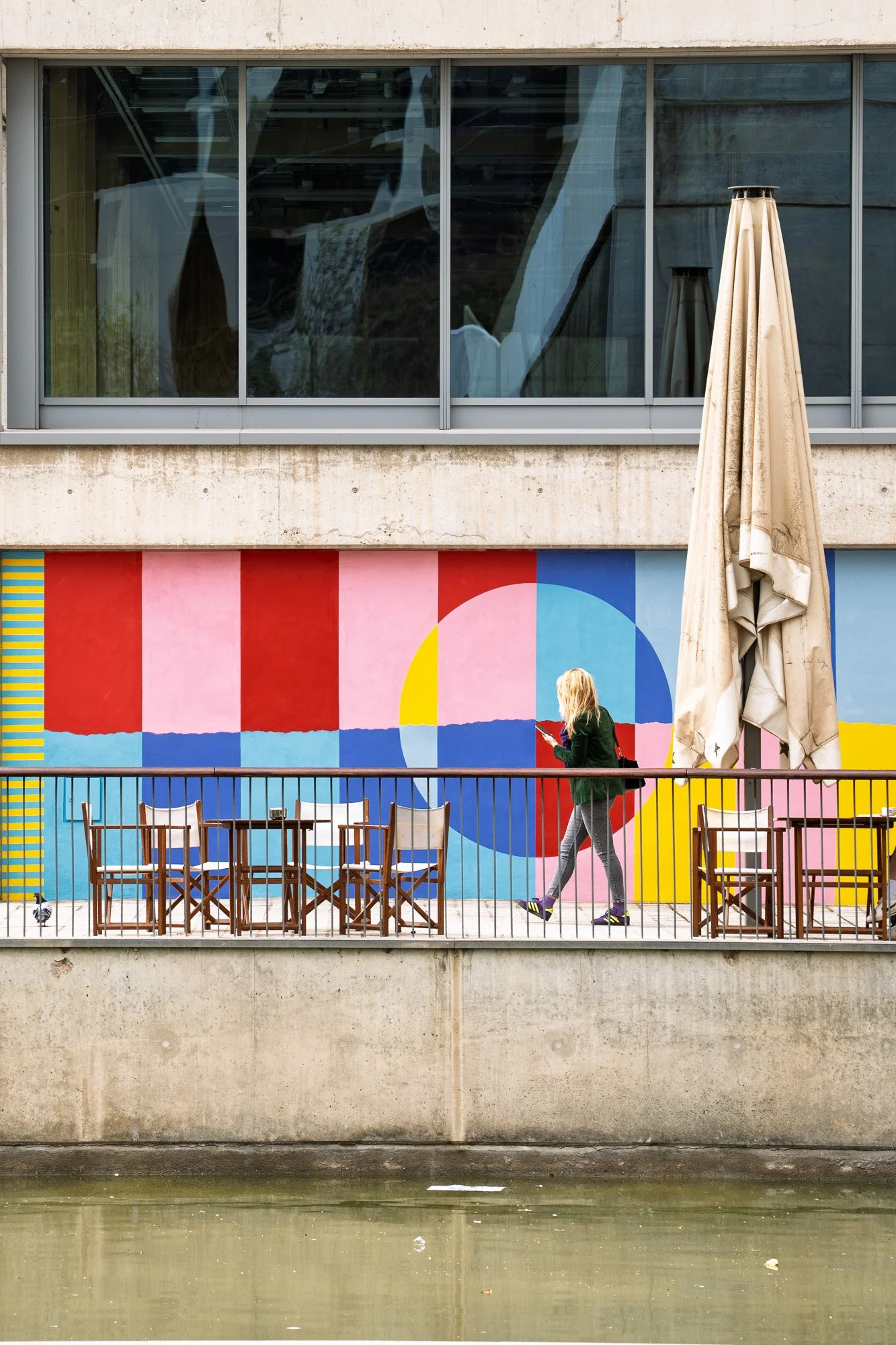
Into the Painting — Sony a7R IV
The last photograph is a reflection, a theme I keep coming back to. A man in sunglasses and a backpack stopped beside a shop window, and the glass gave him a twin, the two face to face with the apartment blocks continuing behind them. No trick, only a window and the patience to wait. More of these frames are in my reflections gallery.
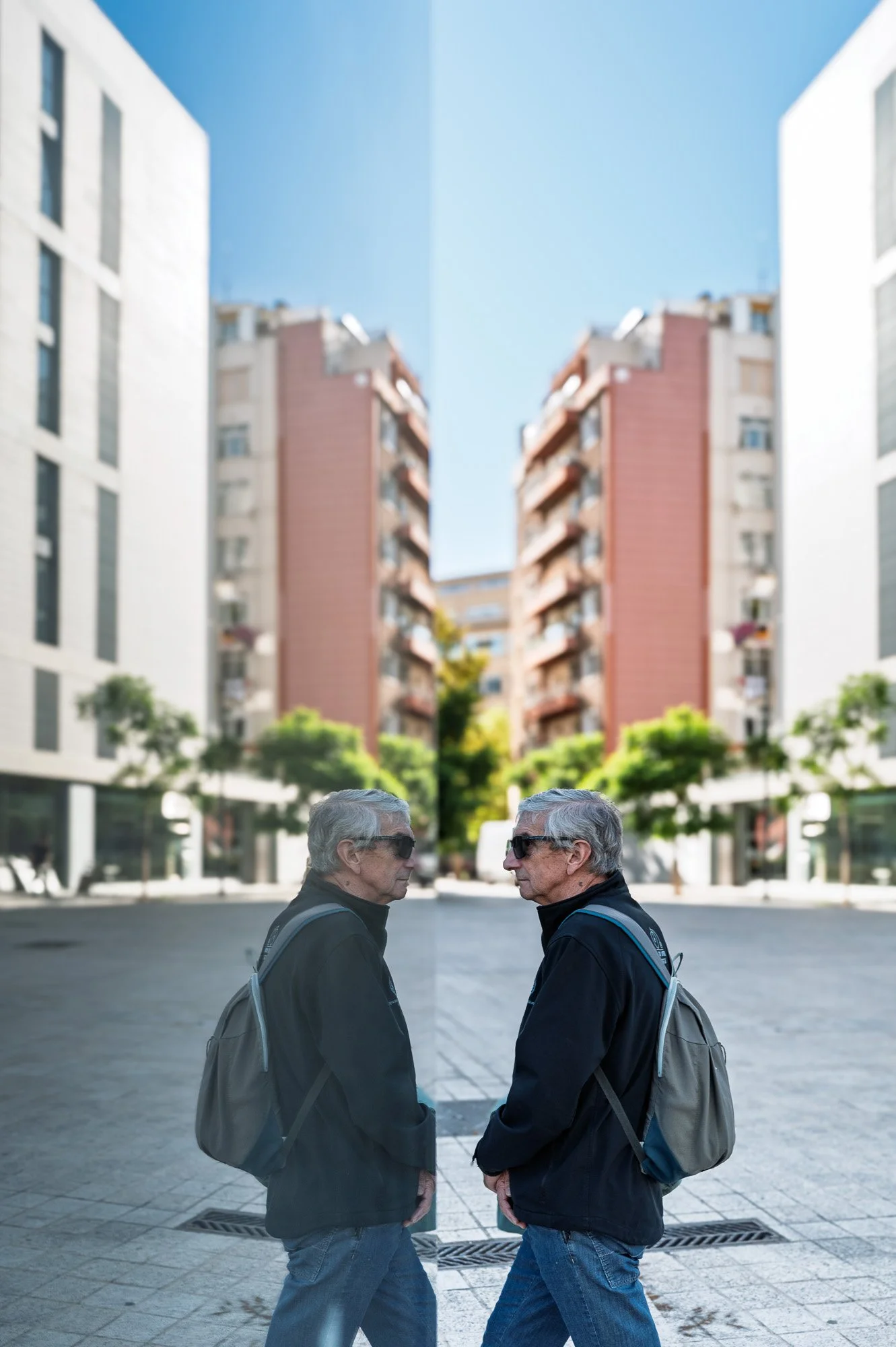
Face to Face — Leica Q3
For a photographer, Poblenou deserves a good walk. It is a neighbourhood with a lot of life and plenty to photograph, from the geometry around Glòries to the old chimneys and the people who have made the new district their home. For a longer route, combine it with the other areas in my guide to the best street photography spots in Barcelona.
Take the tram to Glòries, walk down into the old factory streets, and look for the places where the two Poblenous meet.Subscribe to the newsletter for new walks through Barcelona, along with a free street photography guide.
Photos: Leica Q3 · 28mm · August 2023 and October 2026 · Sony a7R IV · Sony FE 24-105mm f/4 G OSS · April 2024 · Barcelona
See more urban architecture and street photography in the portfolio. Every photograph in this post is also available as a fine art print.
Cosme Lapena is a Barcelona-based street and urban photographer and founder of bCLPhoto.
Exhibited at espai [b] since 2010 and PH21 Gallery · Published in The Eye of Photography, 35mmc, Macfilos and Street Photography Magazine. Browse the portfolio or read more on the blog.