Prague Reflections: Glass, Water and a Layered City
Prague reflections are everywhere once you start looking for them. In our first post from this trip we turned the camera on the crowds facing the monuments. This time we turned it towards the glass: shop windows, café mirrors, a polished steel head, the dark water of the Vltava. Glass is the city's second skin. It holds the street and the interior at once, and on a good day it adds a third layer: the one we are standing in.
Reflection photography is mostly a matter of angle and light. With the Leica Q3's fixed 28mm lens we worked close to the glass, shifting a few degrees at a time to decide how much of the street would lie over the interior. The September light kept changing between bright sun and passing cloud, and every change moved the balance: sun on the street strengthens the reflection, shade outside lets the room behind the glass show through.
Prague Reflections in the Shop Windows
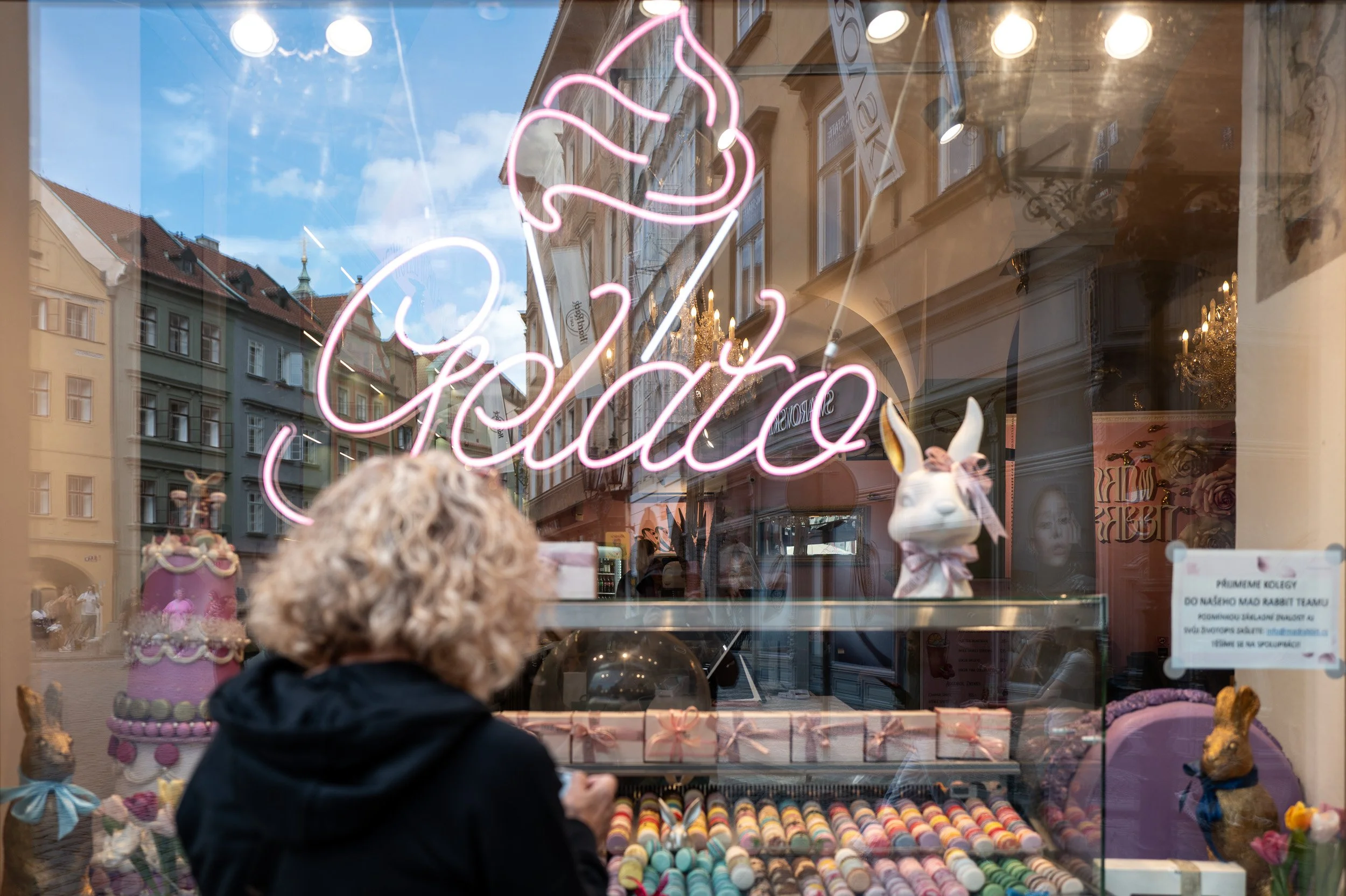
Neon over the Old Town — Leica Q3
In the Old Town, a pastry shop window does half the work for you. A pink neon Gelato, written in looping script beneath the outline of a cone, glows over rows of pastel macarons, gift boxes tied with ribbon and a white rabbit with a pink bow. Across all of it lies the street: ochre and grey-green façades, a green spire, blue sky, even a jeweller's name spelled backwards. A woman with curly fair hair stopped at the glass and gave us the anchor we needed, one solid figure looking in while the city looked back over her shoulder.
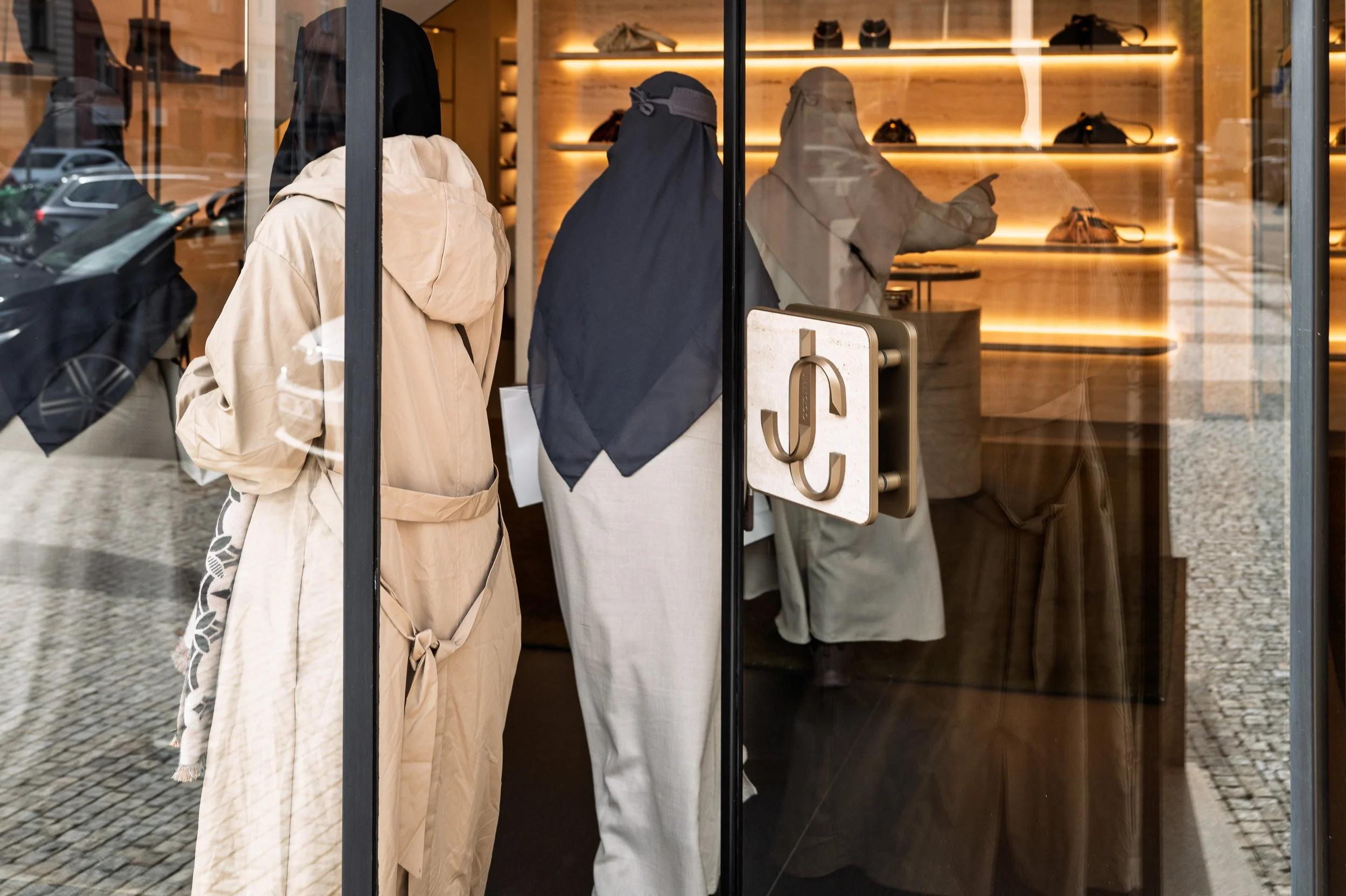
Both Sides of the Glass — Leica Q3
At the door of a designer boutique, three women stood looking in. Two we saw clearly from behind: one in a pale trench coat with the belt knotted at her back, the other in long grey robes with a dark veil tied behind her head. The third had already gone inside. Through the glass she appears pale and translucent among the lit shelves of handbags, one arm raised towards a bag, the street's reflection washing over her until she seems to belong to both sides of the window at once. That uncertainty is exactly what we were chasing.
Faces in the Glass
Where the stalls of the Havelské market come to an end, the windows of the Illusion Art Museum Prague ↗ hold a different kind of portrait. The museum specialises in anamorphic and optical art: famous Czech faces built from hundreds of small pieces that only resolve into a likeness from the right spot. Behind glass, with the street laid over them, they become something else again.
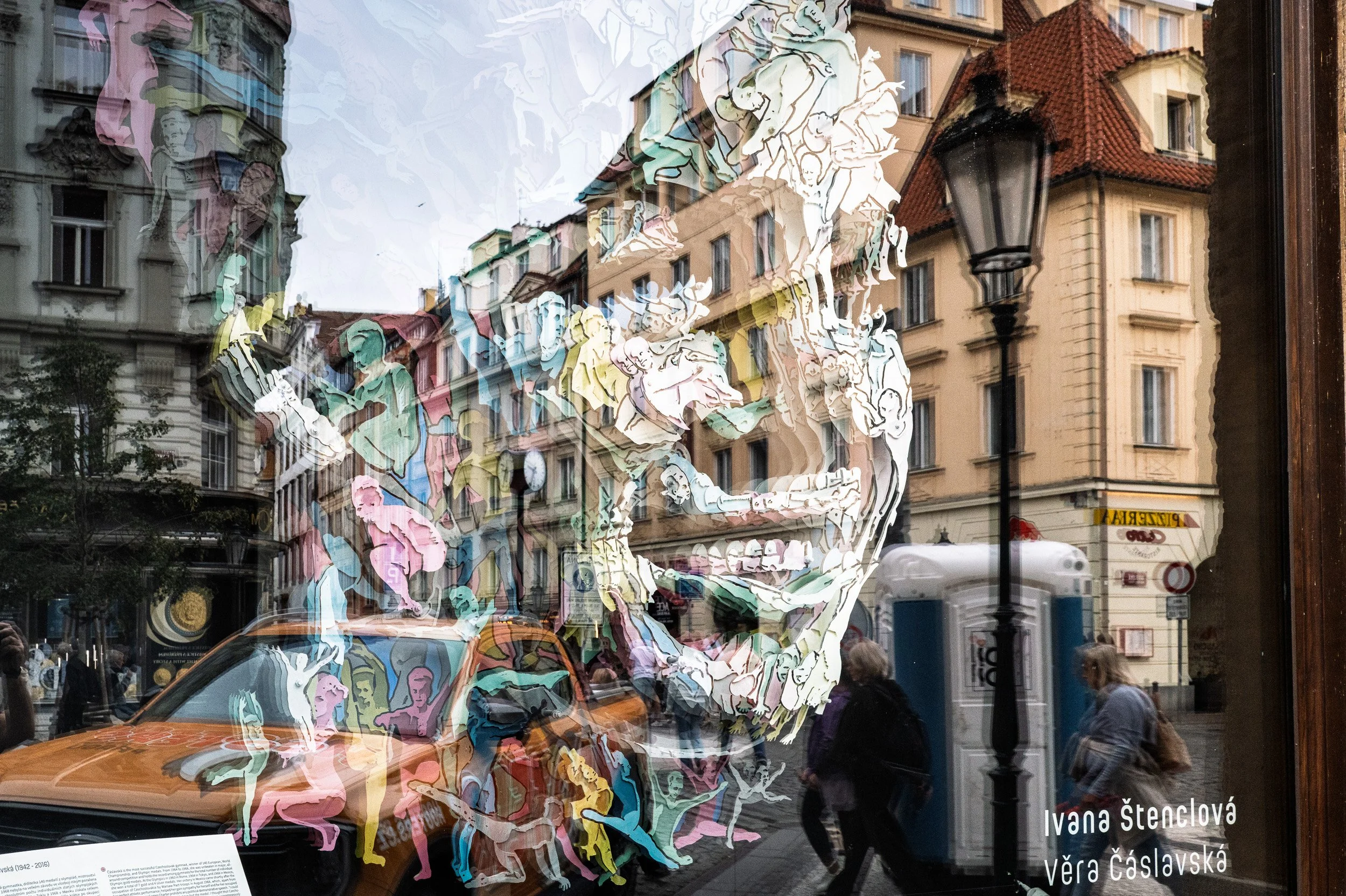
The Gymnast and the Street — Leica Q3
Ivana Štenclová's portrait of Věra Čáslavská ↗ is made from cut-out gymnasts in chalky pinks, blues, yellows and greens, small bodies mid-leap and mid-turn that together form the face of the woman who won seven individual Olympic golds. In Mexico City in 1968 she lowered her gaze and turned her head while the Soviet anthem played, a silent protest against the invasion of her country. Here the street moves through her instead: an orange car, a lamp post, pastel façades, passers-by, even a row of blue portable toilets.
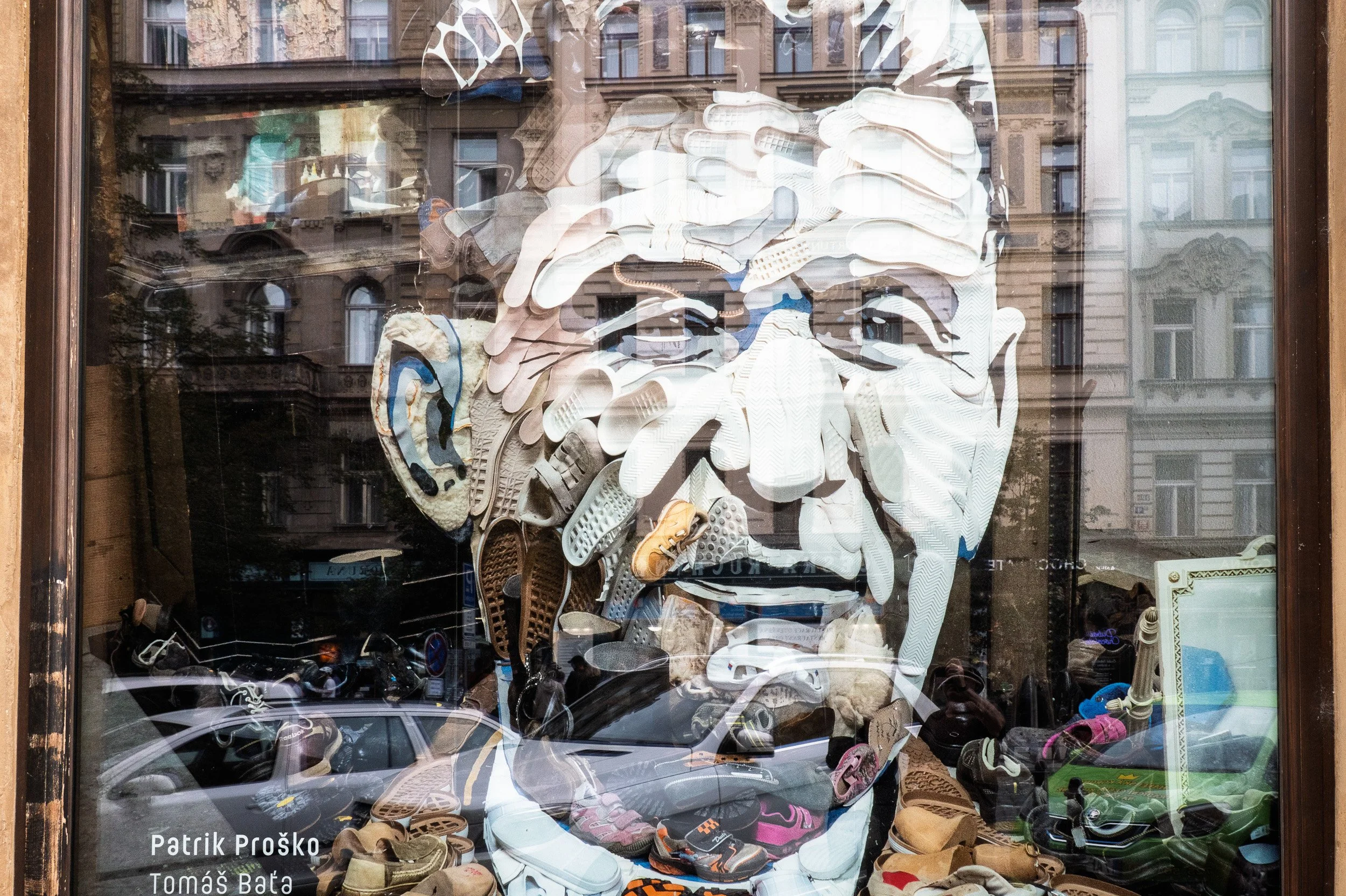
Built from Shoes — Leica Q3
A few windows along, Patrik Proško's Tomáš Baťa is built from shoes: pale soles and insoles for the forehead and cheeks, worn trainers for the shadows, a heap of real footwear, children's shoes included, spilling out at the bottom. It is a fitting material for the man behind the Baťa shoe empire. The ornate façades across the street lay their windows over his brow, and parked cars slide across his chin. Step a metre to either side and the likeness falls apart.
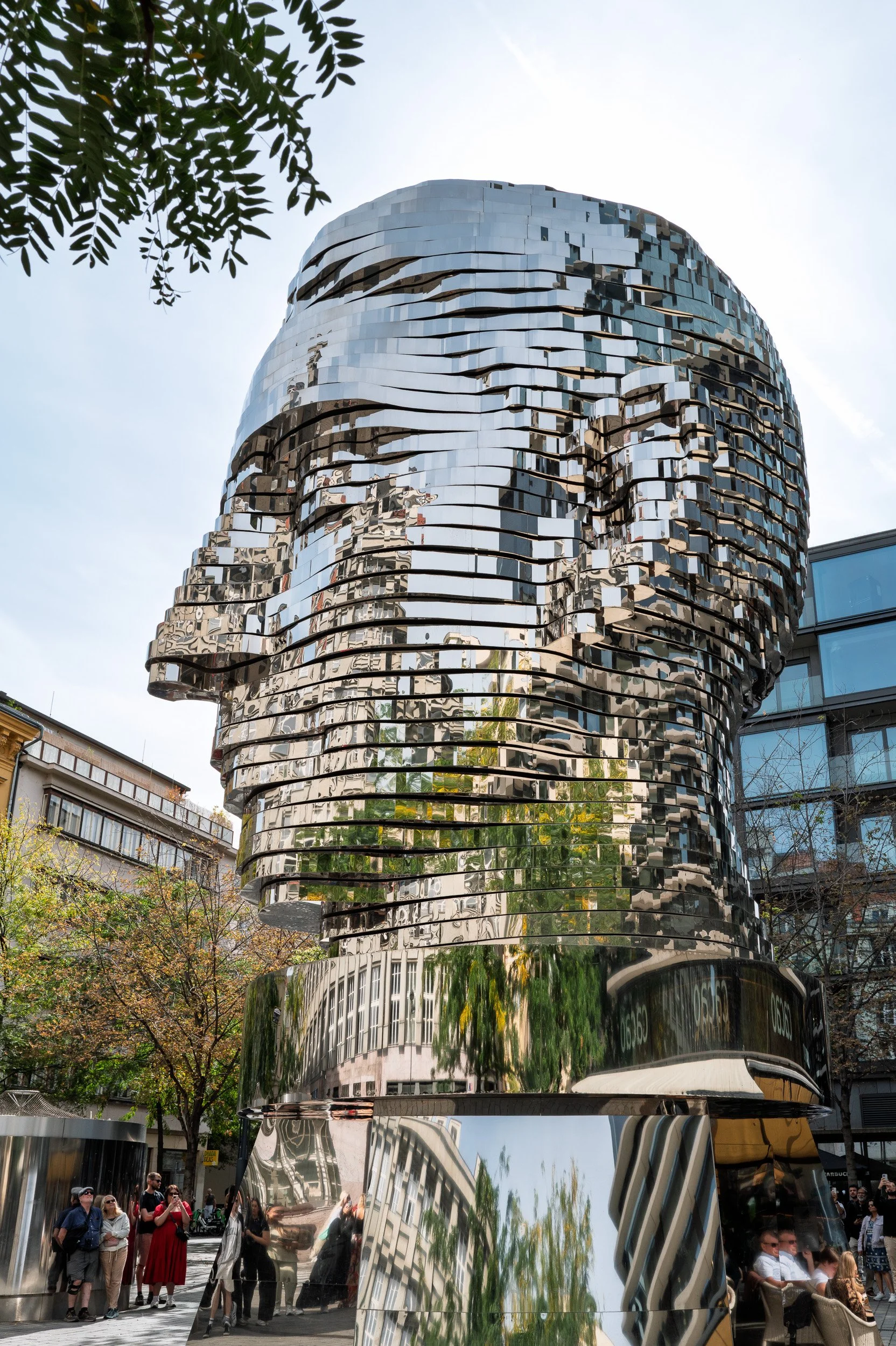
Kafka in Pieces — Leica Q3
The third face needs no window at all. David Černý's Head of Franz Kafka, outside the Quadrio shopping centre, is itself a mirror: forty-two layers of polished steel that rotate, pull the likeness apart and put it back together. Standing beneath it, we watched office blocks and trees slide across Kafka's cheek in broken strips. At the base, a small group had stopped to look up and film, their own reflections folded into the steel below them.
Mirrors, Car Roofs and a Theatre Door
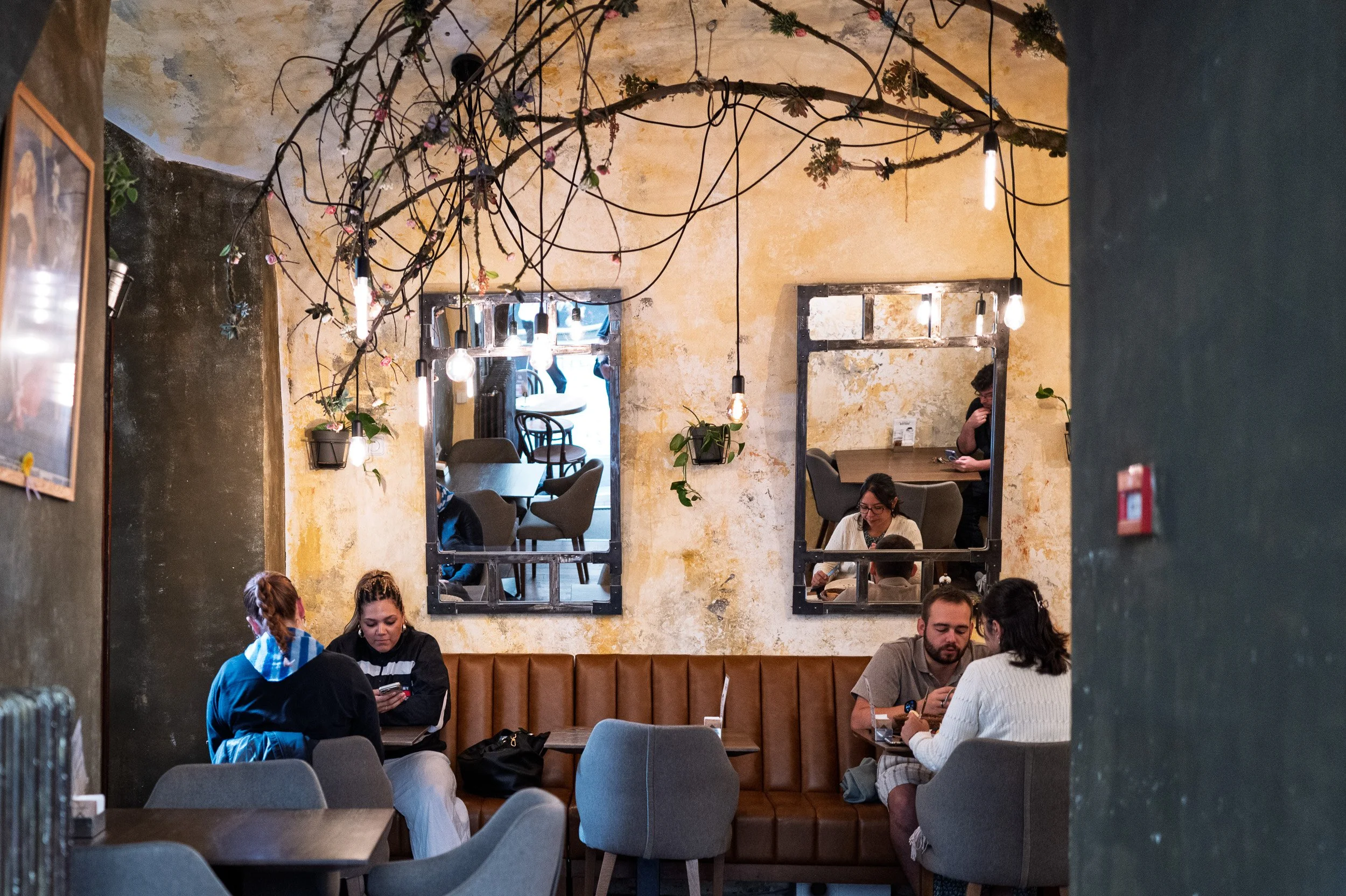
A Room Twice Over — Leica Q3
Indoors, mirrors take over from windows. In a café with ochre walls worn back to the plaster, a canopy of branches, small flowers and bare bulbs hangs from the ceiling, and two iron-framed mirrors sit side by side above a tan leather banquette. We framed it from a dark doorway. At the tables below, one of two friends checked her phone while a couple leaned in over lunch; in the right-hand mirror, a woman in glasses ate at a table we could not see directly. The room doubles itself without anyone noticing.
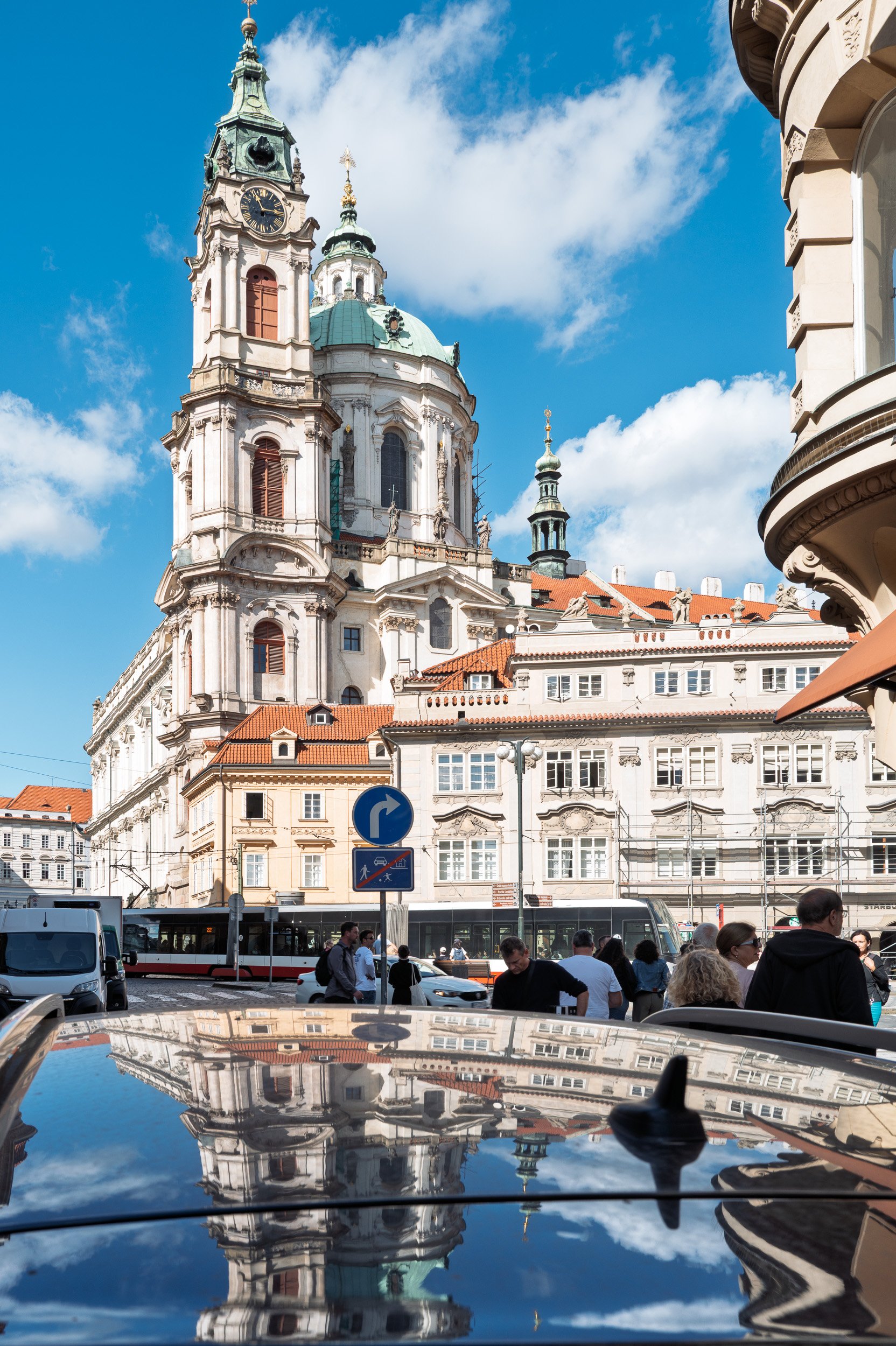
Baroque, Upside Down — Leica Q3
In Malá Strana, the most unexpected mirror of the trip was a parked car. Its black, gently curved roof turned the Church of St Nicholas upside down, tower and green dome hanging in a dark sky, cut through by the fin of an antenna. Above it, the real church stood against a clean September blue, a red-and-white tram rattled across the square and people waited to cross. We lowered the camera until the roofline split the frame in two: the city above, its inverted copy below.
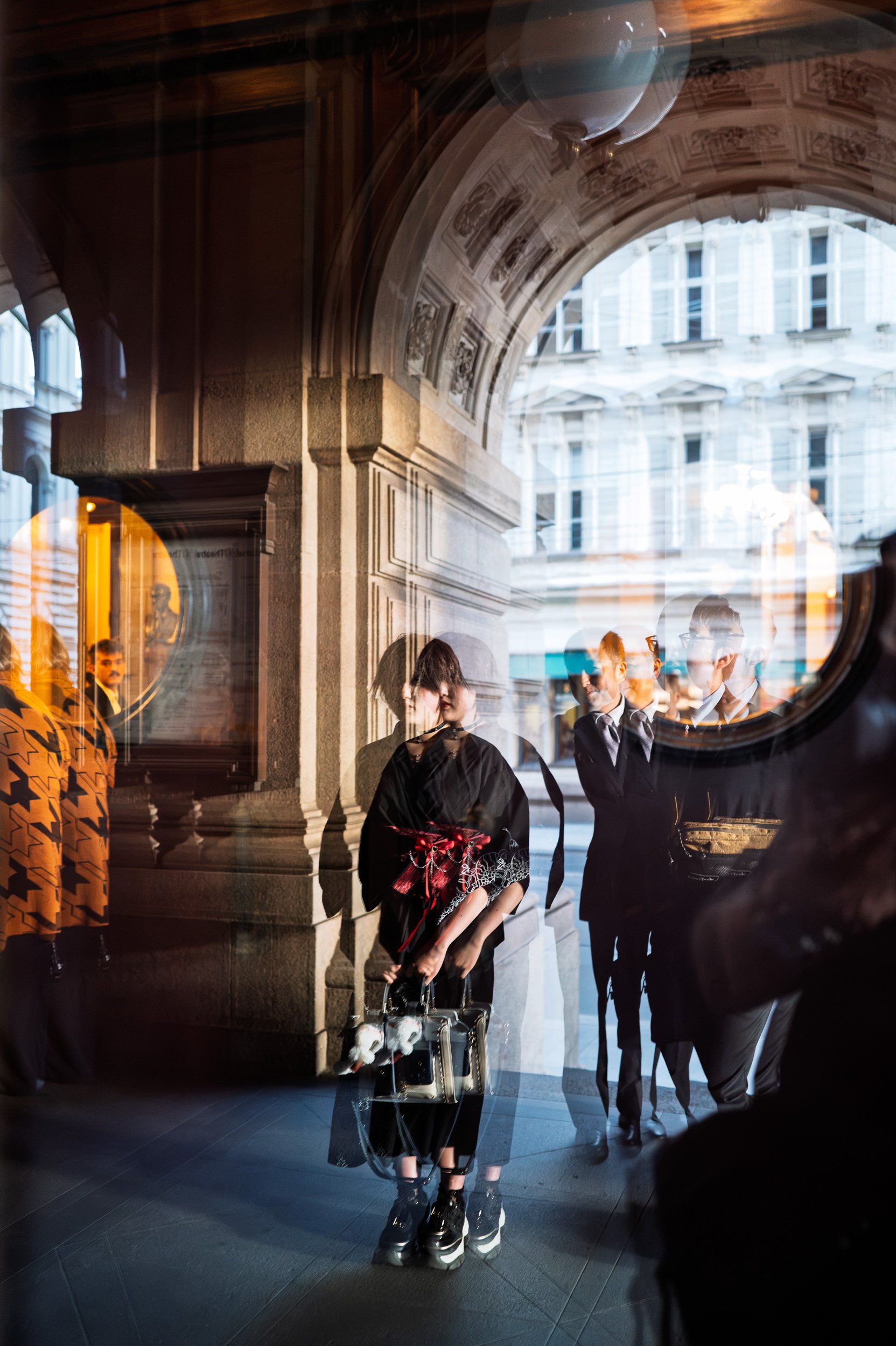
Standing Still Among Ghosts — Leica Q3
The heart of the series came under the arcade of the National Theatre. Pointing the camera at the glass of the entrance, we found several panes and a round porthole stacking their reflections: stone arches, a coffered vault and the white façades across the street, all merged with the people waiting outside. A young woman in black, her fringe falling over her eyes, a red bow at her waist and small white plush charms hanging from her bag, stood perfectly still while everything around her multiplied. In the porthole, men in dark suits appeared twice.
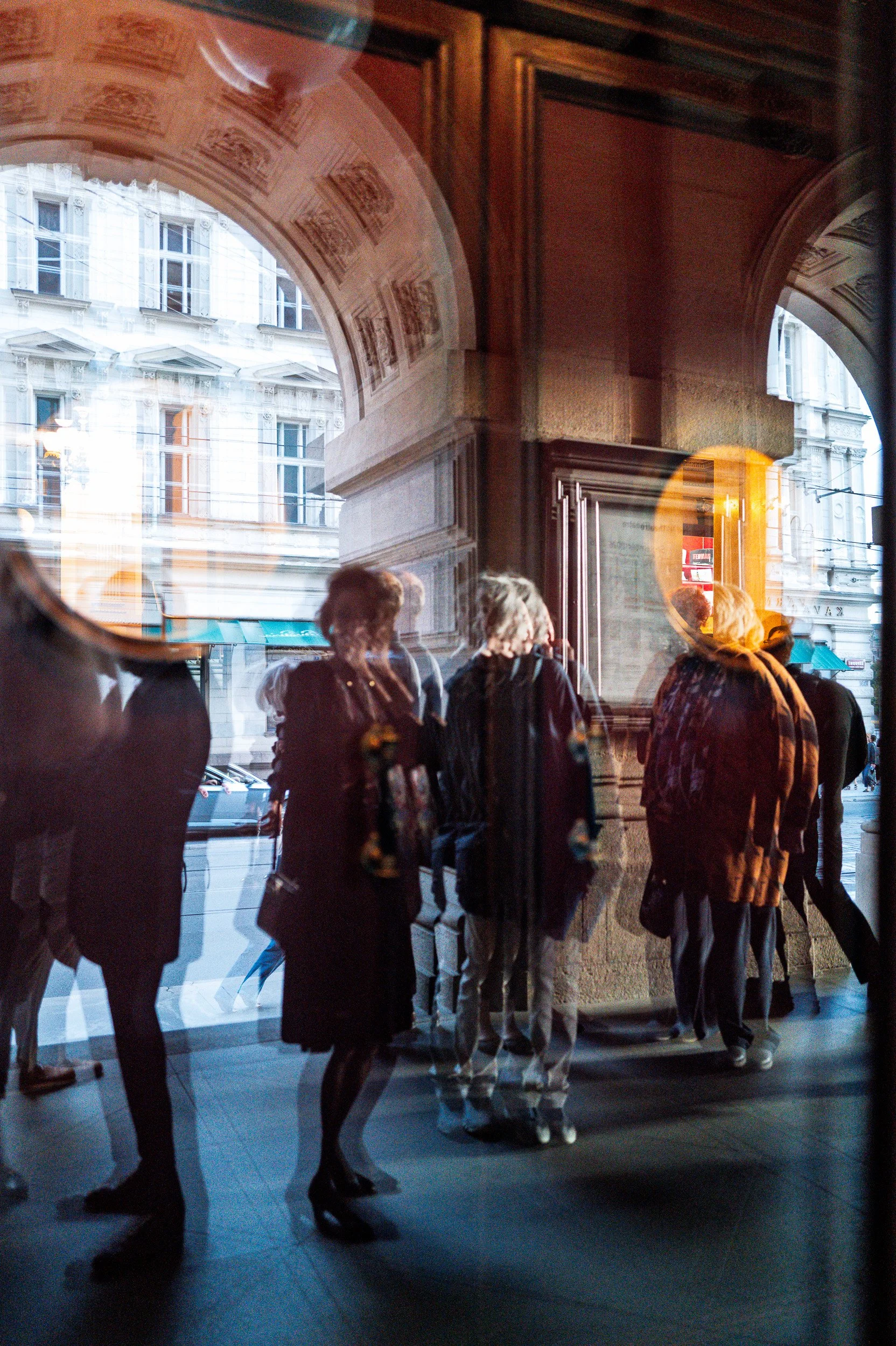
Several Moments at Once — Leica Q3
In another frame, a group of older visitors in dark coats and patterned scarves gathered under the arches, and the glass split each of them into two or three overlapping figures, as if the camera had caught them at several moments at once. A warm circle of light glowed from inside the building. Nothing in the picture is quite solid, and yet every detail is real.
The Vltava at Dusk
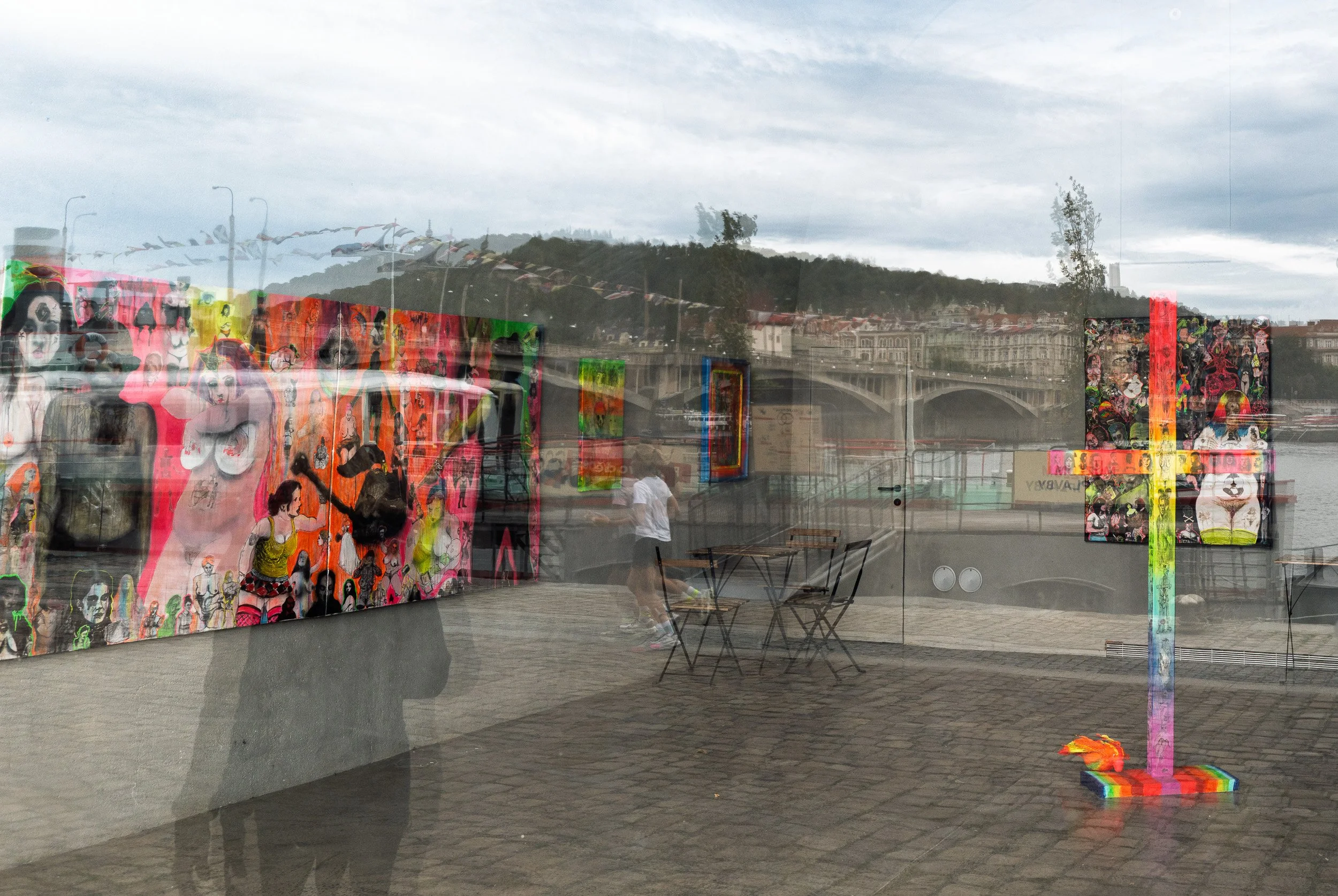
The River Behind the Paintings — Leica Q3
Down on the embankment, a small gallery with a glass front gave us the last of the window reflections and the first of the river. Neon-bright paintings and a rainbow-striped cross stood inside; laid over them were the Vltava, an arched bridge, a wooded hill, strings of pennants and a runner in a white T-shirt in full stride. On the left, a dark silhouette stands in the middle of it all: ours.
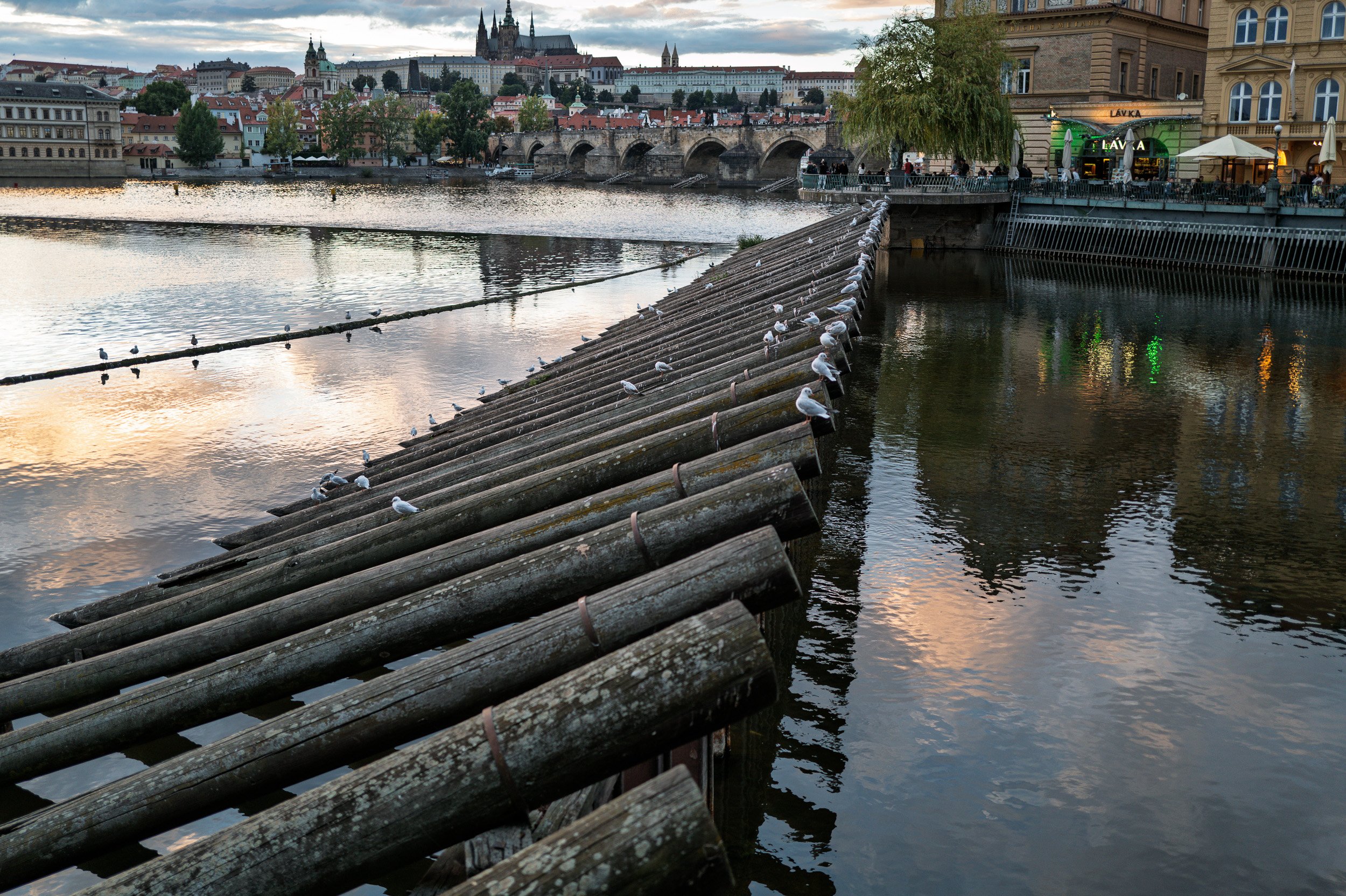
Gulls on the Timbers — Leica Q3
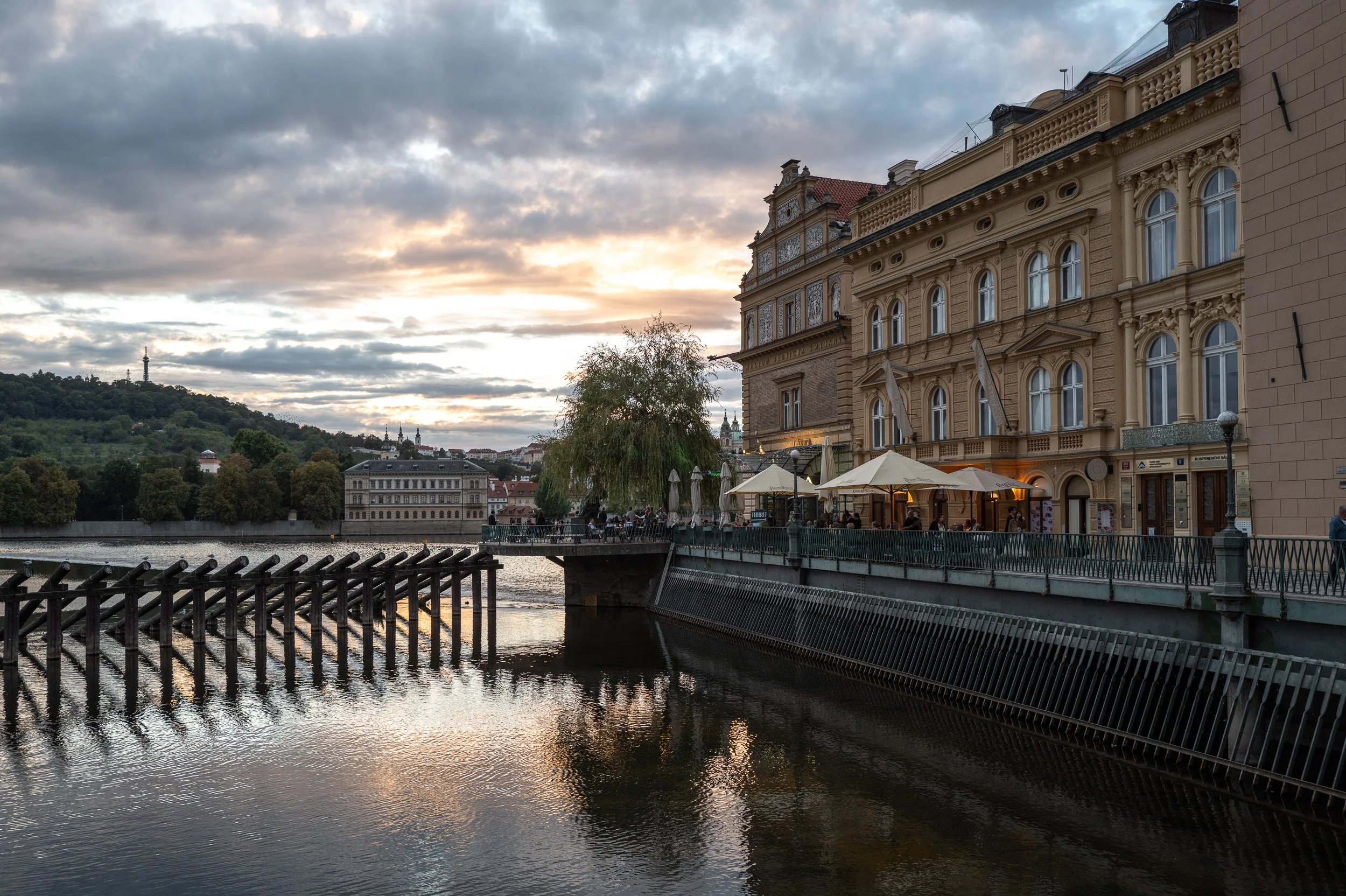
At the end of the day, beside the Lávka terrace near Charles Bridge, rows of weathered logs lie angled into the current, and at dusk they were lined with gulls. The logs pull the eye straight across the water to Charles Bridge and the Castle, while the river beside them holds the pink of the sky and the green neon of the terrace bar.
The River Takes Over — Leica Q3
A few steps on, the same timbers stood in silhouette against a sunset over Petřín Hill, and their reflections turned the water into a pattern of dark stripes. The terraces below the Smetana Museum had filled up, umbrellas glowing, a willow leaning over the rail. After a day of chasing reflections in glass and steel, the river did it on its own: slower, softer, with the whole sky in it.
Into the Picture — Leica Q3
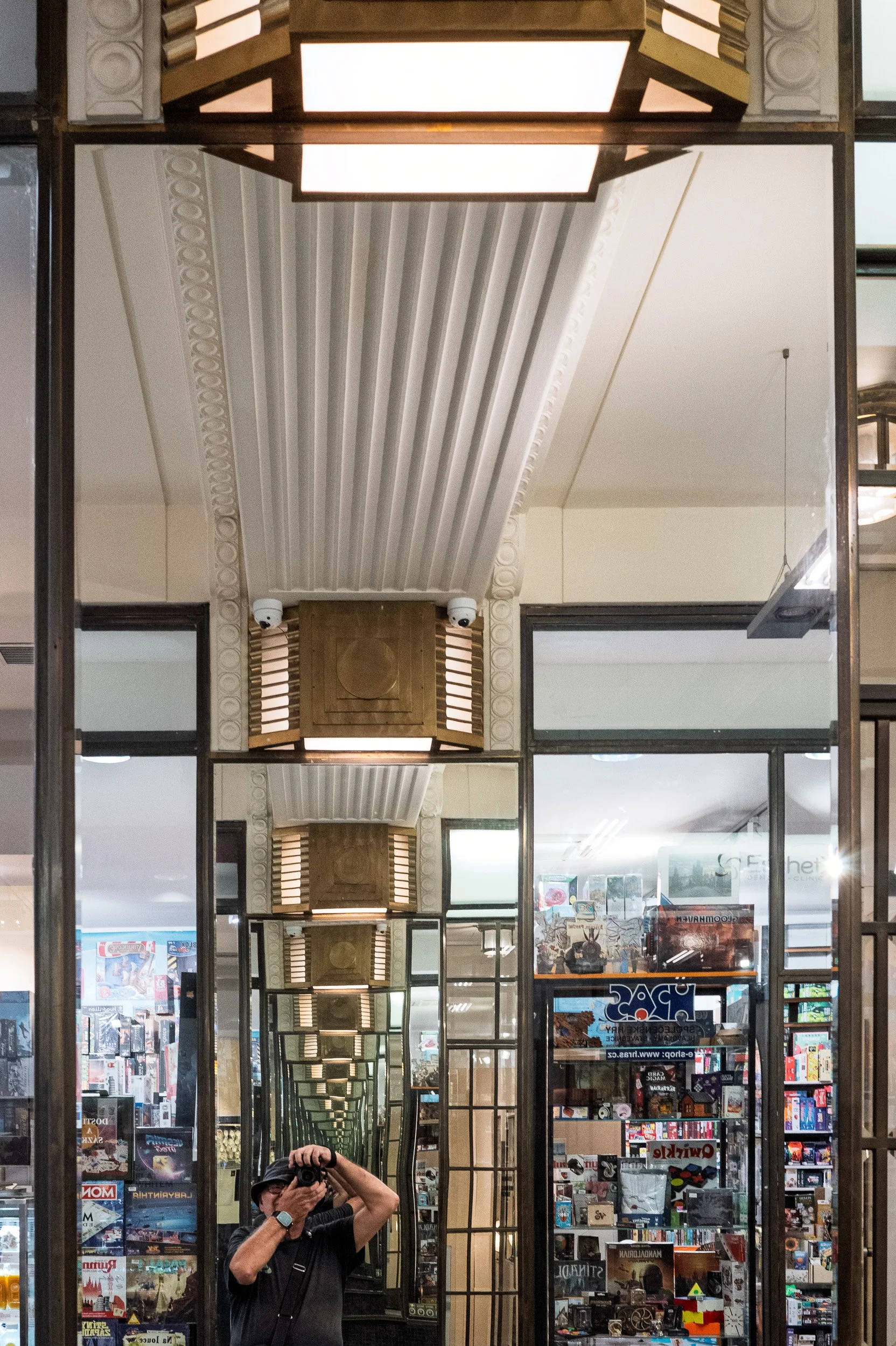
In the Lucerna passage, the same arcade where David Černý hung his upside-down horse ↗, we finally met the reflection we had been avoiding all trip. A mirrored pillar beside a board-game shop repeated the brass lanterns of the ceiling into a narrowing tunnel, and at the bottom of it, bucket hat on and camera raised, stood the photographer. Reflection photography always includes us somewhere: a shadow, a silhouette, a hand at the edge of the frame. In Prague, for once, we stepped into the picture.
Next time you walk through Prague, look at the glass instead of through it: the city is usually standing right behind you.
Photos: Leica Q3 · 28mm · f/2.8–8 · 1/250s · ISO 200-1000 · Prague, September 2026
See more reflection photography in the portfolio.
Every photo on this site can be printed — archival paper, signed and numbered. Browse prints →