Basilica Cistern Photography: Istanbul’s Sunken Palace in 2010
ORIGINALLY PUBLISHED AUGUST 2023 — REWRITTEN OCTOBER 2026
I took these Basilica Cistern photographs in July 2010, on a day when Istanbul was hot enough to make any patch of shade feel like a gift. I was travelling with my wife and our youngest daughter, a teenager at the time, and on Yerebatan Caddesi, a few steps from Hagia Sophia, we went in through a small entrance building that gives almost nothing away. Then we went down the stairs, and the city above simply stopped.
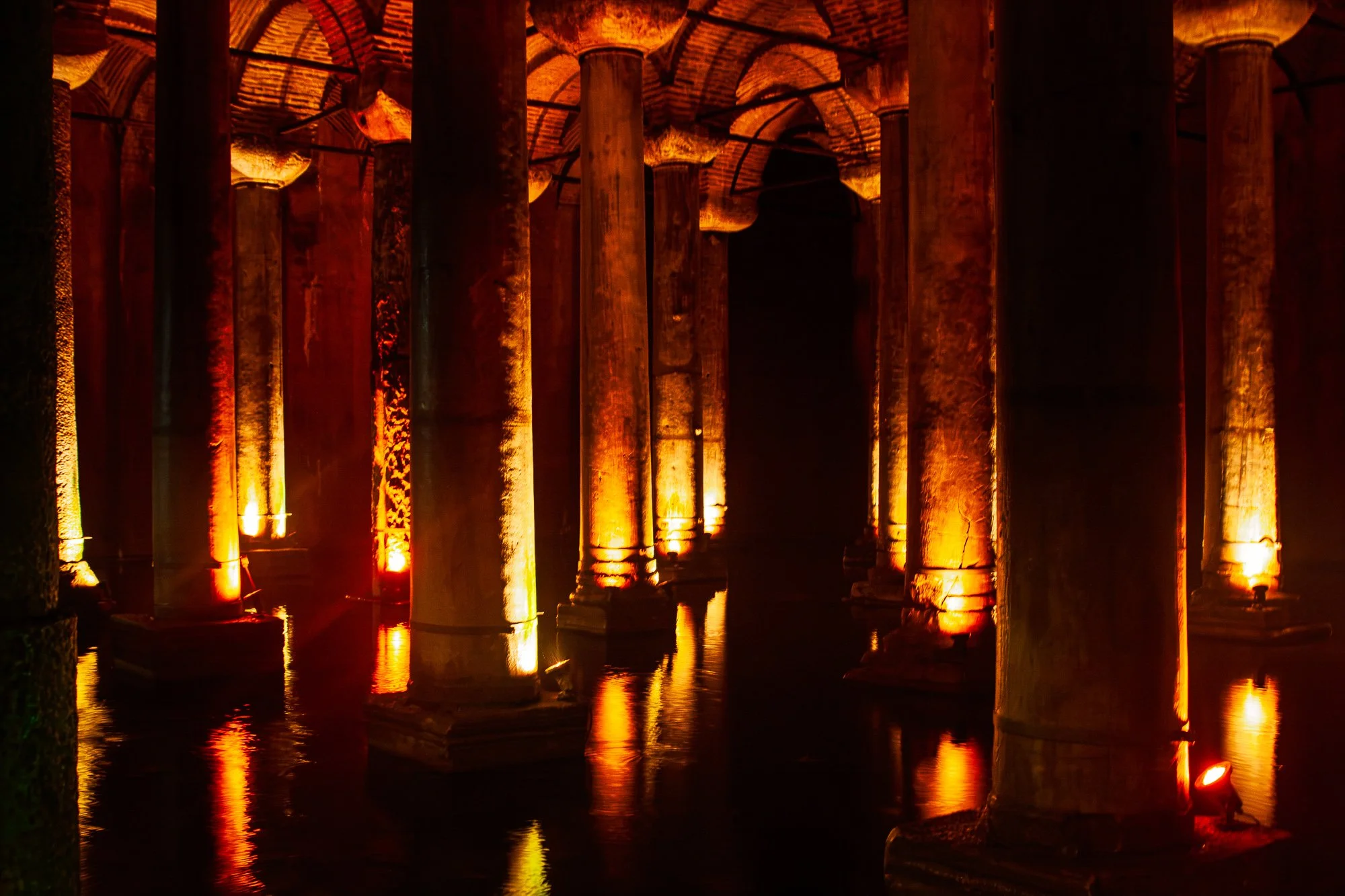
Where the light stops — Canon EOS 40D
Down there the temperature drops, the noise drops, and your eyes take a while to catch up. What they find first is the columns: row after row of them rising out of black water, each one lit from its base so that the stone glows amber and then fades towards the brick vaults overhead. The reflections go just as deep in the other direction. In the middle of the frame there is only darkness. The cistern goes on; the light doesn't.
Inside the Basilica Cistern
The cistern was built in the sixth century, under the Byzantine emperor Justinian, to store water for the Great Palace and the buildings on the First Hill of Constantinople. Water reached it by aqueduct from the forests north of the city. It takes its name from the Stoa Basilica, the great public square that once stood above it; the Turkish name, Yerebatan Sarayı, means the Sunken Palace, which is closer to how it feels. It is roughly 138 metres long and 65 wide, and its roof rests on 336 marble columns about nine metres tall, gathered from older buildings across the empire, so no two of them quite match (Basilica Cistern).
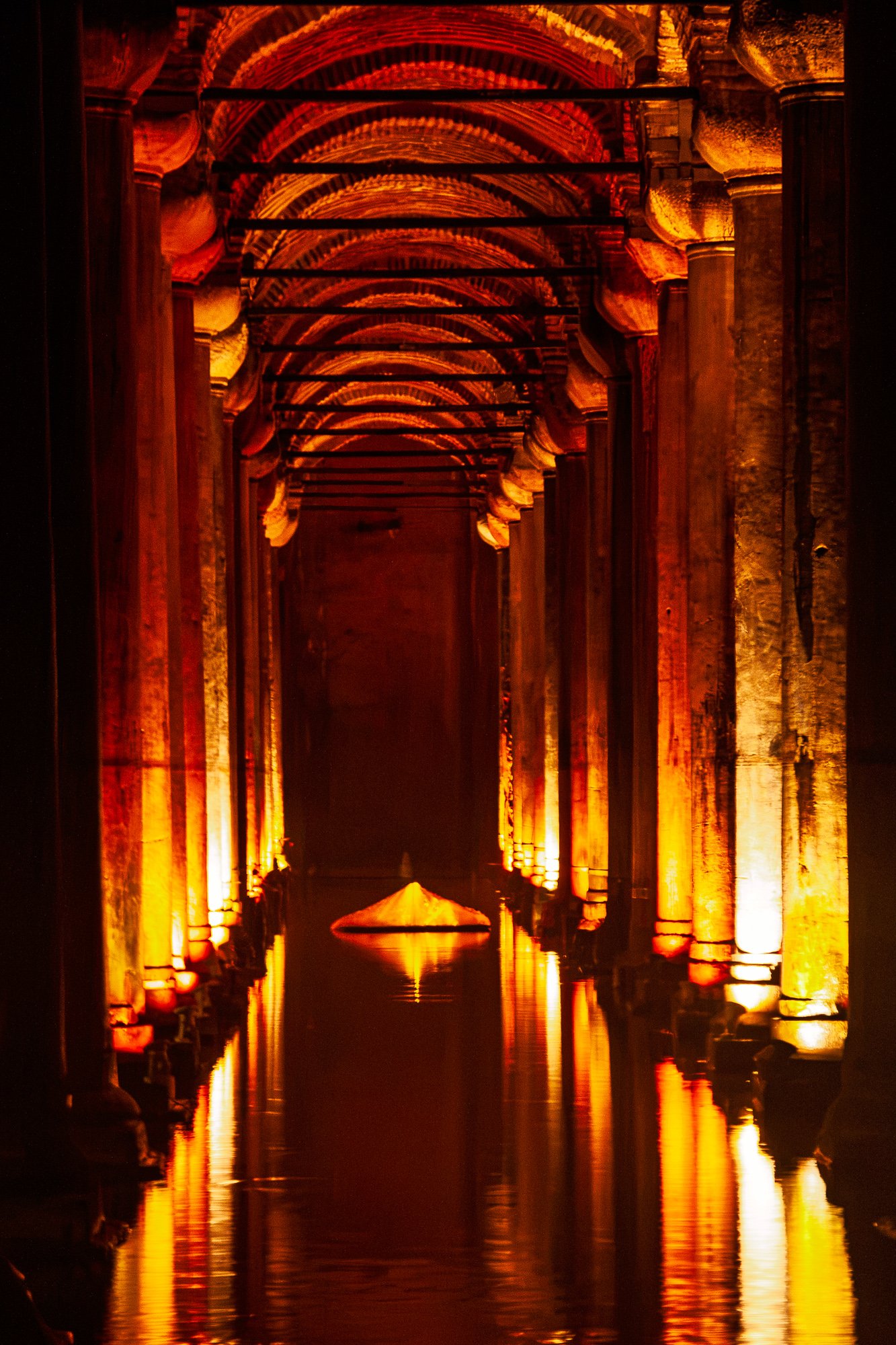
The long aisle — Canon EOS 40D
At the head of one of the long aisles, the geometry takes over. The columns line up like a corridor, the brick vaults repeat towards the far wall, and iron tie-rods cross between the capitals, each a little closer to the next as they recede. At the far end that summer, something sat on the water: a cone of pale, lit material, doubled by its own reflection. I framed it dead centre and let everything else converge on it.
Stories from the Sunken Palace
For a long time the city forgot this place was here. The Ottomans preferred running water to stored water, and the cistern dropped out of use. In the sixteenth century the French scholar Petrus Gyllius heard that people in the neighbourhood were drawing water, and even catching fish, through holes in their basements, and went down to see for himself. He found the hall by boat, and boats were how visitors saw it for centuries afterwards, until the 1980s, when the city cleared some 50,000 tonnes of mud from the floor and built raised walkways in their place.
The cistern's best-known stones are at its far corner: two column bases carved with the head of Medusa, one set upside down and the other on its side. Nobody knows for certain where they came from, but the way they were laid suggests the builders saw them as reusable blocks rather than anything to be displayed. The cistern has had a second life on screen too. In 1963 James Bond was rowed through it in From Russia with Love, and half a century later it staged the finale of Dan Brown's Inferno.
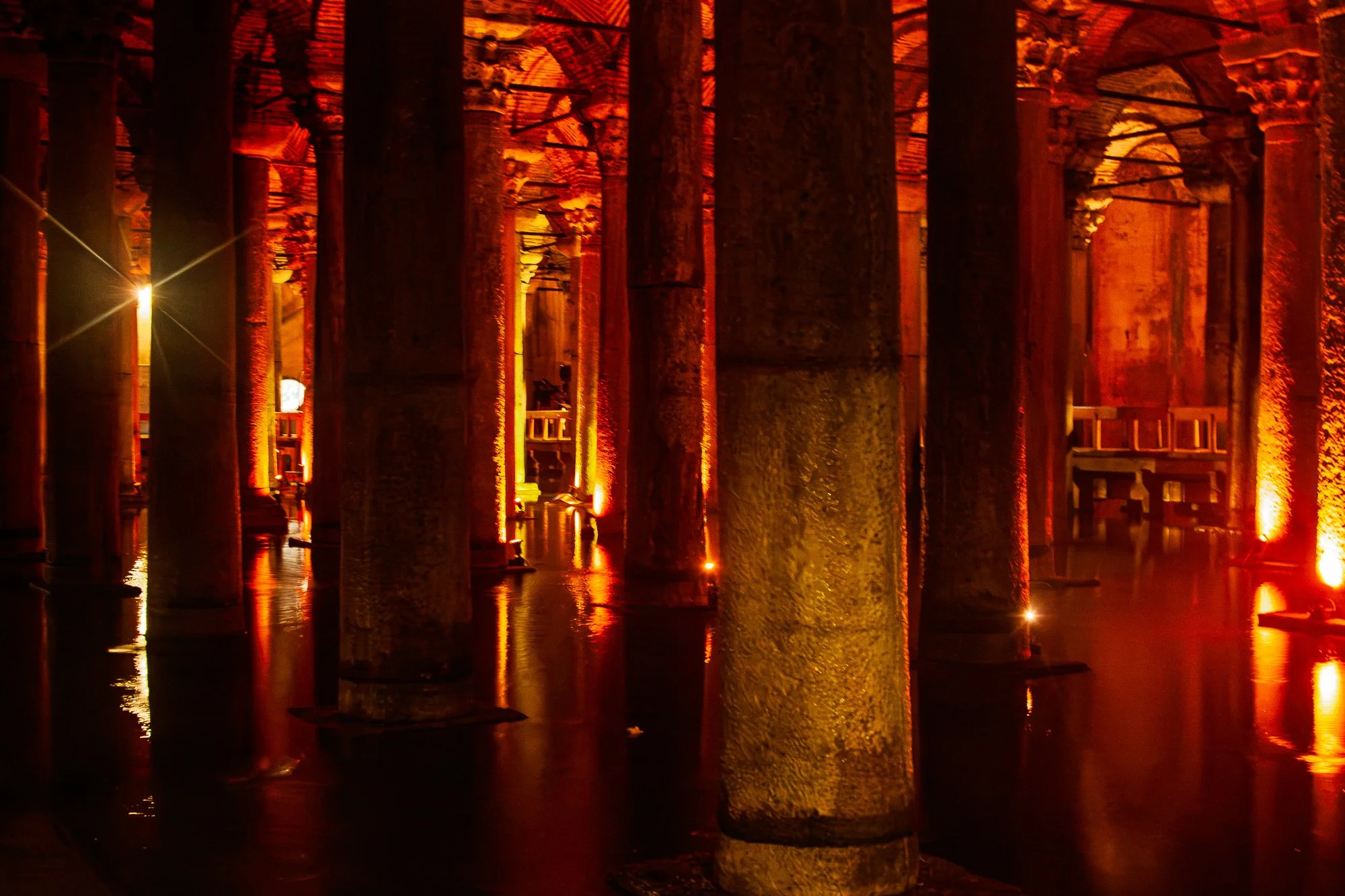
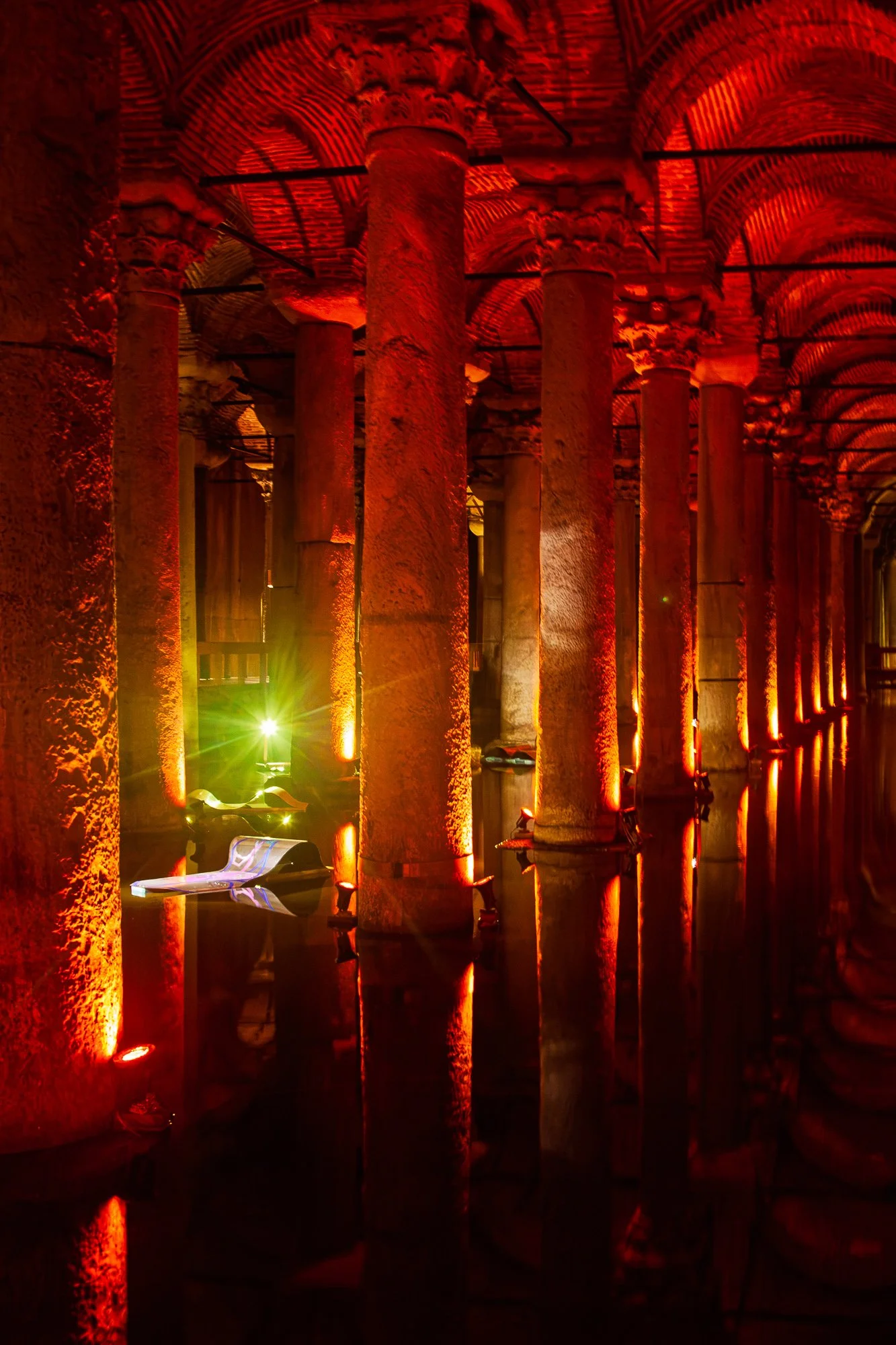
Stone, close up — Canon EOS 40D
Up close, the columns stop being architecture and become surfaces. The one in the middle of this frame is pitted and rippled from top to bottom, and the uplighting rakes across it so that every mark throws a small shadow. Behind it the aisles open out towards the visitors' walkways, and a single lamp on the left has turned into a star in the lens.
Photographing in the Dark
Basilica Cistern photography is mostly a negotiation with the light you are given. Adding my own was never an option: a flash would have flattened everything that makes the place worth photographing. I had the Canon EOS 40D and the 24–105mm f/4L, and I shot at ISO 1250 and f/4.5, with exposures between half a second and two seconds. On a camera of that generation ISO 1250 was already as far as I wanted to push, so the only variable left was time.
The technique is the same one I relied on under the vaults of the Grand Bazaar: brace against something solid, breathe out and press the shutter in the pause. I shot several frames of each view and kept the ones that held. Those have something a faster exposure would not: the water goes still, the reflections turn to glass, and points of light open into stars.
Art on the Water, 2010
That summer the cistern held more than columns and water. An art installation had been set out among them: translucent cones and crumpled forms in red and yellow, painted panels floating between the columns, a domestic lampshade standing in the middle of a sixth-century reservoir. 2010 was also the year Istanbul was one of the European Capitals of Culture.
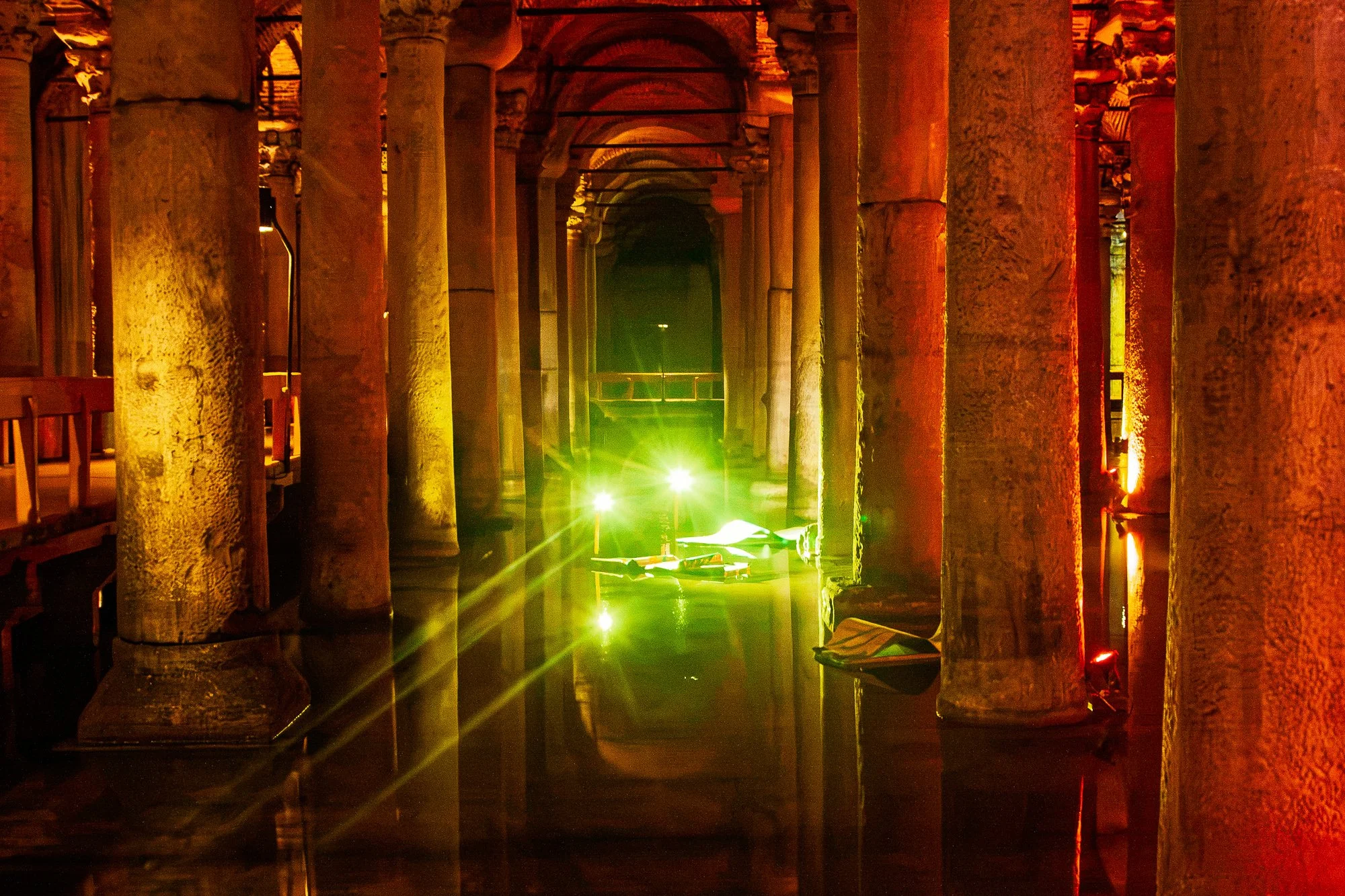
Green, for once — Canon EOS 40D
The strongest colour came from a corner where a cluster of green lights sat just above the water. Against the amber of everything else it looked almost chemical. The long exposure turned the two brightest lamps into stars and laid long green rays across the surface, and the floating sheets beneath them picked up the same colour. On the left, the edge of the walkway and its railing give the scale; at the far end, the aisle runs under an arch into a dark opening.
Old capitals, new work — Canon EOS 40D
In another aisle the light was almost entirely red. The columns here carry carved Corinthian capitals, and the vaults above them glow like the inside of a kiln. A long white sheet painted with loose blue and violet lines curves on the water at the lower left, while a green lamp behind it throws its own star through the gap between two columns. It is the frame where the old building and the new work sit most comfortably together.
The Basilica Cistern Before the Restoration
Looking at these frames sixteen years on, what strikes me most is how much of what I photographed has gone. In 2017 the cistern was closed for restoration and earthquake strengthening, and it reopened in July 2022 with new walkways, a new lighting design and, for the first time, a floor you can see through the water. The amber uplights, the spotlights on their little stands and the colours in these pictures belong to the cistern as it was in 2010. You can no longer stand in this light.
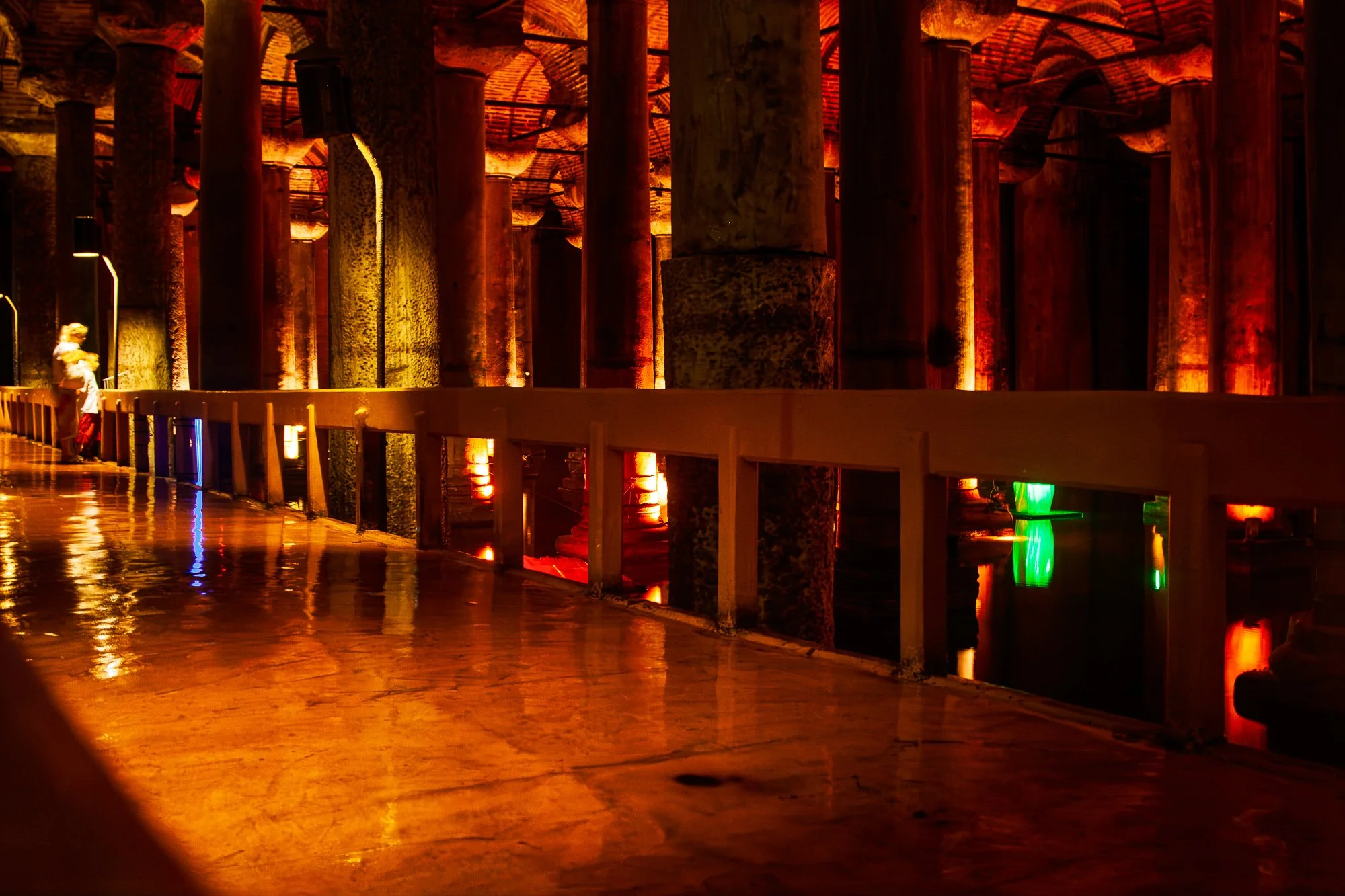
The old walkway — Canon EOS 40D
This is the old walkway: a low white railing, a floor so wet it mirrors the lamps, and green and red lights showing through the gaps where the installation sat on the water. At the far end, two visitors I never met lean on the railing and look down into the water. It is the only frame from that visit with people in it, and it gives the place its real scale.
Back Up to Yerebatan Caddesi
Coming back up is the other half of the experience. The stairs bring you out on Yerebatan Caddesi, into the light and the July heat, with Hagia Sophia across the road and the trams running past, and the whole underground hall closes behind you like a lid. The cistern sits in the middle of the Sultanahmet I was photographing that week: the Sultanahmet mosques are a few minutes' walk away, and so are the streets where I found Istanbul's street vendors and their old trades.
If you go today, check tickets and hours before you go: the cistern passed to a new administration in 2026. Arrive at opening time or come for the evening session if you want the reflections without a crowd.
If you are in Sultanahmet in summer, save the cistern for the hottest hour of the day — it is the coolest room in the city. Subscribe to the newsletter for new stories from the street, along with a free street photography guide.
Photos: Canon EOS 40D · Canon EF 24-105mm f/4L IS USM · ISO 1250 · f/4.5 · 0.5–2s · Istanbul, July 2010
See more travel photography in the portfolio. Every photograph in this post is also available as a fine art print.
Cosme Lapena is a Barcelona-based street and urban photographer and founder of bCLPhoto.
Exhibited at espai [b] since 2010 · Published in The Eye of Photography and 35mmc.
Browse the portfolio or read more on the blog.