ORIGINALLY PUBLISHED MAY 2026 — REWRITTEN OCTOBER 2026
I visited the Museum of Forbidden Art in Barcelona on 26 October 2023, two days after it opened. Every work inside it had been banned, removed, attacked or taken to court somewhere in the world, and the collection had been placed in one of the grandest houses in the Eixample. I went with my friends Jordi and Benet, both photographers, and my Leica Q3, expecting to photograph art. What I ended up photographing most was the building, and the people moving through it.

Watched from the stairs — Leica Q3
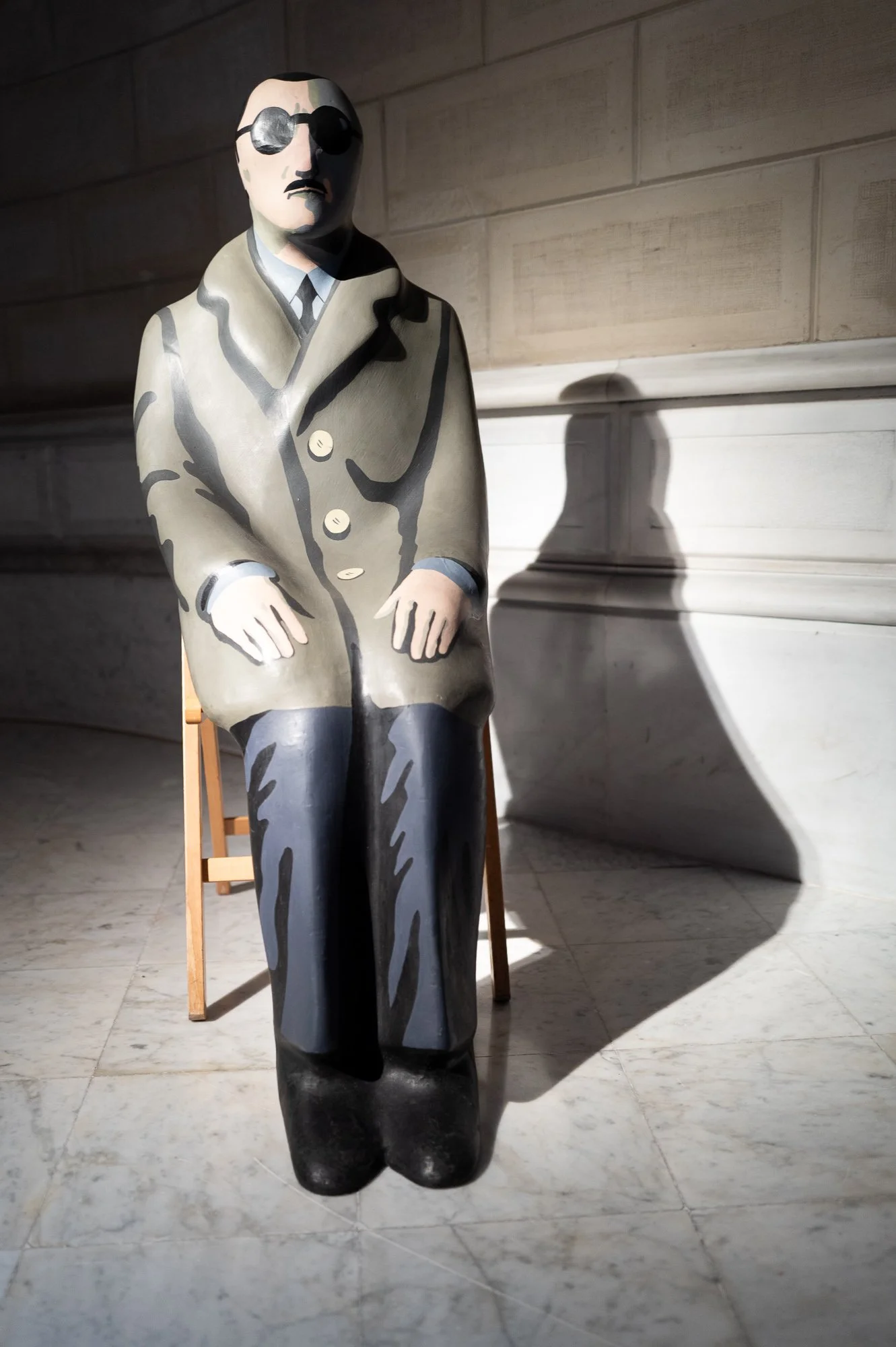
This is the frame I took first. From the landing, the marble staircase curls down in one long spiral, every step edged with two black lines, and at the bottom, in a pool of light, a man in a grey overcoat and dark glasses sits on a folding wooden chair. On the right, through a glass door, a boy in a football shirt walks past the red lockers without noticing him. It took me a moment to realise the man was a sculpture, which is exactly what its makers intended.
Spectator of spectators — Leica Q3
He is one of the Espectador de espectadores figures by Equipo Crónica, the Valencian collective. In 1972, at the Encuentros de Pamplona arts festival, they placed a hundred of these papier-mâché men among the audience: plain-clothes policemen, watching the people who had come to watch the art (Museo Reina Sofía). Fifty years later, sitting at the foot of the stairs, he still does the same job. Close up, the paint is flat and almost cartoonish, but his shadow on the stone wall is taller than he is.
The Museum of Forbidden Art Barcelona and Its Staircase
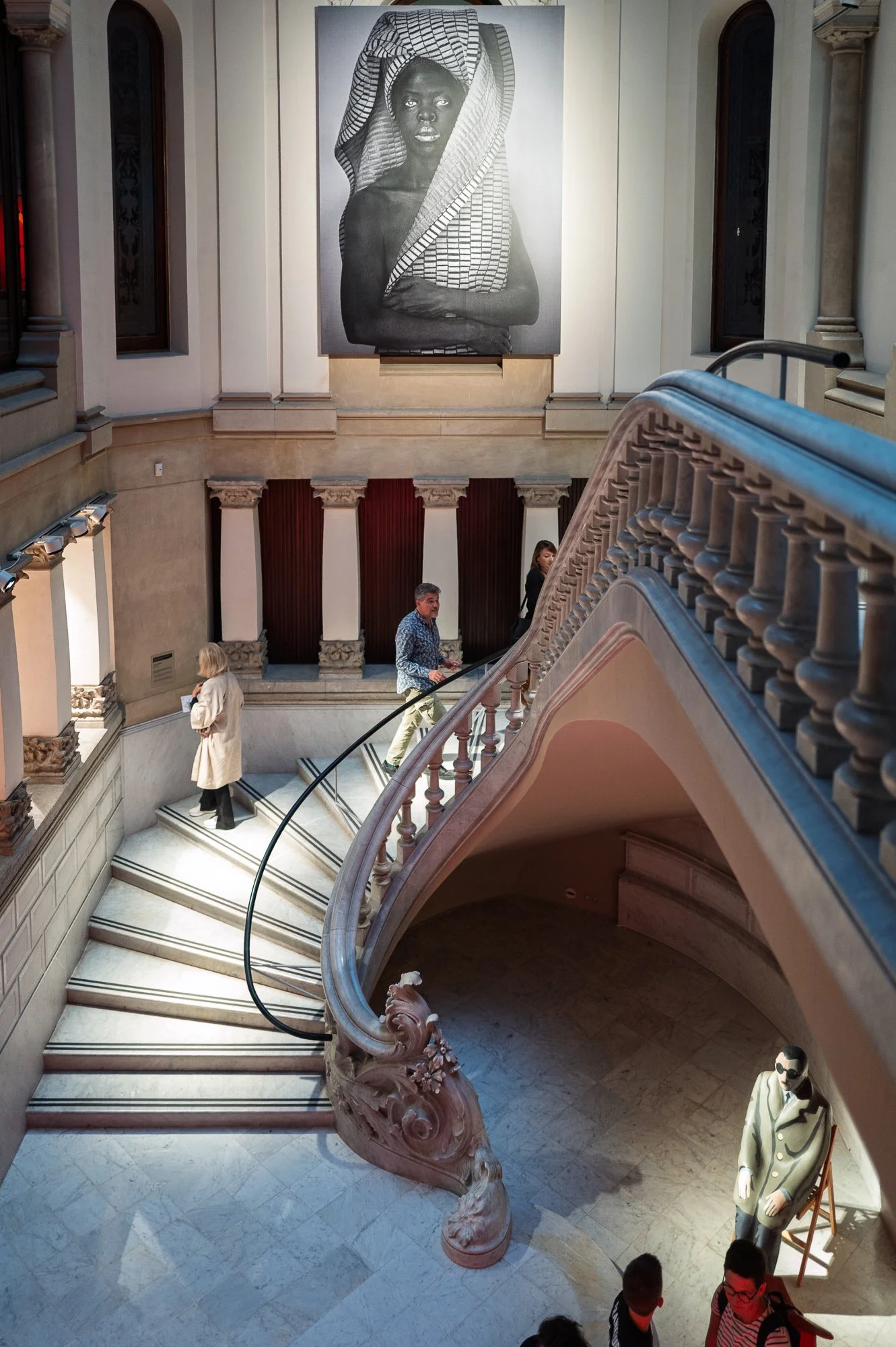
The museum was the collection of the businessman Tatxo Benet, and it occupied the Casa Garriga Nogués, a palace on Carrer de la Diputació built for a banking family in the early twentieth century. Its heart is the stairwell: a sweep of white marble rising through two floors, carved balusters, Corinthian pilasters, and at the top a stained-glass skylight that pours daylight down the whole height of the house.
Up and down under Lena — Leica Q3
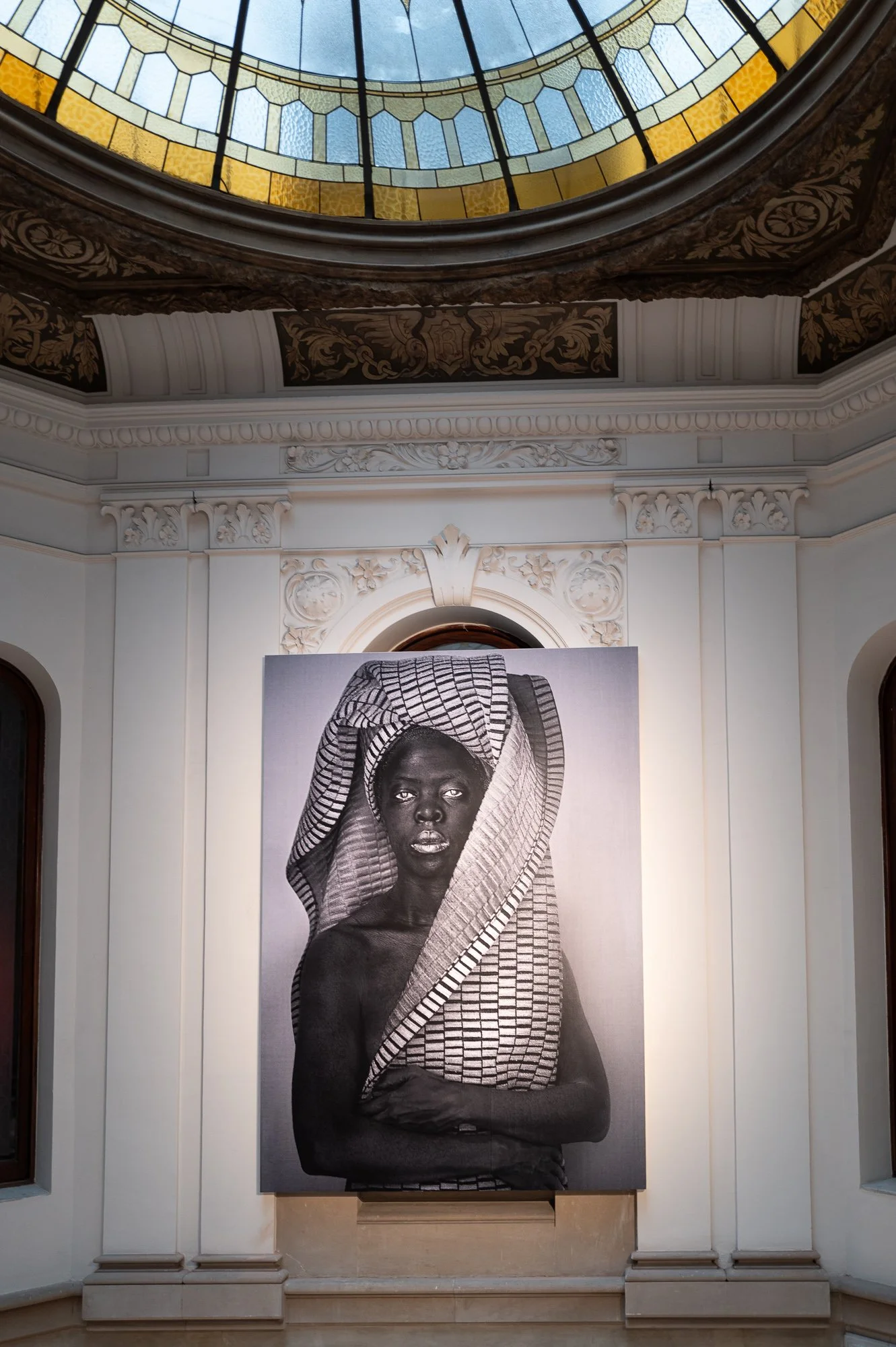
Above the landing hung the largest image in the building: a black and white self-portrait by the South African photographer Zanele Muholi, a woman wrapped in a patterned cloth, staring straight back at whoever comes up the stairs. Muholi's work, on Black lesbian and LGBTQ+ lives, was at the centre of a censorship row in Johannesburg in 2009. Here it presided over the whole house. A woman in a cream coat paused on the stairs, a man in a patterned shirt came up behind her, and the papier-mâché policeman kept watch from the corner.
Under the skylight — Leica Q3
From the upper floor I tilted the camera up. The skylight is a dome of amber and pale blue glass in an iron frame, ringed by dark gilded plasterwork, and directly below it the portrait sits between two arched windows like an altarpiece. It is a strange pairing, a bourgeois palace of 1900 and a photograph that challenges every certainty that palace was built on, and it works.
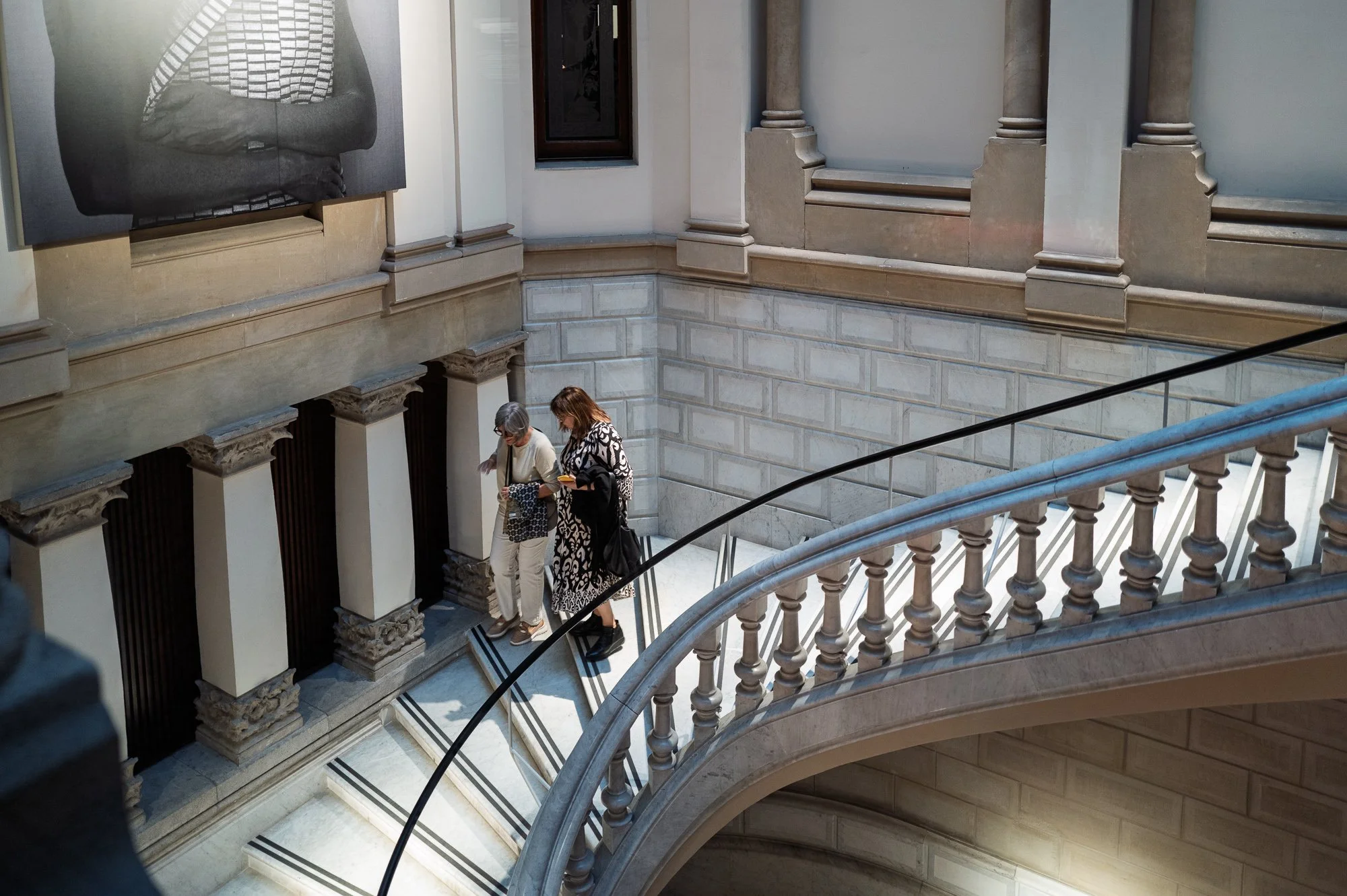
On the way down — Leica Q3
Photographing People on the Stairs
The staircase turned out to be the best street photography spot in Barcelona that week, and the three of us kept drifting back to it between rooms. People slow down on stairs, look up, stop to talk. Two women came down together, one in a black and white patterned dress that answered the portrait above them, the other in cream, both looking at a phone. I shot from the landing, where the balustrade cuts across the frame in a long grey curve.
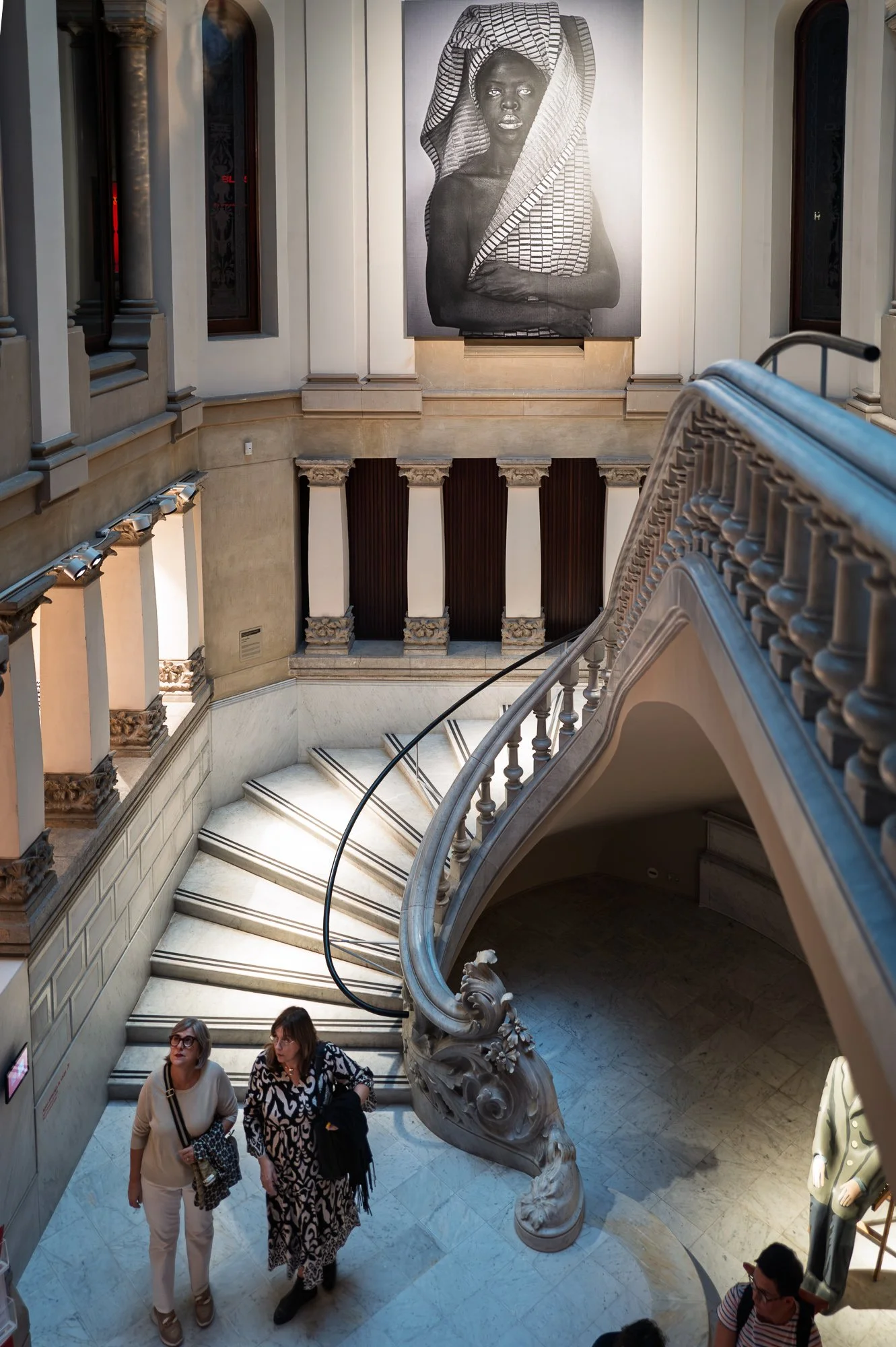
Looking back up — Leica Q3
At the bottom they turned and looked back up at the portrait, and I took the picture again from above, with the carved newel post curling beside them like a wave. The light that afternoon was low and soft, coming down from the skylight, and at 1/60s and f/1.7 the Q3 handled it without needing to push the ISO much past 1000.
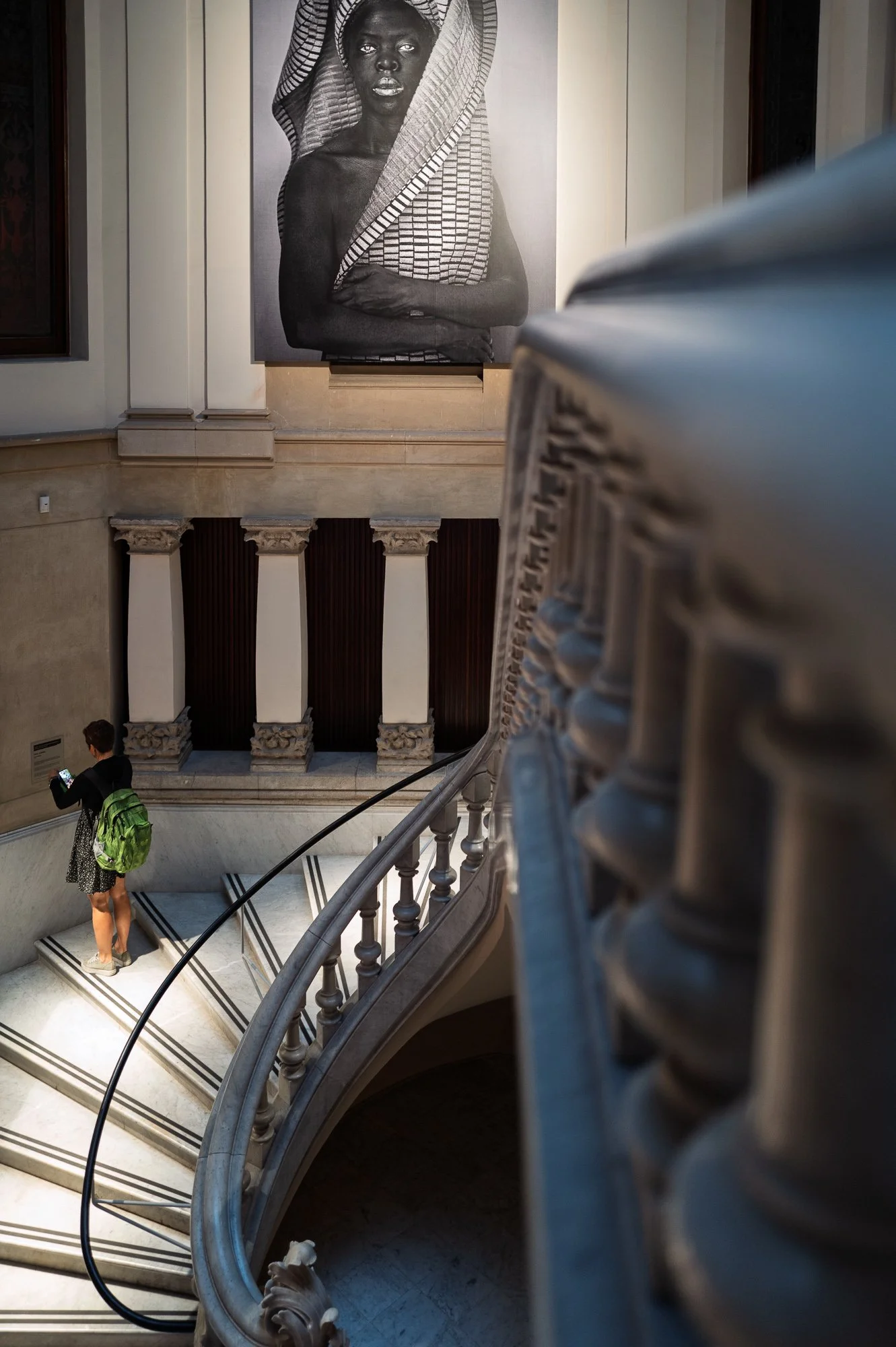
Everyone photographs the label — Leica Q3
A young woman with a green backpack stopped halfway up to photograph a wall label with her phone. Almost everybody did that. In a museum where the story behind each work matters as much as the work itself, the labels were as photographed as the art. I kept the stone balustrade out of focus in the foreground, and the portrait looking down on all of it.
The Girl of Peace
The work I had come for was on the first floor. The Statue of a Girl of Peace, by the Korean sculptors Kim Seo-kyung and Kim Eun-sung, was first installed in 2011 opposite the Japanese embassy in Seoul, in memory of the girls and women forced into sexual slavery by the Japanese army before and during the Second World War. In 2019 a version was shown at the Aichi Triennale in Japan and the section was closed after protests and threats (Wikipedia).
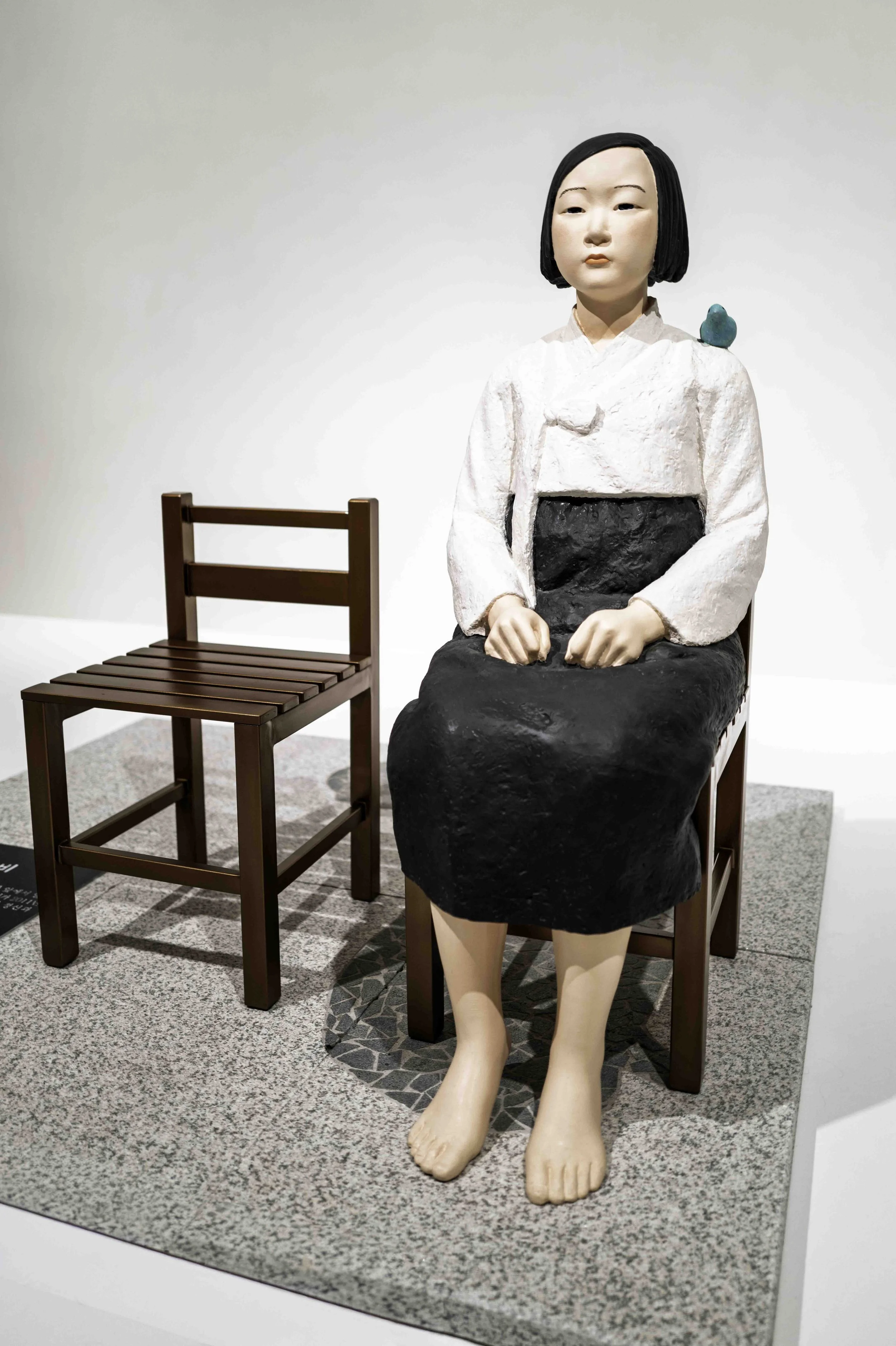
The empty chair — Leica Q3
She sits barefoot on a plain wooden chair, in a white jacket and a black skirt, her hair cut short, a small bird on her shoulder. Beside her is an empty chair, left for whoever wants to sit with her, and for the women who never came home. Seen whole, she is small and still, much smaller than I had imagined from the photographs.
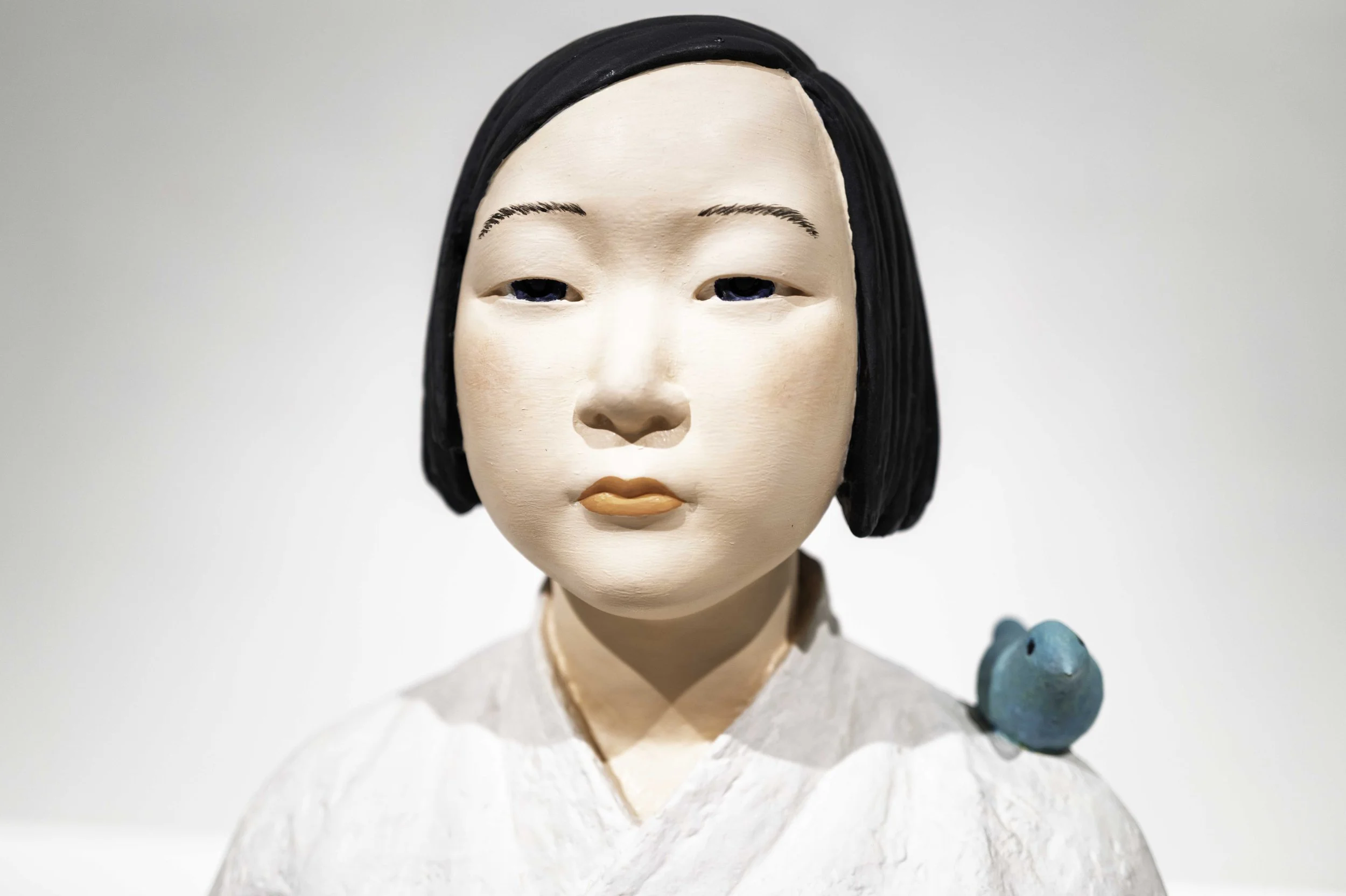
The face that does not plead — Leica Q3
Up close, the face is what holds you. It is young and composed, the eyes level with yours, the mouth closed. She is not asking for anything. I shot it straight on at f/1.7, so that the white wall behind dissolved and nothing competed with her.
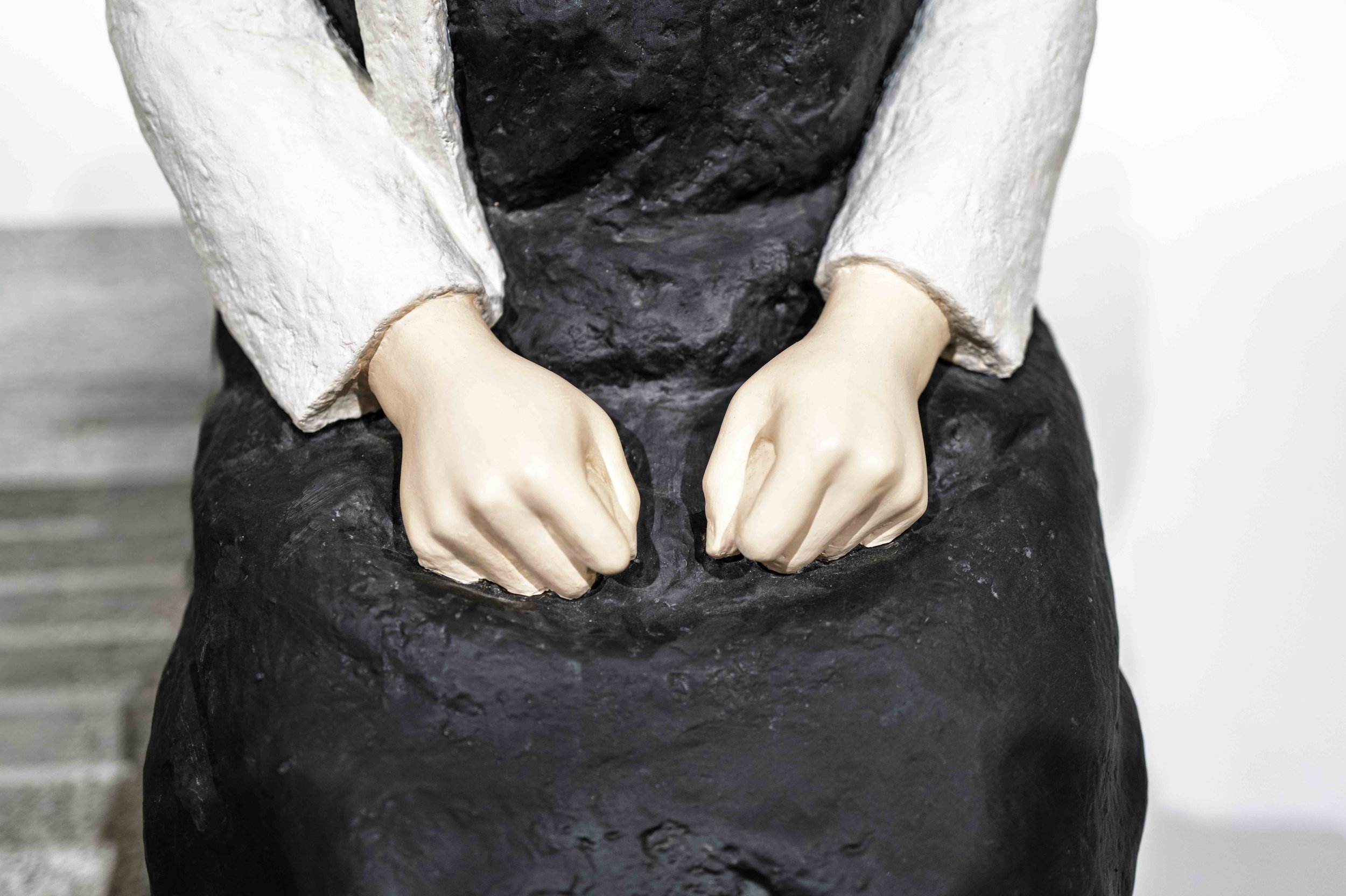
Between surrender and defiance — Leica Q3
Then the hands, which tell a different story from the face. They rest on her lap, but they are clenched, the knuckles pressed into the black skirt. It is the detail most people walk past, and the one that stayed with me longest.
Censored Art, Room by Room
The rest of the museum was a catalogue of things someone, somewhere, had wanted to remove. Some were famous, some I had never heard of, and a few were genuinely hard to look at.
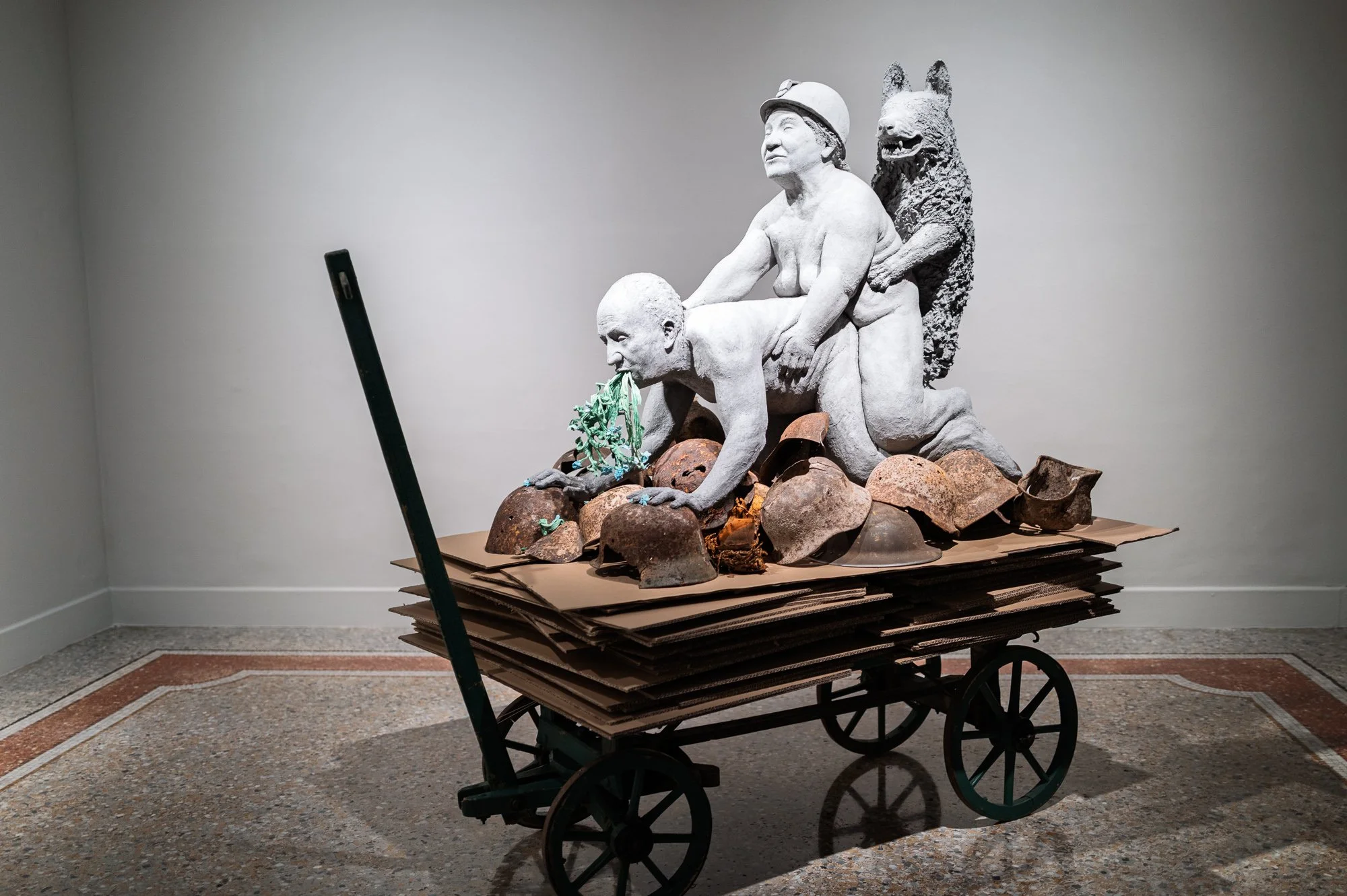
The one that started it — Leica Q3
This one has a Barcelona story. Not Dressed for Conquering / Haute Couture 04 Transport, by the Austrian artist Ines Doujak, was due to be shown at the MACBA in 2015, in an exhibition called La bestia y el soberano. The director cancelled the show over the piece, which shows a figure widely read as King Juan Carlos I on a handcart of rusty army helmets, and the outcry ended with his resignation. A few streets away, eight years later, it stood in its own room.
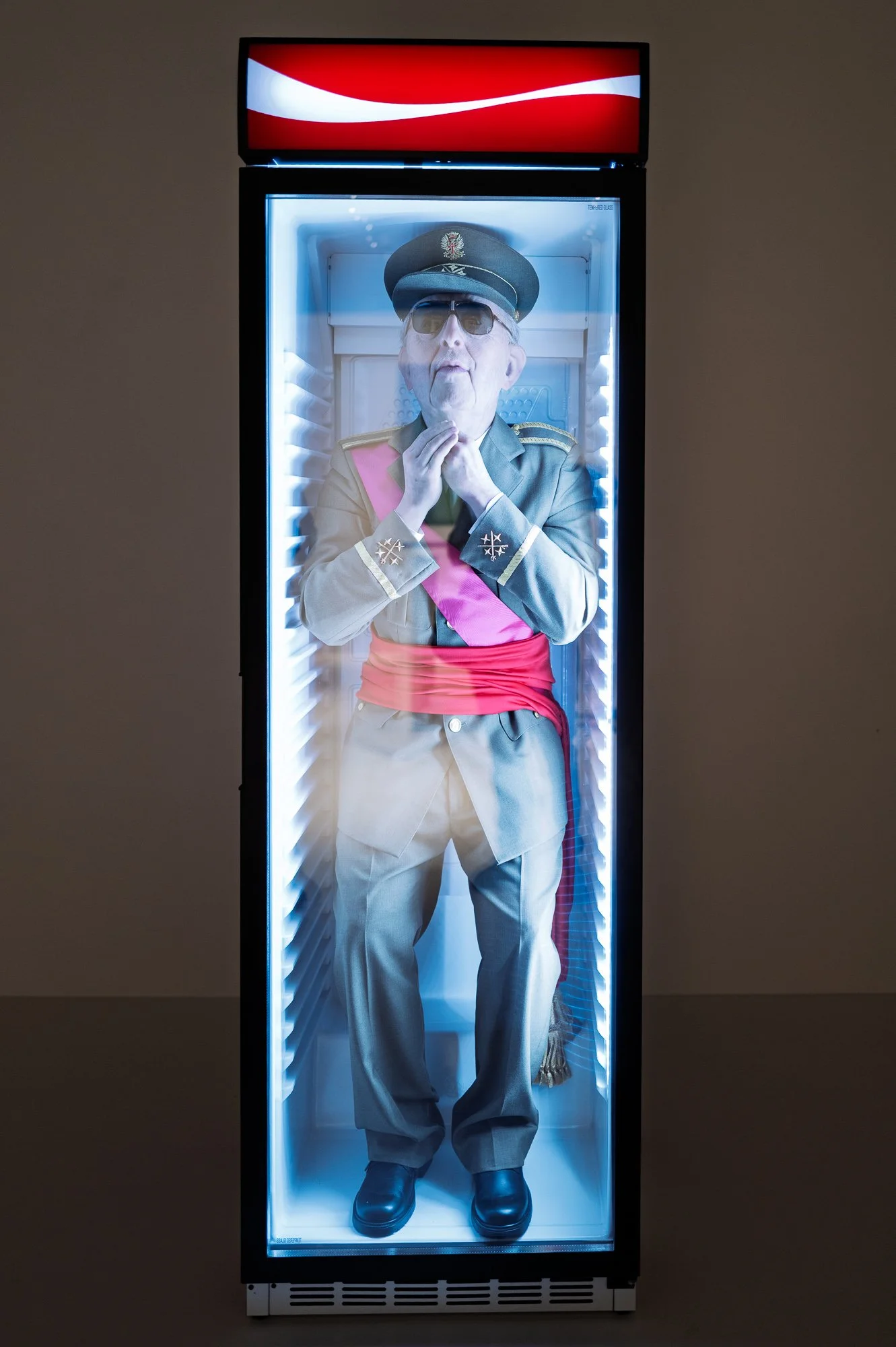
Always Franco — Leica Q3
Eugenio Merino's Always Franco (2012) puts the dictator, in uniform, sash and sunglasses, inside a glass-fronted drinks fridge. When it was shown at ARCO in Madrid, the Francisco Franco Foundation went to court. Under the fridge's cold light the face looks almost waxy, and the reflection of the room on the glass door meant I had to move several times before the figure came through clearly.
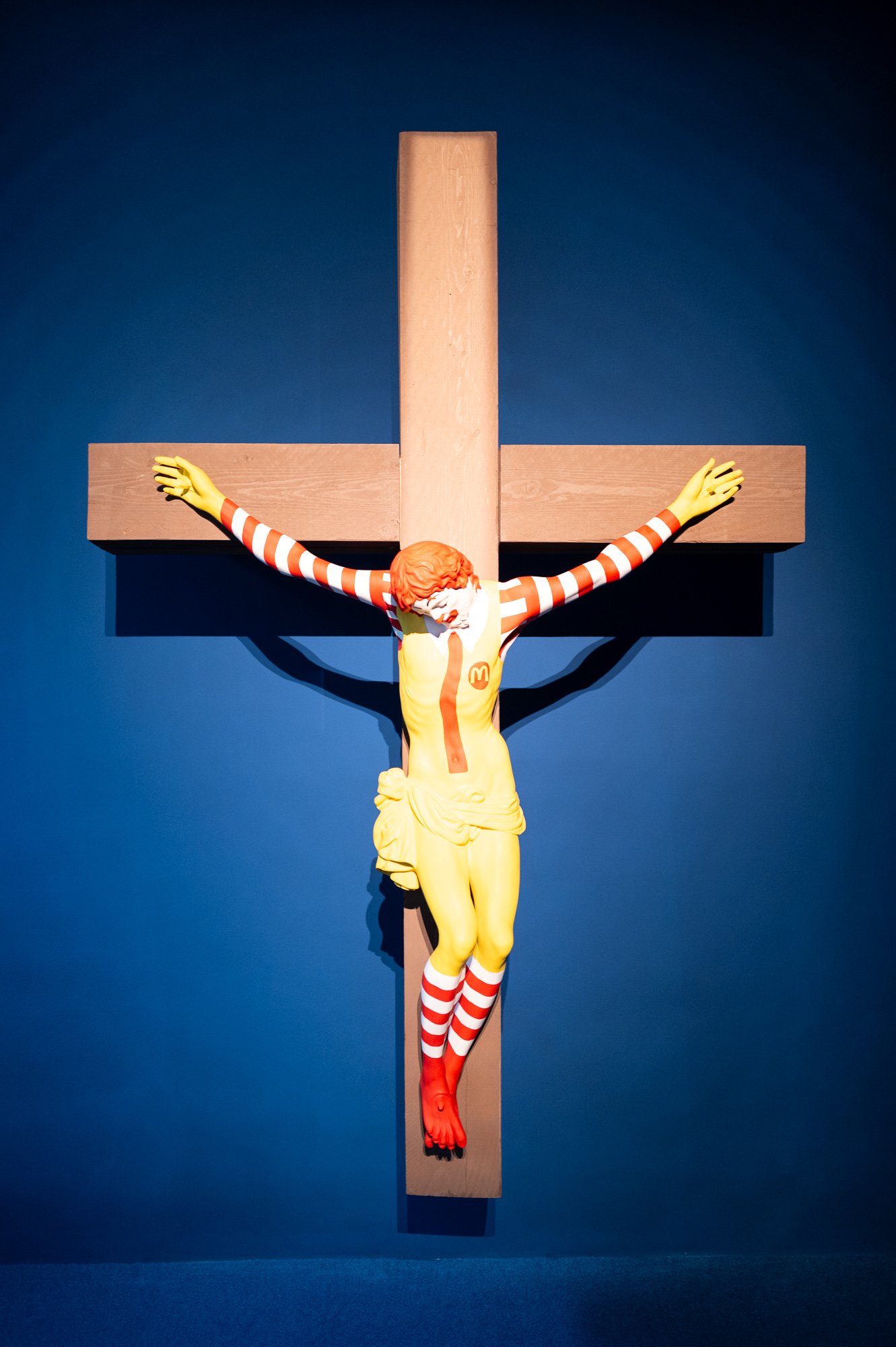
McJesus — Leica Q3
Jani Leinonen's McJesus (2015) hangs on a deep blue wall: a crucified figure in the yellow, red and white of a fast-food clown. In 2019 it led to violent protests at the Haifa Museum of Art in Israel, and it was taken down. Against the blue the colours are almost unbearably cheerful, which is the point.
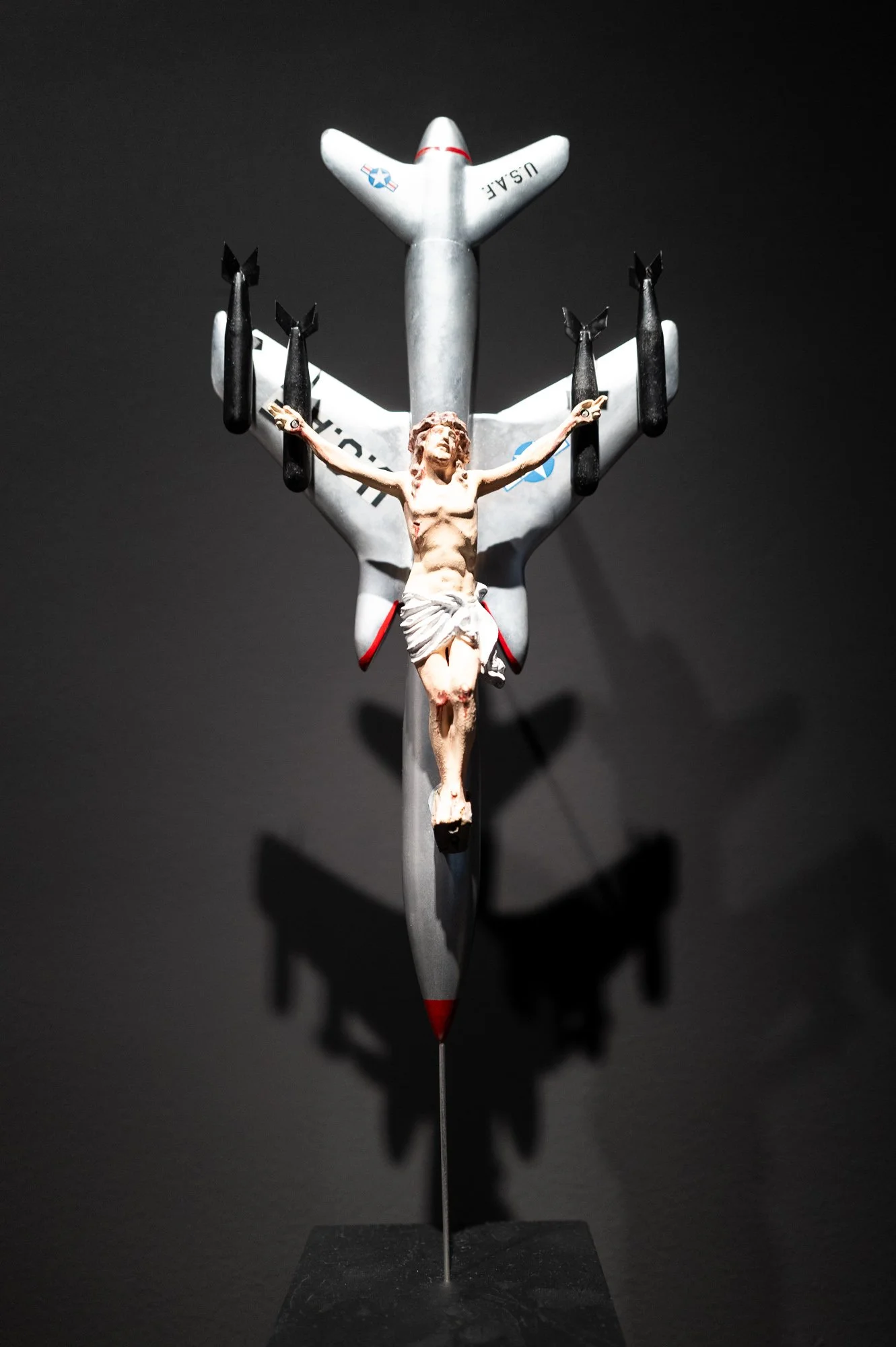
Western and Christian civilization — Leica Q3
The Argentine artist León Ferrari made La civilización occidental y cristiana in 1965, during the Vietnam War: a Christ crucified on a US Air Force bomber. It was removed from an exhibition in Buenos Aires before the show opened. A spotlight from above threw the plane's shadow on the wall behind it, a second bomber, larger and darker than the first.
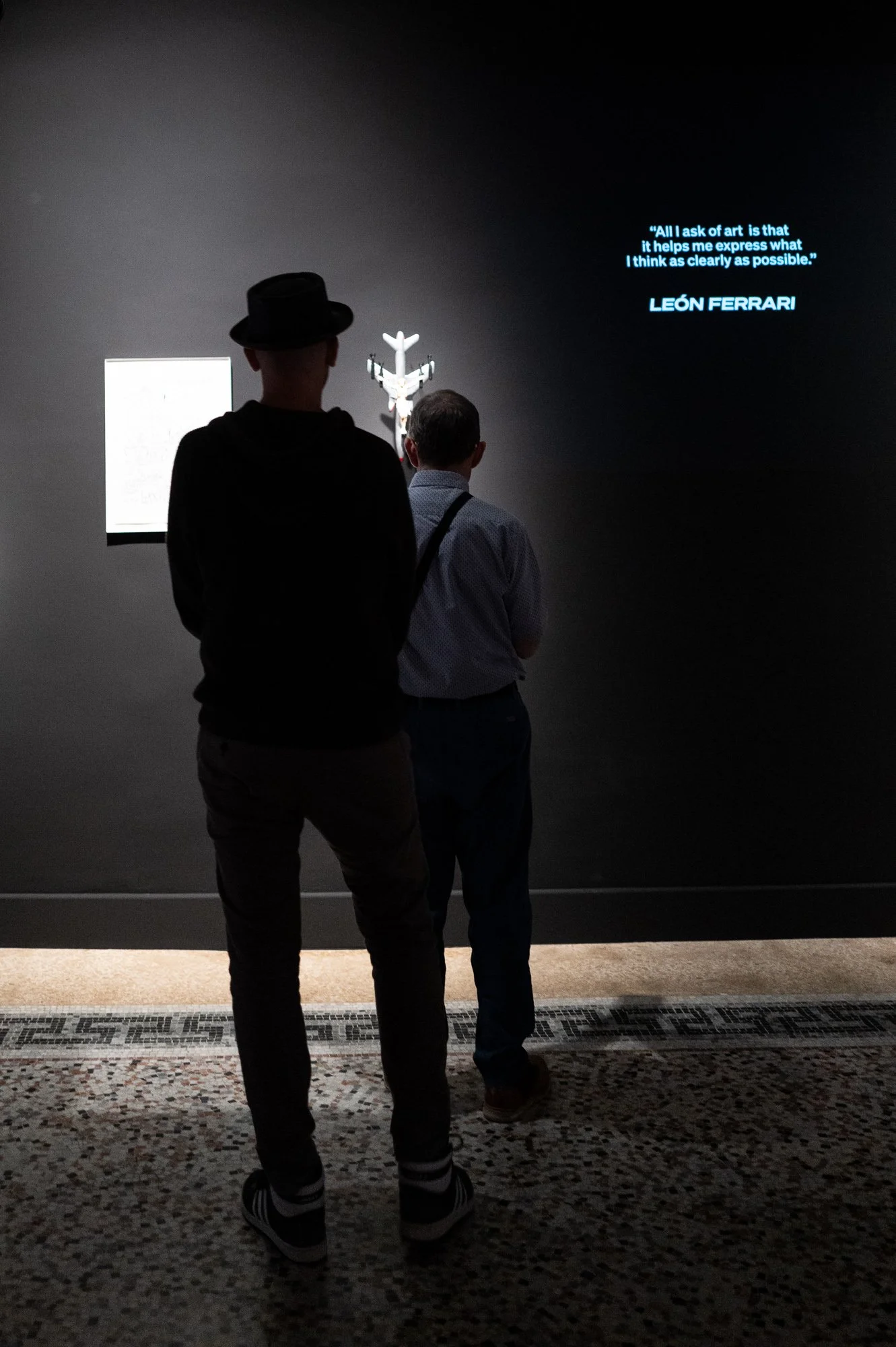
"As clearly as possible" — Leica Q3
Two visitors stood in front of it for a long time, one in a black hat, one in a pale shirt, side by side and silent. On the wall to the right, Ferrari's own words were projected in blue: all he asked of art was that it help him say what he thought as clearly as possible. I stepped back so that the men, the bomber and the quotation would all fit in one frame.
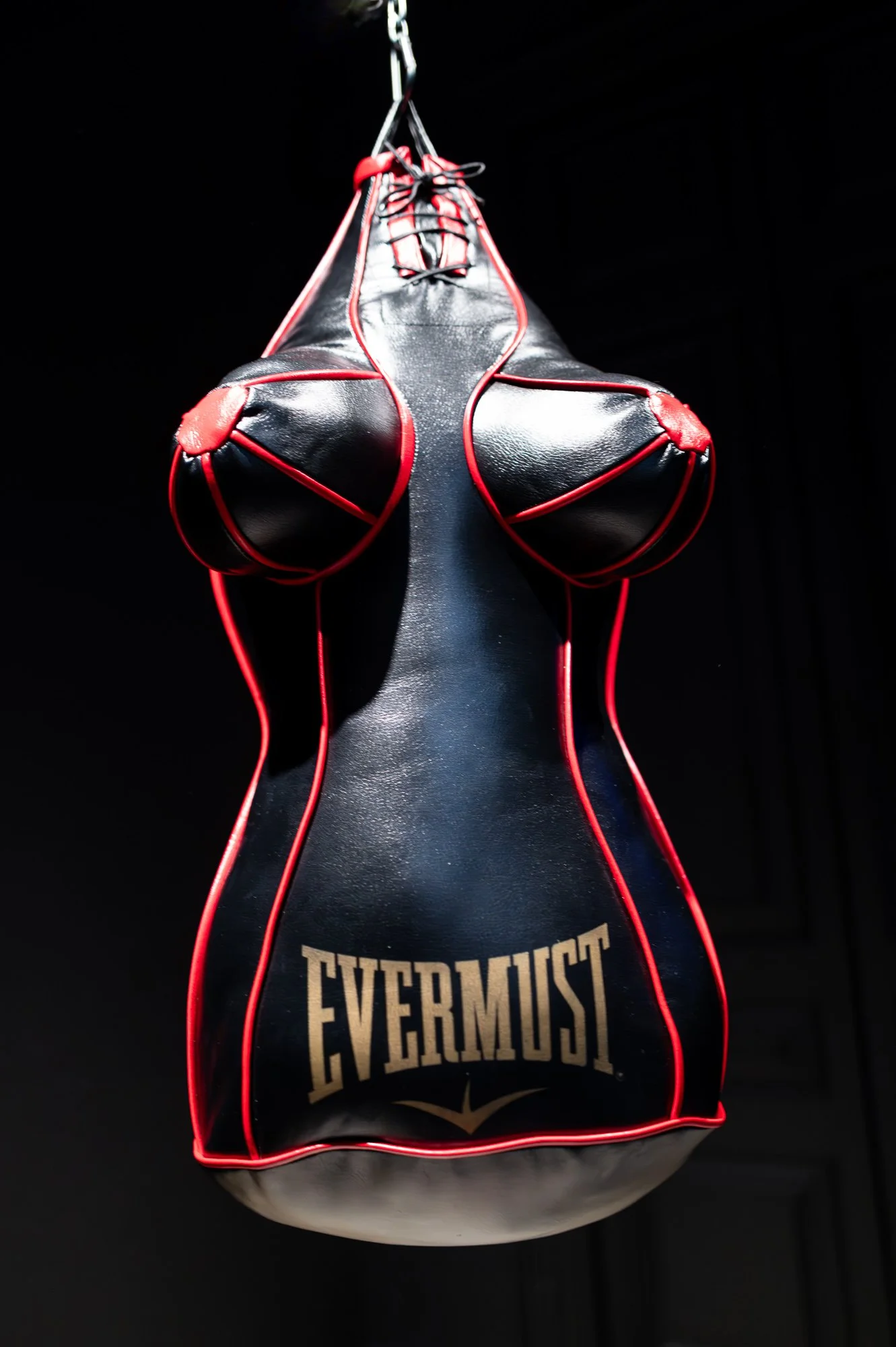
Evermust — Leica Q3
Zoya Falkova's Evermust, a boxing bag cut and stitched into the shape of a woman's body, was removed from the first Femminale in Bishkek, Kyrgyzstan, after protests (Art Focus Now). The artist described it as a symbol of a society that treats violence as normal. It hung in the dark, lit from one side, and it was the only work in the museum I photographed without any wish to linger.
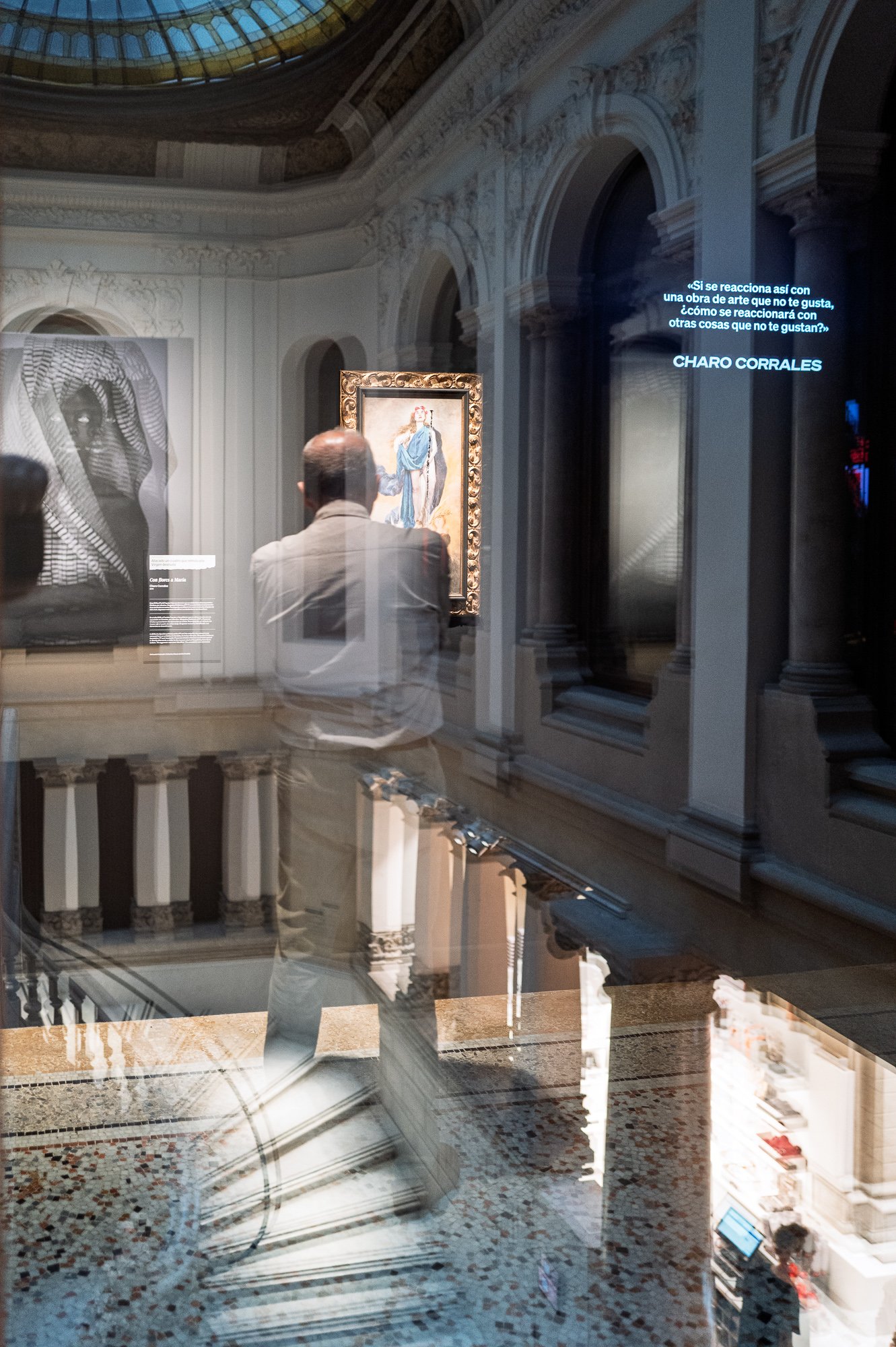
Several rooms at once — Leica Q3
Before the Museum Closed
On my way out I found a sheet of glass on the upper landing that held the whole museum in one reflection: a man photographing Charo Corrales's painting of the Virgin, the Muholi portrait on the left, the stairwell and the mosaic floor below, and on the right, projected in blue, Corrales's question about how people who react like that to a work of art will react to other things they don't like.
The Museum of Forbidden Art closed in June 2025, after months of disputes with its subcontracted staff, and the collection is now set to travel (3Cat). Looking at these pictures now, I'm glad I went that first week, when the house was still new to everyone. A museum of censored art that has itself gone quiet is an irony I didn't expect to be writing about.
For other encounters with sculpture that stops you in the street, see Louise Nevelson's Big Black and the Soul of the Ebro by Jaume Plensa. And for the city outside, black and white street photography in Barcelona.
If the collection comes to a city near you, go, and take the stairs slowly. Subscribe to the newsletter for new stories from the street, along with a free street photography guide.
Photos: Leica Q3 · ISO 100–1000 · f/1.7 · 1/60s · Barcelona, 26 October 2023
See more street photography in the portfolio.
The artworks shown belong to their artists; the architectural and street frames from this visit are available as fine art prints.
Cosme Lapena is a Barcelona-based street and urban photographer and founder of bCLPhoto.
Exhibited at espai [b] since 2010 · Published in The Eye of Photography and 35mmc. Browse the portfolio or read more on the blog.